

Fewer than 1% of UK franchise units close each year due to commercial failure, a figure that stops most aspiring entrepreneurs in their tracks. With 93% franchisee profitability reported across the sector and roughly 48,600 franchised units currently operating across the country, franchising is not a niche shortcut for the lucky few. It is a structured, evidence-backed model for building a business that actually works. This guide cuts through the noise, explaining what franchising really offers, why it accelerates growth, how it compares to going it alone, and precisely what you need to check before you invest.
Key Takeaways
| Point | Details |
|---|---|
| Franchising reduces risk | UK franchise failure rates are under 1% a year, making it a safer growth option. |
| Growth through proven models | Franchising offers established systems, helping entrepreneurs scale quicker with support. |
| Research is still crucial | Despite strong data, always check franchise disclosure and talk to current franchisees. |
| Clear advantages over start-ups | Evidence shows franchising outperforms start-ups for profitability and support. |
Understanding franchising: A proven growth engine
Most people think of franchising as simply buying the right to use a brand name. In reality, it is far more than that. A franchise is a complete business format agreement, where a franchisor grants a franchisee the right to operate a proven business model, using established systems, branding, training, marketing, and supplier networks. You are not just putting your name above a recognisable shopfront. You are plugging yourself into an infrastructure that has already been tested, refined, and validated in the marketplace.
Compare that to starting a business from scratch. When you launch independently, you are building everything yourself. You design the systems, find the suppliers, create the brand, write the marketing strategy, and hope your product or service resonates with customers. Each of these steps involves considerable trial and error, wasted time, and financial exposure. Most independent start-ups do not fail because the founder is incompetent. They fail because they are figuring out too many unknowns at once.
Franchising removes a significant portion of that uncertainty. The core decisions have already been made by the franchisor, tested in real markets, and refined over years. Your job is to execute brilliantly at a local level, not to reinvent every wheel. That is a fundamentally different and far more manageable challenge.

The scale of franchising in the UK backs this up. According to parliamentary evidence, 48,600 franchised units currently operate across the country, with profitability rates remaining high and closure rates consistently very low. This is not a coincidence. It reflects the structural advantages that the franchise model bakes in from the start.
The core advantages franchising offers over building independently include:
- Instant brand recognition with customers who already trust the name
- Comprehensive training programmes so you do not need sector experience to succeed
- Proven operational systems covering everything from stock management to customer service
- National and regional marketing run centrally, reducing your own promotional burden
- Preferred supplier agreements giving you better pricing than you could negotiate alone
- A peer network of fellow franchisees who have faced identical challenges and can advise
“The franchise model allows an entrepreneur to take an established business blueprint and apply it locally, dramatically reducing the learning curve that defeats so many independent start-ups in their first two years.”
For a detailed breakdown of the franchise vs startup advantages, it is worth reading how UK entrepreneurs who have made both choices evaluate the trade-offs in hindsight.
Why franchising accelerates growth and reduces risk
Once you understand what franchising actually is, the next question is obvious. Why does it work so much better than going it alone? The answer is not magic. It is structure. And structure, it turns out, is exactly what most new businesses desperately lack.
Here are the five primary reasons franchised businesses scale faster and fail less often than their independent counterparts:
- Brand power from day one. When you open a franchise unit, customers already know what to expect. That trust took the franchisor years to build. You benefit from it immediately, rather than spending months or years earning local recognition from scratch.
- Training that removes the knowledge gap. Franchisors invest heavily in their onboarding programmes because a poorly performing franchisee damages the entire network. You receive structured training covering operations, customer service, financial management, and local marketing before you open your doors.
- A built-in peer support network. Other franchisees in the same system have already navigated the problems you will face. Regional meetings, online forums, and direct peer contact mean you are never solving a new problem entirely alone.
- Central marketing investment. Many franchise groups run national advertising campaigns funded by a collective marketing levy. You benefit from television, digital, and outdoor advertising that would be financially impossible to fund as an independent.
- Negotiated supplier pricing. Because the franchisor buys on behalf of the entire network, your cost of goods and services is typically lower than any independent business could achieve on its own.
The figures bear all of this out. Franchisee profitability sits at 93%, with over two-thirds of units that have been running five years or more describing themselves as either quite or highly profitable. Fewer than 1% close per year due to commercial failure. These are remarkable numbers in any business context.
That said, low failure rates do not mean zero risk. The franchise model reduces trial-and-error dramatically, but it does not eliminate the need for careful research, proper financial planning, or strong local execution on your part. Understanding how to research franchise opportunities thoroughly before committing is just as important as choosing the right brand.
“Buying a franchise removes many of the unknowns, but it does not remove the need for the franchisee to work hard, manage finances carefully, and serve their customers brilliantly. The model supports success; it does not guarantee it.”
Pro Tip: Before signing any franchise agreement, speak directly with at least five to ten current and former franchisees. Ask them honestly about their profitability, the quality of support they actually received, and whether they would invest again. No franchisor’s marketing brochure will tell you what these conversations will reveal.
If you are ready to take practical steps, the step-by-step guide to buying a franchise walks you through every stage from initial research to signing day, so you know exactly what to expect.
Comparing outcomes: Franchising versus independent business start-ups
Data is more persuasive than anecdote when you are considering investing your savings and your next five years. Here is a direct, side-by-side comparison of the two paths.
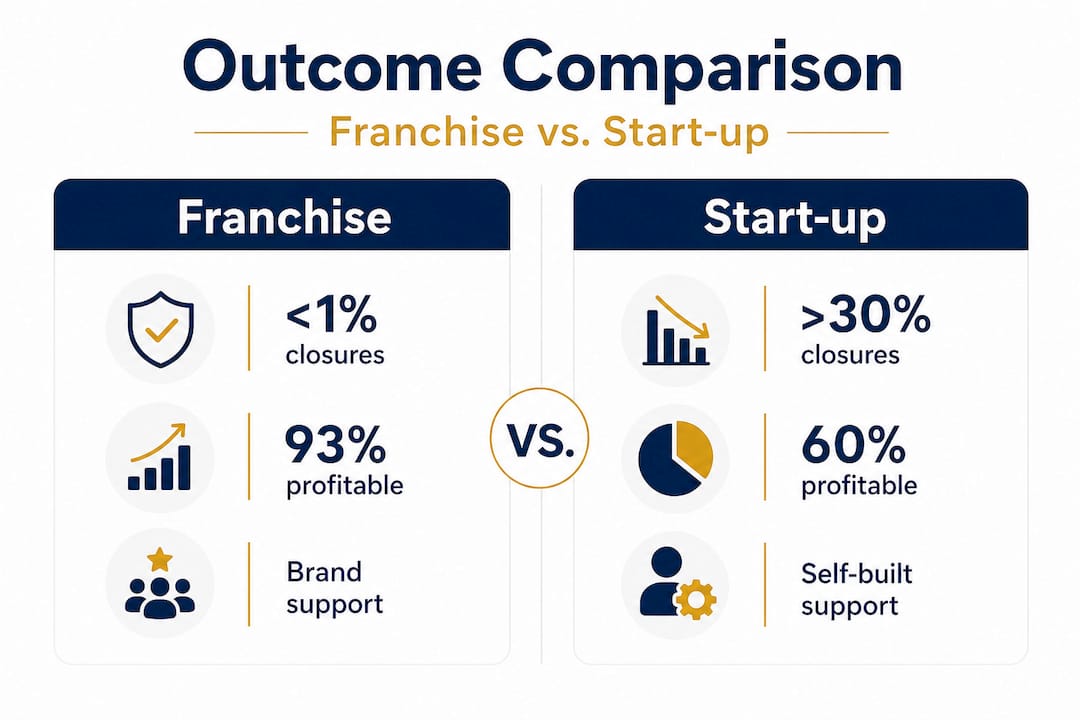
| Factor | Franchising | Independent start-up |
|---|---|---|
| Annual closure rate | Under 1% (commercial failure) | Significantly higher across all sectors |
| Profitability rate | 93% of franchisees report profitability | Varies widely; many never reach profitability |
| Brand recognition | Immediate, established brand | Built from zero over time |
| Training and support | Structured, ongoing from franchisor | Self-directed; often costly to source |
| Marketing | Centrally funded campaigns available | Entirely self-funded and self-managed |
| Supplier pricing | Negotiated group rates | Individual rates, often less favourable |
| Peer network | Built-in network of fellow franchisees | Must be built independently |
| Flexibility | Operates within franchisor guidelines | Complete operational freedom |
| Initial investment | Franchise fee plus setup costs | Variable but no franchise fee |
The table makes the structural advantages clear. Franchising offers meaningful, measurable improvements across nearly every dimension that determines whether a new business survives its first few years.
However, an important caveat deserves direct attention. The self-reported nature of franchise data means that headline statistics, including that impressive 93% profitability figure, are largely based on franchisor surveys and franchisee self-reporting. This does not make the data dishonest, but it does mean you must verify claims independently before assuming they apply to the specific franchise you are evaluating.
“Even when published failure rates appear very low, every prospective franchisee should pressure-test the opportunity using disclosure documents and direct franchisee reference checks. Reassuring statistics are a starting point, not a substitute for thorough research.”
When you are comparing franchise or start-up options, use the table above as a framework. But always layer in your own due diligence to confirm that the specific opportunity you are assessing genuinely delivers on these advantages.
Key factors for your franchising growth journey
Understanding the broad advantages of franchising is useful. Knowing specifically what to look for in a franchise before you invest is what actually protects you and maximises your chance of success. Not all franchises are equal. Some offer exceptional support and a genuinely proven model. Others trade on a recognisable name while delivering very little in return for your franchise fee.
Here is what matters most when evaluating any franchise opportunity:
- Earnings disclosure. Does the franchisor provide clear, audited figures showing typical franchisee earnings? Vague promises about “unlimited earning potential” are a warning sign.
- Franchisee satisfaction. Ask for a full list of current franchisees, not just a curated selection, and contact them directly. Ask whether they would invest again.
- Support quality. What does training actually consist of? Is there ongoing support after launch, or does the franchisor’s involvement drop off once you have paid your fee?
- Territory protection. Is your trading area clearly defined and legally protected from competition by other units in the same network?
- Financial health of the franchisor. Request audited accounts. A franchisor in financial difficulty cannot deliver the support you are paying for.
- Exit terms. What happens if you want to sell your franchise? Are there resale restrictions or fees that could significantly reduce the value of the asset you are building?
The self-reported nature of industry benchmarks reinforces why each of these checks matters. Industry-wide statistics are encouraging. Individual franchise results vary considerably, and the only way to know which category your target opportunity falls into is through rigorous, direct investigation.
| Question to ask | Who to ask | What a good answer looks like |
|---|---|---|
| What are typical annual earnings after fees? | Franchisor and franchisees | Specific figures with supporting data |
| How much ongoing support do you actually receive? | Current franchisees | Regular contact, clear escalation path |
| Would you invest again knowing what you know now? | Former franchisees | Honest, thoughtful response either way |
| What does the territory agreement cover precisely? | Franchisor (legal review) | Clearly defined, legally protected boundaries |
| How financially stable is the franchisor? | Audited accounts | Profitable, growing, low debt |
Good franchise research steps always include reviewing the franchise disclosure document in detail with a specialist franchise solicitor. Once you are satisfied, building a realistic franchise business plan tailored to your territory and personal investment level is the essential next step before any money changes hands.
Pro Tip: The best franchisors actively encourage you to speak with franchisees, provide full disclosure documents without being prompted, and welcome questions about their financial accounts. If a franchisor resists transparency at any point during your research, treat that as a serious red flag.
A fresh perspective: What most new franchisees overlook
Here is something we see repeatedly at Franchise Local, and it is worth stating plainly. The biggest mistake aspiring franchisees make is not choosing the wrong brand. It is approaching franchising with the assumption that the model does most of the work for them.
The statistics are genuinely impressive. A 93% profitability rate and failure rates under 1% per year are figures that most industries would find astonishing. But those figures describe the sector as a whole, not any individual opportunity. Treating them as a guarantee rather than as a starting benchmark is where things go wrong.
There is also a persistent misconception that franchising is a form of passive investment. It is not. The most successful franchisees are hands-on, operationally engaged, and genuinely invested in their local customer relationships. The model provides the infrastructure. You provide the energy, management, and local excellence that makes that infrastructure produce results in your specific area.
Another thing few people consider before signing: not all support is equal. Two franchises operating in the same industry can offer wildly different levels of training, operational guidance, and ongoing mentorship. The one with the larger brand is not automatically the one with better support. Dig into what the support actually consists of, talk to franchisees who have been in the network for three or more years, and find out whether that support holds up after the excitement of launch fades.
Finally, negotiation matters more than most new franchisees realise. Franchise agreements are legal documents, and while the core terms are rarely negotiable, elements such as territory boundaries, renewal conditions, and marketing contribution levels can sometimes be adjusted through careful, well-informed dialogue. Understanding the franchise negotiation process before you enter discussions puts you in a far stronger position than arriving at the table with only enthusiasm and a signed cheque.
The franchisees who thrive long-term are not those who found the best brand. They are those who chose wisely, asked difficult questions early, and committed to excellent local execution from day one.
Ready to take your next step in franchising?
Everything covered in this guide points towards one practical conclusion. Franchising offers UK entrepreneurs a genuinely powerful route to business growth, with structural advantages that independent start-ups simply cannot replicate. But realising those advantages requires careful research, honest evaluation, and the right sources of guidance. Our comprehensive UK franchising guide gives you a clear foundation for understanding what the sector offers and how to approach it intelligently. When you are ready to explore live opportunities tailored to your budget, location, and lifestyle, our franchise directory connects you with hundreds of verified UK franchise brands across every sector and investment level. Your next business chapter starts with asking the right questions.
Frequently asked questions
Is franchising really less risky than starting a business from scratch in the UK?
Evidence strongly supports this. UK franchise failure rates sit below 1% per year, compared to significantly higher closure rates among independent start-ups, largely because franchisees benefit from proven models and ongoing support rather than building everything from zero.
Can I trust franchise profitability and success rate statistics?
The headline figures are encouraging but largely self-reported by franchisors and franchisees, so you should always verify claims by reviewing official disclosure documents and speaking directly with a cross-section of current and former franchisees before investing.
What are the core advantages of franchising for UK entrepreneurs?
Franchising delivers a proven business model, structured training, instant brand recognition, group supplier pricing, and a peer support network, all of which contribute to high profitability rates that independent businesses rarely achieve within their first five years.
What should I check before investing in a franchise?
Always verify earnings claims against actual franchisee figures, review the full disclosure document with a specialist franchise solicitor, and conduct direct franchisee reference checks to understand both the quality of support and the realistic financial returns before committing any capital.