

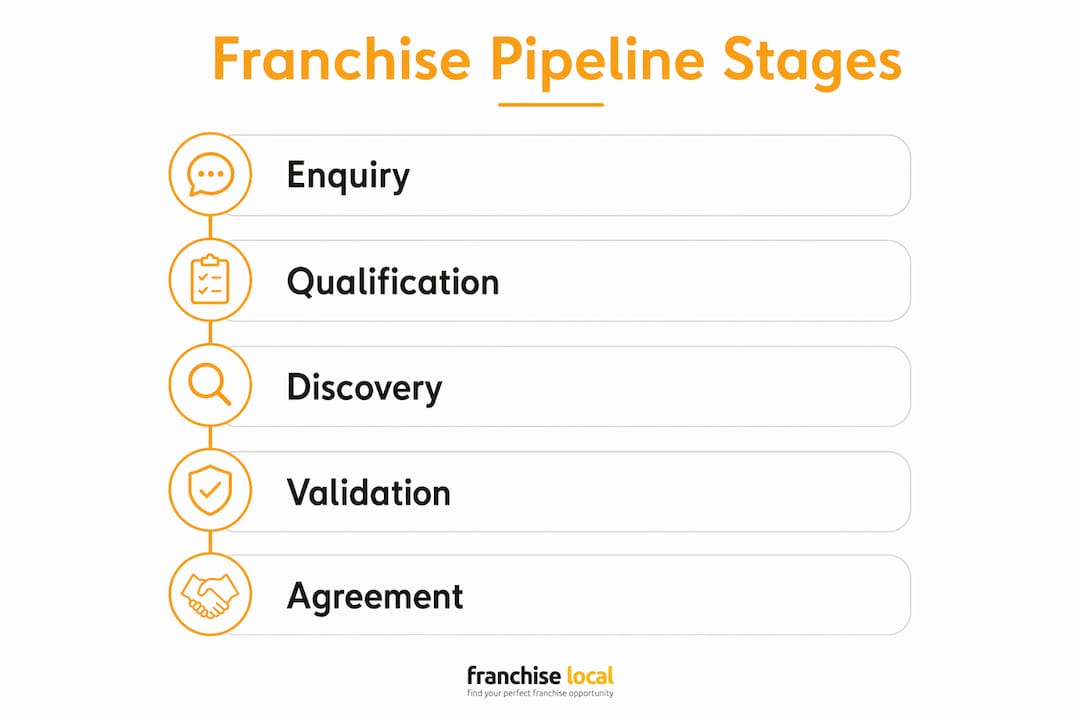
A franchise pipeline is defined as a structured, visual roadmap that tracks every prospective franchisee from initial inquiry through to signed agreement, typically across seven core phases. Think of it as the operational backbone of any franchise sales process. Without it, franchisors have no reliable way to measure progress, enforce compliance, or predict growth. For entrepreneurs and investors evaluating franchise opportunities, understanding this pipeline is the difference between entering a well-run system and stumbling into a disorganised one. The pipeline covers lead generation, qualification, Franchise Disclosure Document (FDD) delivery, Discovery Day, validation, approval, and contract signing.
What is a franchise pipeline and why does it matter?
A franchise pipeline is the franchisor’s primary tool for managing candidate relationships at scale. It maps every stage of the franchise sales process, from the moment a prospect submits an enquiry form to the day they sign a franchise agreement. The pipeline gives both franchisors and prospective franchisees a shared language for where they stand and what comes next.
The pipeline matters because franchise sales are not simple transactions. The overall sales cycle spans several months, requiring structured follow-up at every stage. That length creates real risk of candidates going cold, losing confidence, or receiving inconsistent information. A clearly defined pipeline prevents all three problems by setting expectations and automating touchpoints.

For investors, the pipeline is also a signal of brand maturity. A franchisor who can show you a defined process, with stage criteria and timeline estimates, is one who has thought seriously about growth. A franchisor who cannot describe their pipeline is one worth approaching with caution.
The pipeline also enforces legal compliance. UK franchise law and international standards require that candidates receive the FDD and observe a mandatory waiting period before signing. A pipeline without a compliance checkpoint at the disclosure stage is a liability, not an asset.
What are the key stages in a franchise pipeline?
The franchise pipeline follows a logical sequence. Each stage has a specific purpose, and candidates should only advance when they meet defined criteria.
-
Lead generation and initial enquiry. The pipeline begins when a prospect expresses interest, whether through a franchise directory like Franchiselocal, a digital ad, or a broker referral. The goal at this stage is volume with relevance. Not every enquiry will qualify, but every enquiry must be captured and logged.
-
Qualification. The franchisor assesses whether the candidate meets minimum financial thresholds, including net worth and liquid capital. Cultural fit and relevant experience are also evaluated. This stage filters out candidates who are unlikely to succeed, protecting both parties from wasted time.
-
FDD delivery and waiting period. Legal compliance defines this stage. The franchisor issues the Franchise Disclosure Document, and a mandatory 14-day waiting period must pass before any agreement can be signed. This period gives candidates time to review the document with a solicitor and ask informed questions.
-
Discovery calls. A series of structured conversations between the candidate and the franchisor’s development team. These calls address the business model, territory options, support structures, and financial projections. The candidate should leave each call better informed, not more pressured.
-
Discovery Day. The candidate visits the franchisor’s headquarters or a live operating unit. Discovery Days typically last one to two days and include meetings with operations, training, and marketing teams. This is the most decisive stage in the pipeline. Candidates who attend and remain engaged are statistically the most likely to sign.
-
Validation. The candidate speaks directly with existing franchisees to verify the franchisor’s claims. Well-educated candidates at this stage reduce brand risk and raise long-term franchisee success rates. Franchisors who restrict or discourage validation conversations are a red flag.
-
Approval, signing, and onboarding transition. The franchisor’s award committee reviews the candidate’s application and approves or declines. If approved, the franchise agreement is signed and the candidate transitions into the onboarding process. The pipeline’s job is complete. The franchisee’s journey begins.
Pro Tip: If you are evaluating a franchise opportunity, ask the franchisor to walk you through their pipeline stages. A clear, confident answer tells you a great deal about how they run their business.
How do franchisors build and manage an effective franchise pipeline?
Building a franchise pipeline requires decisions about technology, lead sources, and qualification discipline. The choices franchisors make at this stage determine whether their pipeline produces consistent results or creates bottlenecks.
Manual tracking versus CRM adoption
Early-stage franchisors often track candidates in spreadsheets. This works when the volume is low, but it breaks down quickly. Franchisors awarding 15 or more franchises per year must use a dedicated CRM system to maintain speed and compliance. CRM platforms like Salesforce, HubSpot, or franchise-specific tools enforce stage criteria automatically and prevent candidates from advancing without meeting defined thresholds.
Proprietary pipelines versus broker reliance
The source of leads shapes the quality of the pipeline. Franchisors who rely entirely on broker networks or franchise portals rent their demand from third parties. Building a proprietary lead generation system through targeted digital advertising gives franchisors better data, stronger conversion tracking, and leads who have already self-selected based on genuine interest. Proprietary pipelines cost more to build but deliver better long-term returns. You can read more about UK franchise lead generation strategies to understand how this works in practice.
Key practices for effective pipeline management
- Enforce data gates at every stage. CRM systems should block advancement unless candidates meet specific criteria such as minimum net worth or confirmed liquidity. Manual follow-up alone is not sufficient at scale.
- Track velocity, not just volume. Measure how long candidates spend in each stage. A candidate sitting in the qualification stage for 45 days when the average is 12 days signals a messaging problem, not a candidate problem.
- Maintain consistent touchpoints. Candidates who go quiet between stages rarely re-engage. Automated email sequences and scheduled calls keep momentum without requiring manual effort from the development team.
- Invest in candidate education early. Franchisors who provide detailed information upfront, including Item 19 financial performance data, attract more serious candidates and reduce drop-off at the FDD stage.
Pro Tip: Velocity tracking is one of the most underused tools in franchise pipeline management. If candidates are stalling in a specific stage, the problem is almost always the content or communication at that stage, not the candidates themselves.
What franchise pipeline metrics should entrepreneurs expect?
Pipeline metrics tell you whether a franchise system is growing efficiently or burning through leads without results. For investors evaluating a franchisor, these numbers reveal the health of the entire development operation.
The most important benchmark is the conversion cascade. Closing 10 franchisees requires approximately 6,000 qualified web visitors per year. That figure reflects the cumulative drop-off across every pipeline stage. It also means that marketing scale is not optional for franchisors with serious growth targets.
| Pipeline stage | Typical conversion rate |
|---|---|
| Web visitor to enquiry | Variable by channel |
| Enquiry to qualified lead | 30–60% |
| Qualified lead to Discovery Day | 30–50% |
| Discovery Day to signed agreement | 40–60% |
These figures show why pipeline volume matters. Even with strong conversion rates at each stage, a franchisor needs a substantial number of qualified enquiries to produce a handful of new franchisees each year.
“Selling right matters more than selling fast. The pipeline exists to resolve key uncertainties about business model fit and cultural alignment, not to rush candidates toward a signature.” Franchise sales process, step by step
Velocity metrics add a second dimension to this picture. A pipeline where candidates move from enquiry to Discovery Day in six weeks is performing well. A pipeline where the same journey takes six months has a bottleneck somewhere. Measuring time spent in each stage identifies exactly where that bottleneck sits.
Item 19 of the FDD, which discloses financial performance data, also affects pipeline conversion rates. Franchisors with strong, transparent Item 19 disclosures convert more candidates at the Discovery Day stage because the financial case is already made. Franchisors who omit or obscure this data create doubt that no amount of follow-up can fully resolve.
Emerging versus established franchisors: how does the pipeline differ?
The franchise pipeline looks very different depending on where a brand sits in its development. Emerging and established franchisors face distinct challenges, and the pipeline approach must reflect that.
| Factor | Emerging franchisor | Established franchisor |
|---|---|---|
| Annual franchise awards | Fewer than 15 | 15 or more |
| Pipeline tracking method | Spreadsheets or basic CRM | Dedicated franchise CRM |
| Primary lead sources | Portals, brokers, referrals | Proprietary digital channels |
| Qualification rigour | Often informal | Systemised with data gates |
| Discovery Day format | Smaller, founder-led | Structured, team-delivered |
| Key risk | Rushing stages to close deals | Pipeline bottlenecks at scale |
Emerging franchisors face a specific temptation: the pressure to sign franchisees quickly to prove the model works. Rushing candidates through the pipeline, particularly the FDD waiting period or the validation stage, creates franchisees who are underprepared. Underprepared franchisees underperform, and underperformance damages the brand’s ability to attract future candidates.
Established franchisors face the opposite problem. At scale, the pipeline can become bureaucratic. Candidates wait too long between stages, lose momentum, and withdraw. The solution is CRM automation combined with clear internal accountability for stage progression times.
Both types of franchisor benefit from targeted franchise marketing strategies that attract candidates who are already aligned with the brand’s investment level and sector. The UK franchise application process also has specific compliance requirements that apply regardless of brand size, and both emerging and established franchisors must meet them.
Why the pipeline is really a relationship, not a funnel
Most people who ask what is a franchise pipeline expect a sales answer. The honest answer is that the pipeline is a relationship-building process that happens to end in a commercial agreement.
The franchisors I have seen build genuinely strong systems treat every pipeline stage as a conversation, not a conversion event. They are not trying to close candidates. They are trying to find out whether a candidate is right for their network, and whether the network is right for the candidate. That distinction sounds subtle, but it produces completely different behaviour at every stage.
The franchisors who rush the pipeline, who skip validation conversations or gloss over difficult FDD disclosures, tend to sign more franchisees in the short term. They also tend to have higher franchisee failure rates, more legal disputes, and weaker unit economics within three years. The pipeline is where brand quality is either built or eroded.
What I find most telling is how a franchisor responds when a candidate raises concerns during Discovery Day. A franchisor who addresses concerns directly, who brings in existing franchisees to speak candidly, and who is willing to slow down the process is one who understands what the pipeline is actually for. A franchisor who deflects or accelerates at that moment is one to walk away from.
My advice to any investor is this: use the pipeline stages as a due diligence checklist. If a franchisor cannot show you a defined process, cannot tell you their conversion rates, and cannot connect you with franchisees for honest validation conversations, the pipeline is broken. And a broken pipeline is a broken business.
— Will
UK franchise opportunities worth building your pipeline around
Franchiselocal gives you direct access to top UK franchise opportunities across sectors ranging from financial services and business consulting to telecommunications and driving instruction. The directory is built for investors who want to compare opportunities by investment level, sector, and location without contacting multiple franchisors individually. If you are ready to move from research into active pipeline conversations, browsing franchise opportunities by industry gives you a clear starting point. Franchiselocal also lists business services franchises and B2B franchise opportunities that suit investors looking for professional, recurring-revenue models.
FAQ
What is a franchise pipeline in simple terms?
A franchise pipeline is a structured process that moves a prospective franchisee from initial enquiry to signed agreement across defined stages including qualification, disclosure, and Discovery Day. It gives franchisors control over the sales process and gives candidates a clear path to follow.
How long does a franchise pipeline typically take?
The full franchise sales cycle spans several months, with the mandatory 14-day FDD waiting period alone built into the legal compliance stage. Total timelines vary by brand and candidate, but three to six months from enquiry to signing is common.
What conversion rates should I expect across the pipeline?
Typical rates run at 30–60% from enquiry to qualified lead, 30–50% from qualified lead to Discovery Day, and 40–60% from Discovery Day to signed agreement. These figures vary by brand strength, sector, and lead source quality.
What is the difference between a franchise pipeline and a sales funnel?
A sales funnel measures volume and drop-off. A franchise pipeline tracks individual candidate progress through defined stages with compliance checkpoints and qualification criteria. The pipeline is a relationship management tool as much as a sales tool.
How do I know if a franchisor has a well-managed pipeline?
Ask the franchisor to describe their stages, their average timeline, and their conversion rates. A well-managed pipeline will have clear stage criteria, a CRM system for tracking, and a structured Discovery Day process. Franchisors who cannot answer these questions clearly have not invested in their pipeline.