

Franchise discovery is the structured evaluation process that prospective franchisees use to assess whether a franchise opportunity is the right fit before signing any agreement. It covers everything from initial research and financial review to attending a formal franchise discovery day, where both the franchisee candidate and the franchisor assess each other. The process typically involves reviewing the Franchise Disclosure Document (FDD), speaking with existing franchisees, and meeting the franchise development team in person. Done properly, franchise discovery protects your investment and gives you the clearest possible picture of what life inside that franchise system actually looks like.
What is franchise discovery and why does it matter?
Franchise discovery is the complete due diligence process a prospective franchisee undertakes before committing to a franchise investment. The industry term most commonly used is “franchise due diligence,” but franchise discovery has become the widely accepted shorthand for the full sequence of research, evaluation, and validation steps. It is not a single meeting or a brochure review. It is a methodical process that typically runs over several weeks and culminates in a franchise discovery day.
The importance of franchise discovery comes down to one fact: buying a franchise is a significant financial commitment. First-time buyers typically invest between £100,000 and £300,000. That level of investment demands more than reading a franchisor’s marketing materials. Discovery gives you the tools to verify claims independently, assess the health of the franchise system, and decide whether the opportunity genuinely matches your skills, goals, and finances.

Franchise discovery also protects the franchisor. Reputable franchise brands use the process to filter candidates who are not a good operational or cultural fit. A franchisor who skips this mutual evaluation is a warning sign in itself. The best franchise systems are selective, and discovery days are where that selection happens on both sides.
What happens during the franchise discovery process?
The franchise discovery process follows a clear sequence. Understanding each stage helps you prepare properly and avoid being caught off guard.
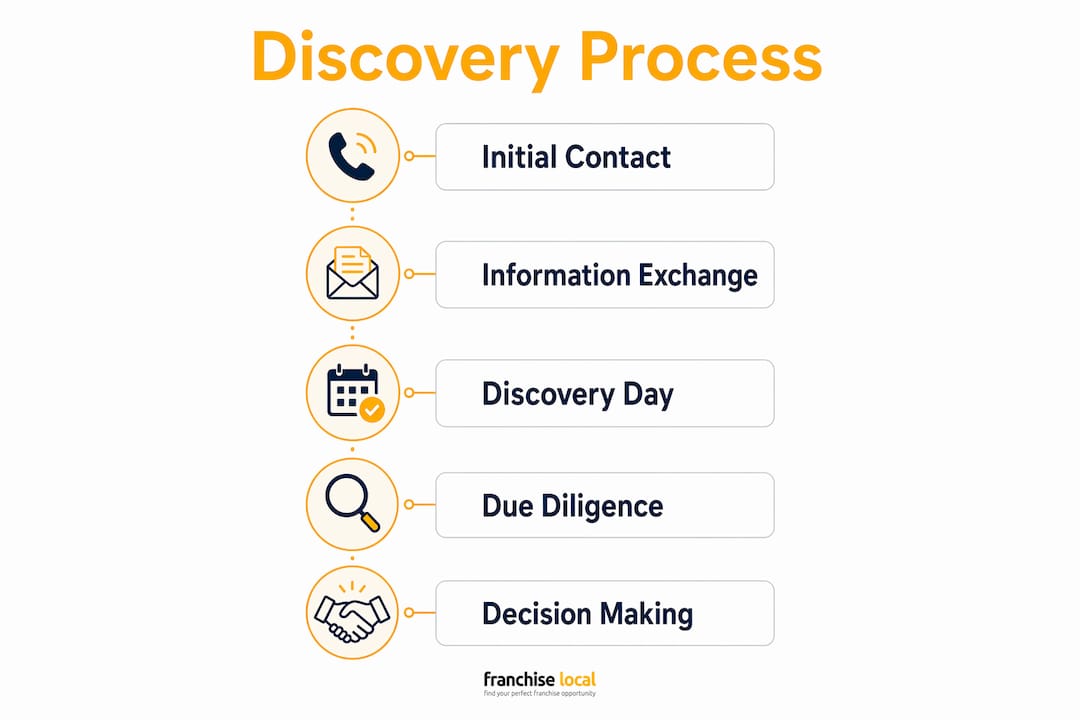
The typical timeline
The process usually begins with an initial enquiry and information exchange, followed by a series of calls or meetings with the franchise development team. The Franchise Disclosure Document plays a central role at this stage. The FDD must be delivered at least 14 calendar days before you sign any binding agreement or pay any fees. That 14-day window exists so you have adequate time to review the document with a solicitor before committing.
The franchise discovery day
The discovery day is the pivotal event in the entire process. Discovery days typically occur 4–8 weeks into the franchise investigation and last between 4 and 8 hours. They represent the second-to-last step before contract signing. Missing or rushing this stage is one of the most common mistakes new franchise buyers make.
A well-structured discovery day includes the following elements:
- Formal presentations from senior leadership covering the brand’s history, values, and growth plans.
- Operations walkthrough showing how the franchise model works day to day, including supply chains, technology platforms, and customer service standards.
- Training demonstrations that give you a realistic view of what onboarding looks like and how long it takes to become operational.
- Financial discussions covering territory performance, average revenues, and realistic profit timelines.
- Cultural exposure through informal time with the franchise development team, existing franchisees, and sometimes head office staff.
Effective discovery days include structured presentations, operational walkthroughs, interaction with leadership, and candid financial discussions, all without rushing you toward contract signing.
Pro Tip: Arrive at a discovery day with a written list of questions prepared in advance. Franchisors notice candidates who have done their homework, and it signals that you are a serious, capable operator.
Discovery days are decision-enablement experiences where expectations are aligned upfront, reducing later franchise relationship failures. That alignment is only possible if both parties engage honestly during the day itself.
How to research and validate franchises during discovery
The most reliable franchise research happens outside the franchisor’s control. The most informative insights come from speaking directly with current and former franchisees, not from reading the franchisor’s own materials. This is where serious candidates separate themselves from casual enquirers.
Effective franchise research during the discovery process covers several critical areas:
- Speak to franchisees beyond the reference list. Franchisors typically provide a curated list of franchisees willing to speak to candidates. Contact a diverse range of franchisees beyond that list to uncover challenges that do not appear in official materials. Ask about day-to-day support, whether the franchisor delivers on its promises, and what they would do differently.
- Assess the closure-to-opening ratio. Healthy franchise systems maintain a closure-to-opening ratio below 10%. A high closure rate signals systemic problems with the business model, the support structure, or both.
- Stress-test the financial projections. Run the numbers at 70%, 85%, and 100% of projected revenues. If the business only works at full projected revenue, the risk profile is too high for most first-time buyers.
- Use third-party reviews and data. Check Companies House for the franchisor’s filed accounts. Search for franchisee reviews on independent forums and business review platforms. Cross-reference what the franchisor tells you with what you find independently.
- Assess cultural fit and leadership credibility. Cultural fit and leadership style are often the greatest predictors of franchise relationship success, alongside financials. Pay attention to how the leadership team communicates, whether they listen, and whether their values align with yours.
For a thorough framework on this stage, Franchiselocal’s guide on franchise due diligence covers the essential verification steps in detail.
Pro Tip: Ask former franchisees why they left the system. Exited franchisees often provide the most candid and useful feedback of all, because they have nothing to lose by being honest.
A candidate’s preparation should include independently vetting the business model under various stress scenarios and validating support systems firsthand. No amount of polished presentation material replaces that independent verification.
What questions and red flags should you watch for?
Discovery days are designed to move candidates from interested to ready to sign. Investors should treat them as audits, not sales pitches. That mindset shift changes everything about how you engage on the day.
The right questions reveal far more than the answers alone. Strong questions to ask during a franchise discovery day include:
- What does the first 90 days of trading look like for a new franchisee?
- What is the average time to break even across your current network?
- How do you handle underperforming franchisees, and what support do you provide?
- What has changed in your support model over the last two years?
- How many franchisees have left the network in the past 12 months, and why?
“A franchisor who cannot answer basic questions about franchisee profitability or network health is not ready to take your investment. Confidence in the numbers is a sign of a well-run system.”
Beyond the questions, watch for these red flags:
- Pressure to sign at or immediately after the discovery day. Pressure tactics pushing for signing at or immediately after discovery day represent significant red flags. No credible franchisor needs you to decide on the spot.
- No candidate filtering. If the franchisor appears to accept every candidate who attends a discovery day, the system lacks quality control. Good franchisors reject unsuitable candidates.
- Scarcity tactics. Claims that “this territory won’t be available next week” are sales pressure, not fact. Treat them as a reason to slow down, not speed up.
- Vague answers about franchisee earnings. A franchisor who deflects questions about real franchisee income has something to hide.
- No time for your questions. A discovery day that is entirely franchisor-led, with no space for candidate questions, is not a mutual evaluation. It is a sales presentation.
How a franchisor responds to difficult questions tells you as much as the answer itself. Defensiveness, deflection, or irritation at being challenged are all signals worth noting.
How to choose the right franchise after discovery
After attending discovery days and completing your research, the next step is comparing your findings across multiple franchise options side by side. Emotion plays a role in this decision, but the final choice should rest on evidence.
Comparing franchise options
| Evaluation factor | What to assess |
|---|---|
| Financial viability | Does the model work at 70% of projected revenue? |
| Franchisor support | Is training, marketing, and operational support clearly defined? |
| Network health | Is the closure-to-opening ratio below 10%? |
| Cultural fit | Do the franchisor’s values and leadership style match yours? |
| Legal clarity | Is the franchise agreement fair and clearly written? |
| Franchisee satisfaction | Do independent franchisee conversations confirm the franchisor’s claims? |
Use this framework to score each franchise you have researched. The option with the strongest evidence across all six factors is the one worth pursuing.
Next steps before signing
Once you have identified your preferred franchise, follow these steps before committing:
- Instruct a franchise solicitor to review the franchise agreement in full. Do not use a general commercial solicitor. Use one with specific franchise experience.
- Instruct an accountant with franchise knowledge to review the financial projections and your funding plan.
- Re-read the FDD with your solicitor present. Pay particular attention to the litigation history section and the list of franchisees who have left the network.
- Conduct one final round of franchisee calls to confirm any outstanding questions that arose during the discovery day.
- Confirm your funding is in place before signing. Whether you are using personal savings, a bank loan, or a combination, have written confirmation before you proceed.
Franchiselocal’s guide on evaluating franchise agreements provides a detailed breakdown of what to look for in the legal documents before you sign.
For candidates still comparing options, the franchise selection workflow on Franchiselocal offers a structured framework for narrowing down your shortlist.
The part of franchise discovery most candidates get wrong
Most candidates approach a franchise discovery day as a test they need to pass. They prepare to impress the franchisor, dress well, and answer questions confidently. That instinct is understandable, but it is the wrong frame entirely.
The discovery day is your audit. You are the one writing a cheque for up to £300,000. The franchisor needs to impress you, not the other way around. I have seen candidates leave discovery days excited about the brand’s energy and enthusiasm, only to realise months later that they never asked a single hard question about profitability or franchisee turnover. Excitement is not due diligence.
The candidates who make the best franchise investments are the ones who treat every piece of information as a claim to be verified. When a franchisor says “our franchisees typically break even within 12 months,” the right response is to ask for the data, then call five franchisees and ask them directly. Cultural alignment matters enormously. A franchise system where the leadership team communicates poorly, dismisses concerns, or talks over candidates in meetings will not suddenly become collaborative once you have signed the agreement.
Patience is the most underrated skill in franchise discovery. The process takes weeks for good reason. Rushing it to secure a territory or meet an artificial deadline is how people make expensive mistakes. The best franchise relationships start with thorough discovery. The worst ones start with shortcuts.
— Will
UK franchise opportunities worth considering
Franchiselocal lists hundreds of UK franchise opportunities across sectors including networking, financial services, telecommunications, driving, and logistics. Each listing includes investment levels, industry category, and lifestyle filters, so you can match opportunities to your budget and goals before you even reach the discovery day stage. Whether you are drawn to networking franchises or prefer a service-based model, the directory gives you a practical starting point for building your shortlist. Use it alongside the research and validation steps covered here to approach every discovery day fully prepared.
FAQ
What is a franchise discovery day?
A franchise discovery day is a structured meeting, typically lasting 4–8 hours, where a prospective franchisee visits the franchisor’s head office to assess the business in detail. It is the final major step before signing a franchise agreement.
How long does the franchise discovery process take?
The full franchise discovery process typically takes several weeks. Discovery days usually occur 4–8 weeks after the initial enquiry, with legal and financial review following before any agreement is signed.
What is the Franchise Disclosure Document?
The Franchise Disclosure Document (FDD) is a legal document that franchisors must provide to candidates. It must be delivered at least 14 calendar days before any agreement is signed or fees are paid.
What are the biggest red flags at a franchise discovery day?
Pressure to sign immediately, scarcity tactics around territory availability, and vague answers about franchisee earnings are the most significant warning signs. A credible franchisor welcomes detailed questions and never rushes the decision.
How much does it cost to buy a franchise in the UK?
First-time franchise buyers in the UK typically invest between £100,000 and £300,000. The exact figure depends on the sector, brand, and territory size.