

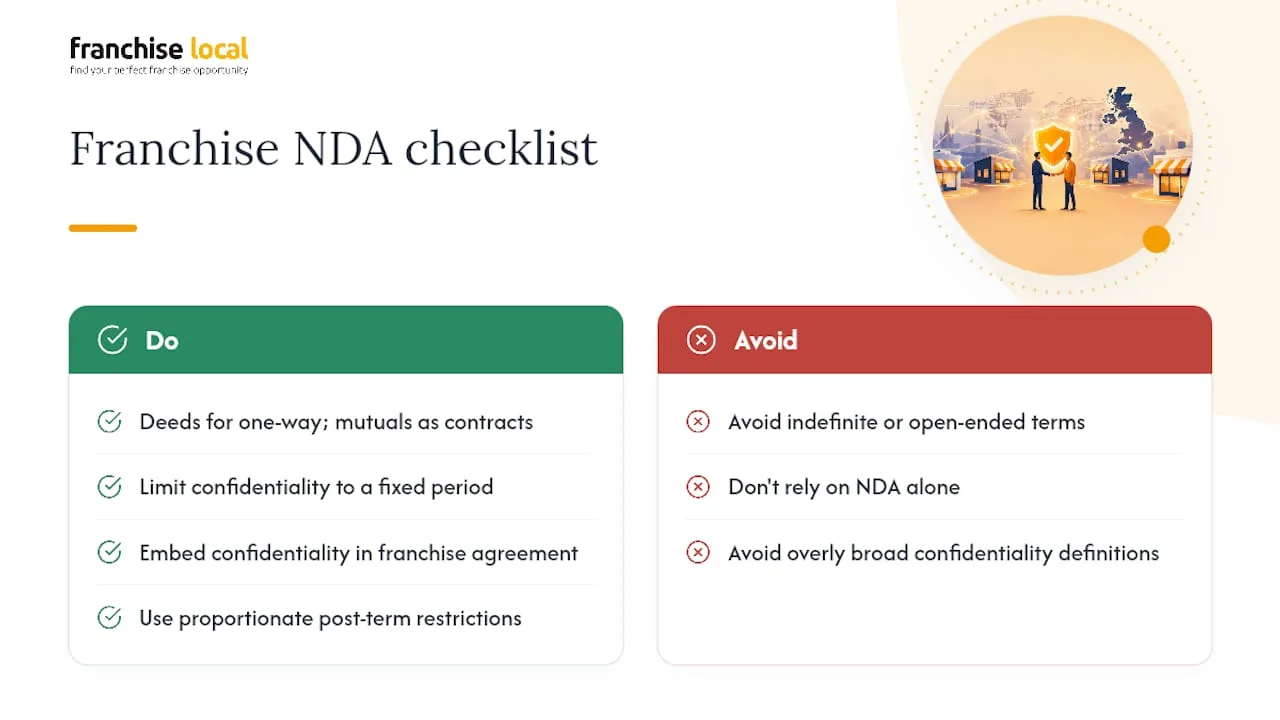
A UK franchise NDA must stop unauthorised use or disclosure of a franchisor’s financials, know-how and operating methods. The immediate action is simple: sign the right form of NDA before any sensitive document leaves the franchisor’s hands, execute it as a deed if it’s one-way, and release information on a staged, need-to-know basis with legal input at the drafting stage.
Before you send or sign anything, work through this checklist:
- Decide whether the NDA should be mutual or one-way based on who is actually disclosing information.
- Confirm whether a one-way NDA needs deed execution, since Gov flags this as a common enforceability gap.
- Define the permitted purpose narrowly (evaluating the franchise opportunity, nothing wider).
- Name the permitted recipients and require advisers to countersign or confirm adherence.
- Insist on staged disclosure with document logs before management accounts or manuals are shared.
- Book a solicitor’s review before the deed is signed, not after.
| Clause | What it should cover | Common failure point |
|---|---|---|
| Definition of confidential information | Management accounts, operations manuals, supplier terms, pricing models | Definitions too vague to enforce |
| Permitted purpose | Evaluation of the franchise opportunity only | Left open enough to cover unrelated use |
| Duration | Confidentiality obligation with a reasonable fixed term from disclosure | No end date, or survives indefinitely |
| Exclusions | Public domain information, independently developed material | Missing entirely, creating unfair exposure |
| Return/destruction | Timed obligation with written confirmation | No mechanism to verify compliance |
GOV.UK’s guidance on non-disclosure agreements also recommends specifying duration and which courts have jurisdiction, and confirms that a one-way NDA “may need to be executed as a deed to be fully enforceable.” That single formality trips up more franchisors than any clause dispute.

Pro Tip: Don’t rely on a broad NDA to cover for careless disclosure. Share less than you think you need to, log who has seen what, and let staged access do the protective work a blanket confidentiality clause can’t.
An NDA’s real value is deterrence, not a guarantee. It gives you a clear route to injunctive relief or damages if someone misuses your operations manual, but courts scrutinise wording closely, and overly broad restraints risk being unenforceable if they read like disguised non-competes rather than proportionate confidentiality terms.
Franchise NDAs UK: the clause checklist franchisors and buyers actually need
Franchisors typically introduce a standalone NDA at the earliest stage of recruitment, before a franchise agreement exists, to protect the management accounts, business plans and operating methods that make up the disclosure pack. Sensitive materials, including manuals and supplier terms, are routinely released only after a short, mutual NDA has been signed.
Most franchise recruitment NDAs are mutual, because both sides exchange something worth protecting. The franchisor discloses financials and know-how; the candidate may disclose personal financial standing or business plans of their own. A one-way NDA fits only when disclosure genuinely runs in one direction, and that’s precisely the scenario where deed execution becomes important. Get the signing authority and witnessing wrong, and the deed can fail on a technicality that has nothing to do with the confidentiality terms themselves.
The clause checklist deserves care beyond a template pull:
- Definition of confidential information: name the categories (accounts, manuals, supplier pricing), not just “all information disclosed.”
- Permitted recipients: list roles, not just “advisers,” and require sign-off from each named party.
- IP carve-outs: state explicitly that trademarks, systems and manuals remain the franchisor’s property regardless of disclosure.
- Audit rights: give the franchisor a route to confirm destruction or return of materials.
Franchisors don’t operate under a single UK franchising statute, but they remain bound by the Misrepresentation Act 1967 and general unfair trading law, which is why confidentiality terms have to sit alongside honest, timely disclosure rather than replace it. An NDA that tries to suppress legitimate due diligence questions invites trouble rather than protection. Once the parties move towards signing the franchise agreement itself, confidentiality obligations should migrate there in aligned language. Treating the NDA as a temporary shield rather than permanent protection avoids the gap that opens when an NDA expires but the franchise relationship, and its trade secrets, continues. Courts have consistently favoured narrow, role-based restrictions over sweeping catch-all wording, so tighter drafting genuinely outperforms broader drafting in enforcement terms. For a wider view of the legal documents that sit around the NDA, Franchiselocal’s guide to franchise legal requirements is worth reading before you draft anything.
How to handle disclosure in practice
- Confirm signing authority first. Check who has the power to bind the franchisor or the corporate franchisee before any deed goes out, and get the deed formalities right the first time.
- Share an overview only at initial contact. No accounts, no manuals, just enough to let a genuine prospect assess fit.
- Sign the NDA before redacted financials move. This is the point at which most franchisors slip, sending figures ahead of paperwork because a candidate seems trustworthy.
- Release full management accounts only under stricter controls. Watermarked documents, logged access, and time-limited data room permissions all create an evidential trail if something goes wrong later.
- Confirm advisers separately. Solicitors and accountants reviewing the pack should countersign or confirm they’re bound by the same terms.
- Diarise the expiry. Most confidentiality periods run three to five years; know when yours ends and what should replace it.
Bespoke drafting from specialist franchise counsel typically costs more than a template review, but the gap narrows quickly once you factor in the cost of an unenforceable deed. A straightforward review of an existing NDA is usually quicker and cheaper than drafting from scratch, and most franchisors budget legal review time into the weeks before disclosure packs go out, not after a candidate has already seen the numbers.
Pro Tip: Keep a simple disclosure log alongside the NDA: who received what, when, and under which version of the document. It costs nothing to maintain and becomes the single most persuasive piece of evidence if you ever need an injunction.
Franchiselocal’s resource on preparing a franchise disclosure pack walks through what belongs at each stage in more depth, and the due diligence guide covers the document flow that typically sits behind the NDA. Prospective franchisees weighing up risk more broadly may also find the franchise investment risks overview a useful companion read.
Once your confidentiality terms are settled, browsing live opportunities is the natural next step. Franchiselocal’s directory of the best UK franchise opportunities lets you filter by sector and investment level, so you can move from paperwork to genuine prospects without losing the protections you’ve just put in place.
Frequently asked questions
Does every franchise NDA need to be a deed?
No. Only one-way NDAs typically need deed execution to be fully enforceable under UK practice. Mutual NDAs, where both parties disclose information, are usually signed as ordinary contracts.
How long should a franchise NDA last?
Most confidentiality obligations run for a limited period from disclosure. Anything indefinite or open-ended is a red flag worth challenging before signing.
Can an NDA stop a franchisee copying the business model after the relationship ends?
Not on its own. An NDA deters and provides remedies, but long-term protection depends on aligned confidentiality clauses in the franchise agreement itself, plus proportionate, well-drafted restrictions rather than sweeping non-compete language.
What happens if the confidentiality definition is too broad?
Courts have shown they’ll refuse to enforce wording that reads as a disguised restraint of trade rather than a genuine confidentiality protection, so narrower, better-defined clauses hold up more reliably.
This article provides general information on UK franchise confidentiality practice and is not a substitute for advice from a qualified solicitor on your specific agreement.