

Yes, flexible and part-time franchise formats are genuinely available across the UK, from home-based tutoring to mobile van rounds. Success depends less on the sector and more on matching a franchise’s real hours, staffing rules and costs to your own life. Start by using a UK franchise marketplace to filter by home-based, mobile or part-time formats, then work through a proper due-diligence checklist before you sign anything.
Types of flexible franchise formats to consider in the UK
“Flexible” covers several distinct business shapes, and each one suits a different kind of life. Home-based franchises need a spare room and a laptop. Route or van-based models need a vehicle and a driving licence, but often run on school-hours schedules. Part-time management franchises let you employ staff to cover the floor while you handle admin and growth from the sidelines. Consultancy and B2B service franchises trade on your existing professional skills rather than physical premises, and a growing number of subscription-style “franchise-as-a-service” models let you start small and scale contributions as capacity allows.
Sector fit matters as much as format. Tutoring and children’s activity franchises naturally cluster around after-school and weekend hours, which suits parents balancing school runs. Pet care and dog walking franchises tend to run in blocks through the day, leaving mornings or evenings free. Domiciliary care franchises can offer flexible shift patterns, though demand is often front-loaded at particular times of day. Mobile repair and maintenance franchises (vehicles, appliances, property snagging) let you set your own callout windows. B2B digital services franchises, from marketing to bookkeeping, can often be run entirely around client meetings you schedule yourself.
The trade off is real. Analysis of the sector notes a structural shift toward home-based, mobile and service franchise models, partly because they lower the barrier to part-time operation. But lower barriers don’t mean no barriers:
- Home-based and consultancy formats usually demand fewer weekly hours but rely heavily on your own client-winning skills.
- Van and route-based franchises have fixed territory runs, so flexibility often means rearranging the round, not shrinking it.
- Care and tutoring formats can have seasonal or term-time peaks that concentrate demand into specific weeks.
- Management franchises need staffing budgets from day one, which raises the entry cost even as it frees your hours.
How to assess a franchise’s actual flexibility: a due-diligence checklist
Marketing copy will call almost anything “flexible.” The only way to know if that’s true is to interrogate the paperwork and the people already running it. BFA commentary is blunt on this point: flexibility isn’t a lifestyle bonus that arrives automatically, it requires systems, people and technology built in from the start, and it depends on you being upfront with the franchisor about your constraints.
Work through these checks in order:
- Ask for the expected weekly hours in writing, not the verbal “as flexible as you like” pitch you’ll hear on a discovery call.
- Check mandatory on-site or on-call hours separately from total hours. Some models cap total time but insist on fixed windows.
- Review the training timetable. A two-week residential course is a very different commitment to a self-paced online induction.
- Confirm staffing and delegation rules. Some agreements restrict how much of the operation you can hand to employees.
- Clarify territory and exclusivity terms, since a smaller territory can mean fewer hours but a longer road to profitability.
- Read the marketing fund and minimum purchase clauses. Ongoing obligations here can quietly eat into any time you saved elsewhere.
Then move to the contract itself. Legal guidance for UK franchise buyers flags personal guarantees, restraint of trade clauses, and renewal or exit terms as the areas most likely to catch new franchisees out. Ask specifically whether the franchisor will confirm part-time operation in writing, because a verbal assurance carries no weight if the agreement says otherwise.
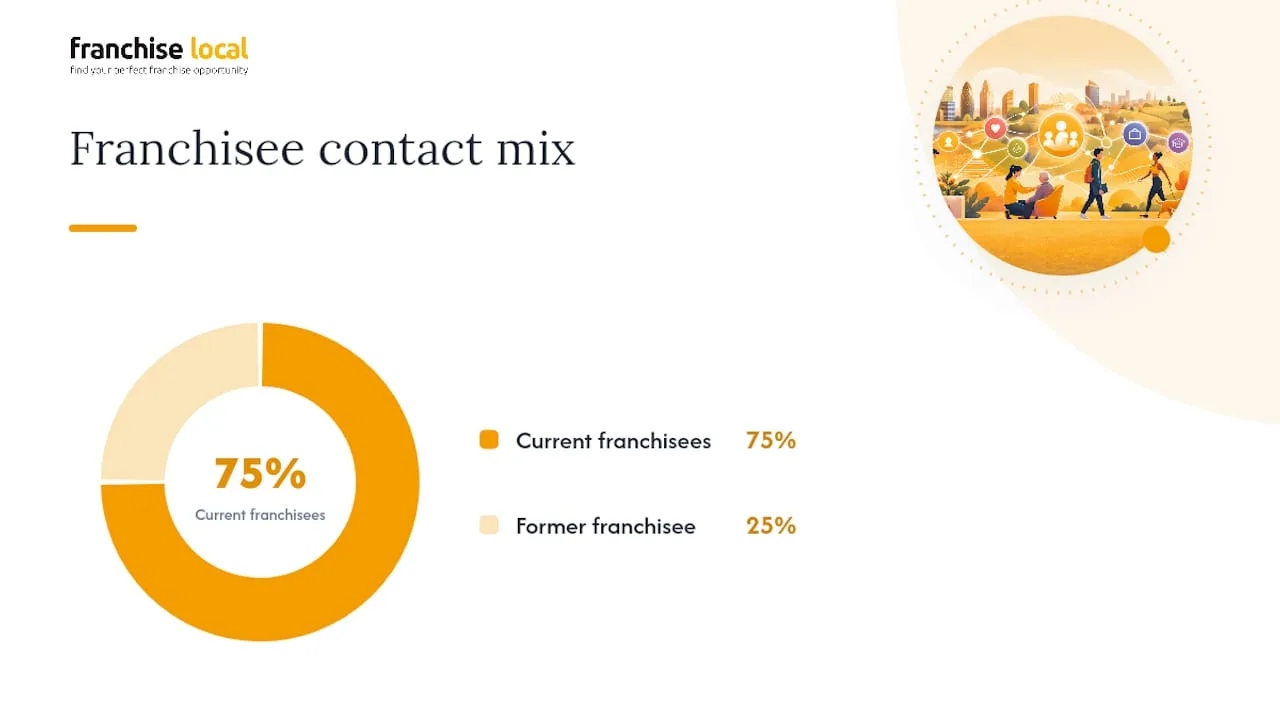
Finally, talk to people who’ve actually done it. Speak to both current and former franchisees, since former operators tend to give the most candid account of why a model didn’t meet expectations. Cross-check British Franchise Association membership and pull the franchisor’s Companies House filings before you go further.
Pro Tip: Ask three current franchisees and one former franchisee the exact same question about weekly hours. If the answers vary wildly, the franchise probably isn’t as standardised or as flexible as the brochure claims.
Typical costs, timeline and realistic earnings expectations
Cost structures for flexible franchises follow a similar shape whatever the sector, even if the totals differ enormously. You’re typically paying for:
- An initial franchise fee, which covers brand licence and territory rights.
- Kit, equipment or vehicle costs, from a laptop and software licence up to a fitted-out van.
- Training and onboarding fees, sometimes bundled into the initial fee and sometimes billed separately.
- Working capital to cover the first few months before regular income arrives.
- Ongoing royalties and marketing fund contributions, usually a percentage of turnover.
Home-based and consultancy models sit at the lower end of the investment scale, while van-based and premises-linked formats need considerably more capital for vehicles or fit-out. The sector overall has proved commercially resilient. The British Franchise Association’s long-run data puts the commercial failure rate below 6%, a figure worth holding onto against the higher failure rates typically seen in independent start-ups.
The path to trading runs fairly consistently: initial enquiry, an information pack, a discovery day, formal training, licence signing, then launch. Realistic breakeven timelines depend heavily on format. Consultancy and B2B models with low overheads can reach breakeven faster than models carrying vehicle finance or premises costs, though every franchisor should be able to show you the range their existing network has actually achieved.
Funding and sensible tactics to make a flexible franchise affordable
Most flexible franchise purchases are funded through a mix of routes rather than one single source. Personal savings remain the starting point for most buyers, topped up by a bank loan, franchisor-arranged finance, or in some cases family investment. Phased subscription-style models, where you pay a lower entry fee and scale contributions as the business grows, are becoming more common in the lower-investment brackets.
A few tactics reliably cut the initial outlay:
- Start genuinely part-time and reinvest early profit into growth, rather than borrowing to launch at full scale.
- Outsource admin, bookkeeping or marketing tasks instead of hiring staff before you have the client base to support them.
- Defer premises costs by running from home for as long as the franchise agreement allows.
- Use shared services (call answering, scheduling software) instead of building your own systems from scratch.
Pro Tip: Before you approach a lender, ask the franchisor for validated financial performance data from existing franchisees. A bank manager will ask for it, and having it ready speeds up the whole application.
Speak to an accountant before you commit funds, and bring the franchise agreement, the disclosure document and your own cash flow projections to that meeting.
How to get started quickly with a flexible franchise search
A structured search beats a scattergun one. Here’s a sensible sequence:
- Clarify your availability and budget first, in writing, before you look at a single franchise listing. Vague numbers lead to vague conversations with franchisors.
- Filter by format. Use a UK part-time franchise search to narrow by home-based, mobile or low-hours models rather than browsing everything on offer.
- Request information packs from three to five franchisors in your shortlist, not just one, so you have something to compare terms against.
- Speak to their franchisees using the questions covered earlier, and note where answers agree or diverge.
- Run the numbers before you commit, using an affordability calculator and an ROI estimator to stress-test the figures the franchisor gives you.
- Get legal and financial review done properly before signing, even if it feels like the last hurdle after months of research.
Franchiselocal’s directory groups opportunities by industry, price and lifestyle filters, which turns weeks of scattered searching into a shortlist you can compare side by side. One habit matters more than any tool, though: be transparent with every franchisor about your real time commitments from the first phone call. Franchisors that build genuinely flexible systems, as BFA research describes, tend to respond well to that honesty and will tell you plainly if their model isn’t a fit.
Strategies for balancing a flexible franchise with other commitments
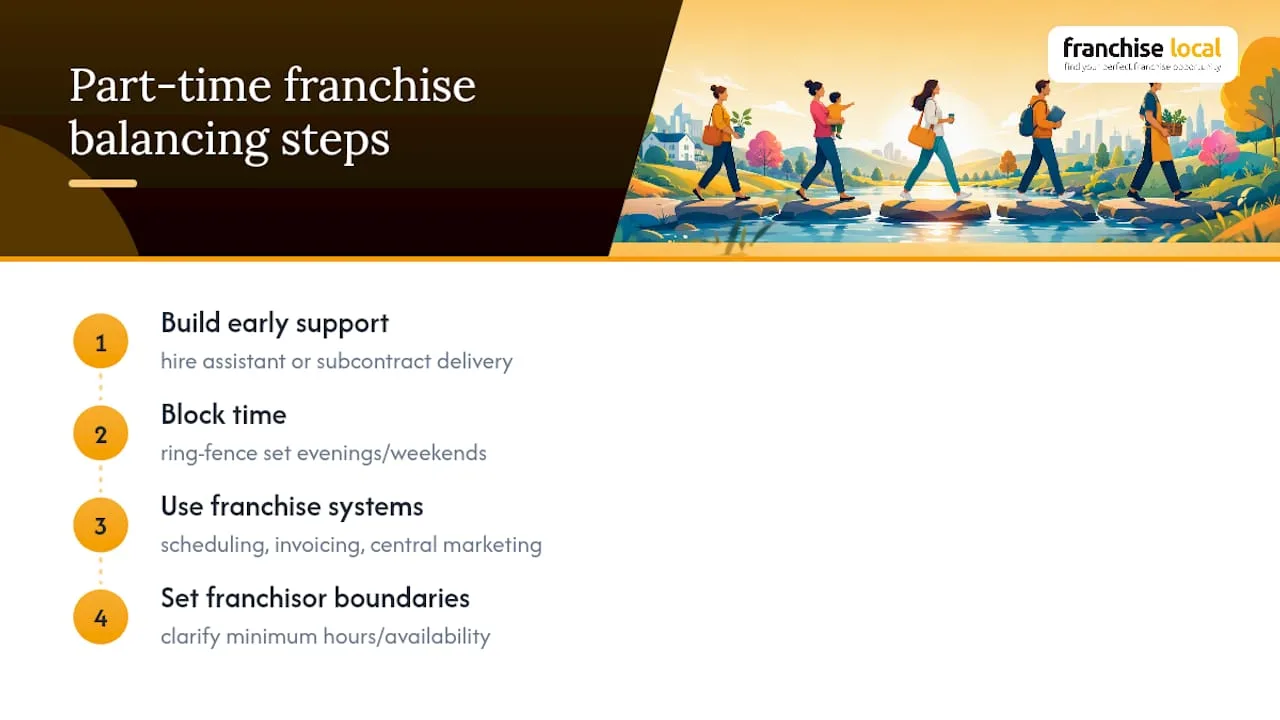
The franchisees who make part-time models work treat the business as a system, not a series of personal tasks. That distinction shows up in three habits.
First, they build a small support structure early, even if it’s just a part-time assistant or a subcontracted delivery driver, rather than waiting until they’re overwhelmed to delegate. Owner stories collected by trade press describe franchisees structuring their businesses around travel, childcare and health routines specifically by building teams that keep trading without the owner physically present.
Second, they block time deliberately. A tutoring franchisee working around a day job might ring-fence Tuesday and Thursday evenings plus Saturday mornings, and refuse bookings outside that window rather than letting the business creep into every spare hour. Consultancy franchisees often batch client calls into set days to protect the rest of the week for other work.
Third, they use the tools the franchise system gives them rather than reinventing their own admin. Scheduling software, automated invoicing and centralised marketing support exist precisely so a part-time owner doesn’t have to run the back office manually. Franchisees who ignore these systems and handle everything by hand tend to find the “part-time” model quietly expands to fill every gap in the week.
Setting a firm boundary with the franchisor also helps. If the agreement mentions minimum trading hours or availability windows, get clarity on those figures before launch, not after your first term-time clash with the school calendar.
Which lifestyle needs suit which flexible franchise format
Not every flexible franchise suits every kind of flexibility, and this is where a lot of buyers get the fit wrong. Someone with fixed hours (a part-time employed parent, say) needs predictable time blocks. Someone caring for a relative needs unpredictable, short-notice flexibility instead. Those are different problems with different solutions.
If you need predictable hours, look at tutoring, children’s activity or scheduled B2B consultancy franchises, where you set your calendar in advance and clients book around it.
If you need unpredictable, short-notice flexibility, home-based and consultancy formats with digital delivery tend to work better than anything involving a fixed round or physical premises, since you can shift work by hours rather than days.
If your priority is income ceiling rather than time, management franchises where you delegate delivery to staff can scale further, but they need more upfront capital and more admin oversight, which eats into the very flexibility you’re trying to buy.
If you’re balancing a franchise with another job, check the franchisor’s stance on secondary employment explicitly. Some agreements are silent on it; others restrict it outright.
Match the format to the specific shape of your constraint, not just the general label “flexible.” A franchise that’s flexible for a retiree with predictable free afternoons may be entirely wrong for a parent juggling unpredictable school pickups.
Common challenges when running a flexible franchise, and how to fix them
The most common pitfall is scope creep: hours that were meant to be part-time gradually become full-time because the franchisee under-delegates. The fix is structural, not willpower-based. Build the staffing or subcontracting plan into your launch budget from day one, rather than treating it as something to add once you’re “busy enough.”
The second recurring problem is underestimating peak periods. A tutoring franchise looks light in August and heavy in September; a pet care round looks light midweek and heavy on Mondays after a weekend of enquiries. Ask franchisors directly for a month-by-month demand pattern from their existing network, not just an annual average.
Personal guarantees catch out a surprising number of new franchisees who assume limited company status protects their personal assets. In practice, franchise agreements frequently still require a personal guarantee from the director, which matters a great deal if the business underperforms. Know this before you sign, not after.
Territory disputes and renewal terms cause the next wave of problems, usually years into ownership rather than at launch. Franchise agreements often carry strong control rights around territory, renewal and exit clauses, and a franchisee who didn’t read those clauses carefully can find their flexibility shrinking exactly when their life circumstances change.
Finally, isolation catches part-time franchisees who work largely alone from home. Franchisor-run regional meet-ups and franchisee networks exist for a reason; use them rather than skipping them because you’re “too busy.”
What successful flexible franchise ownership looks like in practice
The pattern among franchisees who make flexible models work isn’t luck or a particularly forgiving sector. It’s design. Coverage of the sector describes owners deliberately structuring their businesses around travel, childcare and health commitments, which only happens when systems and people are built to run the operation without the owner glued to it.
The BFA’s own framing of this is worth repeating: flexibility is a strategic design choice, not a happy accident of a particular sector. Franchisees who set expectations clearly with their franchisor from the outset, and who invest early in the people and systems that let the business run without them, are the ones whose “part-time” description still holds true two or three years in.
That’s a useful test to apply to any opportunity you’re weighing up. Ask not just “can this run part-time on day one?” but “what has this franchisor’s existing network actually built, structurally, to keep it that way as the business grows?” The answer tells you far more than any hours-per-week figure in a brochure.
Franchiselocal: search UK franchises built for flexible lives
Franchiselocal exists for exactly this search. Rather than trawling dozens of franchisor websites and comparing brochures by hand, the searchable directory lets you filter by lifestyle, investment level and industry in one place, so home-based, mobile and part-time formats surface alongside the detail you need to compare them properly.
Once you’ve shortlisted a few, the affordability calculator and ROI estimator help you stress-test the numbers a franchisor gives you against your own budget and time constraints, rather than taking their projections at face value. Trending searches and curated lists can point you toward opportunities that are actively recruiting flexible franchisees, which saves the time of chasing brands that aren’t currently taking on new territories.
If you’re ready to see what’s genuinely available, browse trending flexible opportunities on Franchiselocal today and start building a shortlist around the hours, budget and lifestyle you actually have, rather than the ones a generic listing assumes you want.