

If you want revenue from month one and a track record you can check against real accounts, buy a resale. If you want lower entry costs, a blank slate, and full control over how the business is built, go greenfield. The choice comes down to a trade between speed and money on one side and autonomy and price on the other, and the comparison below walks through both in detail.
Greenfield vs resale franchise: the quick comparison
Both routes get you the same franchise brand, the same operating manual, and the same support line to the franchisor. What differs is what you’re buying into on day one.
A resale hands you a functioning business: existing customers, trained staff, a lease already in place, and a set of accounts that show whether the thing actually works. A greenfield territory hands you a licence, a manual, and an empty patch of ground. Everything else, you build.
Here’s how the two stack up across the factors that actually decide most buyers’ choices:
- Time to first revenue: Resale wins clearly. You inherit trading customers and cash flow from completion day. Greenfield typically needs three to twelve months of setup before meaningful revenue arrives, depending on the sector.
- Typical upfront cost: Greenfield usually has the lower headline purchase price, since you’re paying franchise fees and fit-out rather than goodwill. Resale carries a premium on top of the base franchise fee, reflecting the business’s trading history and customer base.
- Control and flexibility: Greenfield gives you a genuinely blank canvas, within the franchise system’s rules. Resale means adapting to systems, staff habits, and supplier relationships someone else already set up.
- Risk profile: Resale risk is concentrated in what you can’t see in the accounts. Greenfield risk is concentrated in whether the local market responds the way the franchisor’s projections assume it will.
- Suitability by entrepreneur skillset: Resale suits operators and “fixers” who improve what exists. Greenfield suits builders comfortable with ambiguity and slower payback.
One useful way to think about it: a resale buyer often plays what the British Franchise Association describes as an integrator role, refining and stabilising something that already runs, rather than inventing systems from scratch. If that description makes you feel relieved rather than bored, resale is probably your lane.
None of this means one route is objectively better. It means they suit different starting positions, different bank balances, and different temperaments. A franchise resale explainer is worth a closer read if you’re leaning resale, and the sections below break down costs, timelines, and due diligence for both paths so you can weigh your own circumstances against the evidence rather than a gut feeling.
Financing behaves differently too. Lenders generally feel more comfortable backing a resale with documented trading history than a greenfield site built on projections alone, which affects how much deposit you’ll need and how quickly a loan gets approved. That single fact shapes a lot of the decision for buyers who need to borrow a meaningful chunk of the purchase price.
Greenfield franchises: tasks, timeline and what to expect
A greenfield, sometimes called a virgin territory, is an unopened patch of the franchisor’s map. No previous owner, no existing customer base, no inherited staff. You’re the first person to trade under that brand in that postcode, which is exactly the appeal for entrepreneurs who want to build something from their own effort rather than inherit someone else’s decisions.
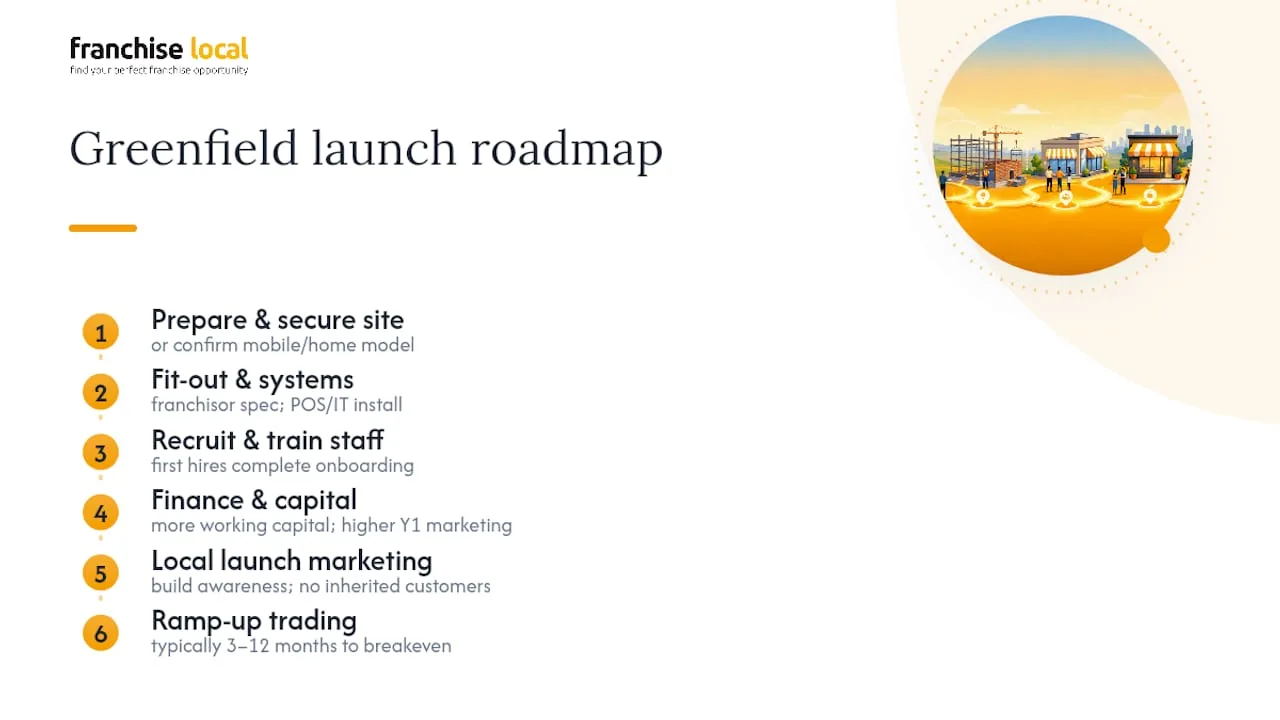
The task list looks similar across most sectors: find and secure premises (or confirm a mobile/home-based model), complete the fit-out to the franchisor’s specification, recruit and train your first staff, install the IT and point-of-sale systems, and run a local launch marketing campaign to generate the customer base a resale would already have. Franchisors typically provide a structured launch programme covering all of this, but you’re the one executing it on the ground.
That’s precisely why greenfield ramp-up takes longer than resale completion. There’s no trading history to fall back on while the phone starts ringing. Depending on the sector, you might see three months to a year of below-target trading while local awareness builds, staff bed in, and word of mouth starts doing its job. Home-based and mobile franchises tend to ramp faster since there are no premises fit-out to wait on; retail and hospitality territories usually take longest, because footfall habits form slowly.
The cost profile flips compared with resale. You avoid paying a premium for goodwill or an existing customer book, so your headline purchase price and franchise fee are lower. But you’ll need more working capital to cover the gap between opening day and break-even trading, plus a heavier marketing budget in year one to build the awareness a resale inherits for free. Franchisors typically specify minimum working capital requirements precisely because this gap catches under-capitalised buyers out more often than any other single factor.
Risk in a greenfield territory is mostly about whether the local market matches the franchisor’s model. Mitigate it by talking to existing franchisees in comparable territories about their own launch experience, not just their current numbers. Ask specifically how long it took them to reach breakeven trading and what they’d do differently on launch marketing. Franchisor support during the pilot phase, structured onboarding, launch marketing templates, a dedicated business development manager, should also feature heavily in your decision, since the quality of that support often determines how fast the ramp-up actually goes.
If you’re testing assumptions about local demand before committing capital, the discipline used in early-stage startup idea validation transfers well to franchise territory selection: talk to prospective customers before you sign anything, not after.
Resale franchise: what you’re buying and how it’s priced
A resale purchase typically includes far more than a lease and a sign above the door. You’re buying an existing customer base, trained staff already familiar with the systems, stock or work-in-progress, supplier relationships, and goodwill built up over however many years the previous owner traded. That bundle is exactly why resales cost more than starting fresh, and exactly why plenty of buyers accept the premium without hesitation.
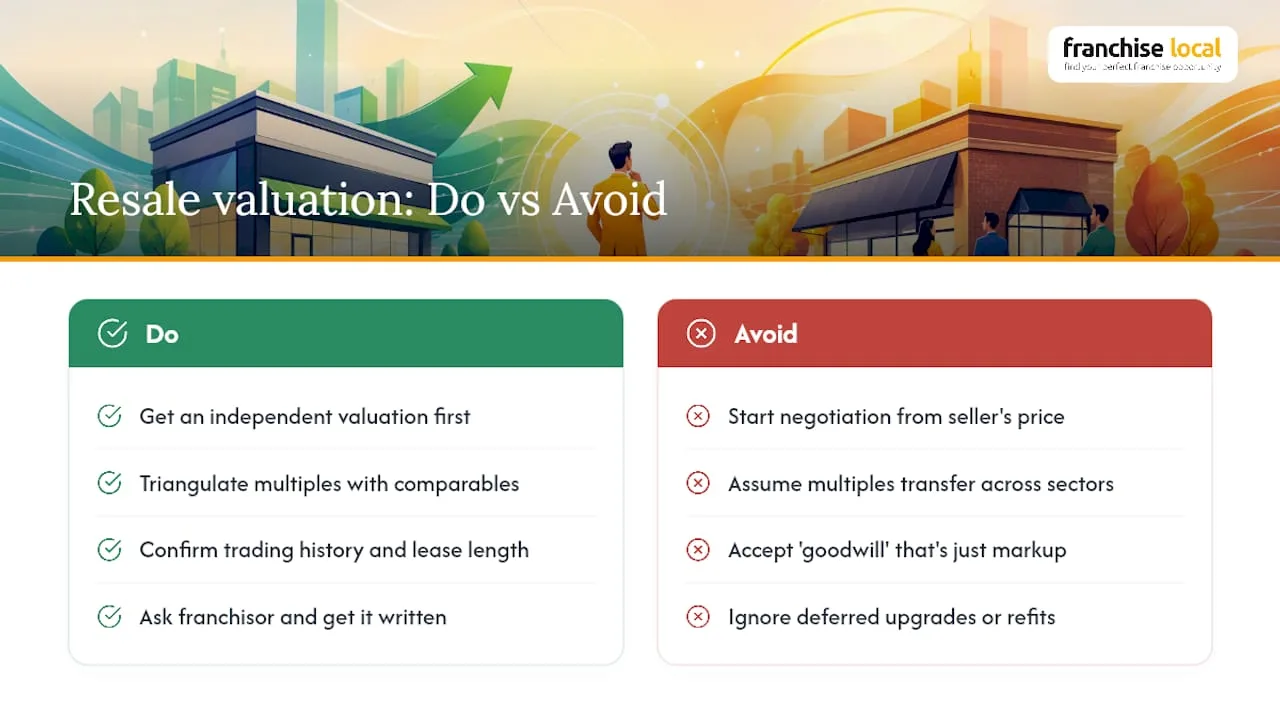
Valuation for a resale isn’t guesswork, though plenty of sellers price as if it were. The British Franchise Association’s guidance for resale buyers points to historic cash flow multiples, goodwill, contracted or recurring income, territory attractiveness, and asset values as the core drivers. An independent valuation that triangulates cash flow multiples against local market comparables and asset values gives you the most defensible number to negotiate from, rather than accepting the seller’s own figure at face value.
Accountants and franchising professionals can supply comparable sale multiples for your specific brand and sector, which matters because multiples vary considerably between industries. A well-established cleaning franchise with recurring contract income will command a different multiple to a food-service unit trading mostly on footfall. Don’t assume a multiple you’ve heard quoted for one sector transfers cleanly to another.
The premium a resale commands is justified when the trading history backs it up: consistent revenue over multiple years, a lease with reasonable time left to run, staff who plan to stay, and no looming capital expenditure the seller has quietly deferred. It’s not justified when the “goodwill” figure is really just a markup on a business that’s been coasting, or declining, for the past two years.
That last point deserves particular attention because it’s where resale buyers most often get caught out. The British Franchise Association warns that outgoing owners sometimes defer franchisor-mandated upgrades, equipment renewals, or branding refreshes right up until the point of sale, leaving the incoming owner to fund them almost immediately after completion. Ask the franchisor directly whether any refresh or refit obligations are due, and get the answer in writing before you agree a price. A detailed look at resale valuation approaches is worth reading alongside your own accountant’s numbers, not instead of them.
Pro Tip: Never treat the seller’s asking price as the starting point for negotiation. Get your own independent valuation first, then use it to challenge the figure, not simply to confirm it.
Costs, timeline and financing for both routes
Resale purchases follow a fairly predictable timeline. The British Franchise Association’s data on the resale process puts the full journey at three to six months from first enquiry to completion and training, broken down roughly as follows:
- Research: 1 to 2 weeks reviewing the opportunity and initial figures
- Seller review: 2 to 4 weeks of early conversations and information exchange
- Due diligence: 4 to 8 weeks verifying accounts, contracts, and legal position
- Negotiation: 1 to 4 weeks agreeing final price and terms
- Completion and training: 4 to 12 weeks covering legal completion and franchisor-led handover training
That six-month upper bound is worth remembering when you’re comparing offers or setting your own expectations. A resale that completes in six weeks flat has skipped a stage somewhere, and it’s usually due diligence.
Greenfield timelines vary more by sector but generally run from finding suitable premises (often the single longest gating task) through fit-out, recruitment, and franchisor-approved launch. Three to twelve months from signing the franchise agreement to opening day is a realistic range, with premises-based models at the longer end and home-based or mobile models opening considerably faster.
Budget in distinct buckets rather than one lump sum: the franchise fee itself, working capital to cover the pre-breakeven period, fit-out or refurbishment costs, initial training costs, and (for resale) the goodwill premium on top of the underlying business value. The affordability calculator is a useful way to stress-test these numbers against your own capital position before you get emotionally attached to a specific opportunity.
Financing behaves differently across the two routes, and it’s worth knowing this before you approach a lender. Lenders are typically more comfortable financing resales because documented trading history and evidence of sustainable cash flow give them something concrete to underwrite against. Greenfield lending relies more heavily on the franchisor’s track record across other territories and your own personal financial standing, since there’s no trading history for the new site itself. Either way, expect to provide three years of personal financial history, a business plan, and (for resale) the target business’s full accounts.
Due diligence checklist: what to check before buying a resale
Due diligence on a resale needs to go considerably deeper than a greenfield purchase, precisely because there’s an existing business with an existing history to interrogate. Sprintlaw’s guidance for UK buyers flags this as one of the most commonly underestimated parts of the process.
- Request three years of full accounts, not just a summary, plus the most recent management accounts to check nothing has shifted materially since the last filed set.
- Check the sale structure, share purchase or asset purchase, since each carries different tax treatment and different exposure to historic liabilities. An independent solicitor and accountant with franchise experience should review this before you sign anything.
- Review the lease terms directly, including how much time remains, rent review dates, and whether assignment to you needs landlord consent.
- Check for pending legal disputes and employee grievance records, since these transfer with the business in most sale structures and can surface expensive problems months after completion.
- Assess staff retention risk by asking how long key employees have been in post and whether any have indicated plans to leave once ownership changes.
- Inspect equipment condition against franchisor-mandated standards, and confirm in writing whether any refresh obligations are outstanding.
- Review supplier contracts for tie-in periods, pricing terms, and whether they transfer automatically or need renegotiating.
- Ask the seller directly why they’re selling, and treat vague or evasive answers as a signal to dig further rather than move faster.
Red flags worth taking seriously: declining year-on-year revenue with no clear external explanation, a seller unwilling to let you spend time in the business before completion, franchisor records showing repeated compliance issues, or an asking price with no supporting valuation methodology behind it. A franchise due diligence guide covers the documentation checklist in more depth if you want a working template to take into meetings.
Pro Tip: If a seller resists a reasonable request to shadow the business for a few days before completion, treat that resistance itself as information. Legitimate sellers with nothing to hide rarely object.
Handover and the first 90 days: protecting what you’ve bought
The handover period is where resale purchases succeed or quietly start failing, often before the new owner even realises it. The British Franchise Association’s resale guidance stresses that spending real time observing day-to-day operations alongside the outgoing owner reveals the less visible factors behind a business’s success, the small habits and relationships that never make it into a set of accounts.
Insist on these before you complete:
- Genuine overlap time trading alongside the seller, not just a token handover meeting
- A joint customer communication plan so regular customers hear about the change from both owners together, not through rumour
- Personal introductions to key staff, made by the outgoing owner, before day one under new ownership
The first 90 days then follow a rough priority order. In the first 30 days, maintain existing standards exactly as they were, resist the urge to change anything visible, and focus entirely on staff retention. In days 30 to 60, look for genuine quick wins, small operational fixes staff already know about but the previous owner never got round to. From day 60 onwards, start budgeting for any franchisor-mandated refresh work you identified during due diligence, since this is typically when that capital expenditure becomes due.
Pro Tip: Defer rebranding, menu changes, or new systems for at least the first eight weeks. Preserving the existing rhythm of the business matters more in that window than any improvement you’re itching to make.
Which route fits your circumstances?
Run through these five questions honestly, and the right answer usually becomes obvious fairly quickly.
- How soon do you need revenue? If you need income within weeks of completion, weight heavily towards resale.
- How much capital do you have, and how much is tied up in working capital reserves versus purchase price? Tighter cash reserves after purchase favour greenfield’s lower entry cost.
- What’s your appetite for uncertainty over the first year? Low tolerance points to resale’s trading history; high tolerance opens up greenfield.
- Do you want to build systems or refine them? Builders lean greenfield; operators and fixers lean resale.
- What’s your actual operational skillset? Sales and marketing strength suits greenfield’s launch phase; process and people management suits stepping into an existing resale team.
Score yourself honestly against these five, and one route should pull clearly ahead. Once it does, the next steps are the same regardless of which way you lean: start formal due diligence, get financing conversations moving in parallel rather than afterwards, and secure franchisor approval early, since most franchisors run their own vetting process for incoming owners on both resale and greenfield deals.
Compare listings and run the numbers with Franchise Local
There are platforms that provide a single place to compare resale and greenfield opportunities side by side, avoiding the need to chase separate broker listings and franchisor websites. The trending opportunities page lets you filter curated listings by price, industry, and location, so you can shortlist resales with genuine trading history alongside greenfield territories in the sectors you’re actually considering.
Before you approach a lender or a franchisor, run your own numbers through the affordability calculator and ROI estimator to see how working capital requirements and projected returns compare across the specific opportunities on your shortlist. Being prepared with affordability figures before a franchisor approval meeting may benefit prospective buyers. Browse the full franchise directory to start building your shortlist today.
This article is general information, not a substitute for advice from a qualified financial advisor. Consult a qualified financial professional about your own circumstances before acting on anything here.
Sources
- The resale route: what to expect when buying an existing franchise – British Franchise Association
- Buying an existing franchise in the UK: steps and risks | Sprintlaw UK
FAQ
How long does a franchise resale purchase usually take?
Most resales complete in three to six months from initial enquiry to completion and training, with due diligence alone typically taking four to eight weeks.
Is a greenfield franchise cheaper than a resale?
The upfront purchase price is usually lower for greenfield, since you’re not paying a goodwill premium, but you’ll typically need more working capital to cover the slower ramp to breakeven trading.
How is a resale franchise valued?
Valuers typically weigh historic cash flow multiples, goodwill, contracted income, territory attractiveness, and asset values, and an independent valuation is strongly recommended before you negotiate.
Do I still need franchisor approval to buy a resale?
Yes. Franchisors typically vet incoming owners for resales just as they do for greenfield applicants, so factor approval time into your overall timeline.
What hidden costs catch resale buyers out most often?
Deferred equipment or branding refresh obligations that the previous owner postponed are the most common surprise, so always confirm in writing whether any upgrades are due before you complete.
Can Franchiselocal help me compare both routes?
Yes. Franchiselocal’s directory lets you filter both resale and greenfield listings by price, industry, and location, and its calculators help you model affordability and returns before you commit.