

Franchise restrictive covenants are enforceable in the UK only when they protect a genuine business interest and go no further than necessary: the starting legal presumption treats them as a restraint of trade, and the Competition Act’s VABEO safe harbour only covers a 1-year, premises-limited non-compete. Blanket 12-month terms are no longer a safe default after Dwyer (UK Franchising) Ltd v Fredbar Ltd. The practical message: tailor every clause to the franchisee’s actual footprint rather than copying a standard template.
What franchise restrictive covenants cover
A restrictive covenant in a franchise agreement limits what a franchisee can do during or after the relationship ends. Three types appear in nearly every UK franchise contract, each protecting a different interest:
- Non-compete clauses stop a former franchisee trading in a similar business, usually within a set territory and time.
- Non-solicitation clauses prevent a leaving franchisee from approaching former customers or poaching staff.
- Confidentiality clauses protect trade secrets, operating manuals and other know-how the franchisor shares during training.
In practice, these clauses protect goodwill built under the franchisor’s brand, the customer connections a franchisee develops locally, and the operational know-how that makes the franchise system work. Drafting typically ties the non-compete to the specific territory or premises the franchisee operated from, with a post-term period commonly set at about a year or less. Our franchise NDAs checklist sets out how confidentiality clauses are typically structured alongside these restraints.
How courts decide if a covenant is reasonable
UK courts start from the position that a restraint of trade clause is presumed unenforceable unless the franchisor proves otherwise. According to Travers Smith’s analysis of the Court of Appeal’s approach, enforceability turns on whether the franchisor can show a legitimate business interest and whether the restriction goes no wider than necessary to protect it.
Courts weigh several factors together rather than applying a fixed formula:
- Whether the franchisor has a genuine interest worth protecting, such as know-how, goodwill or customer connections.
- Whether duration, geographic scope and the activities restricted are proportionate to that interest.
- The parties’ relative bargaining power and whether the franchisee negotiated the terms or had independent legal advice.
- Whether the clause was reasonable at the point the agreement was signed, not at the point it is enforced.
One year is treated as a loose benchmark, not a guarantee. Travers Smith notes that courts assess reasonableness against the specific facts at signing, including how much bargaining power each side actually had. Severance of an offending part of a clause, often called blue-pencilling, is available only in limited circumstances: if removing the unreasonable wording would change the substance of the bargain, the whole clause falls.
Dwyer, Pirtek and the Competition Act safe harbour
The clearest signal on where UK law now stands came from the Court of Appeal in Dwyer (UK Franchising) Ltd v Fredbar Ltd. The case concerned a 12-month post-termination non-compete inside a 10-year franchise agreement, and the court held there is no general rule that a 12-month restriction is automatically reasonable. Enforceability depends on the facts, including the bargaining power of the parties and whether the clause reflected genuine negotiation.
There is no settled assumption that a 12-month non-compete is reasonable in a franchise context; the position depends on the circumstances at the time the agreement was made, including the parties’ bargaining strength.
That contrasts with the earlier case of Pirtek (UK) Limited v Joinplace Limited, where the High Court upheld a one-year restraint confined to the franchised territory because the franchisor could point to genuine know-how and assistance given to the franchisee. The difference between the two outcomes is evidence and tailoring, not the headline duration.
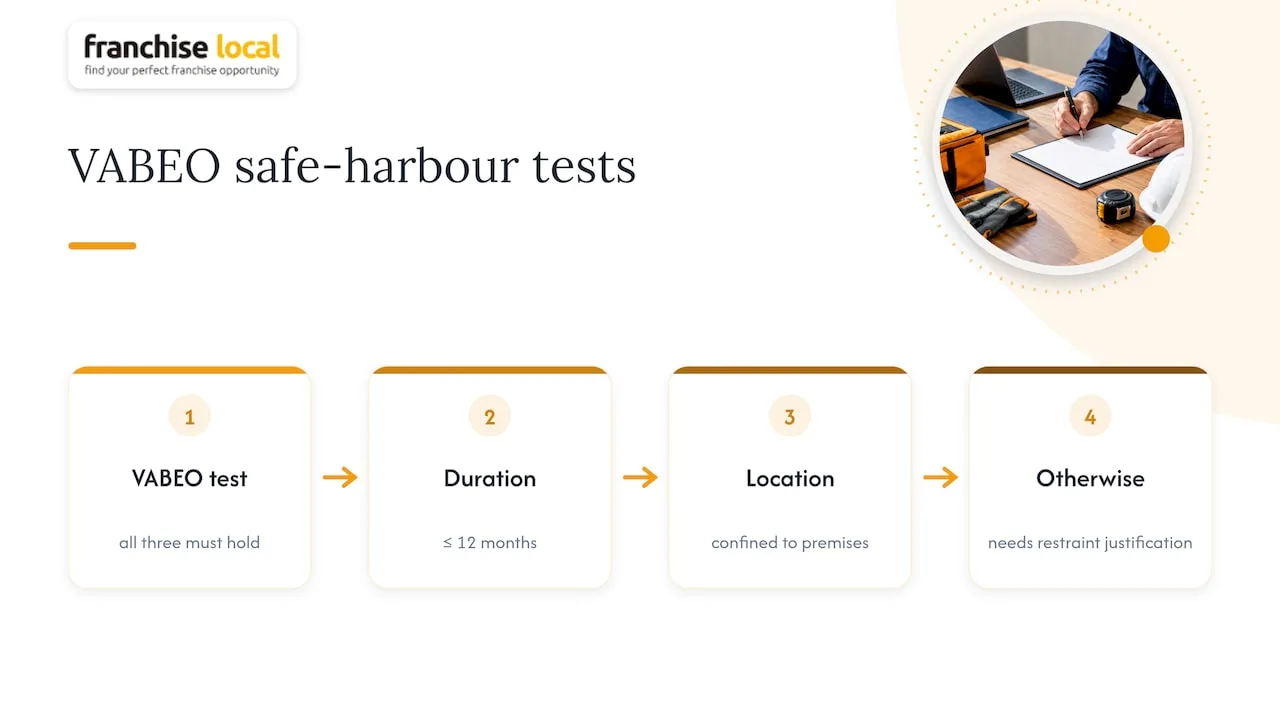
Sitting alongside the case law is the competition regime. The Competition Act 1998 (Vertical Agreements Block Exemption) Order 2022, known as VABEO, gives certain vertical restraints a safe harbour, but only narrowly. A post-term non-compete may fall within that exemption if it is limited to one year and confined strictly to the premises or land the franchisee operated from. Anything broader, wider territory, longer duration or unrelated products, sits outside the exemption and needs its own justification under ordinary restraint of trade principles.
The rule of thumb that follows: 12 months is only safe when it is narrow, evidenced and tied to a specific premises. Anything wider needs to be justified by the actual goodwill at stake.
Drafting and recruitment steps that improve enforceability
Franchisors who want covenants to survive a challenge tend to build the case for them long before any dispute arises, not after.
- Tier duration and territory to trading history. Link the length and geographic scope of the restraint to how long the franchisee has traded and how much goodwill they have actually built, rather than applying one network-wide term.
- Document the recruitment process. Keep records of projections given, negotiations held and any changes made at the franchisee’s request, since this evidence shows the clause reflected a real bargain.
- Encourage independent legal advice. A franchisee who took advice before signing is far harder to argue was unfairly disadvantaged by a covenant’s terms.
- Keep non-solicitation and confidentiality clauses narrow. Draft them to protect the specific customer lists or know-how at stake rather than every conceivable commercial activity.
- Do not rely on severance as a safety net. Draft each clause so it can stand on its own; courts in Mayer Brown’s review are reluctant to blue-pencil overly broad wording, and a badly drafted clause can be struck out entirely.
- Assemble enforcement evidence early. Training records, customer lists and territorial sales data demonstrate the goodwill the covenant is meant to protect, and are far easier to gather before a dispute than during one.
Pro Tip: Treat every covenant as something you may one day need to defend in court: if you cannot point to the evidence that justifies it today, it probably will not survive a challenge later.
Our guide to preparing franchise disclosure covers how to document recruitment conversations in a way that supports this kind of evidence trail.

A checklist for franchisors and franchisees right now
Before relying on any existing covenant, or drafting a new one, it is worth working through a short set of checks.
- Map each clause against the franchisee’s actual trading footprint, not a generic network-wide template.
- Reconsider duration and geography: 6 months, a tiered structure, or site-specific drafting often stand up better than a blanket 12 months.
- Record the bargaining history and confirm the franchisee had the chance to take independent legal advice.
- Benchmark drafting against the BFA Code of Ethics, which recommends transparency and proportionate post-term restrictions.
| Action | Why it matters |
|---|---|
| Tailor duration to trading history | Courts assess reasonableness at signing, not generically |
| Limit non-competes to the specific premises | Keeps the clause within the VABEO safe harbour |
| Keep recruitment and advice records | Evidence of fair bargaining supports enforceability |
| Benchmark against BFA Code of Ethics | Recognised industry standard for proportionate terms |
Our overview of franchise regulation in the UK sets out how the BFA Code fits alongside statutory obligations for franchisors.
How we help you navigate franchise opportunities
Finding the right franchise, or the right franchisee, starts with clear information, and that is what our directory is built around. There are directories listing UK franchise opportunities across industries and investment levels, with filters for price, lifestyle and location, so you can compare options against what actually matters to you rather than wading through generic listings. Franchisors may use platforms that help them reach entrepreneurs who are actively searching, not cold prospects.
If you are weighing up a franchise purchase, start with our trending franchise opportunities to see what is attracting buyers right now. If you are a franchisor preparing agreements and want a clearer sense of how your sector approaches recruitment and documentation, our complete guide to franchising covers the practical steps from first enquiry through to signed agreement.
This article is general information, not a substitute for advice from a qualified lawyer. Consult a qualified legal professional about your own circumstances before acting on anything here.
FAQ
What is the 12 year rule for restrictive covenants?
There is no general “12 year rule” for restrictive covenants in UK franchise law; this is sometimes confused with limitation periods for separate legal claims. What matters for a franchise covenant is whether its duration and scope are reasonable and necessary at the time the agreement was signed, as set out in Dwyer.
How enforceable are restrictive covenants in the UK?
Restrictive covenants are enforceable only when the franchisor can show a legitimate business interest and the restriction is no wider than necessary in duration, geography and scope. Since Dwyer, a standard 12-month non-compete is not automatically treated as reasonable, and each clause is judged on its own facts.
Can a company legally stop you from working for a competitor?
A franchisor can restrict a former franchisee from competing only through a clause that passes the restraint of trade test: it must protect a genuine interest and be proportionate in scope. A restriction that goes beyond the premises or territory the franchisee operated from may also fall outside the VABEO safe harbour, making it harder to defend.
Is a franchise agreement legally binding?
Yes, a franchise agreement is a legally binding contract once both parties sign it, and most of its terms are enforceable in the usual way. Restrictive covenants within it are the exception that courts scrutinise more closely, since they restrain trade and must meet the reasonableness test rather than being automatically upheld.