

For franchise applications, lead with a one-line fit summary, a clear financial snapshot and three measurable achievements. Franchisors want proof you can follow a system, manage people and money, and bring enough capital to operate from day one. Use their own language: operations, customer-facing, leadership, and be upfront about your finances rather than letting a credit check surprise them.
What to include in a franchise CV and why each item matters
A franchise CV is not a job application. You are pitching yourself as a business partner, and every section should answer a specific question the franchisor is asking behind the scenes.
Franchisors tend to look past exhaustive academic histories and focus on managerial skills, people management and business acumen, scanning for measurable achievements rather than a list of past duties, as Elite Franchise Magazine notes on CV design in franchising. That single shift in emphasis should shape every line you write.
Five elements carry the most weight:
- Personal summary: a short statement of intent that signals cultural fit, not just availability.
- Financial summary: investable capital, your funding route, and an honest note on any credit issues.
- Relevant experience with metrics: sales growth, cost savings, team sizes, anything countable.
- Behavioural attributes: your ability to follow a system, show up reliably and put the customer first.
- Supporting documents and referees: evidence that backs up what the CV claims.
The financial summary deserves particular care. Franchisors are assessing whether you can fund the investment and survive the early cashflow dip, so state your available capital plainly rather than implying it. If there is a past credit blemish, a brief, factual note paired with context reads far better than silence followed by a flagged credit check.
On experience, resist the urge to list job titles. A franchisor reading “Assistant Manager, 2019 to 2022” learns nothing; “grew weekend footfall by introducing a loyalty scheme” tells them you think commercially. The behavioural layer matters just as much: franchisors are buying into your temperament, not just your track record, which is why soft skills such as reliability and customer focus often decide between two otherwise similar applicants.
Finally, referees and supporting paperwork (a reference from a previous employer, a letter from an accountant, a basic business plan) give the franchisor something to verify, which speeds up their decision rather than slowing it down.
Copyable franchise CV examples and short templates to adapt
The examples below are deliberately short. Treat them as starting templates, not finished copy, and swap in your own figures.
- Single-unit operator (retail or service): “Managed a team of 6 in a fast-paced retail environment; introduced a simple upselling script that lifted average transaction value, and maintained a 98% customer satisfaction score across two years.” Keep the structure: team size, one process change, one measurable result.
- Multi-unit or investor-operator: “Oversaw three service outlets with combined annual revenue of £1.2 million; recruited and trained 14 staff; reduced stock wastage by standardising supplier ordering across sites.” This version leans on oversight and financial scale rather than hands-on tasks.
- Career changer: “Ran a 20-person logistics team under strict delivery SLAs; translated this into franchise terms as ‘managed time-critical operations against fixed targets, with direct accountability for customer outcomes.’” Frame unrelated experience around the skill the franchisor actually needs: discipline, accountability, customer focus.
The before-and-after conversion is the most useful exercise you can do before submitting anything. An ordinary line like “managed a retail team” becomes “managed a retail team of 8; increased average transaction value by 12% in 12 months by introducing upsell incentives”, a rewrite that turns a duty into evidence, as Business Franchise’s guidance on CV and interview preparation sets out. Go through every bullet on your current CV and ask: what number sits behind this sentence?
Pro Tip: Keep one master document with every achievement and its number, then trim it down differently for each franchisor rather than writing from scratch each time.
If you are moving into a sector you have never worked in, our guide to franchises that need no prior experience is worth reading alongside your CV draft, since many franchisors build training into the model specifically so they can recruit outside the industry.
Tailoring your wording and formatting your CV for ATS systems
Franchisors often use the same recruitment keywords across their information pack, website and operations manual. Mirror that language rather than guessing at your own.
Pull phrases directly from the franchisor’s materials: terms like “customer-facing”, “team management”, “sales” and “leadership” recur often enough in franchise recruitment that Elite Franchise Magazine flags them as the keywords franchisors search for. If their prospectus talks about “managing day-to-day operations”, use that exact phrase where it genuinely applies to your background. Our partner guide to matching your CV language to a job description covers the same principle in more depth if you want a repeatable process.
Formatting matters too, especially once an applicant tracking system is involved:
- Keep the CV to one or two pages, with the most relevant experience near the top.
- Use a standard font and simple headings; avoid tables, text boxes or images that scanning software may misread.
- Put role-relevant words (operations, management, customer service) in headings and bullets, not buried in paragraphs.
- Save and send as a PDF unless the franchisor’s application form specifies otherwise.
Alongside the CV itself, most franchisors expect a short pack: a one-page finance summary, a brief tailored cover note explaining why this franchise specifically, and a list of referees. If your CV’s layout needs a tidy-up before it goes anywhere, a quick design pass, such as the kind offered by AMW Media’s graphic design service, can make a one-page finance summary look considerably more credible.
Common mistakes and how to disclose financial issues honestly
Vague claims are the single biggest weakness in franchise CVs. “Responsible for team performance” tells a franchisor nothing; a number always beats an adjective.
Inconsistent timelines are the second problem, gaps in employment or vague date ranges invite questions you would rather answer on your own terms, in writing, than explain awkwardly at interview.
Credit and financial history deserve a direct approach. Franchisors run credit checks as standard, so disclosing a minor issue upfront, in one honest sentence with a short mitigating note, demonstrates integrity rather than risk, according to Elite Franchise Magazine’s analysis of the franchise recruitment process. Concealment that surfaces later costs you far more credibility than the issue itself ever would.
- Avoid vague, unmeasured claims; replace every one with a number or a concrete outcome.
- Disclose credit or financial issues early, briefly and with supporting evidence attached.
- Watch for behavioural red flags franchisors actively avoid, such as reluctance to follow a set system or a pattern of short-lived ventures.
- Prepare mitigation in advance: an accountant’s letter, a simple cashflow plan, or references from a previous employer or supplier.
The ability to follow an established system is widely cited as the strongest single predictor of franchisee success, according to Business Franchise’s guidance on finding the right fit, which is exactly why a CV that signals respect for process, rather than a desire to reinvent it, tends to perform better.
How to submit your CV and follow up without chasing
The submission pack matters as much as the CV inside it. Franchisors expect a tailored cover note, your CV, a one-page finance snapshot, a referees list and any forms they have specifically requested.
Once sent, give it a week before any follow-up, then send one polite email checking it arrived and asking about next steps. If you are invited to progress, a phone call at the two-week mark is a reasonable second touch; beyond that, chasing repeatedly tends to work against you.
- Send a complete pack the first time: cover note, CV, finance snapshot, referees, requested forms.
- Log every submission and response so you can track which franchisors you have contacted and when.
- Keep further financial documents (bank statements, accountant letters) ready in case they are requested after initial review.
- Treat our step-by-step guide to the franchise application process as a checklist for what typically comes next.
Preparing a short business plan alongside your CV also helps when finance conversations start, since assessing a franchise opportunity properly often means visiting existing franchisees and having a plan ready for lenders, as nibusinessinfo’s guidance on assessing a franchise opportunity sets out.
How a franchise CV differs from a traditional job CV
A traditional job CV sells your skills to an employer who will manage you. A franchise CV sells your capability, temperament and capital to a partner who needs you to run their system well.
That changes the structure. Where a job CV opens with a career objective, a franchise CV opens with a fit statement: why this brand, why now, and what you bring financially and operationally. Education moves down the page, sometimes off it entirely, while a financial summary moves up, often appearing in the first third of the document.
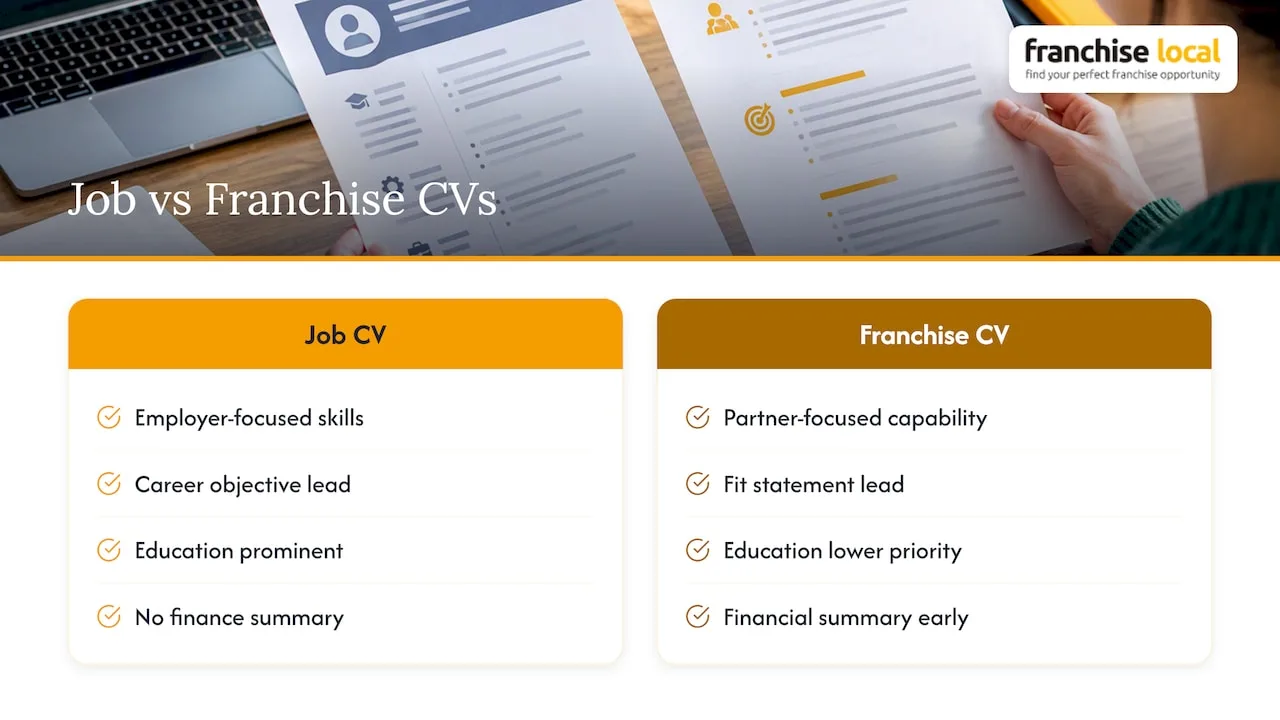
Experience sections shift tone too. A job CV lists responsibilities; a franchise CV lists outcomes you achieved within a structure someone else set, since that is the exact behaviour franchisors are trying to predict. Soft skills around discipline and customer focus carry more weight than specific technical experience, particularly for franchises that provide full training, which is one reason prior industry experience is often not a requirement for general retail or service franchises.
Finally, a franchise CV usually needs a second document attached: a one-page finance snapshot. A job CV never requires this, but a franchisor cannot properly assess your application without seeing that you can fund the investment and sustain the business through its early months.
Examples of franchise CVs across different industries
The core structure stays the same across sectors: fit statement, financial snapshot, measurable achievements. What changes is which achievements you foreground.
For a food or retail franchise, lead with customer-facing metrics: footfall, repeat custom, team sizes managed during peak trading. For a home-based or service franchise (cleaning, tutoring, mobile repair), lead with scheduling discipline, customer retention and your ability to manage your own time without daily supervision, since many home-based models hinge on self-direction. For a business-to-business franchise, such as financial or business services franchises, lead with client relationship management, contract value and any experience negotiating with other businesses rather than consumers.
For driving, logistics or courier-style franchises, safety record, route efficiency and vehicle management experience matter more than sales figures. For networking or sales-led franchises, lead with lead generation numbers, conversion rates or relationship-building achievements, even if the figures come from an unrelated sector.
The common thread: whatever industry you are targeting, the franchisor is reading your CV to answer one question, “can this person run our system profitably?” Choose the two or three facts from your history that answer that question most directly for their specific model, and cut everything that does not.
Highlighting entrepreneurial experience and business management skills
If you have run your own business before, even briefly, lead with it. Franchisors value genuine entrepreneurial experience highly, but frame it carefully: a franchise is a system to be followed, not a venture to be reinvented.
Translate entrepreneurial achievements into franchise-relevant terms. “Started and ran a small business” becomes “managed full P&L responsibility for a business generating [a specific revenue figure], including supplier negotiation and staff recruitment.” Specifics beat enthusiasm every time.
Where you have managed people, quantify it: number of staff, turnover rate, training you delivered. Where you have managed budgets, state the figures. Franchisors are assessing whether you can read a profit and loss statement and act on it, not whether you had a good idea once.
Be careful with independence as a trait. Franchisors want confidence and self-belief, but they are also screening for people willing to work within someone else’s framework, so pair any mention of independent decision-making with evidence that you also respect process and guidance, a balance that experienced franchisees are known to strike. A line like “built my own processes from scratch, then standardised them for consistency” signals both capability and discipline at once.
Adapting your CV to specific franchisor requirements
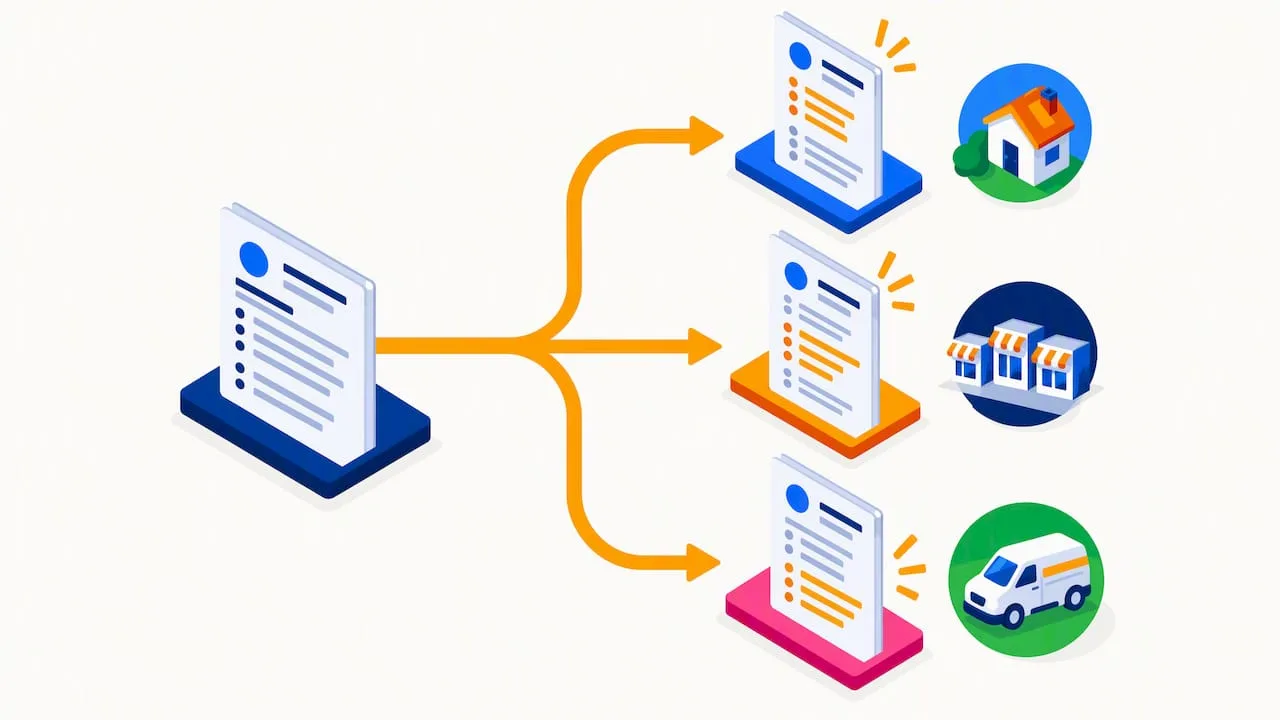
No single CV works for every franchisor. Read the information pack closely before you send anything, since it usually tells you exactly what the brand is screening for.
A franchisor running a low-cost, home-based model is typically screening for self-motivation and time management, so your CV should foreground examples of working independently to targets. A franchisor selling a higher-investment, multi-unit model is screening for management depth and financial resilience, so staff numbers, budgets managed and funding sources should move higher up the page.
Some franchisors publish detailed candidate criteria; others only hint at it through the tone of their marketing. Either way, reviewing the operational responsibilities typical of the franchise type you are targeting helps you work out which of your own experiences are actually relevant before you start writing.
Where a franchisor’s pack mentions specific systems, software or operational language, use those exact terms if they genuinely apply to your background. Proficiency in the language of operations manuals is one of the traits that distinguishes confident, well-prepared franchisees from weaker applicants, so a CV that already speaks that language before day one gives a strong first impression. Keep a base CV as your template, then spend twenty minutes adjusting emphasis for each franchisor rather than sending an identical document to every brand on your shortlist.
Find franchise opportunities and submit enquiries from a single directory
Once your CV is ready, the next step is finding franchisors worth sending it to. Use a directory you can filter by investment level, industry and lifestyle, so you spend less time hunting and more time applying to opportunities that actually fit your background and budget.
Our trending franchise opportunities page is a good starting point for seeing which brands are actively recruiting, and our industry filters let you narrow straight to the sector your CV is built for, from there you can submit an enquiry directly to the franchisor.
FAQ
What should a franchise CV include that a job CV doesn’t?
A franchise CV needs a financial summary covering your investable capital and funding route, something a standard job CV never requires. It should also lead with a fit statement explaining why you suit that specific brand’s model, placed ahead of your work history.
How long should a franchise CV be?
One to two pages is standard, with your most relevant and measurable experience placed near the top. Longer CVs risk burying the figures franchisors are actually scanning for, so trim anything that does not support your financial or operational fit.
How do I disclose a credit issue on a franchise application?
State it in one honest sentence alongside a short mitigating note, since franchisors routinely run credit checks and prefer upfront disclosure over discovering it themselves. Pair the disclosure with supporting evidence, such as an accountant’s letter or a repayment plan, to show the issue is managed.
Do I need industry experience to apply for a franchise?
Not usually. Many franchisors accept candidates without direct industry background and provide structured training instead, so your CV should focus on transferable skills like reliability, management experience and financial readiness rather than sector-specific history.
How soon should I follow up after submitting a franchise CV?
Wait around a week before a polite follow-up email checking the application was received. If you are invited to progress, a phone call around the two-week mark is a reasonable next step, provided you are not contacting them more frequently than that.