

Companies House is the quickest free way to check the legal entity behind a UK franchise. Search the franchisor, confirm you have the right company, then read its status, accounts, filing history, officers, charges and insolvency information. It is a strong first layer of research. It is not the whole picture, and the sections below show where to stop and what to add.
Why Companies House belongs in your franchise research
A franchise brand is a shopfront. The legal entity behind it signs your agreement, takes your fees and carries the obligations. Companies House holds the public record of that entity, so it answers practical questions early in your search:
- Is the franchisor a real, active limited company?
- How long has it existed, and has it changed its name?
- Who runs it, and for how long?
- Does it file accounts on time?
- Does it have secured borrowing against its assets?
The search is free and takes minutes. Do it before you pay any deposit, and before you spend time on franchise discovery days. It sits alongside the wider steps in our guide on how to research franchise opportunities in the UK.
Step 1: Find the right company
The name on the franchise website is often not the name on the register. The company that invoices you can be named nothing like the brand, and groups often register several similar names. Use this order:
- Check your documents. The franchise brochure, website footer, privacy notice and draft agreement usually state the company name and registration number.
- Search by company number if you have it. It is exact and belongs to one company only.
- Otherwise search a distinctive fragment of the name, not the full brand. Several near-identical results are normal.
- Confirm on two facts. Match the registered office and the incorporation date against what the franchisor tells you. A previous name that matches the brand is another good sign.
If the franchisor cannot or will not tell you which company you would contract with, treat that as a question to resolve before going further. Also note that the owner of a trade mark can be a separate holding company from the one that trades. Both may be legitimate, and your agreement should make clear who licenses what.
Step 2: Read the company overview
The overview page is the summary. Check these items first:
| Record | What to look for |
|---|---|
| Company status | Active is expected. Dissolved, liquidation or strike-off notices need an explanation |
| Incorporation date | How long the entity has existed, compared with how long the brand claims to have traded |
| Registered office | Matches the address in your documents |
| Nature of business (SIC code) | Reasonably fits franchising or the brand’s sector |
| Previous names | Explains rebrands and group changes |
| Accounts and confirmation statement dates | Next due dates, and whether anything is marked overdue |
GOV.UK confirms the free search can show legal details, SIC description, status, filing dates, documents, current and resigned officers, disqualified directors, previous names, charges and insolvency information. See the official guidance on searching the register.
A young company is not automatically a problem. Many new franchise brands start with a new company. What matters is whether the story the franchisor tells matches the record.
Step 3: Study the accounts
Accounts show the financial position of the company, but how much they show depends on its size.
- Micro-entity accounts contain very little: a short balance sheet and notes.
- Small company accounts often leave out the profit and loss account.
- Full accounts include a balance sheet, profit and loss, cash flow and a director’s report, with an audit report where required.
What to read for:
- Net assets or net liabilities. Persistent net liabilities mean debts exceed assets.
- Cash at bank compared with short-term creditors.
- Amounts owed to or by directors. Large director loans deserve a question.
- Turnover trend, where the accounts disclose it.
- Notes on going concern and on post year-end events.
Also check the dates. Compare the accounting period end with the filing date. Accounts filed close to the deadline year after year are not a crisis, but accounts filed late or repeatedly extended are worth asking about.
The franchisor’s accounts tell you about the franchisor. They do not tell you what a franchisee makes. For that, see our guide on how to assess franchise financials.
Step 4: Check the filing history
The filing history lists every document filed, newest first. You can filter by category. Look at:
- Name changes and address changes. Frequent moves are worth a question.
- Confirmation statements. These should arrive annually.
- Allotment of shares and share transfers. They show changes in ownership.
- Mortgage and charge filings. They show secured lending.
- Gazette notices. Strike-off and winding-up notices appear here and on the insolvency tab.
Download the document images where something looks unclear. The summary pages can hide detail that the filed document shows.
Step 5: Look at officers and people with significant control
The officers tab lists current and resigned directors and secretaries. Open each director’s profile to see their other appointments. This shows whether the people behind the franchise have run similar businesses, and how those companies are doing.
The people with significant control (PSC) tab identifies people or entities who typically hold more than 25% of the shares or voting rights, can appoint or remove a majority of the board, or otherwise control the company.
If the PSC is another company, open that company and repeat the process. Ownership chains can run several levels deep, and the recognisable name often appears only near the top. This tells you who ultimately owns the franchisor, which matters if you want to know who stands behind the obligations in your agreement.
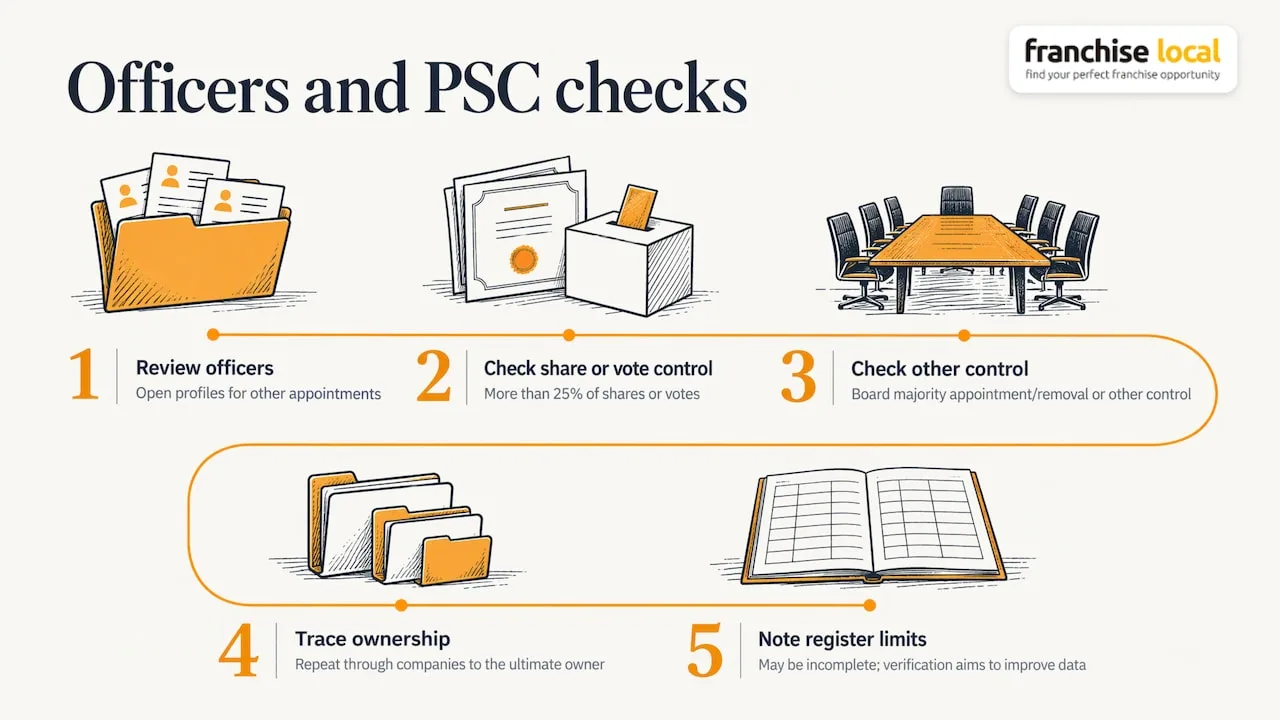
The PSC register is not a complete register of every beneficial owner. Identity verification rules introduced under the Economic Crime and Corporate Transparency Act 2023 are intended to improve the data over time.
Step 6: Check charges and insolvency information
A charge is security a lender holds over company assets. Charges are normal in business. Use them to ask sensible questions:
- Is the franchisor funded by bank debt, and is it satisfied?
- Has a charge been recently added, and why?
- Are there several outstanding charges to different lenders?
The insolvency tab shows administration, liquidation, voluntary arrangements and similar events. Also check the officers tab for any disqualified director flag. If a director’s earlier companies were dissolved or went into liquidation, ask the franchisor about it directly.
Warning signs in a franchisor’s record
No single item proves a problem. Several together justify tougher questions. Watch for:
- Director churn. Several directors appointed and resigned in a short period.
- A one-day change to the accounting period. Professionals describe a shortening by a single day as a red flag, because it can point to poor record-keeping or to an attempt to delay accounts.
- SIC code mismatch. A code that has no link to franchising or the brand’s sector can suggest an older shell company repurposed.
- Overdue accounts or confirmation statements.
- Growing net liabilities with no explanation.
- Name changes soon after complaints or insolvency of a connected company.
- A franchisor entity that is different from the one in your contract, with no clear explanation.
- Stated network size that does not match the scale of the company. A brand claiming a large network, with a tiny balance sheet, needs an explanation.
Take each one to the franchisor as a question. A good franchisor answers clearly and in writing.
What Companies House cannot tell you
Companies House states that putting information on the register does not mean it has verified it. Companies remain responsible for what they file, and Companies House carries out only basic checks on accounts. Its service information advises seeking independent professional advice.
In franchise terms, the register does not show:
- How many franchisees are profitable, or how many have left.
- What the franchise agreement says about fees, territory, renewal and exit.
- Whether the franchisor’s claims about earnings are accurate.
- Franchisee satisfaction and support quality.
- Whether the franchisor is a member of a recognised trade body or follows its code.
Small company accounts are also thin on detail, so a clean record can say less than it appears to.
What to do alongside Companies House
Treat the register as your first filter, then build the rest of your due diligence around it:
- Speak to current and former franchisees, including some you find yourself rather than only those the franchisor suggests.
- Ask for the franchisor’s management accounts, financial projections and details of any loans or debts.
- Obtain the full franchise agreement and model the fees and running costs against realistic sales.
- Have an independent franchise solicitor review the agreement, and an accountant review the figures.
- Check the franchisor’s trade body membership and its training and support commitments.
Our 30 day franchise background check plan turns this into a schedule. For cost modelling, see how to evaluate franchise costs, and for the legal step, read why legal advice is vital before buying a UK franchise. The wider process is covered in franchise due diligence in the UK.
A worked example
Imagine you are looking at a brand called “Bright Home Services”. The website footer names a company with a slightly different name and a company number.
- You search the number. The company was incorporated six years ago, which fits the brand’s claim of six years trading.
- The registered office matches the franchise brochure. A previous name matches the brand, so the identity is confirmed.
- Accounts are small company accounts, filed on time, showing modest net assets and a bank loan in creditors.
- The filing history shows one charge to a high street lender, registered three years ago.
- Officers: two directors, both in post since incorporation. Their other appointments are linked group companies.
- PSC: the two directors each hold more than 25%.
Nothing here is alarming. It gives you a clear list of questions: what the loan funded, how many franchisees the company supports, and what the management accounts show. Now suppose three directors had resigned in the last year and accounts were overdue. The same research would tell you to slow down and ask harder questions before committing.
Assess the opportunity, not just the company
A sound company record is a good start. Your decision still rests on the unit economics, the support, the territory and your own fit with the business. Franchise Local lets you filter UK franchise opportunities by industry, investment level, lifestyle and location, so you can build a shortlist and then run each brand through the checks above. If you are weighing risk across several brands, our guide to assessing franchise risk sets out a method. To browse options with your budget in mind, start from the Franchise Local directory, or read the ultimate guide to franchising first.
FAQ
Is Companies House free to search?
Yes. The search service on GOV.UK is free and shows company status, filing history, officers, charges and insolvency information. You can also download copies of filed documents, such as accounts. You do not need an account to look at a company’s record.
Can I find a franchisor’s profits on Companies House?
Only sometimes. Small and micro companies often file accounts without a full profit and loss account, so turnover and profit may not appear. Even full accounts show the franchisor’s results, not what an individual franchisee earns. Ask for franchisee figures and have an accountant review them.
What if the franchise brand is not on Companies House?
Search by the company name and number in your contract or brochure rather than the brand name. A brand can be operated by a company with a different name. If no UK company appears at all, ask the franchisor in writing who the contracting entity is and where it is registered, and take advice from a franchise solicitor.
Does a clean Companies House record mean a franchise is safe?
No. The register is not verified by Companies House, and it says nothing about franchisee profitability or the terms of your agreement. A clean record is a good first result. Combine it with franchisee conversations, the full agreement, and advice from a franchise solicitor and an accountant.
How often should I check the record?
Check at the start of your research and again just before you sign, since filings can change in between. Look for new charges, officer changes and any insolvency notices. Your solicitor can also run checks as part of the purchase.