

A franchise enquiry is the start of a conversation, not a purchase. If you have sent one, expect a reply from the franchisor, usually a call or email, followed by a structured series of conversations in which both sides assess each other. If you are the franchisor, the enquiry is worth the most in its first hours, and a fixed follow-up routine with a named owner keeps it from going cold.
This guide covers both sides of the exchange. Prospective franchisees get what to expect, how to respond and what to ask. Franchisors and advisers get a response-time standard, a follow-up cadence and a way to avoid sounding pushy. If you are still choosing brands, start with the UK franchise directory, where you can filter by industry, budget, lifestyle and location before you send any enquiry.
What happens after you send a franchise enquiry
Most UK franchisors run a recruitment process in broadly the same order, even though the labels and timings differ from brand to brand:
- Acknowledgement. An automatic email or a short call confirms your details have arrived.
- First conversation. A development manager or the founder asks about your background, your budget and why you are drawn to the brand.
- Information pack and a longer conversation. You receive more detail on the model, costs, territory and support, and you discuss it properly.
- Mutual due diligence. You speak to existing franchisees, review the financial information and take professional advice. The franchisor checks you in return.
- Territory and agreement. You agree where you will trade and review the franchise agreement.
- Training and launch.
Some franchisors publish their own timeline. One UK care franchisor, for example, describes a journey from first contact to trading that takes a matter of months, with a phone call promptly after the enquiry and a longer one-to-one conversation within the first couple of weeks. Treat any figure like that as one brand’s way of working, not a rule. What holds across the sector is the shape: quick first contact, a deeper conversation, then a period of checking on both sides.
The point that surprises many first-time enquirers is that the process is two-way. The franchisor interviews you, and you are expected to assess the franchisor. A good brand welcomes your questions and does not hurry you.
How to respond when the franchisor gets in touch
Your enquiry form is the first thing the franchisor reads about you. Treat it as a short application: say what experience you have, how much you can invest and when you hope to start. Vague forms get generic replies. Specific forms get a conversation pitched at your situation. If you are unsure what the form is asking for and why, our guide to franchise enquiry form design explains what each field is for, and how franchise lead forms work shows where your details go after you press send.
Then follow a few simple habits.
Reply promptly and keep to what you agree
If the franchisor suggests a call, confirm a time quickly and be there. Following a process is part of what franchising asks of you, and the franchisor notices how you handle a simple one. If you will be unavailable for a week, say so in a single line so silence is not misread as lost interest.
Prepare for the first call
Have these ready before you pick up:
- Your realistic investment range, including how much is your own money and how much you might borrow.
- The hours per week you can commit, and whether you plan to work in the business or manage it.
- The area where you want to trade.
- Two or three questions about the brand that its website does not already answer.
Being open about money at this stage saves both sides weeks. It also tells you early whether the brand fits your budget.
Keep notes on every contact
When you enquire with several brands, the details blur quickly. A simple table works well:
| Brand | Date of enquiry | Who replied | What they promised | Next step and date |
|---|---|---|---|---|
| Brand A | ||||
| Brand B |
It also lets you compare how each franchisor behaves. A brand that answers quickly, does what it said it would and gives straight answers on cost is showing you how it will treat you as a franchisee.
When you have not heard back
Silence after an enquiry is common, particularly when a franchisor receives a batch of leads at once or the person handling them is away. A short follow-up is reasonable and professional.
Wait two to three working days, then send a brief email:
- Refer to the date and the brand.
- Restate your interest in one sentence.
- Ask for a specific next step, such as a 20-minute call.
- Offer two or three time slots.
If there is still no reply after a week, call the main number or the number in the enquiry confirmation. After that, one final short message is enough. If a franchisor cannot find the time to reply to a prospective buyer, that tells you something about the support you might receive after you have paid.
And do not rely on a single enquiry. If your shortlist is thin, browse franchises by industry and send enquiries to a handful of brands that suit your budget, so one slow reply does not stall your plans.
Questions to ask in the follow-up conversations
The first calls are mostly the franchisor telling you about the brand. Use the later ones to test what you have heard. UK government business guidance on assessing a franchise points to the number of franchises in the UK, time in business, financial performance, competition, initial and ongoing costs, training and support, and the conditions in the agreement. Turn each into a question:
- How many franchisees are trading, and how many have left in the last few years?
- What are all the costs, upfront and ongoing, including any monthly or percentage fees?
- What training and support do I receive before and after launch, and who provides it?
- How is my territory defined, and what happens if I want to sell or exit?
- What is the range of turnover across the network, not just the average?
Asking for the range matters. An average can be pulled up by a few strong sites and hide how many franchisees are struggling.
Talk to existing franchisees
This is the most valuable step in the process. Ask the franchisor for a full list of current and past franchisees, not a hand-picked pair of star performers, and speak to several. Visit them where you can. The conversation is where you learn what the brochure leaves out.
Questions that tend to produce honest answers:
- Knowing what you know now, would you buy this business again?
- What surprised you most in the first year?
- Did the financial projections match what happened?
- How long did it take to break even?
- Were there costs you did not expect?
- How good is support from head office, and is the ongoing fee worth it?
- How many hours a week do you actually work?
Speak to three to five owners and compare what they say. If their answers on revenue, time to profit and workload line up with what the franchisor told you, you have real evidence. Our franchise validation process guide takes you through this stage in detail, and the franchisee interview page shows what a franchisee’s account sounds like.
Before you sign or pay anything
Get the franchise agreement and the financial information in writing, and take them to a solicitor who knows franchising and to an accountant who can check the figures. Do not pay a deposit or sign until you have done so, and be wary of any pressure to commit by a deadline the franchisor has set. A sound franchisor allows you time to take advice.
For franchisors: respond fast, then keep going
If you pay for listings or receive enquiries through a directory, the follow-up is where the investment is won or lost. Most people who enquire are at an early stage of research. They are comparing several brands, often privately, and a good proportion will never buy. Conversion from enquiry to signed agreement is low across the sector, so every lead you let slip is expensive.
Set a response standard
Speed is the first thing a prospect judges. A workable standard is:
- An automatic acknowledgement within moments of the form being submitted.
- A personal phone call the same working day, and within an hour or two where you can manage it.
- A short email after the call, confirming what you discussed and what happens next.
The first contact should thank the prospect, ask what attracted them to the brand, find out their background and investment capacity, and set out the next steps. Our guide to franchise lead response time goes into how quickly to reply and why it affects the candidates you win.
Qualify early, not late
A common weakness in franchise recruitment is finding out too late that a candidate cannot fund the investment. Ask about budget and funding on the first call, politely and directly. It protects your time and spares the candidate a long process that ends in disappointment.
Use a cadence, not ad-hoc chasing
The leads you lose are rarely lost through a refusal. They stop replying. A set cadence stops that happening because the next contact is already planned. One sequence that works for many networks over the first month:
| Timing | Channel | Purpose |
|---|---|---|
| Within minutes | Email or text | Confirm receipt, say when you will call |
| Same day | Phone | Introduce yourself, qualify, agree next step |
| Day 2 or 3 | Send the information the candidate asked about | |
| Day 5 | Share something useful, such as a franchisee story | |
| Day 8 | Text or call | Check whether they have questions |
| Day 12 to 14 | Email or call | Offer a clear next step, such as a discovery day |
| Day 21 to 25 | Call | Ask whether the timing still suits them |
| Day 30 to 35 | A polite sign-off that leaves the door open |
Treat this as a starting point to adjust against your own results. Slow the pace after the first fortnight. Two emails a week to a new lead is a sensible ceiling, and one a week after that is enough.
A useful rule keeps the cadence professional rather than pushy: every message should help the candidate understand the opportunity or make the next decision easier. Sending “just checking in” adds nothing. Sending a franchisee case study, an answer to a question they raised or an invitation to speak to a current franchisee does. If you are building the sequence from scratch, this explanation of an email nurture sequence gives a clear grounding in how staged emails guide a contact towards a decision.
Automate the routine, keep people for the conversations
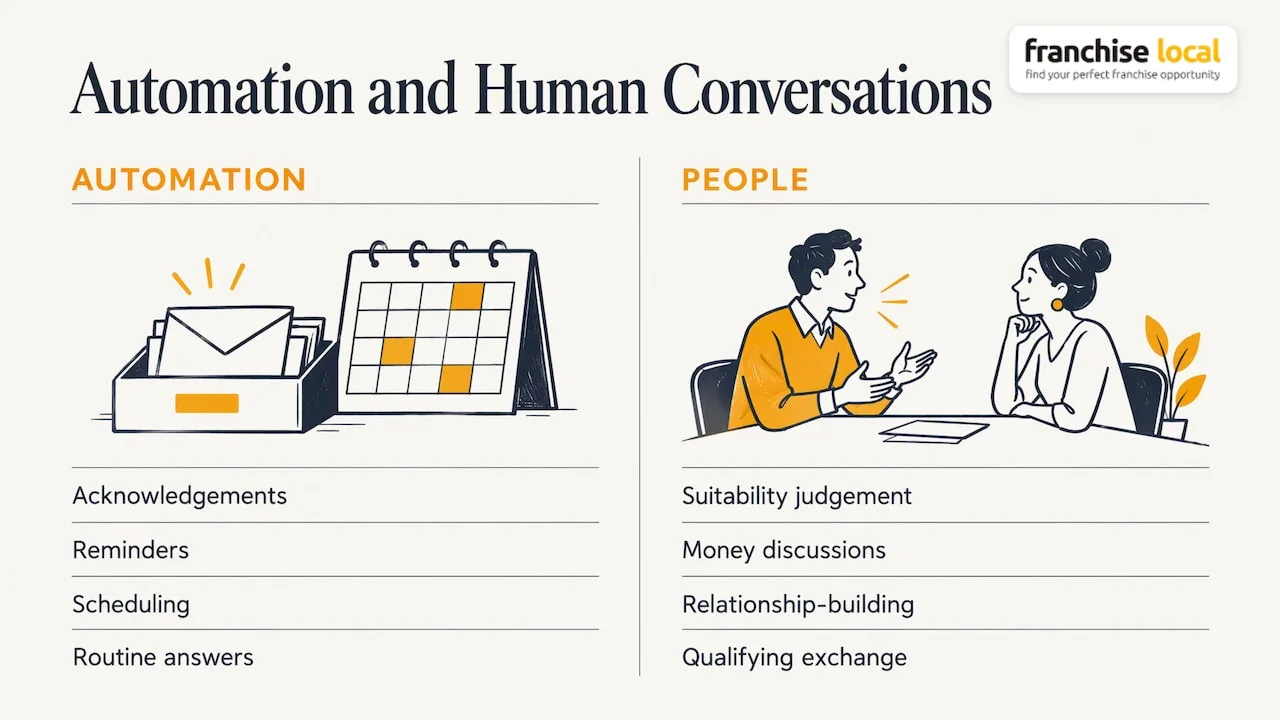
Automate acknowledgements, reminders, scheduling and answers to routine questions. Keep your people for the conversations that need judgement: assessing a candidate’s suitability, discussing money and building the relationship. Not every enquiry deserves a sales call, and a short qualifying exchange first protects your team’s time for the candidates who are serious.
Give one person ownership and record everything
Promising leads go cold when nobody owns them. Name one person for every candidate and log each contact in a CRM, with the date of the next action. Without that record, follow-up depends on memory, and memory fails in a busy week. For the wider picture of how enquiries become signed franchisees, see our guides to the UK franchise sales funnel and franchise recruitment, and the practical playbook for attracting franchisees.
Where Franchise Local fits
Franchise Local is a UK franchise directory. Prospective franchisees search for opportunities by industry, investment level, lifestyle and location, and send enquiries to the brands that suit them. It is free for people searching for a franchise. Franchisors, brokers and advisers list their brands and receive enquiries through the directory.
If you are a prospective franchisee, start with the best franchise opportunities in the UK and narrow the list by budget and lifestyle, so the enquiries you send go only to brands that fit. If you are a franchisor or adviser, our lead generation strategies for UK franchises show how enquiries from a directory sit alongside the rest of your recruitment. The follow-up routines above apply to every enquiry, whichever channel it arrives from.
A short timeline to keep in mind
| Stage | Franchisee’s job | Franchisor’s job |
|---|---|---|
| Enquiry | Complete the form in full and specifically | Acknowledge at once, call quickly |
| First weeks | Attend calls, ask questions, note answers | Qualify, share information, set next steps |
| Due diligence | Speak to several franchisees, take legal and financial advice | Provide franchisee contacts, documents and honest figures |
| Decision | Review the agreement without pressure | Allow time, agree the territory |
| Launch | Complete training | Support the opening |
The common thread is clarity. Each side should know what happens next, who is doing it and by when. Most failed follow-ups come from a missing next step, not from a lack of interest.
FAQ
How long should I wait before following up a franchise enquiry?
Wait two to three working days for an acknowledgement or call. If nothing arrives, send a short email proposing a call, then phone after about a week. One further short message is enough if there is still no answer.
How often should a franchisor contact a new enquiry?
Contact them often in the first fortnight, with a call and a few useful emails, then ease off to roughly one message a week. Each message should offer something helpful, such as an answer, a franchisee story or a clear next step. A sign-off after about a month leaves the door open without chasing.
Is it normal to be asked about my finances on the first call?
Yes. Franchisors need to know early whether the investment suits your budget, and the question saves both sides time. Give a realistic range and say how you plan to fund it. You are equally entitled to ask for a full breakdown of the franchisor’s upfront and ongoing costs.
Should I speak to existing franchisees before going further?
Yes, and to several. Ask the franchisor for a full list of current and past franchisees rather than a selection of top performers. Compare what three to five of them say about income, time to profit, costs and workload.
What if I have enquired and changed my mind?
Tell the franchisor briefly and courteously. A short email is enough and keeps the relationship professional, which matters because the franchising community is small and franchisors often run more than one brand or know others.