

A franchise broker and a franchise consultant can look identical from the outside. The difference that matters is who pays them. A broker is usually paid by the franchisor, often a commission when a buyer signs. A consultant is, in the strict sense, paid by you: either a buyer who wants independent guidance, or a business owner who wants to turn their business into a franchise. Whose money funds the adviser decides whose interests shape the advice.
In practice the two job titles overlap. Many people who sell franchise introductions call themselves consultants, advisers or coaches. So the useful question is not “which title is better?” but “who is paying this person, and for what?” This guide answers that, shows where the role of each one starts and stops, and explains how to search for a franchise so that you are in control before any adviser enters the conversation.
The short version: two roles, two clients
There are really two different jobs hiding behind the word “consultant”, and a third behind “broker”.
| Role | Who the work is for | Who usually pays | Typical job |
|---|---|---|---|
| Franchise broker | Someone who wants to buy a franchise | The franchisor, usually through a commission or success fee | Introduces you to brands in the broker’s portfolio |
| Buyer-side consultant | Someone who wants to buy a franchise | Often the franchisor, sometimes the buyer on a fee basis | Assesses your goals, budget and lifestyle, then narrows the options |
| Franchise development consultant | A business owner who wants to franchise their own business | The business owner | Tests whether the business can be replicated, then builds the model, manuals and legal documentation |
If you want to buy a franchise, the first two rows are your world, and in the UK they frequently blur into one. If you own a business and want to grow through franchising, the third row is the one you need, and a broker is not the right person to ask whether your own business should be franchised.
What a franchise broker does
A broker works on the buying side. They talk to you about your finances, skills and what you want from life, then introduce you to franchisors they work with. When you buy, the franchisor pays them, normally from the initial franchise fee or as a fixed success fee. The International Franchise Association, the US trade body, describes brokers in much the same terms: they help buyers identify opportunities based on goals, preferences and financial capability, and are typically paid when a purchase completes.
That model has real strengths for a buyer:
- No upfront fee. The service does not cost you anything directly.
- Time saved. A good broker spends their working week talking to franchisors and buyers, so they know how brands behave in the recruitment process.
- Structure. They guide you through the sequence: enquiry, discovery, meetings, financials, legal review and decision.
The limitation is built into the payment model. A broker can only be paid by brands that have signed up with them, so the choice you see is a portfolio, not the whole market. A brand that does not pay a commission will not be shown, however well it might suit you. That is not dishonesty. It is how the incentive works, and you should know about it before you start.
What a franchise consultant does
Consultants for buyers
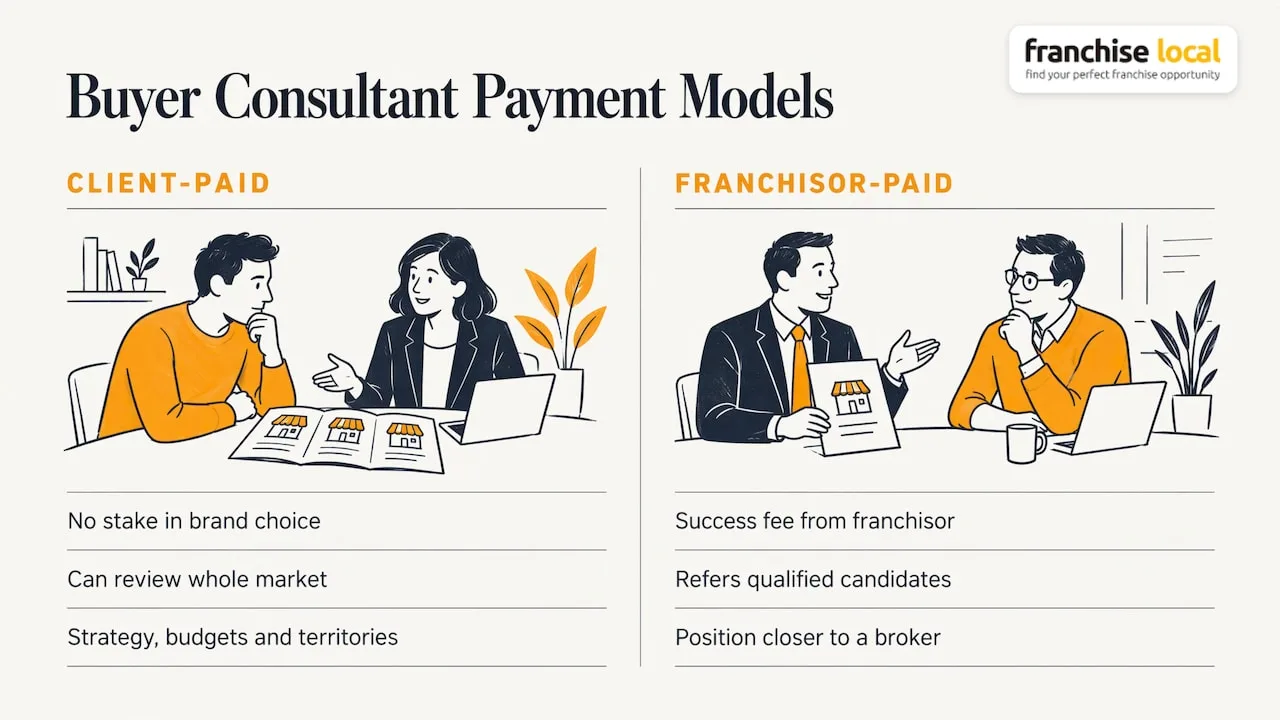
A buyer-side consultant focuses on strategy: comparing franchises, testing budgets, looking at territory questions and helping you weigh up your decision. Some work on a fee paid by you, which means they have no stake in which brand you pick and can look across the whole market. Others, particularly in the UK, are paid a success fee by franchisors and pass qualified candidates to them, so their position is much closer to a broker’s. The Quality Franchise Association has said that most franchise consultants work this way and that their services usually cost the prospective franchisee nothing.
Neither arrangement is wrong. What matters is that you know which one you are dealing with.
Consultants for business owners
The second kind of consultant works for the franchisor-to-be. If you run a successful business and want to replicate it through franchisees, a development consultant will:
- test whether your business model can be copied by other people in other places;
- build the unit economics, so the numbers work for both you and a franchisee;
- write the operations manual and the franchise agreement framework, alongside a solicitor;
- design how you will recruit and support franchisees.
This work is paid for by you, the owner, as a project. It is a different service from introducing buyers to brands, and it is the clearest case where the label “consultant” means something distinct from “broker”. If you are weighing up franchising your own business, our guide to franchise consultants covers what to expect from the engagement.
How brokers and consultants are paid
The table below sets the payment models side by side. Use it as a map, not a rule: always ask the individual adviser to confirm in writing.
| Payment model | Who pays | When | What it means for you |
|---|---|---|---|
| Commission or success fee | Franchisor | When you sign | Free to you; advice may lean towards brands that pay |
| Fee for service | You | Upfront or by the hour | You pay, but the adviser is free to look across the market |
| Project fee | Business owner | During franchise development | Paid for design and documentation work, separate from any recruitment support |
| Retainer plus success fee | Business owner | Monthly, then per franchisee recruited | Common for recruitment support after a model has been built |
For a franchisor, the point worth noticing is that development work and recruitment work are often priced separately. Ask for a clear breakdown of each before you agree anything.
Conflicts of interest: what to watch for
The concern with any commission-based adviser is not that they are dishonest. It is that commission can shape which options you see and how fast you are encouraged to decide. Common signs that the incentive is doing the talking include:
- a strong push towards one brand;
- pressure to commit quickly to a territory;
- little encouragement to take independent legal or financial advice;
- the franchise fee being described as small, when it is the base of the adviser’s own payment.
The Quality Franchise Association has itself warned that some consultants steer people towards the companies that pay the highest commissions rather than finding the best fit. Take that as a prompt to ask questions, not as a reason to avoid advice altogether.
What UK rules say
The British Franchise Association (BFA) sets membership rules for the advisers who join it. Under those rules, a franchise consultant must make clear to everyone involved in a transaction, such as a franchise resale or recruiting franchisees, which party they are acting for and which party is paying their fees. They must also disclose in writing any significant interest in a competing business or any financial interest in goods or services they recommend, and they must not act in a way that puts their own interests ahead of a client’s. Advisers who join the BFA must also gain Qualified Franchise Professional (QFP) accreditation within two years of becoming members and keep it up through training.
These are checkable standards. They do not guarantee that an adviser is right for you, but they give you something concrete to ask about. Our explainer on what the British Franchise Association is covers what membership means for franchisors and buyers, and our piece on BFA accredited franchises explains why accreditation is worth checking on the brand as well as the adviser.
Which one do you need?
Your starting point decides the answer.
You want to buy a franchise
Begin with your own shortlist. A broker or buyer-side consultant is most useful once you know your budget, your preferred sectors and how much time you can give to the business. Knowing these first lets you judge whether the options an adviser puts in front of you are genuinely the best fit or simply the ones in their portfolio.
For a clear picture of how brokers work in the UK, read our buyer’s guide to franchise brokers.
You own a business and want to franchise it
You need a development consultant, not a broker. Look for someone who can show experience taking a non-franchised business through evaluation, model design and documentation. Ask whether they will develop the system or simply facilitate introductions. If you want to see how a consultancy business itself operates as a franchise, our page on consultancy franchises is a useful starting point.
You are already a franchisee
An existing franchisee considering a second territory or a different brand has the same decision as any buyer, with one advantage: you already know what the day-to-day reality of franchising looks like. Use that experience to set your criteria before speaking to anyone.
You are an adviser or franchisor
If you advise franchisees or sell franchises, the points above are the ones your prospects will test you on. Being clear about who pays you, which brands you represent and what is included in your fee is what builds trust with a buyer.
Questions to ask any adviser
A short list of questions will tell you most of what you need to know.
- Who pays you, and how much do you earn if I buy? Expect a direct answer. Under BFA rules, a member must be open about this.
- Which brands do you not represent, and why? A broker’s access is usually limited to authorised brands; a consultant who is brand-agnostic should be able to look wider.
- What is included? Ask for milestones, deliverables and decision support in writing. For a development project, ask what the fee covers and what is priced separately.
- Are you a BFA member, and do you hold QFP accreditation? Membership is a useful signal of vetting and of understanding ethical franchising. It does not replace your own judgement about fit.
- Do you have any financial interest in the brands or services you recommend? Members are required to disclose these in writing.
- Will you encourage me to take independent legal and financial advice? The answer should be yes.
Treat any recommendation as a lead to investigate, not as a conclusion. Whatever an adviser tells you, the franchise agreement should be reviewed by a solicitor with franchise experience, and the figures checked by an accountant, both working for you. Neither a broker nor a consultant replaces that step. Our guide to franchise regulation in the UK explains what buyers and franchisors need to know about the legal framework, and how to assess franchise financials shows how to test a brand’s numbers before you commit.
Do your own groundwork first
The strongest position in any adviser conversation is one where you already know what you want. That means three decisions made before the first call:
- Budget. How much can you invest, including working capital, not just the initial fee?
- Lifestyle. Do you want a home-based business, a team, a shop front, or something you can run alongside a job?
- Sector. Which industries match your experience and interest?
Once those are set, a conversation with a broker or consultant becomes a check on your thinking rather than the source of it. Our guide to franchise market research walks through how to test demand in your area, and the ultimate guide to franchising covers the whole process from first idea to opening day.
Where Franchise Local fits
Franchise Local is a UK franchise directory. You can browse franchises for sale by industry, investment level, lifestyle and location, and searching costs you nothing. That puts the shortlist in your hands: filter by budget, narrow by the way you want to work, and see which brands are trending before you speak to anyone.
If you are drawn to finance, sales or business services, you can start with the pages for financial business franchises, sales franchises, business to business franchises or networking franchises. If you want to speak to a franchise consultancy about finding your match, you can view the listing for Mr Franchise, a franchise consultancy helping people find their perfect franchise. The Franchise Consultant, a business that has earned BFA Approved Advisor status, is also available as a franchise opportunity if you are considering a career in this field yourself.
Putting it together
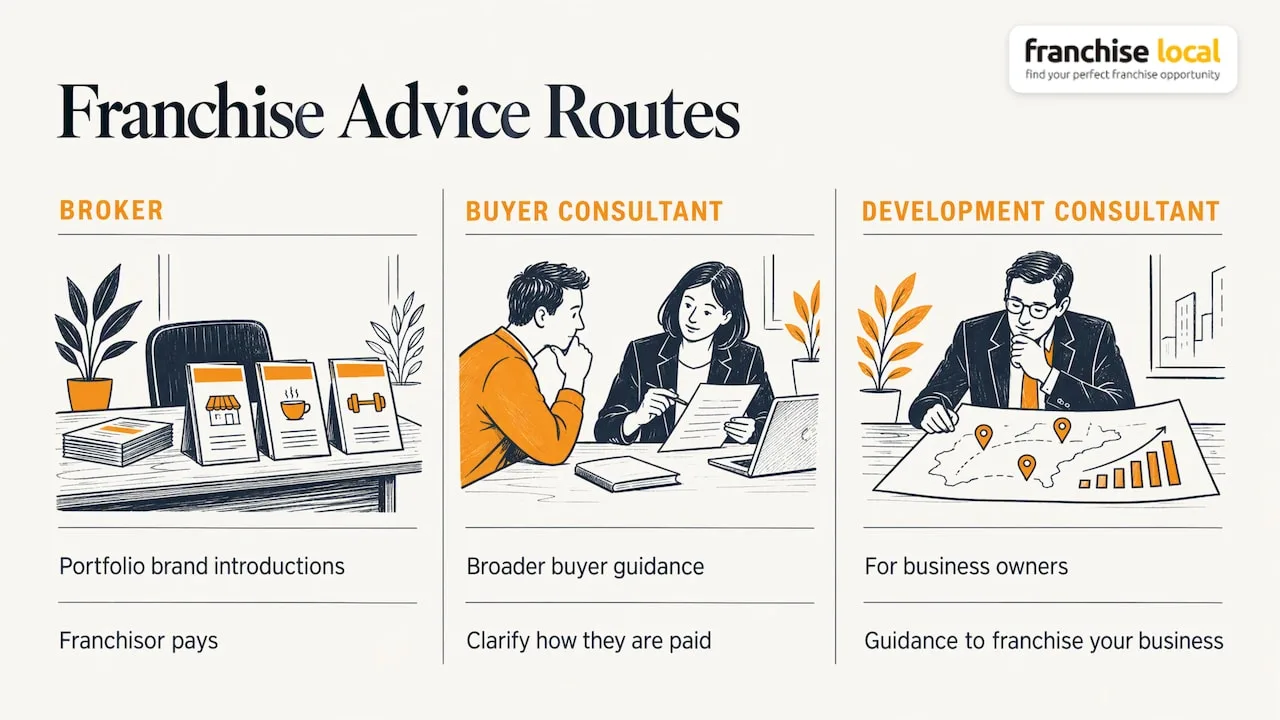
Choose a broker if you want an introduction to brands in a portfolio and you are comfortable that the franchisor is paying. Choose a buyer-side consultant if you want broader guidance and are clear about how they are paid. Choose a development consultant if you own a business and want to franchise it. In every case, ask who pays, ask what is left out, and take legal and financial advice that is yours alone.
FAQ
Is a franchise broker the same as a franchise consultant?
Often, in the UK buying market, yes. Both usually introduce buyers to franchisors and are paid by the franchisor when a buyer signs. The clearest difference is a development consultant, who is paid by a business owner to turn a business into a franchise. Always ask the individual who is paying them.
Do I have to pay a franchise broker?
Usually not. Brokers and many buyer-side consultants are paid by the franchisor, so the service is free to you. Some consultants charge the buyer a fee instead, which can give them more freedom to look across the market. Ask for the arrangement in writing before you start.
Do I need a broker or consultant to buy a franchise?
No. You can approach franchisors directly, and a directory lets you search by budget, industry and lifestyle yourself. An adviser can save time and help you prepare, but you will still need a solicitor to review the agreement and an accountant to check the figures.
How do I check that a UK franchise adviser is reputable?
Ask whether they are a member of the British Franchise Association and whether they hold QFP accreditation. Ask who pays them and whether they have any interest in the brands they recommend. BFA members must be open about who is paying their fees in any transaction.
Which one should a business owner choose to franchise their company?
A franchise development consultant. They assess whether your model can be copied, then build the economics, manuals and documentation. A broker works for buyers, so it is not the right person to ask whether your own business should be franchised.