

Most UK franchise owners earn somewhere between £20,000 for a part-time, home-based operation and £60,000 or more for a well-run, full-time unit in a strong sector. That range is wide because the number depends heavily on sector, royalty structure, and how many hours you put in yourself. The real answer to “how much do franchise owners make UK” starts with turnover, but turnover is not the same as what lands in your pocket.
Franchise owner earnings UK: the headline statistics
The scale of UK franchising explains why “average earnings” is such a slippery phrase. The sector contributes £19.1 billion to the UK economy, and average turnover per franchise unit sits around £400,000, according to the British Franchise Association’s national survey.
That figure alone tells you almost nothing about owner income, because turnover before costs is not profit. What it does confirm is that the model works at scale.
- Roughly 89% of franchise units report being profitable, a genuinely high hit rate compared with independent start-ups.
- The sector’s long-term failure rate over 20 years sits under 6%, far lower than typical small business attrition.
- Average unit turnover of roughly £400,000 spans everything from single-operator home services to multi-site retail outlets.
Sector and cost structure decide which end of that range you land on, not the headline turnover figure.
What “average earnings” actually mean for an owner
Job listing sites often muddy the water. Salary aggregators report franchise owner pay clustering in the mid-£20,000s to mid-£40,000s, but these figures usually blend part-time operators, owner-managers who take a modest wage and leave profit in the business, and multi-unit owners who barely draw a salary at all whilst reinvesting.
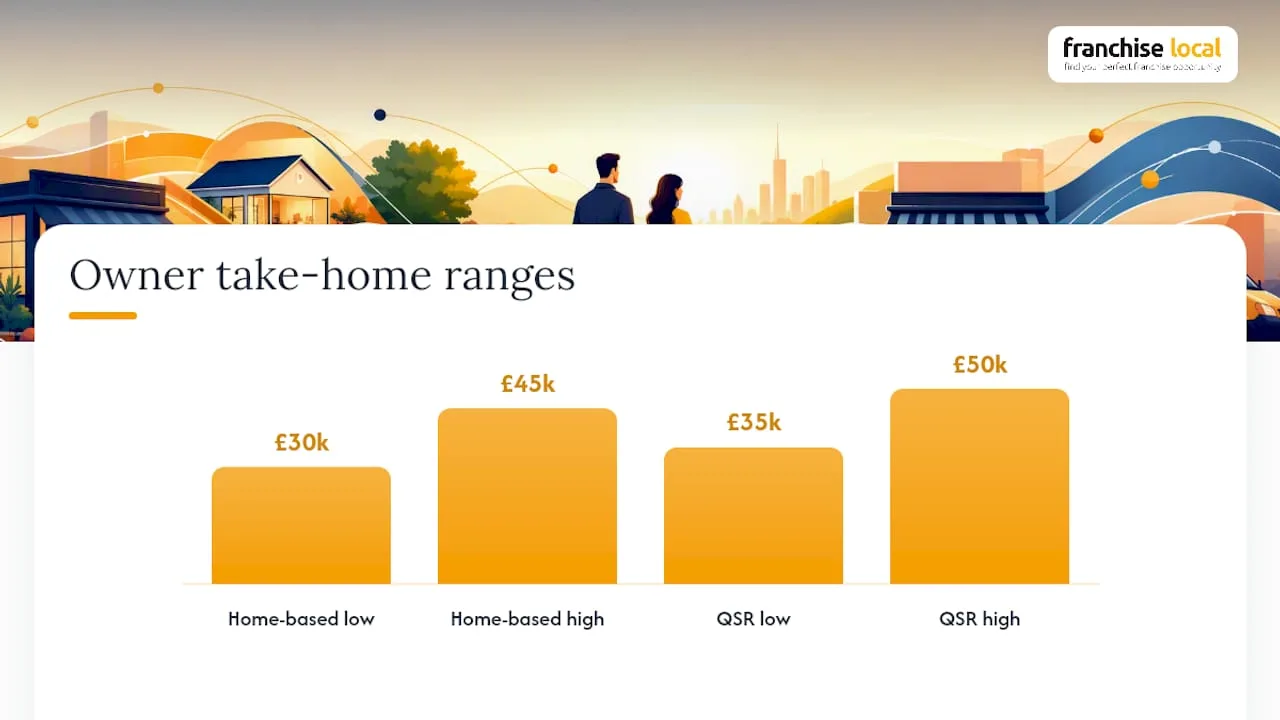
Real owner income comes down to net profit after costs, and how much of that profit the owner chooses to draw as personal pay versus reinvest. Two owners with identical turnover can report wildly different “salaries” purely because of how they structure drawings.
Consider two contrasting examples:
- A home-based tutoring or cleaning franchise with low capital costs might turn over £60,000 to £80,000 a year, and an owner working solo could net £30,000 to £45,000 after fees and running costs.
- A quick-service food outlet might turn over £350,000 to £500,000, but after rent, staff wages, food costs, and royalties, owner take-home can land at a similar £35,000 to £50,000, despite far higher revenue.
Turnover size tells you almost nothing on its own. Margin structure and overheads tell you everything.
Which franchise sectors tend to pay owners more?
Sector choice is the single biggest lever most people overlook when they picture franchise profitability UK-wide. Structural cost differences between sectors create very different pathways to owner income.
- Personal services (domiciliary care, tutoring, pet care, cleaning): recurring local demand and thin premises costs support strong margins. This category expanded by around 53% since 2018, and much of that growth is home-based, low-capex models with genuinely predictable owner pay.
- Cleaning and home services: minimal premises requirements keep fixed costs low, though margins can swing with contract mix and staff turnover.
- Quick service restaurants and retail: higher turnover but heavier capital investment, rent, and staffing costs eat into the margin. Owner income often lags the headline revenue figure.
- Tech and digital franchises: scale without a shopfront. Lower local fixed costs mean a larger share of turnover can flow through to owner profit, though brand maturity and lead volume matter more here than in service sectors.
Pro Tip: *Don’t chase the sector with the biggest turnover headline. Ask franchisors for net margin by unit, not gross revenue.
How turnover becomes owner income: a worked example
Between the top-line revenue figure and what an owner actually earns sits a chain of deductions that every prospective buyer needs to understand before signing anything.
- Initial franchise fee: a one-off cost, typically £10,000 to £30,000 depending on brand and sector, paid before trading begins.
- Set-up capex: fit-out, equipment, vehicles, or premises deposits, which vary enormously by format.
- Royalties: usually 6% to 12% of turnover, paid monthly or weekly to the franchisor.
- Marketing fund contribution: commonly 1% to 3% of turnover, on top of royalties.
- Staffing, rent, and overheads: the largest variable cost block, especially in food and retail formats.
Shift the royalty rate by just 2 percentage points, and owner pay moves by £4,000, which is a meaningful swing on a modest base. Small changes in the fee structure compound quickly at this scale.
How to estimate earnings for a specific franchise
Generic averages only get you so far. Before committing capital, build your own model using real numbers from the specific opportunity you’re considering.
- Request performance data from the franchisor: ask for a typical unit profit-and-loss statement, not just projected turnover, plus the full initial cost schedule.
- Speak to at least three existing franchisees: ask about actual weekly revenue, seasonal dips, staff hours, and the hidden costs nobody mentions in the brochure.
- Build a simple cashflow model: map revenue under conservative, likely, and optimistic scenarios against fixed and variable costs to find your break-even month.
- Stress-test owner pay scenarios: model what happens to your take-home if royalties rise, a key contract is lost, or staffing costs increase.
Pro Tip: Franchisors who resist sharing real unit-level financials, and point only to system-wide averages, are usually hiding a wide performance spread. That reluctance is itself useful information.
Franchiselocal’s Cash Flow Visualiser and Affordability Calculator let you plug in these figures directly rather than relying on guesswork, and the franchise financials guide walks through exactly what to request from a franchisor before you commit.
Test your own numbers before you commit
A cash flow visualiser tool can help users estimate what a specific franchise might pay by allowing input of revenue assumptions, royalty rate, and cost base to model owner pay and break-even timing rather than relying on sector-wide averages.
The affordability calculator works alongside it to check whether your available capital comfortably covers initial fees and the working capital most new units need in their first year. For sector-level comparisons, the curated 129 Best Top UK Franchise Opportunities list groups options by investment level and industry, useful groundwork before you request unit-level P&L data from any franchisor.
Every model depends on the assumptions you feed it. Local competition, footfall, and your own hours worked will shift the output, so treat these tools as a starting estimate, not a guarantee.
Find and model UK franchise opportunities with Franchiselocal
Franchiselocal gives you a faster route to a realistic number than piecing together brochures and salary-site averages yourself. Search the directory of trending UK franchise opportunities by sector, price band, and lifestyle fit, then run the numbers through the Cash Flow Visualiser before you contact a single franchisor.

If cleaning, care, or another personal services format appeals given its margin advantages, or you’re weighing a business services franchise against a retail or food concept, the platform’s filters narrow the field quickly. Once you’ve shortlisted two or three brands, use the directory’s enquiry forms to request unit-level financials and franchisee contacts directly, the exact step that turns a sector average into a number specific to you. Start with the Cash Flow Visualiser to see what a realistic owner income looks like for the sector you have in mind.