

In the UK, a franchisee has no automatic legal right to renew. There is no franchise statute, so renewal is a matter of contract: you can renew only if your franchise agreement says so, and only on the conditions it sets. That makes the renewal clause one of the most important lines to read before you buy, not at the end of your term. This guide explains what the clause usually contains, where renewals go wrong and what to check at each stage. If you are still choosing a brand, Franchise Local’s trending franchise opportunities let you shortlist by budget, industry, lifestyle and location, so you can compare agreements side by side.
The short answer: renewal is contractual
UK franchising has no dedicated franchise law. Agreements are governed by general contract law, and nothing in that law forces a franchisor to offer a new term when the old one ends. Courts do not step in to create a renewal right that the contract does not contain.
In practice, three positions exist:
- A right to renew. The agreement says the franchisee may renew if stated conditions are met. Most agreements are drafted this way, with conditions attached.
- A discretion to extend. The franchisor may offer a new term if it chooses. You have no claim to one.
- No renewal at all. The agreement ends on expiry and you stop trading under the brand.
These are very different positions. A strong trading record helps in a conversation, but it does not turn a discretion into a right. Read the exact wording of your clause and work out which of the three you hold.
What a typical renewal clause contains
Most franchisees sign an initial fixed term. Five years is common and some run to twenty. The renewal clause then sets out how, and whether, you can carry on. Most clauses cover the same ground.
Notice
The agreement will normally require you to tell the franchisor in writing that you want to renew, within a set window before expiry. Some clauses ask for notice of six months or more. Miss the window and you can lose the right entirely, however well the business has performed. The British Franchise Association (BFA) Code of Ethics expects the agreement to set out the basis for renewal, including the notice each party must give.
Put the date in your diary on day one of the agreement. Then add a reminder a year ahead of it.
Conditions
Renewal rights are usually conditional. The common conditions fall into three groups:
- Pass or fail tests. You are not in breach of the agreement, and your fees and royalties are paid up to date.
- Judgement calls. Your performance must be to the franchisor’s satisfaction, or you must meet sales targets. These give the franchisor room to decide.
- Updating. You must sign the franchisor’s then-current form of agreement, refurbish premises or vehicles, or attend further training.
The second group deserves close attention. Where a franchisor holds a real discretion, English courts are likely to expect it to be used honestly and rationally, not arbitrarily or capriciously. That is a limit on abuse, not a promise of renewal. The court looks at the wording and commercial sense of the agreement at the time it was signed.
Fees
Many agreements charge a renewal or administration fee. The BFA’s Rules of Membership say that, for BFA members, renewal fees should not normally exceed the franchisor’s reasonable costs of renewing, mainly legal costs. Check your own agreement for the figure or the formula, and ask what it covers.
The new agreement
This is where renewals surprise people. You are usually asked to sign the franchisor’s current standard agreement, not a copy of the one you signed years ago. Royalty rates, territory, brand rules, reporting duties and the length of the new term can all differ. For BFA members, the rules say the renewal agreement must be on the then-current terms offered in the market and must not use unattractive new terms to discourage renewal. Even so, read the new document as if you were buying a fresh franchise.
What the BFA Code of Ethics adds
The BFA Code of Ethics is a voluntary standard for its members, not law. It is still a useful benchmark for any agreement you are shown. Its renewal provisions say that:
- The agreement should state the basis for renewal, including notice from both sides.
- The term should be long enough for you to recover, through the business, your initial and franchise-specific later investments.
- When setting renewal terms, the length of the original term, the franchisor’s power to demand refurbishment spending and its power to vary terms on renewal should all be taken into account. The overriding aim is that you can recover franchise-specific investment.
If a brand is not a BFA member, none of this binds it. If it is, you have a reference point when you question a clause.
Can a franchisor refuse to renew?
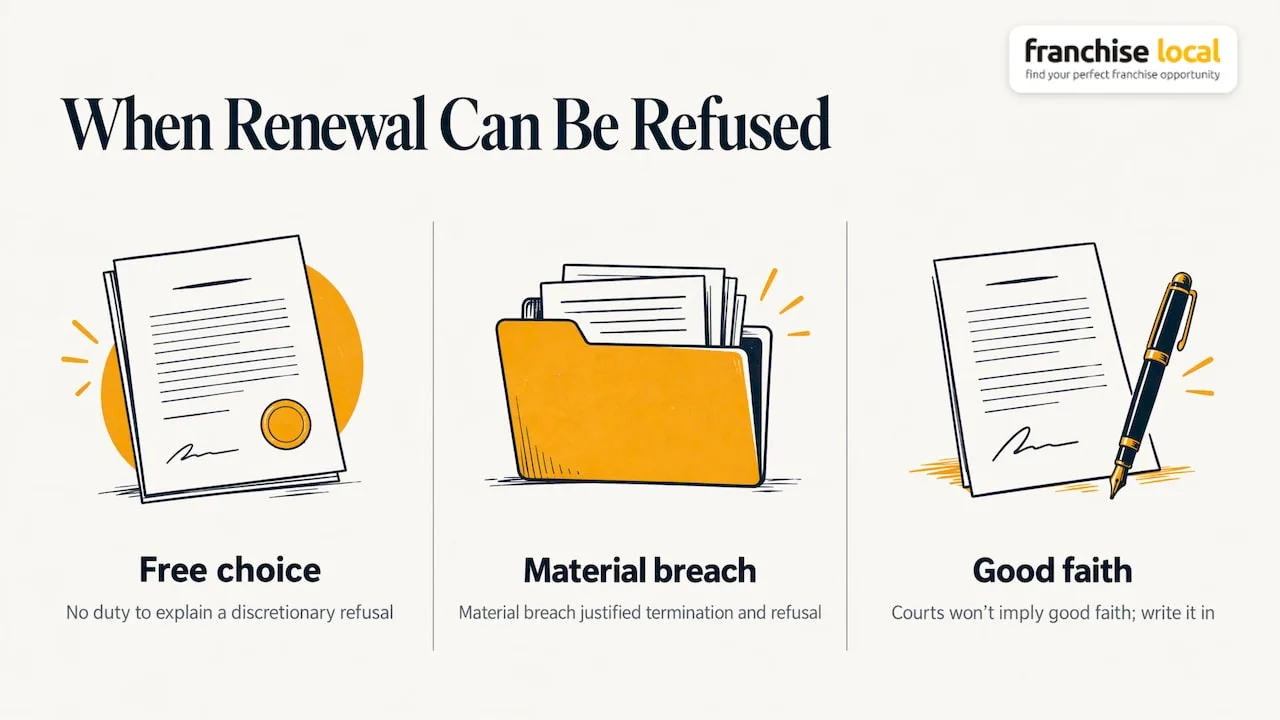
Yes, if the contract does not oblige it to renew, or if you have not met the conditions that the contract does set. There is no general rule in the UK requiring a franchisor to explain or justify a refusal where it has a free choice.
The reported case of Winkworth Franchising Ltd v Goble shows the risk when conditions are not met. The franchisor sent a termination letter days before the term expired, citing material breaches, including a failure to provide requested accounts documentation. The court held the breaches were material, that termination was justified and that the franchisor could refuse to renew. The lesson is practical: records, reports and fee payments matter most in the final year, because any breach can be used to block renewal.
The courts will also not read a general duty of good faith into a franchise agreement. In Hunters Franchising v Brybond (2023), the court declined to imply one. If you want that protection, it has to be written into the contract.
Compensation if renewal is refused
If the agreement gave you no right to renew, a refusal generally carries no right to compensation or damages. If it did give you a right and the franchisor refused to honour it, you may have a claim for breach of contract. That is a matter for a solicitor with franchise experience, ideally one you consult before the term ends. Our guide to franchise renewal terms in the UK goes through rights, fees and process in more detail.
Getting the franchise fee back
Non-renewal does not trigger a refund of the initial fee. That payment buys the right to trade under the brand for the term. For tax purposes it is generally treated as a capital cost, which forms part of the base cost if you later sell, rather than something returned on expiry. Speak to your accountant about how this applies to your own accounts.
What happens when the agreement ends
If the term expires without renewal, or the franchisor terminates for serious breach, the end-of-term clauses apply. You must stop trading under the brand and stop using its trademarks and trade names. Many agreements also give the franchisor a right to step in and take over the business. Your exit position also depends on connected commitments, especially a property lease that may outlast the franchise. Our guide on how to avoid paying rent after your franchise ends covers that risk, and franchise agreement termination explained covers the wider exit rules.
A renewal checklist for current franchisees
If you are in the last few years of your term, work through these steps in order.
- Find your clause. Establish whether you hold a right to renew, a discretion to extend or nothing. Note the exact wording.
- Confirm the notice window. Find how early you must give notice, what form it must take and who it goes to. Send it in writing, keep proof and send it early.
- List the conditions. Mark each as pass or fail, judgement or updating. Ask yourself honestly whether you meet each one today, and fix gaps while there is time.
- Ask about the new terms. Ask the franchisor, well before your deadline, for the length of the renewal term, any sales or performance targets and the fees for re-signing. Ask for clarification on anything unclear.
- Cost the refurbishment. If premises or vehicles must be updated, get quotes and decide whether the new term lets you earn the money back.
- Check connected documents. Leases, personal guarantees, finance, supply contracts and employment contracts may all have different end dates from the franchise agreement.
- Get it in writing properly. An extension may need a formal deed, variation or new agreement. Informal email exchanges may not be enough.
- Take professional advice. Renewal is a legal and financial decision. A solicitor experienced in franchising and your accountant can explain what you are signing and what it costs.
Our franchise business checklist for the UK is a good companion for the financial side of this review.
A worked example
Take a franchisee, Sam, with a five-year agreement. The clause allows one renewal of five years, provided Sam gives written notice at least six months before expiry, is not in breach, pays a renewal fee and signs the then-current agreement. Sam is profitable and keen to continue.
In month 52, Sam reads the clause and realises the notice deadline falls in month 54. Sam sends notice in writing that week. The franchisor replies with its current agreement, which has a higher royalty rate and requires a shop refit. Sam now has real choices: negotiate, cost the refit against expected profit over the new term, or decide not to renew. Because Sam acted early, all three options are open. Had Sam waited until month 58, the right to renew would probably have gone, and the franchisor would be under no obligation to talk.
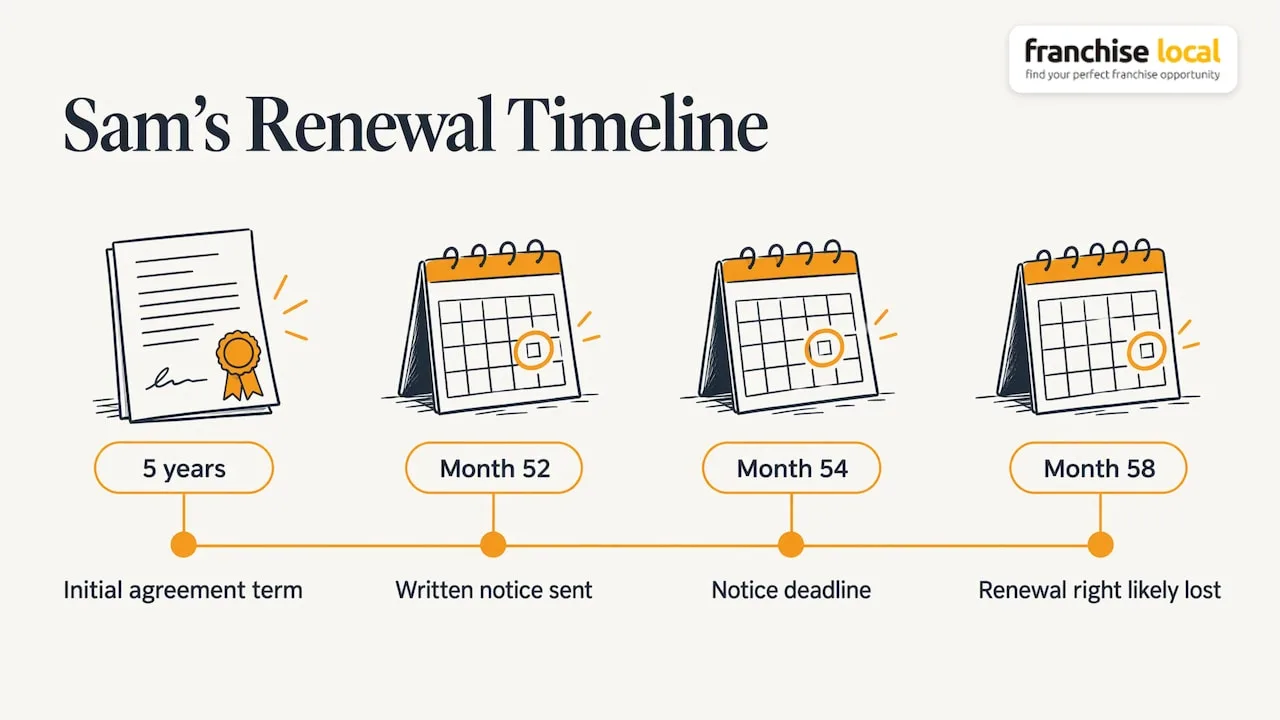
The example is illustrative, not a real case, but the pattern is common: the biggest renewal losses come from missed deadlines, not hard negotiations.
If you are buying: test the renewal clause first
For a prospective franchisee, the best time to deal with renewal is before you sign. You are paying an initial fee and investing capital on a promise that the business will be yours for a term. If the term is short and renewal uncertain, you may have too little time to recover that investment.
Before committing to any brand, check these points in the draft agreement:
- Length of the initial term compared with the time you expect to need to recover your investment. Our guide to franchise investment recovery shows how to think about this.
- Whether renewal is a right or a discretion. Prefer a clear right with objective conditions.
- How many renewals are offered, and for how long each.
- The renewal fee, stated as a figure or formula.
- Whether the franchisor can change terms on renewal, and by how much.
- Refurbishment duties and who decides when they apply.
- What happens at the end: buy-out rights, how any price is set and restrictions after you leave.
A solicitor who knows franchising should read the agreement before you sign it. Our piece on why legal advice is vital before buying a UK franchise explains what that review covers. Pair it with a close look at franchise financials, franchise costs and franchise risk, so renewal is judged alongside the numbers.
Franchisors and brokers: why clear renewal terms help
If you sell franchises, or advise people who buy them, clear renewal terms are a selling point. Buyers who understand what happens at the end of the term can plan their investment with confidence. Setting out notice periods, conditions, fees and what changes on renewal in plain words reduces disputes later. Following the BFA Code of Ethics on renewal basis and investment recovery gives candidates a recognised standard to measure your agreement against.
Comparing franchises with Franchise Local
Renewal terms differ from brand to brand, so the most useful step is to compare several opportunities before you commit to one. Franchise Local is the UK franchise directory where you can filter opportunities by industry, investment level, lifestyle and location, with trending franchises ranked dynamically. It is free for people searching for a franchise. For a guided start, the Ultimate Guide to Franchising walks through the buying process, and Mr Franchise is a franchise consultancy that helps you find a suitable franchise. Once you have a shortlist, ask each franchisor for its draft agreement and read the renewal clause first.
FAQ
Do UK franchisees have a legal right to renew?
No. UK law does not give franchisees an automatic right to renew. Whether you can renew depends on your franchise agreement, and most agreements offer a right to renew subject to conditions such as no breach, notice in time and signing the current agreement.
How much notice do I need to give to renew?
It depends on your agreement. Many clauses set a fixed window, and some require notice of six months or more before expiry. Missing it can end your right to renew, so check the clause now and give written notice early.
Can I get my franchise fee back if my agreement is not renewed?
Generally no. The initial fee pays for the right to trade during the term, and non-renewal does not create a refund right. Compensation is possible only if the contract gave you a renewal right and the franchisor refused to honour it, which a solicitor can assess.
Will the terms be the same when I renew?
Not necessarily. You are usually asked to sign the franchisor’s then-current agreement, which can change royalties, territory, brand standards or term length. BFA members must offer terms current in the market and must not use unattractive terms to discourage renewal.
What should I do first if my term is ending?
Read your renewal clause, note the notice deadline and ask the franchisor for the renewal terms and fees. Then take advice from a solicitor and an accountant before you decide whether to renew.