

Choosing the right franchise territory is one of the most critical decisions an entrepreneur will make when investing in a business across the United Kingdom. With each agreement outlining unique geographic boundaries and exclusivity clauses, understanding your rights can mean the difference between steady growth and internal competition. This guide will help you make informed choices by demystifying key concepts like contractual territory rights, exclusivity provisions, and the vital responsibilities that shape long-term franchise success.
Franchise Territory Rights Defined and Debunked
Understanding franchise territory rights is crucial for entrepreneurs looking to invest in a franchise business across the United Kingdom. These rights define the geographical boundaries and operational parameters within which a franchisee can legally conduct their business. Franchise agreements in the UK are complex legal documents that specify the precise territorial permissions granted by franchisors.
At its core, a franchise territory right establishes a contractual agreement between the franchisor and franchisee regarding exclusive or non-exclusive operational zones. This means the franchisee receives specific permissions to operate within defined geographical limits, protecting their business from direct competition from other franchisees within the same brand.
Key characteristics of franchise territory rights typically include:
- Precise geographical boundaries (city, county, or regional limits)
- Exclusivity provisions preventing other franchisees from entering the same market
- Performance expectations and minimum revenue thresholds
- Rights to serve specific customer segments or market niches
- Mechanisms for potential territory expansion or modification
The legal framework surrounding these rights is not statutory but primarily contract-based. This means every franchise agreement can have unique territorial stipulations tailored to the specific business model and market dynamics. Franchisees must meticulously review these terms to understand their operational scope and potential limitations.
Territory rights are not just lines on a map – they represent a strategic business demarcation that can significantly impact your entrepreneurial success.
Territorial exclusivity does not guarantee automatic market dominance. Franchisees must still actively develop their designated area, meet performance targets, and create value within their defined boundaries. Some agreements include clauses allowing franchisors to reclaim territories if minimum performance standards are not met.
Pro tip: Always engage a legal professional specialising in franchise law to thoroughly review and explain the territorial clauses in your franchise agreement before signing.
Types of Franchise Territories in the UK
Understanding the different franchise territory types is crucial for entrepreneurs seeking to establish a successful business in the United Kingdom. Franchise territory structures vary significantly, offering diverse opportunities for potential business owners with unique operational models and strategic implications.
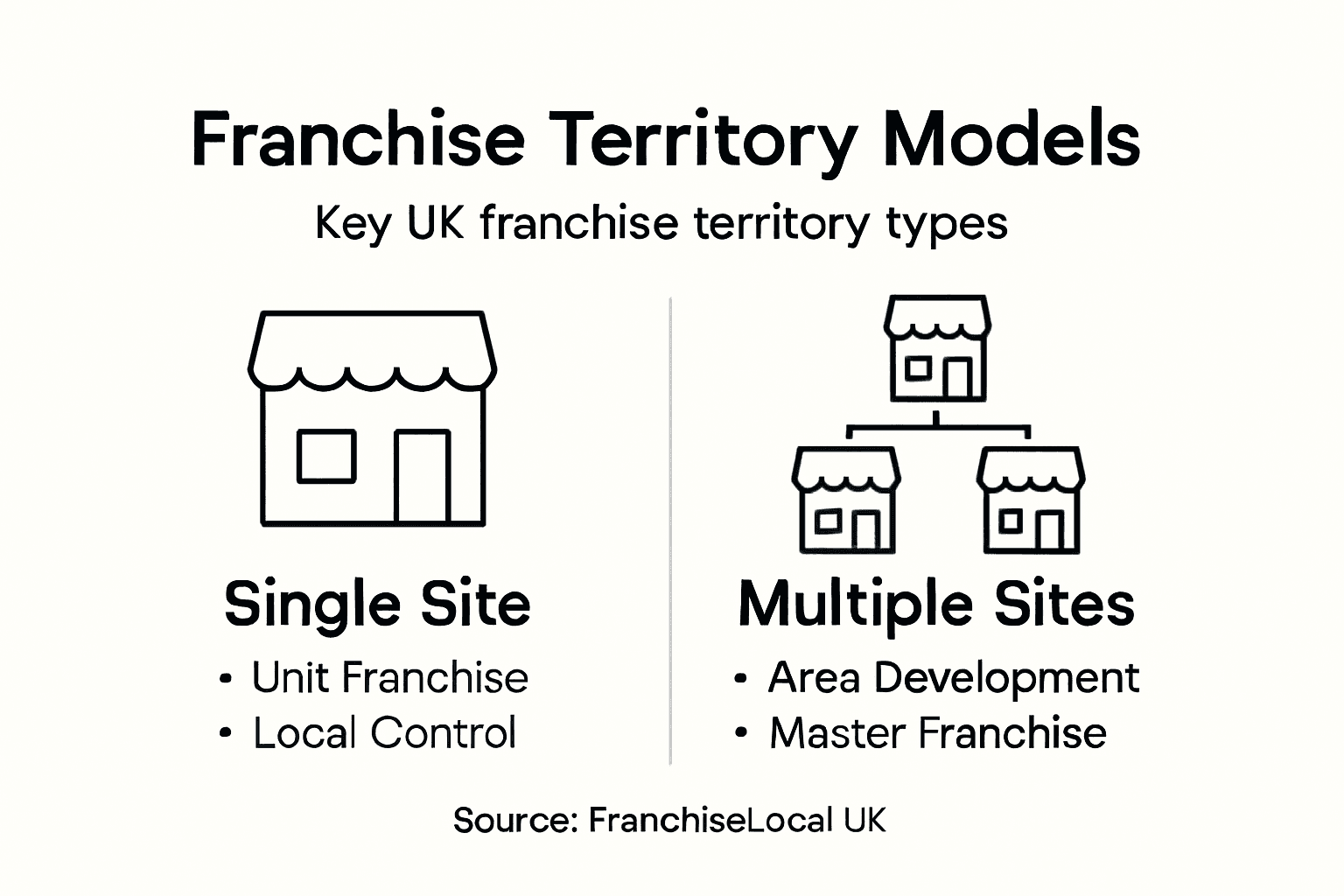
The UK franchise market primarily recognises three distinct territory configurations, each with specific characteristics and legal considerations:
- Unit Franchises: Limited to a single geographical location
- Area Development Franchises: Multiple outlets within a defined region
- Master Franchises: Comprehensive territorial control with sub-franchising rights
Unit franchises represent the most straightforward territory model. These franchisees operate within a clearly defined, typically small geographical area such as a specific town or neighbourhood. They receive exclusive rights to provide services or sell products within that precise location, ensuring minimal direct competition from other franchisees within the same brand.
Area development franchises offer more expansive opportunities. Franchisees commit to developing multiple business units across a larger territory, such as an entire county or metropolitan region. These agreements often include specific timelines and performance targets for establishing additional outlets, allowing ambitious entrepreneurs to scale their business systematically.
Territory selection is not just about geography – it’s a strategic decision that can make or break your franchise investment.
Master franchises represent the most complex and potentially lucrative territory model. These franchisees essentially become mini-brand representatives, gaining rights to develop and sub-franchise within an entire region or even a national territory. They assume significant responsibilities, including recruiting, training, and supporting subsequent franchisees while maintaining quality standards.

Territorial rights are not permanent guarantees. Most franchise agreements include provisions allowing franchisors to reassess territorial permissions based on franchisee performance, market changes, or strategic realignments.
Pro tip: Conduct thorough market research and carefully review territorial clauses to understand the precise boundaries, exclusivity terms, and potential growth limitations of your chosen franchise territory.
To clarify the major franchise territory types in the UK, see the comparison below:
| Territory Type | Franchisee Control Scope | Typical Responsibilities | Potential for Expansion |
|---|---|---|---|
| Unit Franchise | Single outlet, defined area | Operate and market one location | Limited to one unit |
| Area Development | Multiple outlets in larger region | Open several units, meet targets | Moderate within set region |
| Master Franchise | Comprehensive, includes sub-franchises | Manage region, recruit sub-franchisees | High, entire region or nation |
Legal Boundaries and Exclusivity Clauses
Territorial exclusivity forms the cornerstone of franchise agreements, providing critical legal protections for franchisees investing significant capital and effort. UK franchise legal boundaries are meticulously crafted to balance the interests of both franchisors and franchisees while maintaining fair market competition.
Exclusivity clauses typically encompass several key protective mechanisms for franchisees:
- Prevention of direct franchisor competition within the defined territory
- Restriction of additional franchisee appointments in the same geographical area
- Protection against brand cannibalization
- Guarantees of market potential and investment security
- Clearly defined geographical and operational boundaries
The legal framework surrounding these clauses is complex and nuanced. Courts carefully scrutinise exclusivity provisions to ensure they do not unreasonably restrict trade or violate competition regulations. This means that territorial exclusivity must be reasonable in both scope and duration, with clear justification for any limitations imposed.
Territorial restrictions are not absolute. Franchise agreements often include performance metrics that franchisors can use to evaluate and potentially modify territorial rights. If a franchisee fails to meet predetermined growth or revenue targets, they may risk losing their exclusive territorial privileges.
Exclusivity is a privilege, not an absolute right – it must be earned through consistent performance and strategic market development.
Franchise agreements typically outline specific conditions under which territorial exclusivity can be challenged or revoked. These might include sustained underperformance, failure to meet expansion targets, or significant market changes that render the original territory definition impractical.
Pro tip: Engage an intellectual property lawyer specialising in franchise law to meticulously review your territorial exclusivity clauses, ensuring they provide robust protection without exposing you to unintended legal risks.
Franchisee and Franchisor Responsibilities
Franchise partnerships represent a complex legal and operational relationship with clearly defined responsibilities for both parties. UK franchise legal obligations demonstrate a balanced framework that protects the interests of both franchisors and franchisees while maintaining systemic integrity.
Franchisee core responsibilities encompass several critical areas:
- Maintaining brand standards and quality consistency
- Paying required franchise fees and royalties
- Following operational guidelines and training protocols
- Reporting financial performance accurately
- Protecting the franchisor’s intellectual property
- Participating in mandated marketing initiatives
Franchisors equally bear significant responsibilities to support their franchise network. They must provide comprehensive initial and ongoing training, develop robust operational systems, and offer continuous strategic guidance. This includes maintaining the brand’s reputation, developing marketing materials, and providing technological and operational infrastructure that enables franchisee success.
Contractual compliance forms the backbone of the franchise relationship. Both parties must meticulously adhere to the franchise agreement, which serves as the primary governance document outlining specific obligations, performance expectations, and potential consequences for non-compliance.
A successful franchise relationship is built on mutual respect, transparent communication, and a shared commitment to brand excellence.
Performance expectations are typically quantified through specific metrics such as revenue targets, customer satisfaction scores, and adherence to operational standards. Franchisors reserve the right to conduct regular audits and assessments to ensure franchisees maintain the required performance levels and brand integrity.
Pro tip: Conduct quarterly self-assessments of your franchise performance and proactively communicate with your franchisor to demonstrate your commitment to mutual success.
Understanding each party’s responsibilities helps maintain franchise success:
| Party | Key Obligations | Impact on Franchise Outcome |
|---|---|---|
| Franchisee | Adhere to brand standards, report finances | Ensures operational consistency |
| Franchisor | Provide training, maintain reputation | Supports growth, protects investment |
Risks, Disputes and How to Avoid Them
Navigating potential conflicts is a critical aspect of franchise ownership in the United Kingdom. UK franchise dispute resolution requires a strategic and proactive approach to mitigate legal and operational risks before they escalate.
Common risks in franchise relationships include:
- Territorial boundary disputes
- Performance expectation misalignments
- Intellectual property conflicts
- Financial disagreements
- Breach of contractual obligations
- Operational standard violations
Dispute prevention begins with comprehensive, clear franchise agreements that explicitly define expectations, responsibilities, and potential resolution mechanisms. These documents should outline precise territorial boundaries, performance metrics, and consequences for non-compliance, creating a transparent framework that minimises potential misunderstandings.
When conflicts emerge, the UK legal system provides multiple alternative dispute resolution mechanisms. Mediation and arbitration are typically preferred over litigation, offering more cost-effective and confidential approaches to resolving franchise-related disagreements. These methods allow both parties to maintain professional relationships while finding mutually acceptable solutions.
Proactive communication and documented performance expectations are your best defence against potential franchise disputes.
Franchisees can significantly reduce dispute risks by maintaining meticulous records, adhering strictly to franchise guidelines, and fostering open communication with their franchisor. Regular performance reviews, transparent financial reporting, and a commitment to brand standards demonstrate professionalism and reduce the likelihood of conflicts.
Pro tip: Establish a quarterly review process with your franchisor to discuss performance, address potential concerns early, and maintain a collaborative relationship.
Secure Your Franchise Territory with Confidence in the UK
Navigating the complexities of franchise territory rights can be challenging. Whether you are concerned about exclusivity clauses, performance expectations, or choosing the right territory type such as a unit, area development, or master franchise, understanding your options is essential to protect your investment and grow your business successfully. The article highlights these crucial points that every potential franchisee must consider before entering into agreements.
At FranchiseLocal, we offer a comprehensive directory tailored to entrepreneurs looking to secure their ideal franchise territory across the United Kingdom. Our platform allows you to filter franchises by investment level, lifestyle preferences, and operational models, helping you identify the best fit for your goals. By exploring franchises that align with your target markets, you can confidently select opportunities with clearly defined boundaries and realistic expansion prospects.
Start your journey today by visiting FranchiseLocal and uncover franchise opportunities that respect your territorial rights and empower your growth. Do not wait until exclusivity issues or competitive overlap restrict your success. Take control now and find the perfect UK franchise territory that matches your ambitions and secures your future business success.
Frequently Asked Questions
What are franchise territory rights?
Franchise territory rights define the geographical boundaries in which a franchisee can operate their business, protecting them from direct competition within the same brand.
How do territorial exclusivity clauses work in franchise agreements?
Territorial exclusivity clauses prevent franchisors from appointing additional franchisees to operate within the same geographical area, ensuring the franchisee has a secure market for their business.
What are the different types of franchise territories?
The main types of franchise territories include unit franchises (single location), area development franchises (multiple units in a defined region), and master franchises (comprehensive control with sub-franchising rights).
What should I consider when reviewing my franchise territory rights?
When reviewing franchise territory rights, consider the precise geographical boundaries, exclusivity provisions, performance expectations, and any clauses regarding potential territory expansion or modification.