

Selecting the right franchise investment can transform your financial future, yet the sheer volume of opportunities across the UK makes comparison daunting. Many prospective franchisees struggle to distinguish genuine value from marketing hype, risking substantial capital on unsuitable ventures. Without a structured evaluation framework, you might overlook critical red flags or miss opportunities perfectly aligned with your goals. This guide delivers a systematic approach to comparing franchise investments, equipping you with practical criteria, financial benchmarks, and risk assessment tools. You’ll learn to evaluate opportunities confidently, avoid common pitfalls, and make informed decisions backed by UK industry data.
Key Takeaways
| Point | Details |
|---|---|
| Structured evaluation criteria | A standardised set of financial and operational criteria is essential to compare franchises effectively. |
| Risk and profitability | Understanding profitability statistics and risk indicators helps you gauge investment safety. |
| Budget and goals first | Define your investment budget and personal objectives before evaluating opportunities. |
| Standardised comparison framework | Create a standardised comparison spreadsheet with criteria as rows and franchise options as columns to enable objective side by side evaluation. |
Understanding what you need before comparing franchises
Successful franchise comparison starts with honest self assessment and thorough preparation. Before examining any opportunity, define your investment budget precisely, including working capital reserves for the first 12 months. Calculate your expected returns realistically, considering both timeline and lifestyle requirements. Are you seeking immediate income replacement or building long term equity? Your answer shapes which franchises merit serious consideration.

Clarify your business goals and personal commitment level. Full time involvement differs dramatically from semi absentee ownership, affecting suitable franchise models. Consider your skills, interests, and willingness to follow established systems. Franchising demands adherence to proven processes, so evaluate whether you can operate within structured guidelines rather than pursuing complete creative freedom.
Gather essential franchise data systematically. Request disclosure documents detailing initial fees, ongoing royalties, marketing contributions, and estimated setup costs. Obtain average unit turnover figures, profit margins, and franchisee satisfaction ratings. Examine training programmes, operational support structures, and contract terms including length, renewal conditions, and exit provisions. The choosing a franchise UK guide provides comprehensive checklists for information gathering.
Understand that UK franchises show 93% profitability with notably lower failure rates than independent startups. This statistical advantage stems from proven business models, established brand recognition, and ongoing franchisor support. However, success isn’t guaranteed. Your due diligence must verify whether specific franchises deliver these benefits consistently.
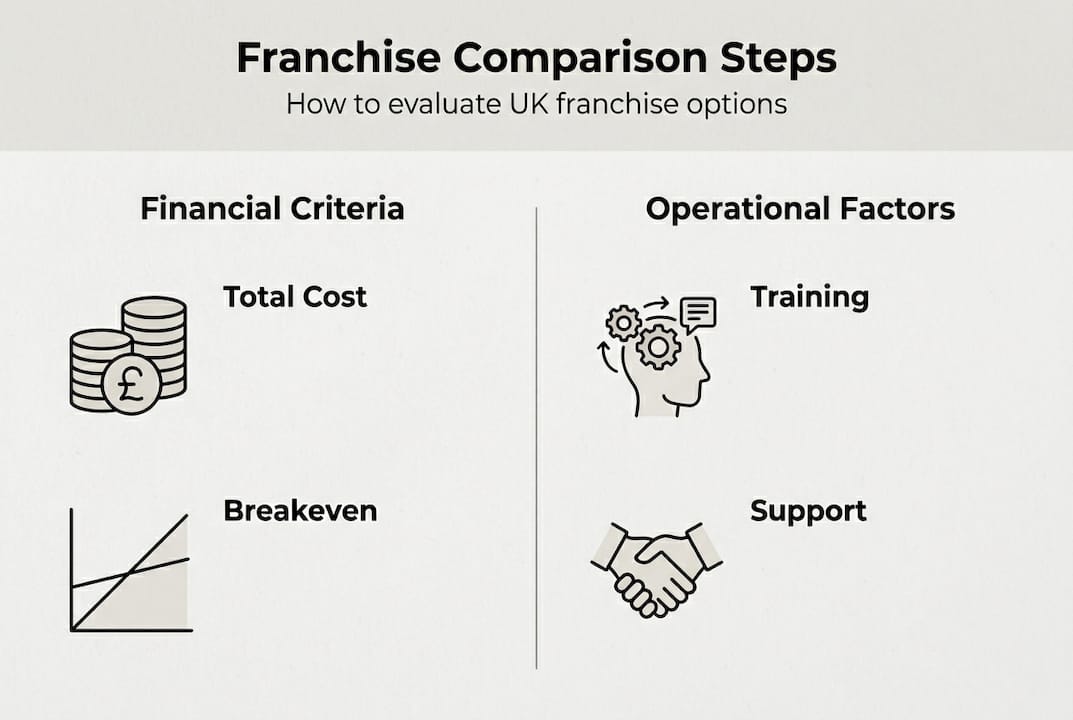
Define comparison criteria across four categories. Financial metrics include total investment, breakeven timeline, average franchisee earnings, and fee structures. Operational factors encompass training quality, territory exclusivity, supply chain arrangements, and technology systems. Support elements cover marketing assistance, ongoing coaching, peer networks, and problem resolution processes. Risk indicators include franchisor financial stability, litigation history, franchisee turnover rates, and market saturation levels.
Pro tip: Create a standardised comparison spreadsheet before contacting franchisors. List your criteria as rows and franchise options as columns, enabling objective side by side evaluation. This structure prevents emotional decision making and highlights meaningful differences between opportunities.
Step by step guide to comparing franchise investments effectively
Execute your franchise evaluation through five systematic stages. First, compile a shortlist of 5 to 8 franchises matching your budget, interests, and lifestyle preferences. Cast your net widely initially, including both familiar brands and lesser known opportunities that meet your basic criteria. Diversity in your shortlist reveals market options you might otherwise overlook.
Second, gather comprehensive data for each franchise. Request franchise disclosure documents, attend discovery days, and study franchise agreements carefully. Document initial franchise fees, equipment costs, property requirements, working capital needs, and ongoing royalties. Note that 60% of UK franchise units achieve turnover greater than £250,000, but individual performance varies significantly based on location, operator skill, and market conditions.
Third, assess financial viability using concrete metrics. Calculate total first year investment including all setup costs and operating reserves. Compare franchisee earnings claims against your income requirements, adjusting for your specific circumstances. Analyse royalty structures, determining whether percentage based or fixed fees better suit projected turnover levels. Examine the franchise profitability factors UK to understand what drives sustainable returns.
Fourth, evaluate operational and support elements systematically:
- Training programmes: duration, location, content depth, ongoing education availability
- Territory rights: exclusivity guarantees, population density, competition restrictions, expansion opportunities
- Marketing support: national campaigns, local marketing funds, digital presence, lead generation systems
- Operational assistance: field support frequency, helpdesk availability, technology platforms, supply chain efficiency
- Contract terms: initial length, renewal conditions, transfer rights, exit provisions, non compete clauses
- Brand reputation: customer recognition, online reviews, media coverage, industry awards, growth trajectory
Fifth, validate all claims through independent verification. Interview current franchisees, asking specific questions about actual earnings, challenges faced, franchisor responsiveness, and whether they’d invest again. Contact former franchisees to understand why they left and whether disputes occurred. Review franchisor financial statements, litigation records, and regulatory compliance history. The research franchise opportunities UK resource explains verification techniques in detail.
Compare franchises using structured tables. Financial comparison should include:
| Metric | Franchise A | Franchise B | Franchise C |
|---|---|---|---|
| Initial franchise fee | £25,000 | £35,000 | £20,000 |
| Total setup investment | £75,000 | £120,000 | £60,000 |
| Ongoing royalty | 8% turnover | £800/month | 6% turnover |
| Marketing fee | 2% turnover | Included | 3% turnover |
| Average unit turnover | £280,000 | £450,000 | £220,000 |
| Reported profit margin | 18% | 22% | 15% |
| Breakeven timeline | 14 months | 18 months | 10 months |
Operational comparison should cover:
| Factor | Franchise A | Franchise B | Franchise C |
|---|---|---|---|
| Training duration | 2 weeks | 4 weeks | 1 week |
| Territory exclusivity | 50,000 population | Postcode area | Non exclusive |
| Contract length | 10 years | 5 years | 15 years |
| Field support visits | Monthly | Quarterly | As needed |
| Technology platform | Proprietary app | Third party | Manual systems |
| Franchisee satisfaction | 87% | 92% | 78% |
Consider longevity and failure rates when gauging risk. Franchises operating successfully for 10 plus years with stable franchisee networks demonstrate proven resilience. High franchisee turnover or frequent territory closures signal potential problems, even if marketing materials emphasise growth.
Pro tip: Weight your comparison criteria according to personal priorities. If work life balance matters most, emphasise operational model and time commitment over maximum profit potential. If building substantial equity drives you, prioritise scalability and exit value over immediate income. Customised weighting ensures your final choice aligns with what truly matters to you.
Common mistakes to avoid when comparing franchise investments
Prospective franchisees frequently stumble over predictable pitfalls that undermine investment decisions. Recognising these errors protects your capital and increases success probability substantially.
Ignoring comprehensive cost assessment represents the most damaging mistake. Initial franchise fees seem manageable, but hidden expenses accumulate rapidly. Property fit out costs, professional fees, initial inventory, insurance, licences, and working capital reserves often double the advertised investment figure. Failing to budget for these elements leaves you undercapitalised, forcing premature closure or emergency borrowing at unfavourable terms. Always obtain itemised cost breakdowns and add 20% contingency for unexpected expenses.
Skipping franchisee interviews risks missing critical red flags. Franchisors naturally present their systems optimally, but current operators reveal operational realities. Without speaking to multiple franchisees across different territories and tenure lengths, you lack perspective on typical challenges, actual support quality, and realistic earnings timelines. Former franchisees offer particularly valuable insights into why relationships soured and whether disputes arose.
Assuming past success guarantees personal achievement misleads many investors. Franchise systems provide proven models, but individual results depend heavily on location quality, operator effort, local competition, and market timing. A franchise thriving in Manchester might struggle in rural Cornwall due to demographic differences. Your skills, work ethic, and business acumen significantly influence outcomes regardless of brand strength.
Neglecting market demand and competitive analysis causes expensive missteps. Saturated markets limit growth potential even for excellent franchises. Thoroughly research local demographics, competitor presence, and customer demand before committing. A coffee franchise might excel nationally but fail in a town already serving three established cafes to a static population. The franchise vs startup UK comparison highlights how franchise failure rates below 10% still require proper market fit.
Overestimating returns based on top performer data distorts expectations. Franchisors often showcase their highest earning franchisees, but these outliers don’t represent typical results. Request median earnings data and full performance distributions to understand realistic outcomes. Most franchisees cluster around average figures, not exceptional ones.
Rushing decisions under pressure from franchisors or fear of missing opportunities leads to regrettable commitments. Quality franchises don’t require immediate decisions or use high pressure sales tactics. Take sufficient time for thorough evaluation, professional advice, and family consultation.
| Common mistake | Better practice |
|---|---|
| Focusing only on initial franchise fee | Calculate total first year investment including all setup costs and operating reserves |
| Accepting franchisor claims without verification | Interview multiple current and former franchisees independently |
| Assuming brand strength guarantees personal success | Assess your skills, commitment level, and local market conditions realistically |
| Ignoring contract terms and exit provisions | Review franchise agreements with specialist solicitors before signing |
| Comparing franchises on price alone | Evaluate value through support quality, training depth, and long term profitability |
| Making emotional decisions based on brand appeal | Use structured comparison frameworks with weighted criteria |
| Skipping professional advice to save costs | Engage franchise solicitors and accountants early in the process |
What to expect after choosing your franchise investment
Understanding post investment realities helps set appropriate expectations and prepares you for the franchisee journey ahead. Initial months focus intensively on training, setup, and launch preparation. Expect to invest 50 to 60 hours weekly during this phase, learning systems, establishing supplier relationships, and building your customer base. The learning curve feels steep initially, but structured support and proven processes accelerate your progress significantly.
Financial performance typically follows predictable patterns. Most franchises require 12 to 18 months to reach breakeven as you build customer awareness and operational efficiency. Turnover grows gradually rather than explosively, with profitability improving as you master systems and reduce wastage. Align your expectations with franchise specific benchmarks rather than hoping for immediate windfalls. Remember that franchises employ over 710,000 people and contribute substantially to the UK economy through steady, sustainable growth rather than overnight success.
Your ongoing obligations include regular royalty and marketing fee payments, compliance with brand standards, participation in training updates, and adherence to operational procedures. Franchisors conduct periodic inspections and performance reviews to ensure consistency across the network. While these requirements might feel restrictive initially, they protect brand value and maintain the proven systems that attracted your investment.
Successful franchisees actively engage with their franchisor and fellow network members. Attend franchisee conferences, participate in regional meetings, and contribute to system improvements. Strong franchisor relationships provide better support, earlier access to innovations, and greater influence over network direction. Peer connections offer practical advice, emotional support during challenges, and potential collaboration opportunities.
Monitor key performance indicators consistently:
- Weekly sales and transaction volumes compared to projections
- Monthly gross profit margins and operating expense ratios
- Customer acquisition costs and retention rates
- Staff productivity and turnover metrics
- Marketing return on investment across channels
- Cash flow adequacy and working capital levels
Regular performance tracking identifies problems early and highlights improvement opportunities. Franchisors typically provide benchmarking data showing how your unit compares to network averages, enabling targeted interventions.
Plan for growth or exit strategically. Successful franchisees often expand through multi unit ownership, leveraging proven capabilities across additional territories. Others build equity steadily before selling to incoming franchisees, realising capital gains from business value appreciation. Understanding your long term objectives shapes operational decisions and investment in systems, staff development, and customer relationships. The investment success in UK franchises guide explores various growth and exit strategies in detail.
Maintain realistic expectations about work life balance. Franchises offer more predictability than startups, but successful operation still demands significant time, energy, and attention, especially during the first few years. Plan accordingly for family commitments, personal health, and stress management.
Explore franchise opportunities and expert guidance
Having learned systematic comparison methods, you’re ready to explore specific franchise opportunities matching your criteria. FranchiseLocal provides comprehensive resources to support your franchise journey, from initial research through final selection and beyond. Our platform aggregates hundreds of UK franchise opportunities across diverse industries, investment levels, and operational models, enabling efficient searching and comparison.
Access detailed franchise profiles including investment requirements, support structures, and franchisee testimonials. Our ultimate guide to franchising explains the entire process from initial consideration through successful operation, answering common questions and highlighting critical decision points. Explore opportunities by sector through our franchise industries UK directory, discovering options in retail, services, food, care, and emerging sectors.
Utilise our advanced search tools to filter franchises by investment level, lifestyle preferences, and business model. Whether you seek home based flexibility, high street presence, or mobile operations, our UK franchise directory connects you with suitable opportunities efficiently. Expert articles, comparison guides, and investor resources equip you with knowledge to evaluate options confidently and avoid expensive mistakes. Start exploring today to find the franchise investment that aligns perfectly with your financial goals and lifestyle aspirations.
How to compare franchise investments: frequently asked questions
What are the most critical financial metrics for comparing franchises?
Total investment cost, average franchisee earnings, and breakeven timeline matter most when comparing franchise investments. Focus on realistic profit margins rather than turnover alone, and calculate return on investment over five years. Examine fee structures carefully, determining whether percentage royalties or fixed fees suit your projected performance better.
How much should I budget for hidden costs when investing?
Budget an additional 20 to 30% beyond stated franchise fees for hidden costs including legal fees, property deposits, initial marketing, licences, insurance, and working capital. Many franchisees underestimate setup expenses, creating cash flow problems during critical launch phases. Request itemised cost breakdowns from franchisors and verify figures with current franchisees.
Why do franchise failure rates differ from startups?
Franchise failure rates remain below 10% whilst non franchised startups fail around 50% because franchises provide proven business models, established brand recognition, and ongoing operational support. Franchisees benefit from collective marketing, bulk purchasing power, and experienced guidance that independent operators must develop alone. However, individual franchise success still requires proper market fit, adequate capitalisation, and competent operation.
How can I verify the claims made by a franchisor?
Verify franchisor claims by interviewing multiple current franchisees independently, reviewing audited financial statements, and checking litigation records through Companies House and regulatory bodies. Request franchisee contact lists rather than relying on franchisor selected references. Engage specialist franchise solicitors to review disclosure documents and contracts for accuracy and fairness.
Is it better to start with low cost or established franchises?
Neither option universally outperforms the other as suitability depends on your capital, risk tolerance, and growth objectives. Low cost franchises offer accessible entry with lower financial risk but may provide limited income potential and less comprehensive support. Established franchises demand higher investment but typically deliver stronger brand recognition, proven systems, and better support infrastructure. Match franchise maturity to your personal circumstances rather than following generic advice.