

A poorly written franchise profile does not just fail to impress. It actively repels the right investors while attracting the wrong ones. If you are serious about growing your franchise network, understanding how to write a franchise profile is one of the most commercially important skills you can develop. This guide covers the full process: what to prepare before you write a single word, how to structure each section for maximum impact, and how to keep your profile compliant and current. Follow these steps and your profile becomes both a marketing tool and a credibility asset.
How to write a franchise profile: what to prepare first
Before you open a blank document, you need the right foundations in place. Skipping this stage is the single biggest reason franchise profiles read as vague or untrustworthy. Preparation is not a formality. It is what separates a profile that generates qualified enquiries from one that generates silence.
Here is what you need to gather and decide before writing a franchise profile:
- Legal documentation. Franchisors must provide a valid Franchise Disclosure Document at least 14 days before contract signing and keep it updated annually. Know your legal obligations before you start making claims in a profile.
- Financial data. Pull together your startup costs, minimum personal capital requirements, royalty fee structure, and expected returns. Successful franchisees typically require around $250,000 in personal capital, with leading brands requiring up to $500,000. Know where your opportunity sits.
- Ideal franchisee traits. Write down the skills, background, and character traits that predict success in your network. Consider whether prior business experience matters. 65% of successful franchise entrepreneurs have prior startup experience, which tells you something about the profile worth communicating.
- Franchise culture definition. What values, working style, and operational standards define your brand? Brands that define a control culture attract partners aligned with standardised processes, and that alignment drives network coherence.
- Operational structure and support systems. Document your training programme, onboarding process, ongoing field support, marketing materials, and technology stack. Vague claims about “full support” carry no weight. Specific details do.
- Company history and management bios. Investors evaluate the team as much as the opportunity. Prepare concise, credible bios for founders and key leadership.
With all of this assembled, franchise description writing becomes a process of selection and arrangement rather than guesswork.
Pro Tip: Do not write your culture section from scratch. Interview your top three performing franchisees and extract the traits they have in common. Real data beats aspirational language every time.
Writing each section of your franchise profile
A well-structured franchise profile is typically 8 to 10 pages, covering the business model, financial performance, operational requirements, and growth opportunities. Each section has a specific job. Here is how to approach each one.

1. Executive summary
Write this section last, even though it appears first. Your executive summary is the elevator pitch. It should answer three questions in under 200 words: What is the opportunity? Why now? Why you? Writing last but positioning first can dramatically increase profile engagement because you write it with full context rather than assumptions. Keep it direct, specific, and free from generic superlatives.
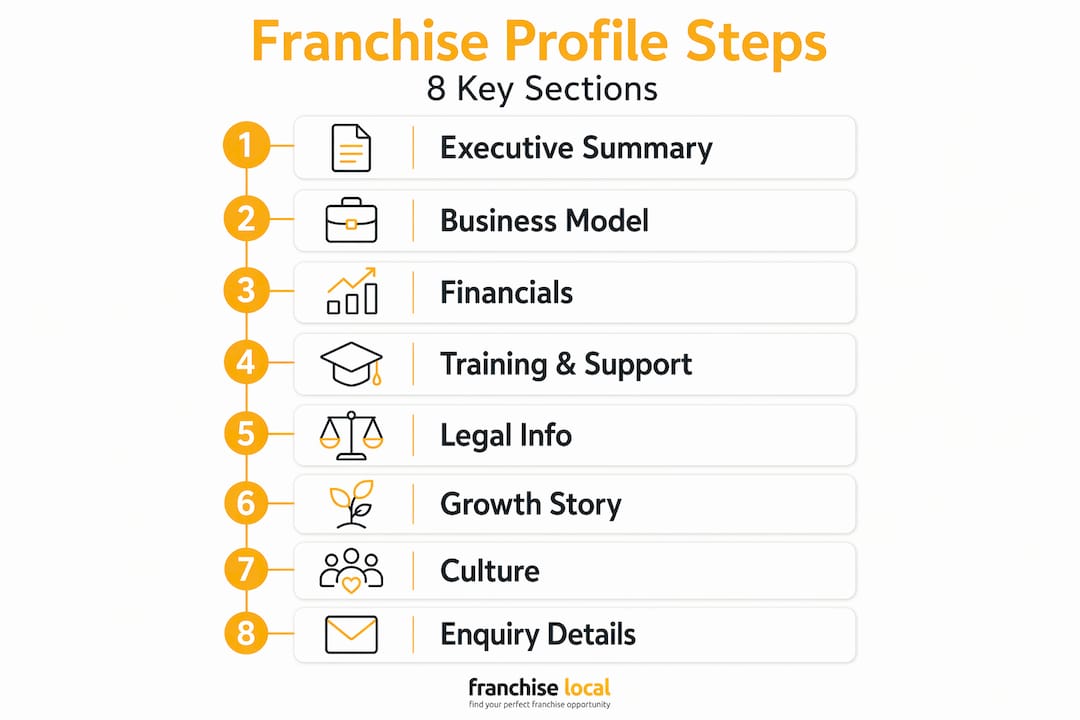
2. Business model and opportunity overview
Describe how the franchise makes money. Explain the revenue model, territory structure, and what differentiates this opportunity from comparable alternatives. Be explicit about whether this is a management franchise, an owner-operator model, or something in between. Ambiguity here kills serious enquiries before they start.
3. Financial projections and unit economics
This is the section where most profiles either build or destroy credibility. Profiles focused on unit economics with clear break-even timelines, royalty fee details, and three-to-five year pro forma statements resonate far more with serious investors than generic mission focus. Use a table to present your fee structure and initial investment clearly.
| Cost item | Low estimate | High estimate |
|---|---|---|
| Franchise fee | £15,000 | £30,000 |
| Equipment and fit-out | £20,000 | £60,000 |
| Working capital (3 months) | £10,000 | £25,000 |
| Training costs | £2,000 | £5,000 |
| Total initial investment | £47,000 | £120,000 |
| Ongoing royalty fee | 6% of turnover | 10% of turnover |
Tailor this table to your own numbers. The point is clarity. Transparent financial information builds credibility with lenders in ways that marketing claims simply cannot.
4. Training, operations, and ongoing support
Detail the initial training period, format (classroom, field-based, online), and duration. Then explain what ongoing support looks like in practice: field visits, helpdesk access, national marketing spend, technology platforms, and peer networks. Be specific. “Two weeks of training” is weak. “14 days of hands-on training at our national training centre in Birmingham, followed by a four-week in-territory launch with a dedicated business development manager” is credible.
5. Legal and compliance information
State your FDD status, registration details, and any relevant regulatory requirements for your sector. If you operate in a regulated industry (financial services, healthcare, food), name those frameworks. This section does not need to be lengthy. It needs to be accurate and transparent. Prospective franchisees and their solicitors will scrutinise it.
6. Growth and expansion narrative
Close the main body with your network growth story. How many units are open? What are the targets for the next three years? Are master franchise or area development options available? This section answers the “where is this going?” question that serious investors always ask.
Pro Tip: When presenting financial projections, include a worked example based on a real or representative unit. Abstract percentages mean little. A concrete scenario showing month-by-month cash flow for a typical franchisee’s first year is genuinely useful and signals operational confidence.
Common mistakes to avoid
Even experienced franchisors make avoidable errors when writing a franchise profile. Understanding where profiles go wrong is just as useful as knowing what to include in a franchise profile.
- Generic mission statements. “We are passionate about our customers” tells an investor nothing. Replace sentiment with specificity. Describe the customer problem you solve, the unit volume that proves demand, and the repeat purchase behaviour that drives franchisee income.
- Unclear or incomplete financials. Omitting royalty structures, marketing fund contributions, or renewal fees creates distrust. Investors and their advisors will find gaps. Present your full fee structure upfront.
- Overclaiming support. Listing 47 support features without explaining how they work in practice does not impress. One genuinely described support system is worth more than a bullet-pointed list of vague promises.
- No culture signal. A franchise profile that could belong to any brand attracts people who cannot distinguish between you and a competitor. Communicating your franchise culture clearly filters for the right people before they even make an enquiry.
- No lead qualification mechanism. Many top franchise profiles integrate gated content such as FDD previews or interactive financial tools to screen leads before full engagement. A public profile that reveals everything with no qualifier attracts browsers, not buyers.
- Poor digital reputation management. Responding to negative reviews within four hours and to enquiries within 24 hours measurably improves local search visibility and brand trust. Your profile does not exist in isolation from your digital footprint.
“The franchise profile is not a brochure. It is the first test of whether a franchisor can communicate clearly, think like an investor, and run a credible operation. If the profile is vague, prospects assume the business is too.”
For advice on how to attract the right franchisees, the franchise recruitment guidance from Franchiselocal covers candidate matching in practical detail.
Keeping your profile current and compliant
Writing a strong profile is a one-time achievement. Keeping it accurate and effective is an ongoing responsibility. Here is a practical process for annual review and ongoing maintenance.
-
Update your FDD annually. Franchisors must keep disclosure documents current, with annual FDD updates required to maintain compliance. Block time at the same point each year to review every financial claim, fee structure, and support offering in your profile against your current FDD.
-
Gather franchisee feedback. Your existing network is your most credible source of profile intelligence. Survey franchisees quarterly and identify gaps between what your profile promises and what they actually experienced. Close those gaps in the next revision.
-
Monitor your digital profile performance. Use a central dashboard to track enquiry volumes, conversion rates from profile to consultation, and search visibility metrics across locations. Automated reputation management at network scale is critical for maintaining consistent franchise image online, especially for multi-location networks.
-
Apply local SEO governance. Multi-location franchises require strict controls on naming conventions, categories, imagery, and localised content to avoid duplicate content penalties and protect search rankings. Each location page should carry unique content, localised proof points, and correct schema markup.
-
Review competitor positioning. Check how comparable franchises in your sector are presenting their profiles every six months. If others are showing unit-level financial performance and you are not, you are at a structural disadvantage with serious investors.
| Profile element | Recommended review frequency | Governance owner |
|---|---|---|
| Financial projections and fees | Annually (with FDD update) | Finance director |
| Franchisee testimonials | Every six months | Marketing manager |
| Legal and compliance statements | Annually minimum | Legal counsel |
| Digital performance metrics | Monthly | Digital marketing lead |
| Franchisee support descriptions | After each operational change | Operations director |
Pairing this review process with a local SEO strategy designed for multi-location brands ensures your profile works not just as a document but as a discoverable, trustworthy asset across search engines.
Will’s perspective: what I have learned about franchise profiles
I have reviewed hundreds of franchise profiles over the years and the pattern is remarkably consistent. The ones that fail do not fail because of bad formatting or missing sections. They fail because the person who wrote them was thinking about impressing the reader rather than informing them.
Here is what I have found: the profiles that generate the most qualified enquiries spend 60% of their space on numbers. Not aspirational numbers. Actual unit economics. What does a typical franchisee gross in year one? What does their cost structure look like? When do they break even? Serious investors do not want to be sold to. They want to evaluate. Give them the data to do that, and you immediately separate yourself from 80% of the profiles in your sector.
The other thing I have noticed is how often franchisors underestimate the importance of communicating culture. It sounds soft. It is not. A profile that reads as culturally specific. One that tells you exactly what kind of person thrives in this network and why. pre-qualifies leads better than any gated content tool. People self-select out when the culture does not match, which saves everyone time and reduces franchisee attrition down the line.
On the legal side, I would caution against two extremes. Profiles that ignore compliance entirely invite serious risk. But profiles that bury investors in legal language lose them before the opportunity has landed. Present legal requirements accurately, keep the language accessible, and direct readers to formal documentation for the detail.
Finally, for anyone managing a multi-location network: centralised governance of your profiles is not optional in 2026. I have seen brands where individual franchisees posted their own location content without oversight, creating duplicate pages, inconsistent claims, and a fragmented brand image that damaged enquiry quality across the whole network. Automate what you can. Govern what you cannot.
— Will
Explore franchise opportunities on Franchiselocal
If you are ready to put your profile to work, Franchiselocal is the ideal place to start. The platform connects franchisors with qualified UK investors searching across industries, investment levels, and locations every day. Whether you are looking to attract investors to a business services franchise or want your opportunity featured among the top UK franchise listings, Franchiselocal offers the visibility and search functionality to reach the right people. The platform also supports franchisors with profile guidance, listing creation, and lead generation tools designed specifically for the UK market. For practical advice on making your opportunity stand out, the franchise offer creation guide is a useful next step.
FAQ
What should I include in a franchise profile?
A franchise profile should cover an executive summary, business model description, detailed financial projections and fee structures, training and support systems, legal and compliance information, and a growth narrative. Including unit economics with clear break-even timelines is particularly effective with serious investors.
How long should a franchise profile be?
A typical franchise profile runs to 8 to 10 pages, covering business model, three years of financial trends, operational requirements, and growth opportunities. Depth matters, but clarity matters more.
How do I keep my franchise profile legally compliant?
Update your Franchise Disclosure Document at least annually and align all profile claims with its current contents. Franchisors must provide a valid FDD at least 14 days before contract signing, so every financial claim and support statement in your profile must be consistent with your disclosed terms.
How do I use my franchise profile to attract better leads?
Gate premium profile content such as FDD previews or detailed financial models behind an enquiry form. Gated financial content pre-qualifies leads effectively, reducing wasted time and improving the quality of investors who progress to consultation.
How often should I update my franchise profile?
Review financial projections and compliance statements annually in line with your FDD update. Update franchisee testimonials every six months and monitor digital performance metrics monthly to keep the profile current, accurate, and competitive.