

Multi-brand franchising means one franchisee, or one franchise group, owns and operates more than one franchise brand. It differs from multi-unit franchising, where you run several outlets of the same brand. In the UK there is no special category for it: each brand sits under its own franchise agreement, and the work is in making those agreements, and your time, fit together.
This guide explains how the model works, what you gain, where the contract risks sit, and how to decide whether a second brand suits you. It also covers a question many buyers raise along the way: whether to pair B2B and B2C franchises.
What multi-brand franchising means
There are three common routes to owning more than one franchise business:
- Single-brand, multi-unit: several territories or outlets of one brand.
- Multi-brand (also called multi-concept): two or more different brands, each with its own franchisor, fees and operating manual.
- Hybrid: several units across several brands, usually reached over many years.
Multi-unit and multi-brand ownership is often described as an advanced scaling strategy. The British Franchise Association (BFA) notes that ownership of multiple locations can be with one brand or several, and that owners need to plan management structures and resources carefully. Success depends less on capital than on whether you can run different systems well at the same time.
If you are still weighing the single-brand version, our guides to multi-unit franchising and growing a UK multi-unit portfolio are the natural starting point.
How common is it in the UK?
Multiple ownership is a mainstream path. A Lexology article from June 2021, citing the BFA-NatWest survey, reported that around one-third of franchisees ran more than one franchise business, up from one-quarter in 2013. That figure covers all multiple ownership, not only multi-brand, and it is several years old, so treat it as a direction of travel.
The wider sector gives the context. The BFA reports that UK franchising supports 50,421 units across 1,009 systems and contributes £19.1 billion to the UK economy, with a forced commercial failure rate below 6%. A deep pool of established brands is what makes combining them possible.
Why owners add a second brand
Spreading risk
One brand means one market, one set of customers and one franchisor’s fortunes. A second brand in a different sector can soften a slow season, a supplier problem or a shift in demand. This only works if the brands are genuinely different. Two services that depend on the same customers and the same economic conditions diversify very little.
Sharing overheads
Premises, vehicles, a bookkeeper, an office manager or a sales lead can sometimes serve more than one business. Shared overheads are one of the main reasons owners expand sideways rather than only adding territories. Check each agreement first: some franchisors restrict shared staff, shared premises or shared branding.
Building transferable skills
Running several systems builds a wider skill set. Franchisors know this, and a franchisee with a record of following one system well is often an attractive candidate for another.
Using one customer relationship twice
Some brands sell naturally to the same customer. A business customer who buys one service may need another. That is the commercial logic behind pairing complementary brands, and it is where the B2B and B2C question comes in.
B2B and B2C franchises: which mix works
A B2C franchise sells to consumers: home services, fitness, food, childcare, retail. A B2B franchise sells to other businesses: business services, recruitment, networking, finance support, print and marketing. Each has a different rhythm.
| B2C franchise | B2B franchise | |
|---|---|---|
| Typical buyer | Households and individuals | Companies and organisations |
| Sales cycle | Short, often one visit or call | Longer, with more decision makers |
| Revenue pattern | Many smaller transactions | Fewer, larger or repeat contracts |
| Demand pattern | Often tied to seasons and consumer confidence | Often tied to business confidence and budgets |
| Working hours | Often evenings, weekends or fixed opening hours | Often weekday, office hours |
| Skills that help | Local marketing, customer service | Relationship building, consultative selling |
The pairing logic is simple. A B2B brand with weekday hours and a B2C brand with evening or weekend demand can fit one working week, though that does not make the workload light. Different demand cycles can also balance each other. Equally, two brands that both need you in the field at the same hours will fight over your calendar.
If you lean towards the B2B side, browse our business services franchises, financial business franchises and networking franchises to see how varied the category is.
What your contracts must handle
This is where multi-brand plans most often go wrong. The legal points below come from a Lexology review of multi-unit, multi-brand franchising. Read them as prompts for questions to put to a franchise solicitor, not as advice on your own contract.
Approval rights over other brands
Franchisors often want approval rights over any additional brand you take on. Their reasons are practical: avoiding conflicts of interest, making sure their brand gets priority for the best sites, and preventing your capital from being spread so thinly that standards slip. Raise your plans early rather than after signing.
Full-time and attention clauses
Many franchise agreements require you to devote your full time and attention to the business. In a multi-brand arrangement, that wording has to be explicitly relaxed or removed, otherwise running a second brand could put you in breach of the first. Ask for this to be addressed in writing.
Cross-default provisions
A cross-default clause allows a franchisor to terminate the agreement for all your units if you fail to meet standards in just one location or a subset of them. That is a serious risk in a portfolio: trouble in one outlet can threaten the rest. Ask whether a clause applies, what counts as a trigger, and whether cure periods are available.
Development schedules and incentives
When a franchisor offers a multi-unit deal, it may ask for a binding development schedule. Legal commentator Gordon Drakes, writing in the same Lexology piece, argues that franchisors should offer incentives such as reduced fees or rebates in return, so that you do not neglect their brand in favour of others. If you are asked to commit to a schedule, check what happens if you miss a date, and whether the incentive justifies the obligation.
Disclosure and the BFA Code
There are no statutory franchise-specific laws or mandatory pre-contractual disclosure rules in the UK, according to Lexology’s overview of franchising in the UK. Members of the BFA, however, must follow the BFA Code of Ethics, which requires full, accurate written disclosure of material information a reasonable time before signing. Because that protection comes from membership, ask every franchisor you speak to whether they are a member and request the disclosure in good time, for each brand separately.
For more detail, see our guides to franchise regulation in the UK, preparing franchise disclosure and franchise legal requirements. If a franchisor asks you to sign a confidentiality agreement before sharing information, our franchise NDA checklist explains what to look for.
How to decide if you are ready
Adding a brand is easier to get right if you work through the same questions each time.
- Is your first business stable? The BFA’s advice on multi-unit ownership stresses planning management structure and resources. A first unit that still needs you full time is not ready to be left to a manager.
- Who runs what? Decide which roles you will hire for before you buy. Training matters here, and our piece on why robust training is critical for franchise brands shows what to look for from each franchisor.
- Do the brands compete for the same resource? Compare working hours, territories, staff skills and peak seasons.
- What does each contract say about other brands? Look for approval rights, full-time clauses and cross-default terms before paying any deposit.
- Can you fund both? Model the initial investment, working capital and your own living costs for each brand, with a margin for slower-than-planned starts.
Our franchise affordability calculator is a useful first check on what you can realistically fund before you approach a second franchisor.
Questions to put to a second franchisor
- Do you allow franchisees to operate other brands, and under what conditions?
- Is your territory exclusive, and could a second brand of mine overlap it?
- Does your agreement include a cross-default clause covering other agreements I hold?
- How many of your franchisees run more than one business, and can I speak to them?
- Will you accept an amended full-time-and-attention clause?
- What support do you give an owner who employs a manager rather than working in the business?
Speak to existing franchisees of each brand, ideally those who also run something else. They will tell you how the day-to-day workload really feels.
Multi-brand, multi-unit or master franchise?
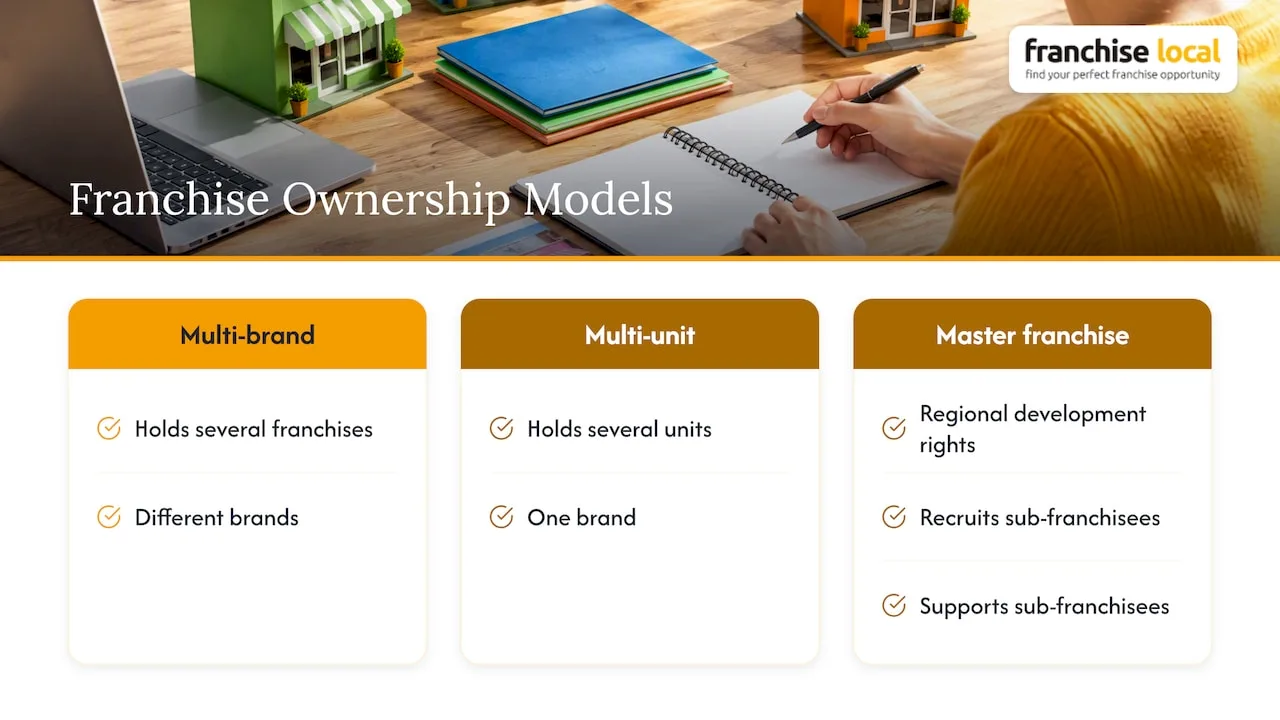
The three terms are often confused. A multi-brand owner holds several different franchises. A multi-unit owner holds several units of one brand. A master franchisee takes on the right to develop a brand across a region, typically by recruiting and supporting sub-franchisees, which is a different business again. Our guide to master franchising covers that route.
For most first-time expanders, the lower-risk order is often to prove a first unit, consider a second unit of the same brand where the franchisor allows it, and only then look at a different brand. That is a judgement, not a rule: a complementary brand can sometimes make more sense than a second territory of the first.
Find your next brand on Franchise Local
We list UK franchise opportunities and let you filter by industry, investment level, lifestyle and location, so you can compare a second brand against your existing one on cost, working pattern and sector. Start with trending franchise opportunities or browse all franchise industries. Enquiries go direct to the franchisor, and searching is free for buyers.
FAQ
What is the difference between multi-brand and multi-unit franchising?
Multi-unit franchising means owning several outlets or territories of the same brand. Multi-brand franchising means owning franchises from two or more different brands. Some owners do both, building a portfolio of several units across several brands over time.
Can I own franchises from different franchisors in the UK?
Yes, but your agreements decide it. Franchisors often require approval before you take on another brand, and some contracts contain full-time-and-attention wording that has to be relaxed. Read each agreement carefully and ask a franchise solicitor to review them before you sign.
Is multi-brand franchising riskier than owning one franchise?
It can be. You carry more capital at stake, a heavier management load, and potentially cross-default clauses that link your agreements. It can also spread risk across sectors. The outcome depends on how different the brands are and how well you can staff and manage them.
Should I choose a B2B or B2C franchise as my second brand?
Choose the one that complements your first in hours, customers and seasonality. A B2B brand with weekday demand alongside a B2C brand with evening or weekend demand may suit one working week, but check each franchisor’s time commitments first.
Sources
- Talking mumbo jumbo: legal risks and rewards of multi-unit, multi-brand franchising, Lexology
- The results are out: 2024 National Franchise Survey, British Franchise Association
- Three top tips to achieve multi-unit ownership, British Franchise Association
- Franchising in the UK, Lexology
- The Code of Ethics for Franchising, British Franchise Association