

Owning multiple franchise locations looks straightforward on paper: replicate a proven model, open more sites, collect more revenue. The reality of multi-unit franchising is far more demanding. You are not simply scaling a single unit. You are taking on binding legal commitments, operational complexity across several locations, and financial exposure that multiplies with every site you sign for. This multi-unit franchising guide cuts through the surface-level advice and gives you the frameworks, legal context, and practical strategies you need to grow a franchise portfolio in the UK with confidence and clear eyes.
Key Takeaways
| Point | Details |
|---|---|
| Two main structures | UK multi-unit franchising typically uses area development agreements or flexible staged approvals for expansion. |
| Due diligence essentials | Review full investment costs, legal contracts, and existing franchisee experiences with specialist UK advisors. |
| Risk management | Missing ADA development milestones risks territory loss and contract termination, requiring proactive operational planning. |
| Operational scalability | Implement management and leadership systems before exceeding about 10 units to sustain growth effectively. |
| Balanced marketing | Combine central brand control with local franchisee marketing for consistent and effective multi-unit performance. |
Understanding multi-unit franchising structures in the UK
Before you commit to owning multiple franchises, you need to understand exactly what you are signing. Two distinct contractual structures govern multi-unit expansion, and confusing them is one of the most expensive mistakes an entrepreneur can make.
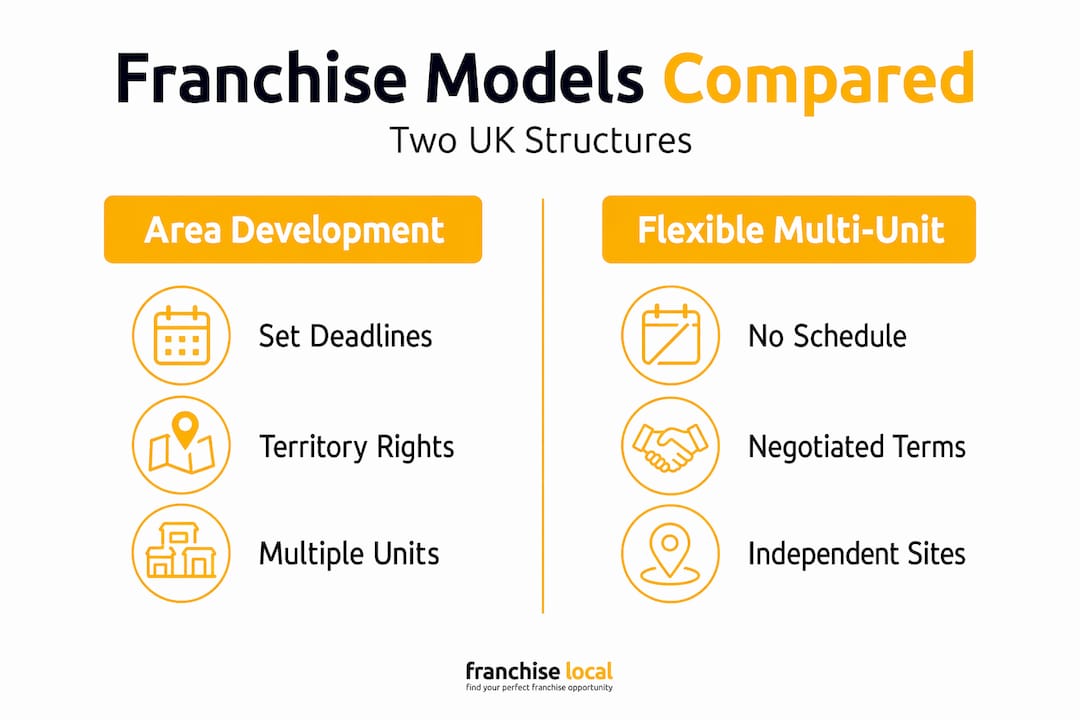
The first is the Area Development Agreement (ADA), sometimes called a Multi-Unit Development Agreement (MUDA). As two common contractual structures show, an ADA reserves a defined territory for you and obligates you to open multiple units within set milestone dates, whereas a multi-unit approach expands via separate or staged approvals rather than one binding schedule. The critical distinction is whether you are locked into a development timetable from day one.
Under an ADA, multi-unit franchising involves the purchase of rights and obligations to open and operate an agreed number of locations in an exclusive territory, with separate unit franchise agreements commonly executed for each location as it opens. In plain terms, you sign one overarching ADA and then a fresh individual agreement for each site you launch. The ADA governs your territory rights; each unit agreement governs how you run that specific location.
The flexible multi-unit model works differently. There is no central development timetable. Instead, you approach your franchisor for approval each time you want to open an additional site. This gives you greater agility, but it also means less certainty. Your franchisor can decline, impose new conditions, or change the terms between approvals. Understanding types of franchise agreements in the UK is essential before you decide which model suits your ambitions.
Here is how the two structures compare at a glance:
| Feature | Area development agreement | Flexible multi-unit approach |
|---|---|---|
| Territory exclusivity | Guaranteed within defined area | Not automatically guaranteed |
| Development timetable | Binding milestones and deadlines | No fixed schedule |
| Risk if milestones are missed | Territory loss or termination | Lower, as each unit is approved separately |
| Upfront investment | Higher development fee | Lower initial outlay |
| Growth certainty | High, if milestones are met | Lower, subject to franchisor approval |
| Operational commitment | Agreed number of units contracted | Open-ended, unit by unit |
Key considerations when choosing your structure:
- Territory protection: An ADA gives you a legally defined area that competitors cannot enter. Without one, another franchisee could open nearby.
- Cash flow timing: ADA development fees are paid upfront, often before a single unit opens.
- Negotiation leverage: Experienced multi-site franchise operators can negotiate more favourable ADA terms, including milestone extensions.
- Exit flexibility: Selling individual units under an ADA can be more complex than under a flexible arrangement.
Understanding the nuances in a franchise agreement and your franchise territory rights before signing is not optional. It is the foundation everything else is built on.
Conducting thorough due diligence for multi-unit franchising
Once you understand the structures, due diligence becomes your most important task. Multi-unit investment amplifies every cost and risk from a single-unit investment, so gaps in your research are costly at scale.

UK franchising due diligence guidance stresses calculating the full investment beyond the entry fee and reviewing legal documents and performance data before committing. The entry fee is visible. What many entrepreneurs underestimate is the complete cost stack: premises deposits, fit-out costs, equipment, initial stock, working capital, royalty percentages, marketing levies, and ongoing operational expenses. Multiply these across three, five, or ten units and the financial exposure becomes significant.
Full cost validation must include premises, staffing, royalties, marketing levies, and a thorough check of franchisor stability and termination terms with specialist UK advisors. This is not an area where general commercial solicitors are adequate. You need a solicitor with direct experience in UK franchise law who can identify restrictive clauses, early termination provisions, and territory definition weaknesses that a generalist would miss.
Follow this sequence when conducting multi-unit due diligence:
- Calculate total capital required across all planned units, including realistic contingency buffers of at least 20%.
- Engage a franchise-specialist solicitor to review both the ADA and individual unit franchise agreements.
- Hire a franchising-experienced accountant to model financial projections based on actual franchisee data, not franchisor estimates.
- Request and review the disclosure pack in full, even though UK franchisors are not legally required to provide a formal Franchise Disclosure Document (FDD) as in the US.
- Interview a minimum of five existing franchisees, including some who have been operating for over three years.
- Speak with former franchisees where possible. Their reasons for leaving are often more instructive than current operators’ enthusiasm.
- Research the franchisor’s financial health through Companies House filings, looking for consistent revenue growth and healthy margins.
Key areas to scrutinise in every franchise document:
- Royalty rates and how they are calculated (gross versus net revenue)
- Marketing levy obligations and how those funds are managed
- Renewal terms and conditions, including fee changes at renewal
- Exit and transfer rights, including whether franchisor consent is required to sell
- Territory definitions and what constitutes a breach of exclusivity
- Performance requirements that could trigger early termination
Review franchise disclosure documents carefully and cross-reference them against what existing franchisees tell you in conversation. Discrepancies between the two are a serious warning sign.
Use the franchise due diligence checklist to ensure nothing is missed, and consider the franchise selection checklist as a companion resource when evaluating different franchise brands.
Pro Tip: Franchising is not paying an entry fee to join a business. You are entering a long-term legal relationship with financial obligations that persist even if trading conditions deteriorate. Treat due diligence with the same rigour you would apply to acquiring an independent business outright.
Managing risks and operational challenges in multi-unit franchising
Knowing the risks before you experience them is what separates prepared franchisees from those who find themselves in breach of contract or operationally overwhelmed.
The most acute risk in an ADA is missing milestone deadlines. ADA development schedules carry consequences for missed deadlines that can include loss or termination of development rights, representing a key contractual risk alongside high upfront investment. If you commit to opening five units over four years and you miss the third milestone, you risk losing the rights to your entire territory, not just the units you have not yet opened.
Cross-collateralisation is another risk that receives insufficient attention. When you finance multiple franchise units through a single loan or combined lending facility, the performance of each unit affects the entire portfolio. A single underperforming site can place the funding for all other units under pressure.
Scaling breaks operationally past about 10 units unless management systems, integrated reporting, and leadership structures are implemented early. This is not a soft management observation. It is a structural reality. Beyond roughly ten locations, a single owner-operator model simply cannot function without the right layers of management, technology, and process beneath it.
Marketing is another layer of complexity. Multi-location performance depends on a two-tier marketing model that splits national brand consistency with local community engagement to avoid uneven campaign performance. Relying entirely on franchisor-led national campaigns is insufficient. Each location needs local marketing effort tailored to its community, competition, and customer base.
Key risk factors and practical mitigation strategies:
- Milestone risk: Negotiate extension provisions into your ADA before signing rather than hoping for goodwill later.
- Cross-collateralisation: Structure financing so that each unit, where possible, carries its own lending responsibility.
- Operational capacity: Hire or develop area managers before you need them, not after you are stretched.
- Brand inconsistency: Implement consistent training and operational checklists across all sites from the outset.
- Staff recruitment: Build a reliable recruitment pipeline early; staffing shortages across multiple sites compound quickly.
- Franchisor dependency: Understand which operational support is guaranteed contractually versus provided informally.
Pro Tip: Start building your management infrastructure before you feel you need it. If you wait until operational strain forces your hand, you will be recruiting area managers while simultaneously firefighting across multiple sites, which rarely ends well.
“Missing a single ADA milestone can trigger termination of development rights across the entire agreement, not just the unit in question. Entrepreneurs must understand that an ADA is not a licence to open units at your own pace.”
Reviewing your franchise territory rights and franchisee responsibilities with your legal adviser before signing any development agreement is strongly advisable.
Applying practical strategies for multi-unit franchising success
Awareness of risk is valuable. Knowing what to do with that awareness is what drives results.
The first strategic decision is choosing the right growth model for your specific situation. An ADA suits entrepreneurs who have strong capital reserves, high confidence in the market territory, and the operational capacity to execute a committed development schedule. A flexible multi-unit approach suits those who want to test one or two sites before scaling, or who are entering a new sector for the first time.
A well-structured development schedule with measurable milestones and sensible extension rules helps preserve forward progress and avoid all-or-nothing outcomes. When negotiating your ADA, push for milestones that reflect realistic lead times for property searches, planning permissions, and fit-out works. UK commercial property timelines are frequently longer than franchise brands anticipate in their standard agreements.
Portfolio corporate structure is one of the most consequential decisions you will make, with options ranging from a single entity, a HoldCo/OpCo arrangement, or separate special purpose entities for each unit. Each structure carries different tax implications, liability profiles, and transfer flexibility.
| Structure | Liability protection | Tax efficiency | Transfer flexibility | Complexity |
|---|---|---|---|---|
| Single entity | Low | Moderate | Simple | Low |
| HoldCo/OpCo | Moderate | Good | Moderate | Medium |
| Separate unit SPEs | High | Variable | High | High |
| Partnership structure | Variable | Variable | Limited | Medium |
Step-by-step planning actions for multi-unit franchising success:
- Assess your operational capacity honestly before choosing between an ADA and a flexible approach.
- Engage a commercial property adviser experienced in retail and leisure to evaluate territory viability.
- Decide on corporate structure with your accountant and solicitor before signing any agreement.
- Negotiate development schedule buffers of at least three to six months per milestone to allow for planning and real estate delays.
- Build your area management team before opening your third unit, not after your fifth.
- Review transfer and exit terms in the franchise agreement before signing, so you know your options from day one.
Exit and transfer considerations that every multi-unit franchisee should understand:
- Most franchise agreements require franchisor consent to sell individual units within a portfolio.
- Selling one unit from an ADA portfolio may affect the development obligations for remaining sites.
- Goodwill valuations on franchise resales are typically lower than on independent businesses.
- Buyer approval processes by franchisors can add several months to a sale timeline.
Reviewing your franchise agreement essentials and territory rights regularly as your portfolio grows will help you stay ahead of contractual obligations.
Pro Tip: Negotiate for graduated remedies in your development schedule rather than binary termination clauses. A franchisor willing to agree to territory reduction before termination is offering you a much fairer safety net than one whose contract jumps straight from missed milestone to full agreement cancellation.
A fresh perspective on multi-unit franchising in the UK
Most multi-unit franchising advice focuses almost entirely on contracts, territory selection, and upfront investment figures. It is useful advice. It is also incomplete advice.
The entrepreneurs who struggle most in multi-unit franchising are rarely the ones who chose the wrong territory or negotiated a weak ADA. They are the ones who signed ambitious development schedules before their internal operations were ready to support them. The operational upside of multi-unit growth is closely tied to contract mechanics, but scaling often falters without leadership structures in place before reaching ten units. The contract does not create the capacity. You have to build that separately.
There is also a persistent misconception that franchisor marketing support removes the need for local marketing effort. It does not. Brand consistency must be balanced with local execution, a nuance often overlooked that causes uneven performance across multi-unit portfolios. A franchisee in Manchester operating within a national campaign designed around London demographics is not going to see the same results without local adaptation. This requires budget, local knowledge, and willingness to invest in community-level activity beyond what the franchisor mandates.
We would encourage you to think of your first multi-unit expansion not as an aggressive growth move but as an operational stress test. How well does your first unit perform without your direct involvement? If the answer is “not reliably,” then opening a second unit will not improve that. It will expose it.
The franchisees who build genuinely successful multi-unit portfolios treat people development as seriously as site development. They hire area managers with genuine authority, not just supervisory titles. They invest in training systems before those systems are urgently needed. They understand their franchisee responsibilities not as a checklist but as the operational DNA of every site they run.
“The contract gives you the right to grow. The systems you build determine whether that growth is profitable or simply expensive.”
Franchisor support and franchisee capacity must align realistically. If a franchisor’s support infrastructure is designed for single-unit operators, their guidance on multi-unit scaling will have limits. Ask franchisors directly: how many of your current franchisees operate more than three units? What dedicated support exists for multi-site operators? Their answers will tell you more than any brochure.
Pro Tip: Before signing a binding development schedule, open your first unit, operate it for at least twelve months, and honestly evaluate whether your systems, team, and finances are genuinely ready for the commitment you are about to make. Contract dates can be negotiated. Operational readiness cannot be faked.
Explore UK franchise opportunities to start your multi-unit journey
If you are ready to move from research into action, finding the right franchise opportunity is the natural next step. Top UK franchise opportunities across dozens of industries are available to explore, filtered by investment level, location, and lifestyle preference to match your specific circumstances.
For entrepreneurs interested in high-growth sectors with strong multi-unit potential, networking franchises and financial business franchises offer compelling options with established brand frameworks well suited to multi-site scaling.
FranchiseLocal gives you the tools to:
- Filter franchise opportunities by investment budget and region
- Compare franchise brands across multiple sectors in one place
- Identify franchises with proven multi-unit track records
- Access detailed listings to support your due diligence process
- Connect directly with franchisors ready to discuss development agreements
The right franchise is out there. Armed with the knowledge from this guide, you are in a far stronger position to evaluate your options critically and build a portfolio that performs.
Frequently asked questions
What is the difference between an area development agreement and a multi-unit franchising approach in the UK?
An area development agreement grants exclusive rights to open multiple units by specific deadlines in a defined territory, while a multi-unit approach involves opening additional units through staged approvals without a binding development schedule. As two common contractual structures confirm, the key distinction is whether you are locked into a development timetable from the outset.
Are UK franchisors required to provide a Franchise Disclosure Document?
No, UK franchisors are not legally required to provide a formal Franchise Disclosure Document as in the US, but they typically offer detailed disclosure packs in advance to comply with fair trading obligations and reduce misrepresentation risk. Reviewing these packs carefully with a specialist solicitor remains essential regardless of statutory requirements.
What are common risks of missing development milestones in a UK area development agreement?
Missing milestones can lead to reduction or loss of exclusive territory rights, termination of the full agreement, and forfeiture of development fees. Common ADA consequences include granting territory rights to others, loss of first refusal on additional units, and potential termination of the entire development arrangement.
How should I prepare operationally for scaling beyond 10 franchise units?
Before reaching about 10 units, implement management systems, integrated reporting, and establish leadership structures to handle increased operational complexity. Scaling breaks operationally past this threshold unless these foundations are in place well in advance.
Why is balancing national brand consistency with local execution important in multi-unit franchising?
National campaigns cannot account for the specific competitive dynamics, demographics, and community relationships of every location in your portfolio. Multi-location performance depends on a two-tier marketing model where central brand messaging is complemented by locally tailored activity to prevent uneven results across sites.