

The UK franchise sector contributes £19.1 billion to the UK economy in 2026, spread across over a thousand franchise systems and more than fifty thousand franchise units. Confidence remains strong, with 77% of franchisors describing themselves as fairly or very confident about the year ahead. The sections below break the numbers down by sector, cost and risk, so you can apply them to your own search or due diligence.
Market snapshot: turnover, units, systems and employment in 2026
The clearest starting point for anyone weighing up UK franchising in 2026 is the British Franchise Association’s national franchise survey, which remains the baseline data set for the sector heading into this year. It puts the total contribution of franchising to the UK economy at £19.1 billion, delivered through 1,009 separate franchise systems operating 50,421 individual units across the country.
The sector supports hundreds of thousands of jobs, with average turnover per franchise unit around several hundred thousand pounds, according to the BFA national franchise survey. That average turnover figure matters because it gives investors a working benchmark against which to judge any franchisor’s own disclosure document, though actual performance varies considerably by sector, location and brand maturity.
To put these numbers in context, the ONS business population estimates recorded 5.7 million private sector businesses operating in the UK at the start of 2025. Franchised units represent a small but structurally distinct slice of that total, one with its own support systems, brand standards and (generally) lower failure rates than independent start-ups.
A few definitions are worth fixing before going further:
- A system (or brand) is the franchised business concept itself, such as a specific cleaning, fitness or food brand.
- A unit is each individually operated outlet or territory trading under that system, whether company-run or franchisee-owned.
- Turnover per unit is a sector average, not a guarantee; a single system’s units can vary widely depending on location and format.
- Employment figures cover both franchisor head office staff and franchisee teams across the network.
These distinctions matter when you are comparing two franchise opportunities. A brand with fewer units but higher turnover per unit may represent a different risk and reward profile than one with many smaller units and thinner margins. Neither figure alone tells the full story, which is why the sector breakdown and forecast sections below dig into the detail behind the headline numbers.
Recent trajectory and key drivers that shaped the 2026 picture
UK franchising has not grown evenly across all sectors. Personal services, in particular, have expanded fast, driven by demographic change and shifting consumer habits. Industry coverage of the sector points to 53% growth in personal services franchising between 2018 and 2024, a pace that outstrips most other franchise categories over the same period.
77% of franchisors entering 2026 describe themselves as fairly or very confident about their business plans for the year, according to the BFA’s confidence survey. That confidence sits alongside one of the sector’s most repeated statistics: a commercial failure rate that has stayed under 6% over the past twenty years. This is a track record franchising regularly cites as its advantage over independent business start-ups.
The drivers behind this picture split into a few clear threads:
- Demographic tailwinds: an ageing population and busier households have pushed demand towards care-led, lifestyle and children’s services franchises.
- Brand resilience: established systems with proven operating models tend to weather cost pressure better than new, unproven concepts.
- Franchisee demand: more people leaving employed roles are choosing a franchise route over starting entirely from scratch, drawn by the lower historical failure rate.
- Investor appetite: steady turnover figures and employment numbers have kept franchising visible to investors looking for defensible, service-based business models.
None of this means the sector is immune to pressure. Rising operating costs and the forthcoming Employment Rights Bill are both cited as headwinds for 2026, pushing up the cost of running a franchise unit regardless of sector. Franchisors with established systems, tested recruitment processes and existing compliance frameworks are generally better placed to absorb these changes than newer, less tested brands, a distinction worth checking carefully during due diligence. Our UK franchising trend overview for 2026 sets out these headwinds alongside the opportunities in more depth.
Which sectors matter in 2026 and what their characteristics are
Not every franchise sector behaves the same way, and the 2026 figures reward a closer look at where growth and investment are concentrated.
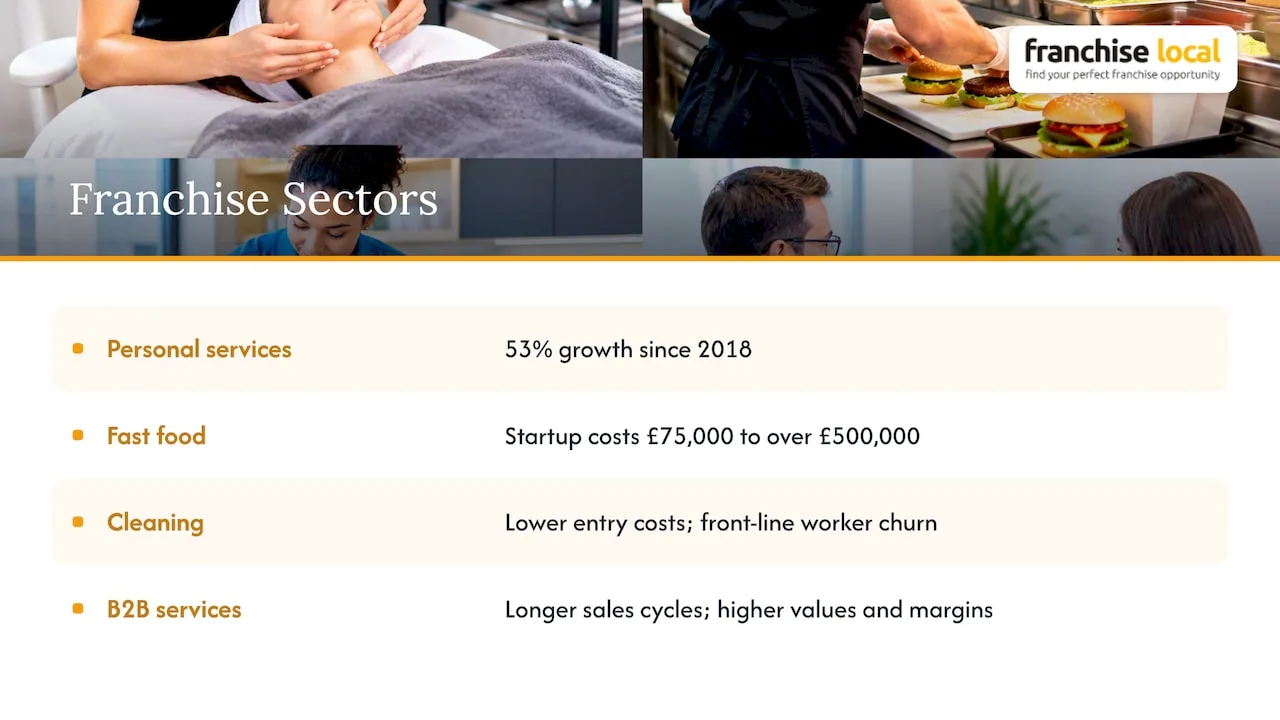
Personal services stand out as the fastest-growing category, with 53% growth reported since 2018. This bracket covers care services, children’s activities and lifestyle-led offers, and its growth is tied directly to an ageing population and households increasingly willing to pay for convenience. Entry costs vary widely within this bracket, but many formats are designed to be run part-time or scaled gradually, which helps explain their appeal to first-time franchisees.
Fast food and hospitality franchises sit at the other end of the capital spectrum. Startup costs in this bracket typically run from £75,000 to over £500,000, reflecting the cost of fit-out, equipment and prime site rents.
Cleaning and home services franchises tend to carry much lower entry costs, which makes them attractive to first-time investors working with smaller budgets. The trade-off is usually in labour management: these businesses depend on reliable staffing and can see higher churn among front-line workers, which affects service consistency and, in turn, customer retention. The BFA’s own guidance on cleaning franchise costs makes the point directly: a lower headline fee does not automatically mean better value, and what is included in that fee, training, systems, lead generation, deserves as much scrutiny as the price tag itself.
B2B and specialist service franchises, including fields like renewable technology, tend to follow longer sales cycles than consumer-facing brands. Deals take longer to close, but contract values and margins can be higher once a client relationship is established. The BFA’s comparison between fast food and B2B renewable technology franchising is a useful illustration of how different these two ends of the market really are, both in capital needed and in how revenue builds over time.
Pro Tip: Match the sector’s sales cycle and staffing demands to your own availability before comparing headline investment figures; a lower entry cost can hide a higher time commitment.
Our franchise industry trends piece for 2026 breaks down opportunity by sector in more detail, useful reading once you have narrowed down a category that fits your budget and lifestyle.
Short-term forecasts to 2026 and how to read them
Franchise forecasting works differently from forecasting in most other sectors, because the data comes from two distinct sources that rarely align perfectly. The BFA’s national franchise survey is a sector-specific survey of franchisors, covering system counts, unit numbers, turnover and employment. The ONS business population estimates are a much broader official data set covering all UK private sector businesses, which gives franchising a frame of reference but does not isolate franchised units with the same precision.
Reading a 2026 forecast properly means understanding how these two data sets are combined and where they diverge:
- BFA figures are survey-based, drawn from franchisor responses, and are the most detailed source for franchise-specific metrics like unit counts and turnover per unit.
- ONS estimates count the UK business population as a whole and are useful for context and for tracking broader economic conditions that affect franchising indirectly.
- Confidence indicators, such as the 77% figure from the BFA’s 2026 survey, are sentiment measures, not hard revenue forecasts, and should be read as a signal of mood rather than a guaranteed trajectory.
- Sector-level growth claims, like the 53% personal services figure, come from industry commentary rather than official statistics, so they are best treated as directional rather than precise.
The sector’s long-term commercial failure rate has stayed under 6% over twenty years, a figure the BFA repeatedly cites when comparing franchising against independent business start-ups.
That consistency is part of why franchising attracts investors who might otherwise be wary of small business risk. But no forecast, however well sourced, accounts for every variable. Caveats worth keeping in mind include differences in survey sample frames between years, the fact that “franchise unit” definitions can shift slightly between reports, and the sensitivity of any turnover projection to macro shocks like inflation spikes or interest rate changes. Treat every 2026 figure as a well-evidenced estimate rather than a certainty, and build your own sensitivity ranges around it rather than taking a single number at face value.
Practical implications for investors and entrepreneurs
The data points towards a few clear conclusions for anyone actively weighing up a UK franchise investment in 2026.
- Deal flow is concentrated in personal services, care and specialist B2B sectors, where demand growth has been strongest and where demographic trends suggest continued expansion.
- Capital requirements vary enormously by sector: fast food and hospitality brands typically require £75,000 to £500,000 upfront, while cleaning and home service franchises generally sit well below that range.
- Royalty and marketing fee norms matter as much as the entry fee: a 5% to 8% royalty plus a marketing levy on top of turnover changes the real cost of ownership significantly over a multi-year term.
- Confirm support structures before committing: ask what training, lead generation and territory protection are included, rather than judging a franchise purely by its headline fee.
- Check churn and retention data where it is available, particularly in labour-intensive sectors like cleaning, where staff turnover affects service quality and customer retention directly.
Pro Tip: Ask any franchisor for audited unit-level results covering at least the past two years rather than relying on average turnover figures alone; averages can mask a wide spread between strong and weak-performing units.
Our financial opportunities overview for 2026 investors goes further into how to prioritise sectors based on your own capital and risk appetite.
Applying these figures to due diligence and modelling
Turning sector averages into a workable investment decision takes a structured approach, not just a glance at the headline numbers.
- Request audited unit-level financials from any franchisor you are seriously considering, covering turnover, gross margin and net profit for at least two trading years, rather than relying on the sector average of around £400,000 per unit.
- Build a three-case model: a conservative case using the lower end of comparable unit turnover, a base case using the sector average, and an optimistic case reflecting a well-located, well-run unit, then apply the brand’s actual royalty and marketing levy percentages to each.
- Check local comparables, since turnover for the same brand can differ significantly between a city centre territory and a smaller town, and ask the franchisor directly how existing units in similar territories have performed.
- Stress-test for cost inflation, particularly on rent, wages and raw materials, given the broader cost pressures the sector is already flagging for 2026.
- Confirm exclusivity and territory terms in writing before modelling revenue, since an overlapping or poorly defined territory can undercut even a strong sector-level growth story.
Our guide to assessing franchise financials walks through this process step by step, and our affordability calculator and ROI estimator let you test your own numbers against a specific franchise’s cost structure before you commit to any formal application.
Franchiselocal resources and tools for sourcing UK opportunities
Once you know which sector and investment range fit your goals, the next step is finding franchises that match that profile. We built our directory to make that search faster and more precise, filtering listings by industry, price band, lifestyle fit and geographic area rather than leaving you to sift through unrelated opportunities.
Our platform includes:
- Advanced search filters covering industry, investment level, lifestyle preference (full-time, part-time, home-based) and location.
- Trending franchise searches, updated to reflect which sectors and brands are drawing the most interest from prospective franchisees.
- Curated listings, giving you a shortlist rather than an unfiltered directory of every franchise on the market.
- Planning tools, including an affordability calculator, ROI estimator and a wider planning toolkit, built to help you test a franchise’s numbers against your own budget before you take the search further.
Combining the market data above with these filters gives you a practical way to prioritise targets. If personal services growth or lower-cost cleaning formats match your budget and goals, filtering by those categories narrows a wide market down to a shortlist worth investigating properly.
Quick next step: find franchises matching your profile
The numbers in this article point to where UK franchising is growing, but turning that into a shortlist of real opportunities takes a proper search. Our directory lets you filter trending franchise opportunities by investment level, sector and lifestyle fit, so you can move from market data straight into comparing specific brands.
If a specific sector has caught your eye, our industry pages are a direct route in: browse networking franchises, loans franchises, financial business franchises or driving franchises depending on where your interest and budget align. New to franchising altogether? Our ultimate guide to franchising covers the basics before you start comparing individual brands.
Start by filtering by your investment range and preferred sector on our trending opportunities page, then use our affordability calculator to check the numbers against your own budget before taking a shortlisted brand further.
FAQ
How much does it cost to open a fast food franchise in the UK?
Startup costs for a UK fast food franchise typically range from £75,000 to over £500,000, depending on the brand, location and fit-out requirements. Ongoing costs usually include a royalty of 5% to 8% of turnover plus a separate marketing levy, so total cost of ownership needs modelling beyond the initial fee.
What are the sizes of businesses in the UK?
The UK had 5.7 million private sector businesses at the start of 2025, according to official ONS business population estimates, spanning everything from sole traders to large employers. Franchised units sit within this wider population as a distinct, structured category with their own reporting through the BFA’s national surveys.
Which franchise is best in 2026?
There is no single best franchise for every investor, since the right choice depends on your budget, sector interest and available time. Personal services have shown the strongest recent growth, with 53% growth reported since 2018, while fast food and B2B sectors suit different capital levels and working styles. Comparing options against your own criteria, using our trending franchise listings, is a more reliable approach than following a single ranking.
Does Tesco use franchising?
Large UK supermarket groups have used franchise-style and licensing arrangements for some smaller-format convenience stores in certain cases, though this differs from the independent franchise systems covered by BFA sector data. For a clear picture of any specific retailer’s current store model, checking the retailer’s own corporate information directly is the most reliable approach.