

Starting a british franchise gives you the chance to run your own business while following proven systems that reduce risk. With more than 45,000 franchise outlets operating across the United Kingdom, this model stands out as a hands-on route into entrepreneurship for first-time investors. Whether you want something flexible or a model that matches your financial plans, this guide lays out the key franchise options so you can confidently decide which fits your goals.
Franchise Model Explained For UK Business
A franchise model represents a strategic business arrangement where an established brand (franchisor) grants independent entrepreneurs (franchisees) the legal right to operate a business using their proven business system, brand identity, and operational processes. This collaborative approach allows individuals to start a business with significantly reduced risk compared to launching an entirely independent venture.
In the United Kingdom’s dynamic business landscape, franchising offers entrepreneurs a structured pathway to business ownership. Franchisees essentially purchase the right to use a recognised brand’s trademark, operational blueprint, and ongoing support infrastructure. This model provides a compelling alternative to traditional start-ups, offering a pre-tested business framework with established market credibility.

The core components of a franchise model typically include an initial franchise fee, ongoing royalty payments, and strict adherence to the franchisor’s operational guidelines. Franchisees benefit from comprehensive training, marketing support, and access to established supply chains, while franchisors expand their business footprint without substantial direct investment. This symbiotic relationship enables rapid business scaling and provides aspiring business owners with a lower-risk entry point into entrepreneurship.
Pro tip: Before committing to a franchise, conduct thorough due diligence by reviewing the franchise disclosure document, speaking with existing franchisees, and understanding the full financial commitments involved in the specific business model.
UK Franchise Types And Key Differences
UK franchises encompass a diverse range of business models, each offering unique opportunities for entrepreneurial investment. The UK’s franchise landscape typically includes several distinct categories that cater to different skills, investment levels, and operational preferences. These primary franchise types include home-based franchises, retail franchises, service-based franchises, and management franchises.
Home-based franchises provide low-overhead opportunities for entrepreneurs seeking flexibility. These typically require minimal initial investment and allow operators to run businesses from their personal residence. In contrast, retail franchises demand more substantial capital investment, involving physical storefront locations and higher operational costs. Service-based franchises, such as cleaning, maintenance, or consulting businesses, offer a middle ground – requiring moderate investment while providing scalable income potential.
Management franchises represent a more sophisticated model where franchisees manage larger operational units or multiple franchise territories. These opportunities often require significant business experience, substantial initial capital, and strong leadership skills. Management franchises can span sectors like hospitality, logistics, recruitment, and business services, offering more complex and potentially lucrative business structures compared to simpler franchise models.
Pro tip: Carefully assess your personal skills, financial capacity, and lifestyle preferences when selecting a franchise type, ensuring alignment between the business model and your individual entrepreneurial goals.
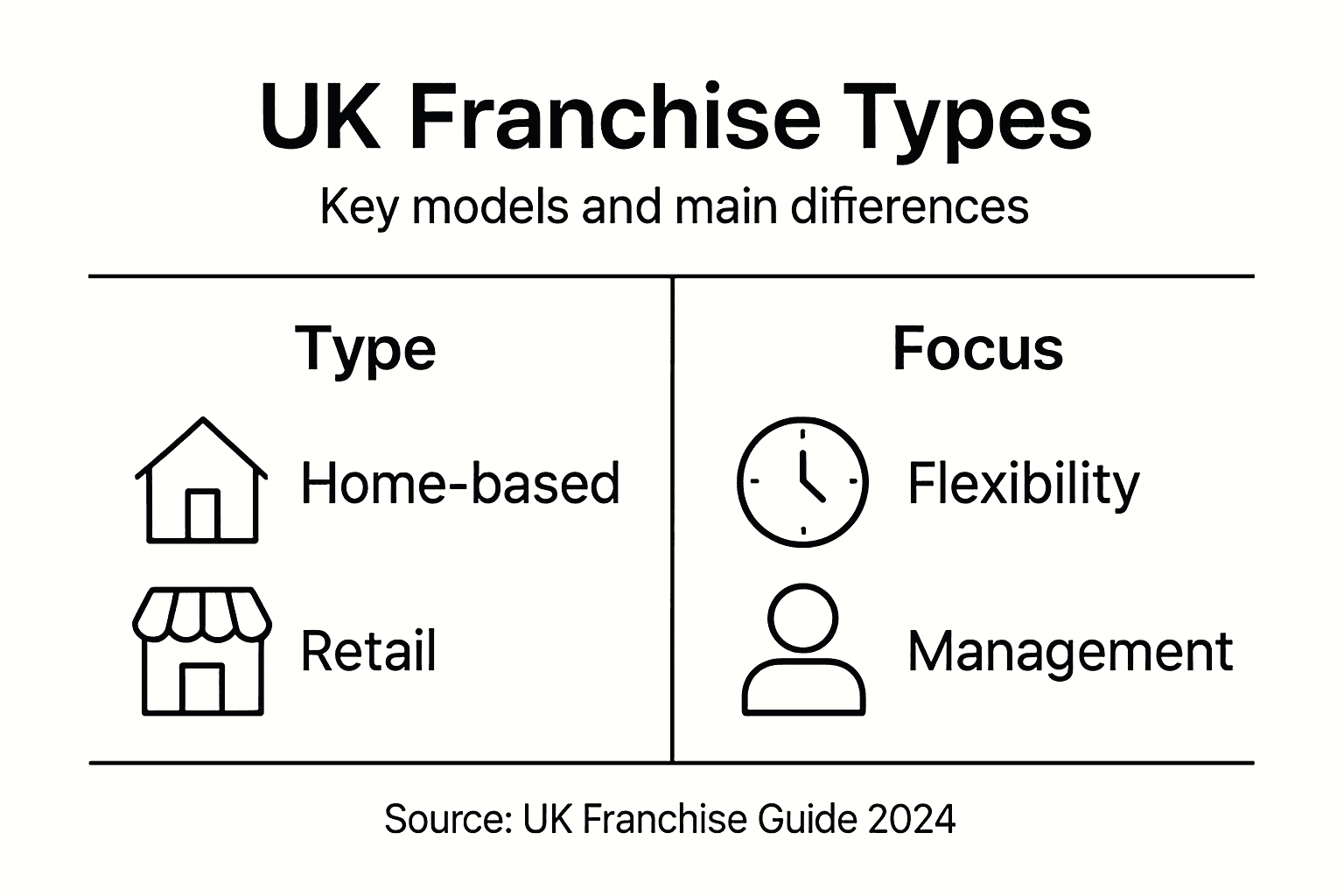
Here’s a comparison of four common UK franchise types to help you assess which best suits your circumstances:
| Franchise Type | Typical Investment Level | Operational Flexibility | Key Skill Requirement |
|---|---|---|---|
| Home-based | Low | High | Self-motivation |
| Retail | High | Low | Customer service expertise |
| Service-based | Moderate | Medium | Technical know-how |
| Management | Substantial | Variable | Leadership and business acumen |
How Franchise Agreements Operate In Practice
Franchise agreements represent complex legal contracts that meticulously define the operational relationship between franchisors and franchisees. Management franchise opportunities illustrate the intricate nature of these agreements, which typically outline comprehensive guidelines covering brand usage, operational standards, financial obligations, and territorial rights.
The standard franchise agreement encompasses several critical components. Initial franchise fees are typically paid upfront, granting the franchisee rights to use the brand’s intellectual property, established business model, and support systems. Ongoing royalty payments – usually calculated as a percentage of gross revenue – provide continuous financial compensation to the franchisor for sustained brand support, marketing infrastructure, and operational guidance. These agreements also specify strict performance benchmarks, quality control mechanisms, and compliance requirements that franchisees must consistently maintain.
Legal frameworks within franchise agreements protect both parties’ interests through detailed provisions. Franchisors retain significant control through clauses defining brand standards, mandatory training programmes, and the right to terminate agreements if performance metrics are not met. Franchisees receive protection through clearly defined territorial rights, transparent financial expectations, and structured support mechanisms that mitigate typical entrepreneurial risks associated with independent business launches.
Pro tip: Always engage an independent franchise solicitor specialising in commercial law to thoroughly review your franchise agreement before signing, ensuring you fully comprehend all legal obligations and potential implications.
Essential Responsibilities Of Franchisees And Franchisors
The franchise relationship involves a delicate balance of responsibilities, with both franchisors and franchisees carrying critical obligations that ensure the success of the business model. Ultimate franchising guide highlights the intricate dynamics of these interdependent roles, where clear expectations and mutual commitment are paramount to sustainable business growth.
Franchisors bear significant responsibilities in supporting their franchisee network. Key obligations include providing comprehensive initial training, delivering ongoing operational support, maintaining robust marketing and branding strategies, and continuously developing the business system. They must develop standardised operational procedures, supply chain networks, and proprietary technologies that enable franchisees to replicate the brand’s success consistently. Additionally, franchisors are responsible for protecting the brand’s reputation, ensuring quality control across all franchise locations, and adapting the business model to changing market conditions.
Franchisees, conversely, are tasked with executing the franchisor’s established business model with precision and commitment. Their core responsibilities include maintaining strict adherence to operational standards, paying prescribed franchise fees and royalties, participating in mandatory training programmes, and representing the brand’s reputation in their local market. Franchisees must also invest in local marketing efforts, maintain prescribed performance metrics, and provide regular financial and operational reporting to their franchisor. This structured approach ensures consistency while allowing some flexibility for local market adaptation.
Pro tip: Develop a transparent communication strategy with your franchisor, treating the relationship as a collaborative partnership rather than a transactional arrangement.
Costs, Risks, And Legal Considerations In Franchising
Franchising presents a complex financial landscape with multifaceted costs and potential risks that prospective franchisees must carefully evaluate. Low cost franchise opportunities demonstrate that initial investment requirements can vary dramatically across different business models, ranging from modest home-based ventures to substantial retail or management franchises.
Initial investment costs typically encompass multiple financial components beyond the standard franchise fee. These include equipment purchases, initial inventory, marketing expenditures, legal and professional consultation fees, lease or property acquisition costs, and working capital reserves. Potential franchisees must conduct comprehensive financial planning, accounting for both upfront expenses and ongoing operational costs. Risks in franchising extend beyond financial considerations, incorporating potential challenges such as territorial limitations, performance expectations, brand reputation dependencies, and complex contractual obligations.
Legal considerations form a critical aspect of franchise investment, requiring meticulous examination of the franchise agreement. Prospective franchisees must thoroughly understand intellectual property rights, territorial exclusivity clauses, termination conditions, renewal terms, and potential restrictions on business operations. The legal framework governing franchises in the United Kingdom provides specific protections for both franchisors and franchisees, but requires careful navigation to ensure comprehensive understanding of mutual responsibilities and potential liabilities.
Below is a summary of essential financial and legal considerations for UK franchisees:
| Consideration | Why It Matters | Common Examples |
|---|---|---|
| Upfront Costs | Determines initial investment | Franchise fee, equipment, inventory |
| Ongoing Expenses | Affects profitability | Royalties, marketing contributions |
| Legal Protections | Safeguards both parties | Intellectual property, territorial rights |
| Operational Restrictions | Impacts business autonomy | Performance benchmarks, exclusivity clauses |
Pro tip: Engage an independent franchise solicitor specialising in commercial law to conduct a comprehensive review of all franchise documentation before making any financial commitments.
Discover Your Perfect Franchise Opportunity in the UK
Understanding the franchise model is the first step toward realising your dream of owning a successful business with reduced risk. Many aspiring entrepreneurs struggle with choosing the right franchise type, navigating complex legal agreements, and assessing the real costs involved. If you are seeking clarity on these challenges and want to explore franchises that align with your lifestyle and investment capacity, FranchiseLocal offers an invaluable resource.
Our comprehensive UK franchise directory connects you with a wide range of options including home-based, retail, service-based, and management franchises. Benefit from detailed listings filtered by price, industry, and operational models to find a franchise that truly fits your goals. Act now to take control of your future by exploring the ultimate franchising guide, reviewing available management franchises, and browsing the full selection on FranchiseLocal. Make informed decisions with confidence and start building your UK franchise business today.
Frequently Asked Questions
What is a franchise model?
A franchise model is a business arrangement where an established brand (franchisor) allows independent entrepreneurs (franchisees) to operate a business using the brand’s trademark, business system, and operational processes.
What are the benefits of franchising for entrepreneurs?
Franchising offers reduced risk compared to starting an independent business, comprehensive training, ongoing support, and a proven operational framework, making it an attractive option for aspiring business owners.
What are the main components of a franchise agreement?
Key components of a franchise agreement typically include an initial franchise fee, ongoing royalty payments, operational guidelines, performance benchmarks, and territorial rights, which govern the relationship between the franchisor and franchisee.
How do I choose the right type of franchise?
To select the right type of franchise, assess your personal skills, financial capacity, and lifestyle preferences to ensure the franchise model aligns with your entrepreneurial goals and allows for the best chance of success.