

Franchise fees confuse more aspiring franchisees than almost any other part of the investment process. You sign up excited about a brand, then discover a web of royalties, marketing levies, and support charges that nobody explained clearly upfront. The result? Budget shortfalls, strained relationships with franchisors, and in some cases, businesses that fail not because of poor trading but because of poor financial planning. This guide walks you through exactly how franchise fees work in the UK, how to structure them sensibly, and how to negotiate from a position of genuine knowledge rather than blind trust.
Key Takeaways
| Point | Details |
|---|---|
| Know your fee types | Identify and understand each fee category to assess their value. |
| Benchmark and research | Compare fees against industry averages and similar franchises to set fair terms. |
| Document everything | Ensure all fee agreements are explicitly written to prevent future misunderstandings. |
| Negotiate confidently | Use data and professional advice to secure the best possible fee structure. |
Understanding franchise fees and their purposes
Before you can structure anything, you need to know what you are actually paying for. Franchise fees are not a single charge. They are a collection of payments, each serving a different purpose, and each affecting your profitability in a different way.
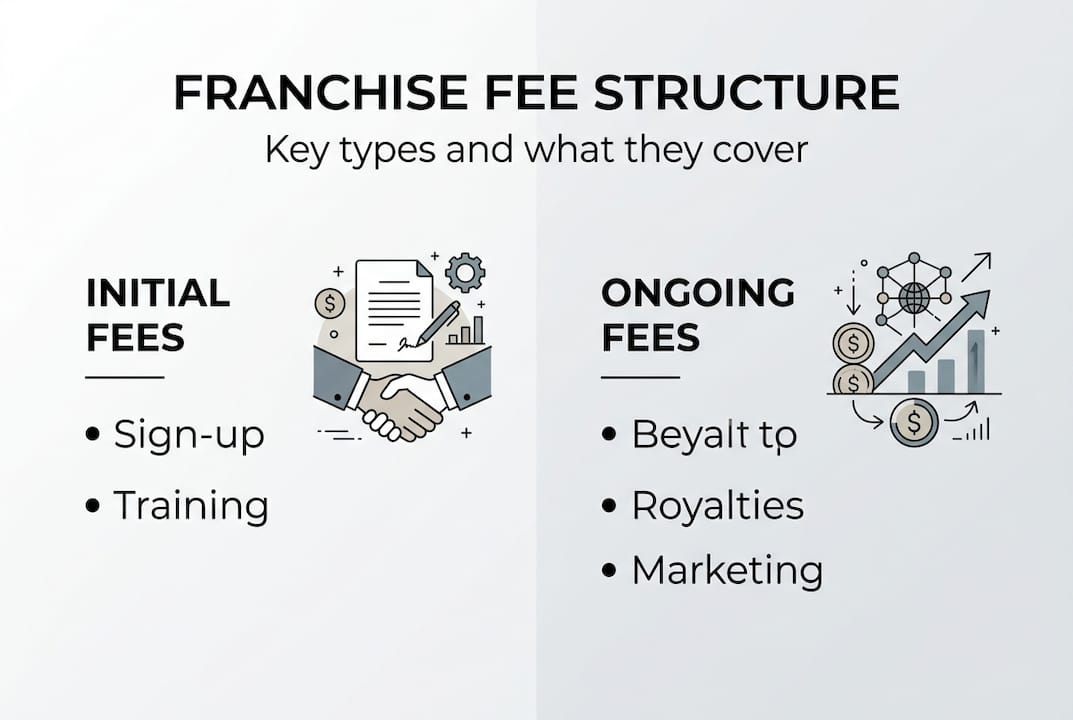
The initial franchise fee is a one-off payment made when you sign the franchise agreement. It buys you the right to trade under the franchisor’s brand, use their systems, and receive initial training. Think of it as the entry ticket. Most UK franchise initial fees range from £5,000 to £50,000 depending on the brand’s scale and reputation.
Royalty fees are ongoing payments, usually calculated as a percentage of your gross turnover. These fund the franchisor’s continued support, head office operations, and product or service development. They are typically charged monthly and are the most significant recurring cost you will face.
Marketing fees (sometimes called the marketing fund levy) are separate contributions that pool together across all franchisees to fund national or regional advertising campaigns. You benefit from brand-level marketing that you could never afford alone, but you have limited control over how the money is spent.
Support fees may cover IT systems, software licences, helpdesk access, and operational tools. Some franchisors bundle these into the royalty; others charge them separately.
Here is a quick breakdown for reference:
| Fee type | Typical structure | What it funds |
|---|---|---|
| Initial fee | Fixed, one-off | Brand licence, initial training |
| Royalty fee | % of gross turnover | Ongoing support, head office |
| Marketing levy | % of gross turnover | National/regional advertising |
| Support/IT fee | Fixed monthly or % | Software, systems, helpdesk |
Key fee types at a glance:
- Initial fee: paid once at the start of the agreement
- Royalty fee: paid monthly, based on sales performance
- Marketing levy: pooled fund for brand-level advertising
- Support fees: cover IT, systems, and operational tools
- Renewal fees: sometimes charged at the end of a franchise term
Understanding the franchise fee breakdown before signing anything is not optional. It is the foundation of every financial decision you will make. Franchisors charge an average of 12% of franchisee sales in total fees to fund support services including training, marketing, and IT. That 12% figure is your benchmark when evaluating any opportunity.
“Clarity on fees is not just good practice. It is the difference between a sustainable franchise and one that quietly bleeds cash from the moment you open your doors.”
Knowing what the marketing fund purpose actually is helps you assess whether the levy is genuinely delivering value or simply subsidising the franchisor’s own promotional costs. Similarly, understanding the support systems for franchisees tells you whether the royalty you pay is earning its keep.
Key steps to structuring your franchise fees
Structuring franchise fees well requires a methodical approach. Whether you are a franchisor setting fees or a franchisee evaluating them, the same logical process applies.
- Research the market. Start by gathering data on what comparable franchises charge. Look at brands in your sector and at a similar investment level. The 12% average total fee is a useful starting point, but sector norms vary considerably.
- Benchmark against similar brands. Do not benchmark in isolation. Compare at least three to five brands at a similar scale. Note which fees are bundled and which are itemised.
- Consult key stakeholders. If you are a franchisor, speak to existing franchisees about what they feel is fair. If you are a franchisee, speak to a franchise solicitor and an accountant with franchise experience.
- Model financial scenarios. Build a spreadsheet that shows your projected revenue at three levels: conservative, realistic, and optimistic. Apply the fee percentages to each. This reveals how fees affect profitability across different trading conditions.
- Test the support systems. Before committing, ask for evidence that the support services funded by your fees actually work. Request references from existing franchisees and ask specific questions about response times and quality.
Here is a comparison of the three main fee models:
| Model | How it works | Best suited to |
|---|---|---|
| Fixed fee | Set monthly amount regardless of sales | Stable, predictable revenue businesses |
| Percentage of turnover | Fee rises and falls with your sales | High-growth or variable revenue models |
| Hybrid model | Fixed base plus a smaller percentage | Balances franchisor security with franchisee fairness |
Pro Tip: When pricing your franchise investment, always model the hybrid option even if the franchisor only offers one structure. It gives you a negotiating reference point and demonstrates that you understand the financials.
One of the most common mistakes is failing to account for the cumulative weight of all fees together. A 7% royalty sounds reasonable. Add a 3% marketing levy and a £300 monthly IT fee, and suddenly you are at 10% plus a fixed charge. Understanding royalty fee considerations in full context is essential before you sign.

Common pitfalls and how to avoid them
Even experienced investors fall into traps when evaluating franchise fees. Knowing where others go wrong is one of the fastest ways to protect yourself.
The most frequent pitfalls include:
- Opaque fee agreements: Franchise agreements that use vague language around fees, such as “reasonable charges” or “as determined by the franchisor,” leave you exposed to unilateral increases.
- Underestimating ongoing support costs: Many franchisees focus on the initial fee and overlook the cumulative cost of royalties and levies over a five or ten-year term.
- Failing to benchmark: Accepting the first fee structure presented without comparing it to market norms is a costly mistake.
- Ignoring renewal terms: Some franchise agreements include fee increases at renewal. If you do not read the small print, you may face a very different cost structure in year six.
- Not budgeting for support shortfalls: If the franchisor’s support is inadequate, you may need to spend additional money on external help, effectively paying twice.
Pro Tip: Before signing any franchise agreement, have it reviewed by a solicitor who specialises in franchising. The British Franchise Association (BFA) maintains a directory of accredited legal advisers. The cost of a professional review is a fraction of what a poorly structured agreement can cost you over a decade.
The consequences of getting this wrong are serious. Total fees averaging 12% of sales means that on a £300,000 annual turnover, you are paying £36,000 per year in fees alone. If those fees are not clearly defined, you have no basis for disputing unexpected charges or holding the franchisor accountable for service delivery.
Learning about negotiating franchise terms before you reach the negotiating table puts you in a far stronger position. And exploring cost-saving strategies can help you identify where efficiencies are possible without compromising on quality.
Verifying and negotiating franchise fees
Once you understand the structure and the pitfalls, the final step is verification and negotiation. This is where many franchisees leave money on the table by assuming that fee structures are fixed and non-negotiable.
Start by verifying every line item in the fee schedule:
- Request a full written breakdown of all fees, including any that are not mentioned in the headline figures. Ask specifically about renewal fees, transfer fees, and any ad hoc charges.
- Confirm what each fee includes. Get written confirmation of exactly what services are covered by each charge. Verbal assurances are worthless in a dispute.
- Speak to existing franchisees. Ask them directly whether the support funded by fees matches what was promised. Their experience is the most reliable data you will find.
- Review audited accounts. For established franchisors, ask to see how the marketing fund has been spent. Franchisors with nothing to hide will share this readily.
- Compare against the 12% benchmark. If total fees significantly exceed the 12% industry average, you need a compelling explanation for why the premium is justified.
When you move to negotiation, preparation is everything.
“The franchisee who arrives at the negotiating table with data, benchmarks, and specific questions will always secure better terms than the one who arrives with enthusiasm alone.”
Gather your benchmarks, prepare alternative scenarios, and be specific about what you want changed. Focus on the elements with the greatest long-term impact: royalty rates, marketing levy transparency, and support service guarantees. Review the franchise negotiation steps carefully before any meeting with a franchisor.
After negotiation, verify the final agreement once more. Ensure every agreed change is reflected in the written contract. Reading the essential tips for new franchisees can also help you spot what experienced franchisees wish they had checked before signing.
Why a transparent franchise fee structure is non-negotiable
Here is an uncomfortable truth: most franchise disputes are not about brand strategy or territory rights. They are about money, and specifically about fees that were never clearly defined in the first place.
We have seen too many franchisees discover, eighteen months into their venture, that the support they thought was included costs extra, or that the marketing levy is being spent on initiatives that benefit the franchisor more than the network. A small variance of even 1% or 2% in fees might seem trivial on paper, but compounded over a five-year term on a growing business, it represents tens of thousands of pounds.
The best franchise relationships are built on transparency, not just brand appeal or gut instinct. Unpacking franchise royalties in full before you commit is not pessimism. It is professionalism. Franchisors who resist providing clear, written fee breakdowns are telling you something important about how they operate. Pay attention to that signal.
Confident negotiation, thorough verification, and a refusal to accept vague language in agreements are not signs of distrust. They are the hallmarks of a franchisee who will succeed.
Ready to franchise with confidence?
Understanding franchise fees is just the beginning. The UK franchise market offers hundreds of opportunities across every sector and investment level, and finding the right fit requires more than fee knowledge alone. At Franchise Local, we have built the ultimate guide to franchising to help you navigate every stage of the process, from initial research to signing day.
Explore franchise industries in the UK to discover which sectors align with your skills, budget, and lifestyle. And when you are ready to get professional support, our directory of expert franchise services connects you with solicitors, accountants, and consultants who specialise in franchising.

Frequently asked questions
What is a typical franchise fee percentage in the UK?
Most franchisors charge around 12% of gross sales in total fees, which generally covers training, marketing, and IT support.
Can franchise fees be negotiated?
Yes, some components of franchise fees can be negotiated, particularly royalty rates and support service inclusions, though initial licence fees tend to be less flexible.
What do franchise fees pay for?
Franchise fees typically fund training, ongoing operational support, marketing campaigns, and IT systems, ensuring consistency and quality across the brand. Franchisors charge fees to fund these essential support services.
What are the risks of unclear franchise fee structures?
Unclear franchise fees can lead to surprise costs, budget shortfalls, and disputes between franchisee and franchisor that are difficult and expensive to resolve.