

Starting a franchise in the UK without understanding exactly what support your franchisor must provide is a surprisingly common mistake. Unlike countries such as the USA, France, and Australia, the UK has no statutory law requiring franchisors to hand over a disclosure document or guarantee any specific level of support. There is no legal baseline. That means what you receive in terms of training, guidance, marketing help, and ongoing operational backing depends entirely on what is written into your franchise agreement and what you are willing to push for during negotiations. This guide cuts through the confusion so you can enter the process informed, protected, and prepared.
Key Takeaways
| Point | Details |
|---|---|
| No legal guarantee | UK franchise law does not automatically grant you franchisor support—always check the contract. |
| Best practice beats assumption | Franchisors are expected to offer written, timely disclosure of support, but this is ethical code, not law. |
| Vague promises risk disputes | Many franchisee problems come from relying on informal or verbal promises instead of written terms. |
| Due diligence is key | Ask questions, review documents, and verify with existing franchisees before you commit. |
What franchisor support actually means
Before you evaluate any franchise opportunity, you need a clear picture of what “franchisor support” actually refers to. It is not a single document or a one-off induction day. Real support spans the entire lifecycle of your franchise, from your first day of training through to your ongoing performance as a franchisee years down the line.
In the UK context, understanding the franchisor’s role is essential because the relationship is built on an asymmetry of knowledge. The franchisor holds the systems, the brand, and the expertise. Your job as a franchisee is to execute. But execution requires consistent, reliable input from the franchisor, and that input takes many forms.
Here is what genuine franchisor support typically includes:
- Pre-opening training: A structured programme covering operations, sales, customer service, and compliance before your doors open
- Ongoing operational guidance: Access to a support team or field consultant who visits regularly and helps troubleshoot problems
- Marketing assets and campaigns: Ready-made materials, digital templates, national advertising, and local marketing support
- IT systems and technology access: Point-of-sale software, CRM tools, reporting dashboards, and any proprietary platforms the network uses
- Supply chain and procurement support: Approved supplier lists, negotiated pricing, and purchasing assistance
- Financial and business planning help: Benchmarking against network performance data, budgeting tools, and sometimes dedicated finance contacts
- HR and legal compliance guidance: Templates, policies, and advice for managing staff within the brand’s standards
“Support commitments should be actively checked for in the disclosure pack and in what the franchisor says is ‘material’ to the relationship.”
Franchise Disclosure Document in the UK: What to Include
This matters because none of these elements are automatically included. A franchisor could technically offer a ten-day training course and call it “full support.” Without specifics written into your agreement, you have no recourse if the training is inadequate or the ongoing help disappears after launch.
Pro Tip: Ask every franchisor to show you the support schedule or service level commitments in writing before you sign. If they cannot produce a document, that tells you something important.
Franchisor obligations in the UK: law, ethics and reality
This is where many prospective franchisees get caught out. The UK is an outlier. In the United States, franchisors must provide a Federal Trade Commission-mandated Franchise Disclosure Document. France has its Loi Doubin, which legally requires disclosure at least 20 days before signing. Australia’s Franchising Code of Conduct is a mandatory industry regulation. The UK has none of these.

As franchising in the UK makes clear, there is no legal requirement for a UK franchisor to issue a formal disclosure document, but best-practice guidelines and ethical codes do expect transparent, timely disclosure that covers training, support, and systems. That is a critical distinction: expectation is not the same as legal obligation.
Here is how the UK compares internationally:
| Country | Legal disclosure required? | Mandatory support provisions? | Governing body |
|---|---|---|---|
| United Kingdom | No | No | British Franchise Association (voluntary) |
| United States | Yes (FTC FDD) | Partially specified | Federal Trade Commission |
| France | Yes (Loi Doubin) | Yes | Commercial law |
| Australia | Yes (Franchising Code) | Yes | ACCC |
The British Franchise Association (BFA) operates a voluntary Code of Ethics that encourages written, timely, and transparent disclosure from its members. This code expects franchisors to share clear details about their support structures, training programmes, and operational systems. However, because membership of the BFA is not compulsory, many franchisors operate entirely outside its framework.
Many franchisees mistakenly believe that BFA membership equals legally binding support commitments. It does not. It signals intent and professionalism, but it is not a guarantee.
This is why reviewing UK franchise legal requirements matters so much before you sign anything. The legal framework around franchise agreements in the UK is contract-based, meaning your rights and remedies depend almost entirely on what the agreement says. Get it right before you sign, not after.
The risks of assumed support: lessons from disputes
When support is vague, reduced, or quietly removed, franchisees can find themselves in a deeply difficult position. This is not theoretical. Disputes involving large, recognisable brands demonstrate just how exposed franchisees can be.
In a high-profile case, franchisees accused Vodafone of making changes to commercial terms and promised support that allegedly left some of them in financial difficulty. The franchisees claimed that support quality deteriorated after the initial agreement was signed and that inconsistencies in how the network was managed compounded their losses. Cases like this highlight that support quality can break down significantly when commercial conditions change, particularly if those commitments are not locked in contractually.
The following table shows common pitfalls that arise when support is not properly specified:
| Pitfall | What it looks like | Impact on the franchisee |
|---|---|---|
| Support withdrawn post-launch | Field visits stop, helpline response times worsen | Franchisee operates without guidance |
| Fees increased mid-term | Marketing levy or royalty rises | Margin eroded, projections invalid |
| Technology changes without notice | New system introduced, old training redundant | Operational disruption and extra cost |
| Marketing support reduced | National campaigns cut, local materials withdrawn | Customer acquisition becomes franchisee’s burden |
| Inconsistent communication | Different answers from different support contacts | Confusion and poor compliance |
| Training quality drops | New staff or content, without updating agreement | Franchisee unprepared for challenges |
Understanding your franchisee responsibilities is important too, because franchisors can sometimes use a franchisee’s failure to comply with obligations as a reason to reduce support. This creates a cycle that is very hard to escape without written clarity from the start.
Here are the steps you should take to protect yourself from these risks:
- Review all written agreements carefully and have a specialist franchise solicitor check every clause relating to support, training, and communication
- Research the franchisor’s history by looking for any public disputes, court cases, or formal complaints lodged with industry bodies
- Clarify every support term explicitly including frequency of field visits, response times, marketing budgets, and what happens if the franchisor changes ownership
- Ask specifically about change management so you know what notice period applies if fees, support structures, or technology platforms change
- Secure written confirmation of every verbal commitment made during the sales process before you proceed
Pro Tip: Never rely on verbal promises, regardless of how senior the person making them is. If it is not in writing, it does not exist as far as your legal protection is concerned.
What to look for: evaluating franchisor support before you sign
Thorough due diligence is your single most powerful tool. The good news is that most franchisors with genuinely strong support will be happy to provide written details, introduce you to existing franchisees, and let their track record speak for itself. It is the evasive ones you need to watch.
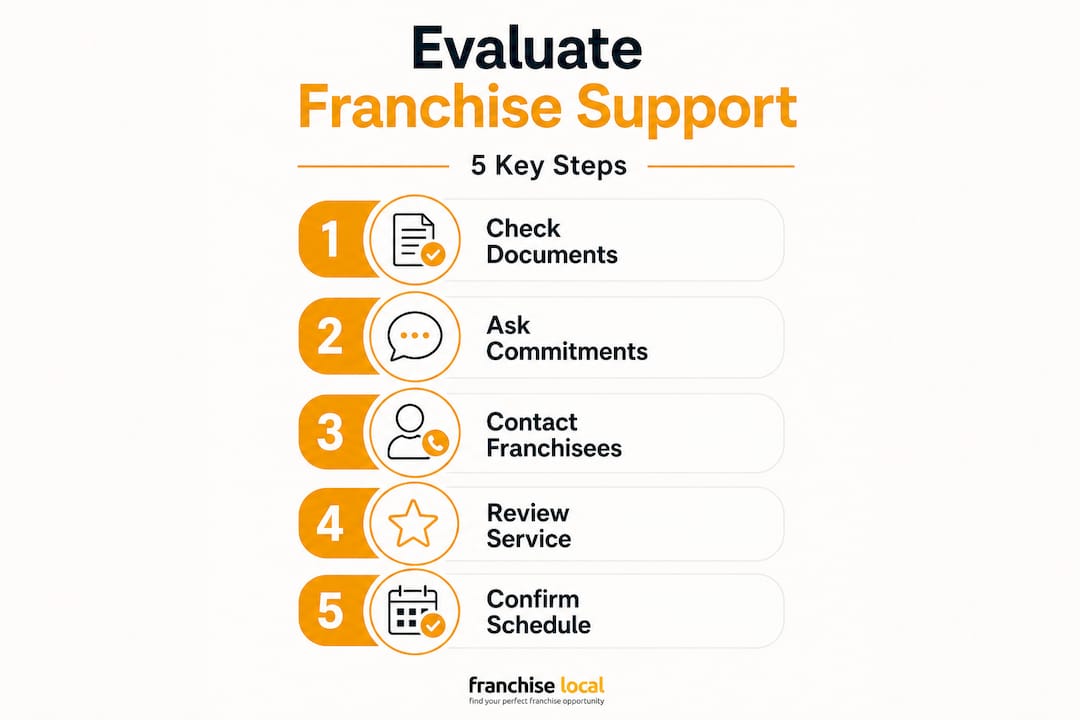
When reviewing a disclosure pack or information memorandum, look for concrete specifics. Vague language like “ongoing support” or “comprehensive training” without any detail is a red flag. You want schedules, timelines, names of support personnel, and measurable commitments. The most important thing to remember is that support commitments must be actively verified from the disclosure pack, not assumed from category-level promises.
Here are the questions you should put to any franchisor before signing:
- How many days of initial training do you provide, and is it classroom-based, on-site, or both?
- Who is my dedicated support contact, and what is their typical response time?
- How often will a field consultant visit my territory, and what does that visit include?
- What happens to my support arrangements if the franchisor is sold or restructures?
- Is there a cap on the marketing levy, and who decides how those funds are spent?
- What support is available for franchise marketing support at the local level as opposed to national campaigns?
- Are there benchmarks or KPIs for how quickly the franchisor must respond to problems?
Exploring the franchisor’s franchise support systems in detail will also reveal whether the infrastructure genuinely exists or is simply described in a brochure.
Watch for these red flags during the evaluation process:
- Broad, non-specific promises about support without any written breakdown
- Reluctance to provide references from current or former franchisees
- Inconsistent answers from different members of the franchisor’s team
- Pressure to sign quickly without giving you time to consult a solicitor
- No mention of support timelines or any service level expectations
Pro Tip: Contact at least three existing franchisees from the network, ideally including one who has been with the brand for more than three years. Ask them honestly whether the support they receive matches what they were promised at the outset.
Why overconfidence in franchisor support can be your biggest mistake
Here is the uncomfortable reality that most franchise sales brochures will never tell you. Brand recognition is not the same as operational support. A well-known national name on the front of your business does not guarantee that the back-end support structures are robust, consistent, or even present. In fact, larger franchise networks sometimes have more impersonal support simply because of scale. You can be one of hundreds of franchisees waiting for a response from an overstretched support team.
We have seen prospective franchisees walk into negotiations assuming that because a brand is well-established, everything must be sorted out. They invest six figures, sign a long-term agreement, and only discover after launch that field support is an annual visit rather than quarterly, or that the “marketing team” is one person managing a national email list.
The robust support systems you need to look for are the ones that have been tested, documented, and verified by actual franchisees in the network, not the ones described in a glossy information pack. Market reputation can help you shortlist candidates, but it cannot replace contractual clarity.
The strongest safety net is the one you build yourself by asking the right questions and securing every single answer in writing. That applies whether you are looking at a fledgling brand with five locations or a national network with five hundred. Neither size nor fame is a substitute for written commitments, specific timelines, and a franchise agreement that actually reflects what you were promised during the sales process.
Demand more than brochure-level assurances. Push back if the answers are vague. And remember that any franchisor who genuinely values its franchisees will welcome your due diligence rather than resist it.
Ready to find the right franchisor support?
Equipped with a clearer picture of what genuine support looks like, what the law does and does not require, and how to protect yourself before signing, you are ready to take your next step with confidence. The franchising essentials guide on Franchise Local covers everything from choosing a sector to reviewing legal documents, all designed for prospective franchisees navigating the UK market. You can also connect with experienced franchise service experts including solicitors, consultants, and financial advisers who specialise in helping prospective franchisees conduct proper due diligence. Making the right decision starts with having the right people and resources around you.
Frequently asked questions
Is franchisor support legally guaranteed in the UK?
No, franchisor support is not required by UK law and must be confirmed in your agreement. As UK franchise law confirms, there is no legal requirement for a franchisor to issue a formal disclosure document, making written contractual commitments essential.
What kinds of support should a UK franchisor offer?
Typically, you should look for training, operational help, marketing resources, and ongoing systems support. These support commitments should appear explicitly in the disclosure pack rather than being assumed from general descriptions.
Can a franchisor change or withdraw support after signing?
It is possible if not explicitly prevented by the contract, so written commitments are vital. Disputes such as those involving Vodafone franchisees show that support quality can deteriorate significantly when commercial conditions shift.
How do I check a franchisor’s support promises?
Review their written disclosure pack, ask for specific commitments, and speak to existing franchisees. The most reliable verification comes from checking the disclosure pack for material details about training, systems, and ongoing help rather than relying on broad assurances.