

Legal compliance is one of the most important factors in franchise success, yet it is also where many operators stumble. Missing a single filing deadline, using an incomplete franchise agreement, or overlooking data protection obligations can trigger regulatory action, costly disputes, and lasting reputational damage. The good news is that compliance is entirely manageable when you approach it systematically. This guide walks you through every essential step, from setting up your foundational documents to running ongoing audits, so you can operate with confidence and protect everything you have built.
Key Takeaways
| Point | Details |
|---|---|
| Start with strong foundations | Secure contracts and register all key documents before operating your franchise. |
| Follow a system | Consistent compliance systems across all outlets reduce risk and build brand reputation. |
| Stay proactive | Routinely audit compliance and update policies as laws and markets change. |
| Act quickly on issues | Address compliance failures immediately to protect your franchise and reputation. |
| Seek expert support | Get specialist legal advice when in doubt to avoid costly mistakes. |
Understanding franchise legal compliance in the UK
Before you can act on compliance, you need to understand what it actually covers. “Legal compliance” in a franchise context means meeting every legal obligation that applies to your business structure, your relationship with the franchisor, your staff, your customers, and your data handling practices. It is not a single task you complete once. It is a continuous commitment.
The main compliance categories UK franchise operators need to manage include:
- Contracts: Your franchise agreement governs your entire relationship with the franchisor. It must be legally sound, clearly worded, and up to date with current UK law.
- Intellectual property (IP): Trademarks, brand assets, and proprietary systems must be correctly registered and protected to prevent misuse.
- Employment law: From contracts and minimum wage to holiday entitlement and disciplinary procedures, your HR practices must fully meet UK employment standards.
- Health and safety: Every outlet must comply with the Health and Safety at Work Act 1974 and sector-specific regulations.
- Data protection: GDPR and the UK Data Protection Act 2018 set strict rules on how you collect, store, and use personal data.
- Consumer protection: Trading standards, advertising rules, and consumer rights legislation all apply to how you operate and market your services.
The scale of UK franchising makes consistent compliance especially critical. UK franchising has a large sector footprint, with thousands of franchise units operating across the country, which increases the practical importance of consistent legal and compliance systems across outlets. When you multiply one small oversight across dozens of locations, the consequences grow fast.
| Compliance area | Potential consequence of failure |
|---|---|
| Contracts | Unenforceable agreements, costly disputes |
| Intellectual property | Brand dilution, competitor misuse |
| Employment law | Tribunals, fines, reputational damage |
| Health and safety | Prosecution, closure, personal liability |
| Data protection | ICO fines up to £17.5 million or 4% of turnover |
| Consumer protection | Trading standards action, legal claims |
Understanding the consequences is not meant to alarm you. It is meant to sharpen your focus. A clear grasp of the franchise legal requirements that apply to your business is the foundation everything else rests on.
“Compliance is not about avoiding punishment. It is about building a business robust enough to grow sustainably and withstand scrutiny at every stage.”
Reviewing a thorough limited company compliance guide can also help you understand the broader business obligations that sit alongside franchise-specific requirements.
Preparing for compliance: Essential documents and requirements
Before you trade, you need the right foundations in place. Many franchise operators underestimate how much paperwork is involved at the outset, and gaps in documentation at launch tend to create serious problems further down the line.

Franchisees must ensure contracts, disclosure documents, IP registrations, and relevant business registrations are all completed before trading begins. This is not optional. Each document serves a distinct legal purpose, and missing any one of them leaves you exposed.
Here is what you need to gather and complete before you open your doors:
- Franchise agreement: The legally binding contract between you and the franchisor. Have a specialist solicitor review this before you sign anything.
- Disclosure document: This sets out all material information about the franchise opportunity and the franchisor’s business. A thorough disclosure document protects both parties.
- Company registration: Register your business with Companies House. Choose your structure carefully, whether sole trader, limited company, or partnership, as each carries different legal and tax implications.
- Trademark registration: Ensure all brand assets are registered with the Intellectual Property Office (IPO) and that your licence to use them is clearly set out in your agreement.
- VAT registration: If your expected turnover exceeds the current threshold (£90,000 as of 2026), you must register for VAT with HMRC before trading.
- Sector-specific licences: Food businesses, care providers, and financial services franchises all require additional licences and regulatory approvals.
A useful way to approach this is to compare what a franchisor should provide against what you need to obtain independently:
| Document | Provided by franchisor | Obtained independently |
|---|---|---|
| Franchise agreement | Yes | Solicitor review required |
| Disclosure document | Yes | Retain your own copy |
| Company registration | No | Companies House |
| Trademark licence | Yes (as part of agreement) | IPO registration check |
| VAT registration | No | HMRC |
| Sector licences | Sometimes | Local authority or regulator |
| Employment contracts | Template often provided | Tailor to UK employment law |
When considering franchising your business or buying into an established brand, you should also work through a detailed launch checklist to make sure nothing is missed. Completing proper franchise due diligence before you commit is equally important.
Common mistakes at this stage include rushing company formation, failing to check that the franchisor’s trademarks are properly registered, and skipping solicitor review of the franchise agreement. All three are avoidable and all three regularly lead to expensive problems. Using a reliable company formation checklist keeps you on track.
Pro Tip: Create a master compliance file from day one. Include signed copies of all agreements, company registration certificates, IP licences, insurance documents, and correspondence with regulators. This file becomes invaluable during audits, disputes, and renewal negotiations.
Step-by-step guide to meeting key compliance obligations
With your documents ready, here is your actionable roadmap for meeting all major compliance obligations.
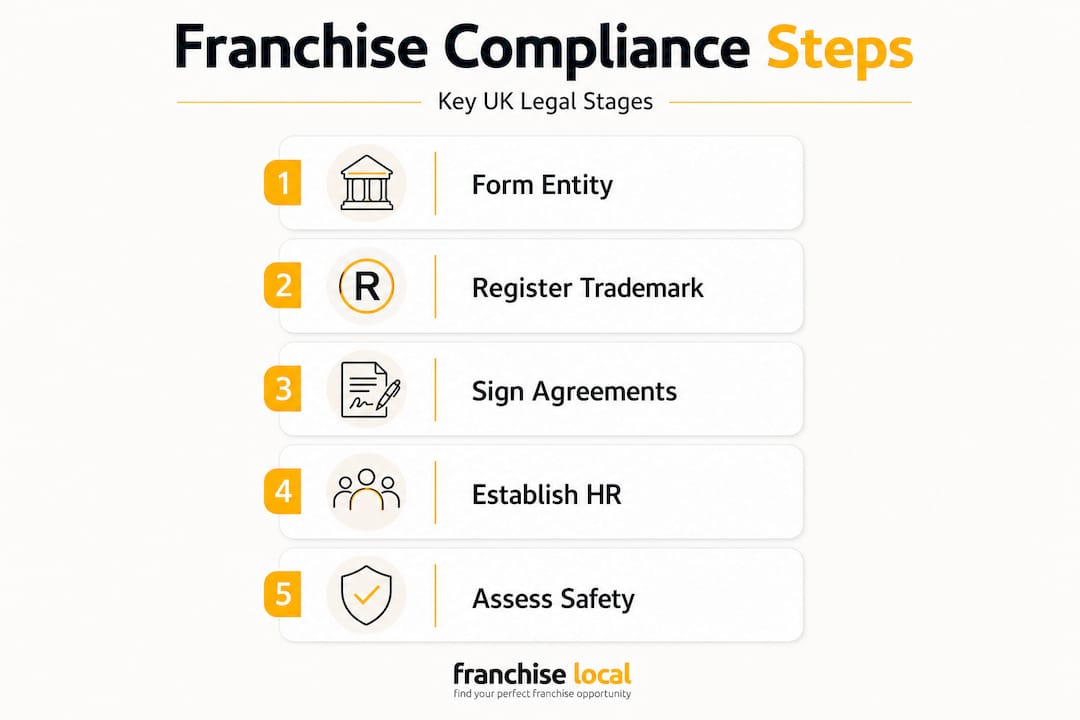
1. Register your business entity
Choose the right legal structure and register with Companies House. A limited company offers personal liability protection, which most franchise operators prefer. Once registered, open a dedicated business bank account and apply for a PAYE (Pay As You Earn) reference number if you plan to employ staff.
2. Register your trademarks and protect your IP
Check whether the franchisor has already registered the brand’s trademarks in the UK. If you are developing your own supplementary IP, register it with the IPO. Your franchise agreements should clearly define what IP you are licenced to use and under what conditions.
3. Establish legally compliant franchise agreements
Your franchise agreement must comply with UK contract law, cover territory rights, renewal terms, exit clauses, and fee structures in precise language. Vague wording creates disputes. Have a solicitor who specialises in franchise law review every clause. This is not an area to save money on.
4. Set up employment contracts and HR compliance
Every employee must receive a written statement of particulars from day one. Ensure your contracts reflect current National Living Wage rates, Working Time Regulations, statutory leave entitlements, and disciplinary procedures. Consistent systems for contracts, IP, employment, health and safety, and consumer and data protection are essential across all your outlets.
Reviewing a thorough payroll compliance checklist ensures your payroll setup meets HMRC requirements from the start.
5. Implement health and safety protocols
Conduct a full risk assessment for your premises or operational environment. Appoint a competent person responsible for health and safety. Display your health and safety law poster where all employees can see it. Keep records of all risk assessments, training, and incidents.
6. Meet GDPR and data protection obligations
Register with the Information Commissioner’s Office (ICO) if you process personal data. Create a clear privacy policy. Establish procedures for handling data subject access requests and data breaches. Train all staff on what they can and cannot do with customer and employee data. Staying on top of HMRC compliance requirements runs alongside your data obligations as part of broader business governance.
7. Comply with consumer protection law
Make sure your marketing materials are accurate and not misleading. Understand your obligations under the Consumer Rights Act 2015, particularly around returns, refunds, and service guarantees.
Statistic to note: The ICO issued fines totalling over £10 million in 2024 alone, targeting businesses that failed to meet basic data protection standards. For a franchise network, one non-compliant outlet can trigger scrutiny across the entire brand.
Exploring the broader legal considerations early helps you anticipate obligations you might not have known about. And understanding the importance of legal advice before committing to a franchise purchase protects your investment from the very beginning.
Pro Tip: Schedule a compliance review every six months for the first two years. New franchise operators regularly discover overlooked obligations during their first year of trading. Catching issues early prevents them from compounding.
Ongoing compliance: Monitoring, audits, and adapting to change
Once your business is up and running, compliance does not stop. This is where many franchise owners relax their focus, assuming the hard work is done. It is not.
Market pressure and regulatory updates require franchises to reassess agreements, HR systems, and data and security measures repeatedly, not just at launch. Laws change. Employment case law evolves. GDPR guidance gets updated. Your franchise network grows. Each of these developments requires a fresh compliance review.
Effective ongoing compliance involves several regular activities:
- Internal audits: Conducted by you or a designated compliance officer, these review whether all policies are being followed across your outlets. Aim for at least quarterly checks on high-risk areas like data handling and payroll.
- External audits: Bring in an independent auditor or specialist solicitor periodically, typically once a year, to assess compliance from an outside perspective. External eyes catch what internal teams miss.
- Staff training: Every new employee needs compliance training as part of their induction. Existing staff need refresher training whenever laws change or internal policies are updated.
- Policy updates: Keep a record of when each policy was last reviewed and updated. Set calendar reminders for annual reviews of your employment handbook, data protection policy, and health and safety procedures.
- Compliance logs: Maintain detailed records of every audit, every training session, and every update made to policies. These logs are your first line of defence if regulators come knocking.
- Franchisor relationship: Stay in close contact with your franchisor’s compliance team. They often receive early notice of regulatory changes that affect the network and can provide updated templates or guidance.
Failing to adapt compliance systems as your business grows is one of the most common mistakes franchise owners make. A single outlet is relatively easy to manage. Five outlets multiplies every obligation by five. Twenty outlets requires a structured, repeatable compliance programme with clear ownership and accountability.
“The franchises that build compliance into their daily operations never treat it as a one-off task. They create habits, not checklists.”
Your franchise launch checklist is a starting point, but ongoing success requires building compliance habits that last. Working with a specialist to understand why financial compliance matters for small and medium enterprises also keeps your financial reporting in good order as the business scales.
What to do when things go wrong: Troubleshooting franchise legal issues
Even experienced franchisees can encounter pitfalls. Compliance failures happen. What separates a recoverable situation from a damaging one is how quickly and effectively you respond.
Common compliance problems in franchise operations include:
- Missed Companies House or HMRC filings: Annual accounts or confirmation statements submitted late trigger automatic penalties and can affect your credit rating.
- HR disputes: Unfair dismissal claims, wage disputes, or failure to follow correct disciplinary procedures result in employment tribunal claims.
- Contract breaches: Violating territory exclusivity clauses, using the brand outside agreed parameters, or failing to pay fees on time can allow the franchisor to terminate your agreement.
- Data breaches: Losing customer data, whether through a system hack or a staff error, must be reported to the ICO within 72 hours if it poses a risk to individuals.
- Health and safety incidents: A workplace accident that occurs because your risk assessment was inadequate or not followed can lead to prosecution under the Health and Safety at Work Act.
When a compliance issue surfaces, take these immediate steps:
- Stop any activity that is actively worsening the situation.
- Gather all relevant records, emails, contracts, and incident reports.
- Inform your franchisor as soon as possible, as they may have obligations to report to the regulator under the terms of the franchise agreement.
- Contact your solicitor before making any public statements or communications with regulators.
- Notify relevant authorities where legally required, such as the ICO for data breaches.
Strong franchise due diligence practices reduce the risk of these scenarios arising in the first place, but having a clear response plan means you are never caught without direction.
For complex disputes, mediation is often faster and less costly than litigation. The British Franchise Association (BFA) has a mediation service specifically for franchise disputes. Use it before heading to court.
Regulatory and reputation risks increase for every compliance lapse. Swift action and professional advice are essential. Delays in responding send the wrong message to regulators, franchisors, and customers alike.
“When a compliance issue arises, your first instinct may be to wait and see. Resist it. Every hour of delay increases the risk of escalation.”
Reviewing how tax compliance is managed within your business is also a sensible step during any broader compliance review, as tax obligations often surface as part of wider audits.
Hard-won lessons: What most franchise guides miss about UK legal compliance
Here is the part most guides skip over entirely. They give you the checklist. They list the documents. They explain the regulations. What they rarely tell you is what actually goes wrong in real franchise operations, and why.
The biggest oversight is treating compliance as a paperwork exercise rather than a cultural commitment. You can have perfect documents and still fail to comply if your staff do not understand why the rules exist, or if your culture quietly tolerates shortcuts. Compliance lives in behaviour, not binders.
There is also a scale problem that sneaks up on franchise owners. At one outlet, you know every employee personally. You can spot when procedures are not being followed. At three outlets, you are stretched. At five, you are dependent entirely on managers who may not share your level of diligence. Every new outlet you add multiplies the potential for small inconsistencies to grow into significant legal exposure. This is why investing in compliance training and culture from the very first day is so important. Not just a one-off session, but an ongoing conversation.
Another reality rarely mentioned is the emotional weight of compliance. When you are focused on growing revenue, handling compliance feels like administration dragging you backwards. That mindset is dangerous. The franchise operators we see thrive over the long term are the ones who treat compliance as a competitive advantage, not a burden. A business that regulators, franchisors, and customers can trust attracts better staff, better partners, and better opportunities.
Finally, do not underestimate the relationship between your compliance posture and your ability to grow. Franchisors review compliance records when approving territory expansions. Investors and lenders look at your regulatory history. Even prospective buyers, if you ever choose to sell your franchise, will scrutinise your compliance documentation closely.
Getting ahead of compliance issues, reviewing your detailed guide on franchise legal requirements regularly, and investing in proper legal advice may feel like costs today. In practice, they are the most reliable form of business protection available to you.
Find trusted franchise opportunities that start with compliance
Ready to explore proven, compliant UK franchises? Your compliance knowledge puts you in a stronger position than most prospective franchisees entering the market. Use that advantage to seek out brands with transparent legal processes, robust support structures, and clear franchise documentation from the outset.
At Franchise Local, you can browse hundreds of verified UK franchise listings across every industry and investment level. Whether you are interested in networking franchise opportunities with established communities, or want to explore the top UK franchises across leading sectors, the platform makes it straightforward to identify brands that align with your ambitions and legal expectations. Start your search today and take your next step with confidence, backed by the compliance knowledge you now have.
Frequently asked questions
What is the first legal compliance step for UK franchises?
Registering your business as a legal entity and securing all required licences and agreements is the vital first step. Contracts, disclosure documents, IP registrations, and business registrations must all be completed before you begin trading.
How often should franchise compliance audits occur?
Most franchises benefit from at least annual compliance audits, with additional checks whenever laws or business operations change. Regulatory updates require franchises to reassess agreements and HR systems on an ongoing basis rather than once at launch.
What are the biggest legal risks for UK franchisees?
Common risks include contract breaches, data protection failures, and employment disputes, each carrying potential fines or legal action. UK franchising’s scale and complexity mean missteps can quickly escalate into legal or reputational issues affecting the entire network.
When should I get specialist legal advice for my franchise?
It is essential to consult a solicitor before signing franchise agreements or launching operations. Contracts, disclosure documents, and IP registrations all require legal expertise to ensure they are complete and enforceable.
What should I do if I realise I am not compliant?
Take swift action to resolve issues by gathering records, informing your solicitor, alerting relevant authorities, and correcting processes immediately. Regulatory and reputation risks increase for every compliance lapse, making a rapid and structured response absolutely essential.