

When you start exploring franchise opportunities, the term “exclusive territory” appears almost immediately. Most prospective franchisees assume it means they own their patch outright and no competitor will ever encroach. That assumption is understandable. It is also frequently wrong. Understanding what is an exclusive territory, how it is defined in your contract, and what exceptions the franchisor may retain is one of the most consequential pieces of due diligence you can do before signing anything. This article covers the definition, the practical realities, the benefits, the trade-offs, and exactly how to negotiate from a position of knowledge.
What is an exclusive territory?
An exclusive territory is a contractually defined geographic area allocated solely to one franchisee or distributor, prohibiting others from operating there. The franchisor agrees not to appoint another franchisee or distributor within that boundary. On paper, this gives you a protected zone in which you alone trade under the brand.
The boundaries themselves vary considerably. Some franchise systems use a radius measured from a central point, such as your premises or the nearest town centre. Others draw boundaries along postcodes, county lines, or population thresholds. A franchise serving a rural area in Scotland, for example, might receive a county-level boundary, while an urban food franchise in London might receive a tightly defined postcode cluster. The method matters because it determines your market size, customer base, and long-term growth ceiling.
It helps to understand how exclusive territories compare with the two other types you will encounter:
| Territory type | What it means | Franchisor can open nearby? | Same-brand competitor allowed? |
|---|---|---|---|
| Exclusive | Sole trading rights in defined area | No (with possible carve-outs) | No |
| Protected | Boundaries defined, limited franchisor rights | Sometimes, via other channels | No |
| Non-exclusive | No defined boundaries | Yes | Yes |
The distinction between exclusive and protected is where most confusion arises. Both offer some boundary protection, but protected territories prevent same-brand franchisees from entering while still allowing the franchisor to compete through other channels such as online sales or alternative brand formats. Exclusive territories go further. They restrict the franchisor itself from operating within your area, at least in theory.
Here is a quick overview of how territory boundaries are typically defined:
- Radius: A set distance from your trading location, commonly 1 to 5 miles in urban areas
- Postcodes: One or more postcode sectors assigned exclusively to you
- County or region: Larger geographic divisions, more common in rural or specialist franchises
- Population-based: A territory is sized to contain a minimum number of residents or households
- Named streets or districts: Hyper-local boundaries used in dense city markets
Understanding how territory mapping works before you sign is not optional. It shapes your entire commercial opportunity.
Hidden limitations in territory agreements
Here is the part most people skip. An exclusive territory definition in your contract does not automatically mean you are protected from every form of franchisor competition. The practical reality is more complex.
Carve-outs are exceptions baked into the agreement that allow the franchisor, or the brand, to operate within your area through specific channels. Even if your contract uses the word “exclusive,” these carve-outs can significantly dilute what that exclusivity actually means in practice.
Common carve-outs include:
- Online and e-commerce sales: Franchise agreements may reserve the franchisor’s right to sell directly to customers in your area through a website or app
- Third-party delivery platforms: Fulfilment through services like Deliveroo or Amazon, where the franchisor retains the trading relationship
- Corporate-owned units: The franchisor may establish company-run outlets within or adjacent to your territory
- Non-traditional venues: Kiosks in airports, hospitals, or transport hubs operating under the same brand
- Alternative brand formats: A separate but related brand owned by the franchisor that targets your customer base
Performance benchmarks add another layer of complexity. Modification rights linked to performance and renewal criteria are built into many agreements, meaning that if you fail to hit agreed sales targets, the franchisor may have the right to reduce, split, or reassign your territory. This is not hypothetical. It happens.
There is also a meaningful difference between an “exclusive marketing area” and a true exclusive territory. Some franchisors grant exclusive marketing rights, meaning you are the only franchisee permitted to actively market in that zone. But the contract may still allow the franchisor or another operator to serve customers who walk in, call in, or purchase online from within your area. These are not the same thing, and conflating them is a costly mistake.
Pro Tip: Before signing, ask the franchisor to list every carve-out in writing. If the agreement says “exclusive” but the franchisor cannot confirm what that excludes, treat the territory clause with considerable scepticism.
Benefits and drawbacks for franchisees
Exclusive territories offer genuine, tangible advantages. But they come with trade-offs worth understanding clearly.
The core benefit is security. When you invest a substantial sum in a franchise, you want confidence that another franchisee carrying the same brand will not open two streets away and split your customer base. Exclusive territories provide that protection at the intra-brand level, and for many franchise buyers, that security justifies a higher initial franchise fee.
Here are the main benefits, ranked by practical impact:
- Protection from intra-brand competition: No other franchisee in your defined area. Your marketing efforts build your business, not a competitor’s.
- Clearer return on investment: You can model your revenue potential based on the population and demand within a defined boundary, making financial projections more reliable.
- Stronger resale value: When you eventually exit, a franchise with a documented exclusive territory is typically more attractive to buyers than one without.
- Negotiating leverage: Committing to multi-unit development can give you stronger grounds to request an exclusive territory rather than a protected one.
- Brand investment confidence: Knowing competitors cannot enter your patch makes it easier to justify local marketing spend.
The drawbacks are real, though.
Exclusivity is a trade-off: it enhances franchisee security but reduces the franchisor’s flexibility to respond to market changes. As a result, exclusive territories are genuinely less common than protected territories across the industry.
From the franchisor’s perspective, granting true exclusivity limits their ability to grow the network, adjust to shifting demographics, or correct underperformance in a given area. That tension means many franchisors resist offering full exclusivity, especially to first-time franchisees or those making modest initial investments.
The risk of revenue cannibalisation through carved-out digital channels is the most underappreciated drawback. Effective “exclusive” territories may still permit sales through digital channels and reserved corporate accounts, diluting exclusivity in practice. If the franchisor has a strong online sales operation, your physical territory may generate less revenue than the boundary map implies.
How exclusive territories are established
Understanding the process of how to establish exclusive territory rights in a franchise agreement puts you in a much stronger position at the negotiation table.

The starting point is the disclosure document. In franchise systems that operate under formal disclosure requirements, Item 12 of the Franchise Disclosure Document is where territory rights are detailed. It covers whether your territory is exclusive, protected, or open; how boundaries are determined; under what conditions the territory can be modified or eliminated; and what rights the franchisor retains to compete within your area through alternative channels. Reading Item 12 carefully, ideally with a franchise solicitor, is not a formality. It is your first real understanding of what you are actually buying.
Key contract terms to scrutinise include:
- Geographic scope: Is the boundary clearly drawn, or does it use vague language like “surrounding area”?
- Exclusivity clause: Does it apply to all sales channels or only physical locations?
- Modification triggers: What sales benchmarks or renewal conditions can alter your territory?
- Rights of first refusal: If an adjacent territory becomes available, do you have the right to acquire it before a new franchisee is appointed?
- Dispute resolution: How are boundary disputes handled if they arise?
When it comes to negotiation, timing and investment level matter enormously. Franchisees with stronger negotiating power tend to be those committing to significant investment levels or multi-unit development agreements. If you are opening a single location at a standard investment level, securing a fully exclusive territory from a reluctant franchisor is difficult. Requesting a right of first refusal on adjacent areas is a more achievable goal in that scenario.
Understanding franchise territory rights in the UK before you enter negotiations gives you the vocabulary and legal context to ask the right questions. Equally, reviewing how to read franchise agreements in detail through resources like disclosure document guidance will save you from agreeing to terms you only half understand.
Pro Tip: Always have a specialist franchise solicitor review the territory clause before you sign. General commercial lawyers often miss the nuances that are specific to franchise agreements, and the cost of a proper review is trivial compared to the cost of a poorly negotiated territory.
Comparing territory types side by side
To make the right decision for your situation, you need a clear picture of how the three territory types differ in practical terms.
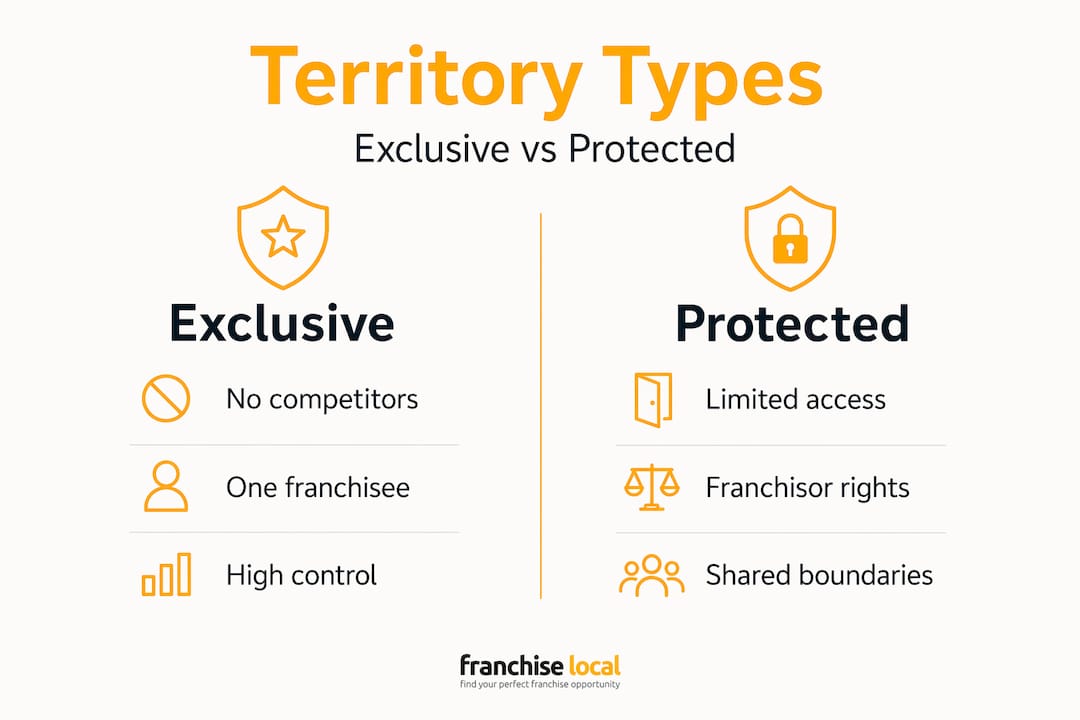
| Feature | Exclusive | Protected | Non-exclusive |
|---|---|---|---|
| Same-brand franchisee excluded | Yes | Yes | No |
| Franchisor can compete in area | No (with caveats) | Sometimes | Yes |
| Online sales carve-outs typical | Yes | Yes | N/A |
| Common in franchise industry | Less common | Most common | Less common |
| Franchisee security level | High | Medium | Low |
| Negotiating difficulty | High | Medium | Low |
| Impact on resale value | Strong positive | Moderate positive | Minimal |
Non-exclusive territories are most often found in franchise systems that operate via referral networks, consultancy models, or businesses where physical proximity to the customer is less relevant. Territory management in these models operates differently from location-dependent franchises. If you are evaluating a service-based franchise, non-exclusive arrangements can work well provided you understand the competitive implications.
Protected territories occupy the middle ground and represent the most common arrangement across the UK franchise sector. They offer meaningful boundary protection at the intra-brand level while giving franchisors more room to respond to market changes. For many franchisees, especially those entering at a moderate investment level, a well-drafted protected territory agreement delivers most of the security value of an exclusive territory without the negotiating friction.
The right choice depends on your risk appetite, your investment level, and the specific franchise system you are evaluating. There is no universal answer. What matters is that you know exactly which type you are being offered and what the practical limits of that arrangement are.
My take on exclusive territory agreements
In my experience, exclusive territories are both the most valued and the most misunderstood clause in any franchise agreement. Prospective franchisees often treat the word “exclusive” as if it settles the matter. It does not. It is the beginning of a more detailed conversation.
What I have observed repeatedly is that the structure of a territory clause tells you a great deal about the franchisor’s intentions. A franchisor who writes clear, tight exclusivity with a minimal list of carve-outs is signalling confidence in their network model and genuine respect for franchisee investment. A franchisor whose territory clause runs to several pages of exceptions and reservations is signalling something quite different.
I have also seen franchisees negotiate better territory terms than the standard offer, simply by doing their homework and coming to the conversation with specific, informed questions. Most franchisors have more flexibility than their initial offer suggests. The franchisees who leave value on the table are the ones who accept the first draft without question.
My strong advice: treat prospective exclusive territories as a contractual right with practical limits rather than an absolute guarantee. Understand the carve-outs. Model what your revenue looks like if the franchisor captures 15% of your area’s demand through online sales. Then decide whether the territory, as actually defined, justifies the investment.
And please, get proper legal advice. The franchise negotiation process is not something to approach with a template checklist downloaded from the internet. A qualified franchise solicitor who knows the UK market is worth every penny.
— Will
Find franchises with strong territory rights on Franchiselocal
If this article has clarified what exclusive territory protection really means, the next step is finding franchise opportunities that offer it. Franchiselocal lists hundreds of UK franchise opportunities across industries, investment levels, and geographic areas, making it straightforward to identify options that match your priorities.
Whether you are drawn to service-based businesses, retail, or something more specialised, the Franchiselocal directory lets you filter by location and investment level so you can focus on opportunities that align with your goals. For those specifically interested in territory-rich sectors, exploring networking franchises for sale is a strong starting point. These often come with clearly defined territories and strong brand support structures. You can also visit the complete franchising guide to build a fuller picture of the franchising process before you commit.
FAQ
What is an exclusive territory in a franchise agreement?
An exclusive territory is a contractually defined geographic area granted to a single franchisee, within which the franchisor agrees not to appoint other franchisees or distributors. In practice, most exclusive territories contain carve-outs such as online sales rights that limit true exclusivity.
What is the difference between exclusive and protected territories?
An exclusive territory prevents both other franchisees and, in principle, the franchisor from operating within your area. A protected territory prevents other same-brand franchisees but may still allow the franchisor to compete through alternative channels such as digital sales.
Can a franchisor take away an exclusive territory?
Yes, in many cases. Modification rights linked to performance benchmarks or renewal conditions can allow the franchisor to reduce or reassign your territory if agreed sales targets are not met. Always check the modification triggers in your contract before signing.
How are franchise territory boundaries defined?
Boundaries are commonly set using postcodes, a measured radius from your premises, county lines, or population thresholds. Some franchise systems use a combination of these methods to size territories according to market potential.
Do I need a solicitor to review my territory clause?
Yes. Territory clauses contain specific legal language and carve-outs that general commercial solicitors may not be familiar with. A specialist franchise solicitor can identify risks, clarify your actual rights, and advise on whether the territory terms match the investment being asked of you.