

When entrepreneurs assess a franchise opportunity, they typically scrutinise financials, territory rights, and training support. What they rarely measure with the same rigour is brand reputation. Yet the role of brand reputation in franchise success is arguably more consequential than any of those factors combined. A franchise with strong consumer trust generates faster customer acquisition, higher retention, and greater franchisee satisfaction. One with a damaged reputation can undermine even the best operational setup. This guide explains exactly why reputation matters, how it shapes purchasing behaviour, and what franchise owners can do to build and protect it.
Why brand reputation matters in franchising
Brand reputation is not the same as brand identity. Your identity is what you project — your logo, colours, and messaging. Your reputation is what people actually believe about you, shaped by every interaction, review, and piece of word-of-mouth feedback your network generates. In franchising, this distinction matters enormously.
A franchise brand exists across dozens or hundreds of locations, each with its own staff, management style, and customer base. Yet consumers experience it as one entity. When they search for a local branch, they read reviews, check star ratings, and form judgements about the entire brand from what they find. Reputation, in this context, is the collective perception of your credibility, reliability, and values across every touchpoint in the network.
Research confirms this matters at every level of the franchise relationship. Franchisees in top-rated brands are more than twice as likely to trust their franchisor and nearly three times more likely to recommend it to others. Owner satisfaction runs 30% to 55% higher in elite franchise systems. That is not a coincidence. It reflects the fact that trust, built through consistent reputation, directly strengthens the bond between franchisee and franchisor, which in turn drives better customer outcomes.
Consumers use reputation as a risk-reduction mechanism. Before spending money with an unfamiliar local business, they look for proof that others have been treated well. The franchise model amplifies this: the national brand name carries an implied promise, and every location either honours or erodes that promise. Here is what feeds into a franchise’s overall reputation:
- Online reviews and star ratings across Google, Trustpilot, and sector-specific platforms
- Response behaviour from franchisees and the corporate team when things go wrong
- Consistency of service quality across locations
- Transparency of pricing, policies, and communications
- Media coverage and word-of-mouth within local communities
For a deeper look at how branding powers franchise growth in the UK specifically, Franchiselocal has detailed guidance on why brand credibility shapes franchisee willingness to recommend and overall system health.
How reputation affects consumer behaviour and sales
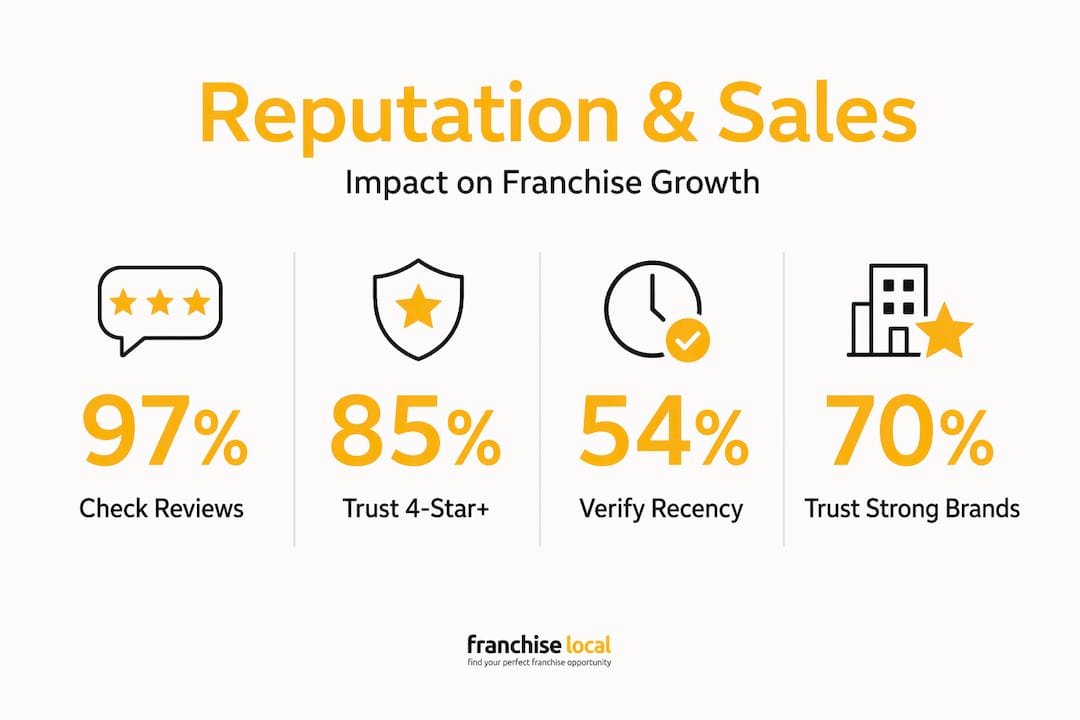
The numbers here are striking, and they matter directly to your bottom line. 97% of consumers use online reviews to guide purchase decisions. Of those, 85% are more likely to use a business after reading positive reviews, while 77% are actively deterred by negative ones. If you run a franchise location and your average Google rating sits below 4.0, a significant proportion of your potential customers are choosing your competitors before they have ever set foot through your door.
The impact of reputation on sales does not stop at the decision to visit. Fifty-four per cent of consumers check a business’s website after reading positive reviews, and 66% research further before making a purchase. This means your reputation creates a ripple effect: good reviews drive website traffic, which drives enquiries, which drives conversions. Bad reviews short-circuit that process entirely.
The table below illustrates how different reputation signals translate into measurable consumer behaviour.
| Reputation signal | Consumer response | Business impact |
|---|---|---|
| Positive reviews (4 stars and above) | 85% more likely to visit or purchase | Higher footfall and conversion rates |
| Negative reviews (2 stars or below) | 77% will avoid the business | Direct loss of potential revenue |
| Business responds to reviews | Consumers rate brand as more trustworthy | Improved loyalty and repeat purchase |
| Transparent pricing and policies | Two-thirds more likely to stay loyal | Reduced customer churn |
| No online presence or few reviews | Consumers perceive higher risk | Slower acquisition in new markets |
Transparency deserves particular attention. Research from Shopify’s 2026 Brand Credibility Report found that 75% of consumers consider transparency important when choosing who to spend money with, and 87% are willing to pay more with brands they trust. In a competitive franchise market, where consumers can often choose between several similar offerings, being the brand that communicates openly and honestly is a genuine commercial advantage.
Pro Tip: Review recency matters as much as star rating. A string of four-star reviews from three years ago will not reassure a customer the way a recent five-star review will. Make review generation an ongoing habit, not a one-off campaign.
It is also worth understanding the broader trust climate. The 2026 Edelman Trust Barometer found that 70% of respondents are hesitant to trust organisations whose values differ from their own. Brand promise fatigue is real. Consumers are more sceptical than ever, which means authentic, consistent trust signals are not just nice to have. They are the price of entry.
Franchise reputation challenges and network effects
Managing reputation as a franchisee is fundamentally different from managing it as an independent business owner. The stakes are higher, and the dynamics are more complex.

The central challenge is this: one poor-performing location can contaminate the reputation of the entire brand. Consumers searching for a franchise brand in their area will see aggregated review profiles. A cluster of one-star reviews at a single outlet, left unanswered, signals to every prospective customer that the brand does not care about service quality. Even if your location is excellent, you may be losing customers to the reputational drag created by a poorly managed outlet three towns away.
This networked risk creates several specific challenges for franchise operators:
- Inconsistency across locations erodes the core promise of a franchise: predictability. Customers expect the same standard whether they visit in Manchester or Bristol.
- Slow or absent review responses at any location suggest the brand is indifferent to customer feedback, damaging trust at scale.
- Franchise-wide crises can originate from a single incident at one location but spread rapidly on social media, affecting all franchisees in the network.
- Local variation in staff training creates gaps in service delivery that generate avoidable negative reviews.
- Third-party review platforms aggregate data automatically, meaning your brand’s public score is shaped by activity you may not even be monitoring.
The importance of brand trust is therefore not just a consumer-facing concern. It is a systemic one. Franchisors need to establish clear reputation management protocols, and franchisees need to follow them consistently.
Pro Tip: Set up Google Alerts and review monitoring tools for your franchise name and location. Respond to every review, positive or negative, within 48 hours. The response itself is visible to future customers and signals that your brand takes service seriously.
Coordinated reputation management means the franchisor setting the standards and tools, and franchisees executing at the local level. The most effective franchise networks treat reputation as a shared asset, not an individual concern. When one franchisee wins a local award or receives a glowing review, the wider network benefits. The reverse is equally true.
Building and sustaining a positive brand image
The good news for franchise owners is that brand reputation management strategies are learnable, measurable, and repeatable. The following steps reflect what research and practice show actually works.
-
Build a trust operating system. Rather than reacting to reviews when they arrive, create a structured process for soliciting, monitoring, and responding to feedback. Research confirms that integrating review management with staff training improves star ratings and business performance outcomes. This means assigning responsibility, setting response time targets, and training staff on the tone and content of responses.
-
Prioritise transparency in all communications. Publish clear pricing, fair return policies, and honest descriptions of your services. Transparency directly influences whether customers stay loyal or switch to competitors. It also shapes how new customers evaluate your brand before they have made a first purchase.
-
Actively generate positive reviews. Do not wait for satisfied customers to leave feedback unprompted. Train front-line staff to ask for reviews at the point of service, include review request links in follow-up communications, and make the process as frictionless as possible. ORM practices that combine customer orientation with timely action show measurable improvements in Google ratings and revenue.
-
Address negative feedback constructively. A negative review is not just a problem to manage. It is a public demonstration of how your brand treats customers when things go wrong. A thoughtful, professional response to a complaint often improves the reviewer’s opinion and signals trustworthiness to everyone else who reads it.
-
Align your digital assets with trust signals. Your website, Google Business Profile, and social channels should proactively answer the questions that reviews raise. If customers frequently mention long wait times, address this in your FAQ. If pricing transparency is a concern, make it prominent on your site. The 54% who check your website after a positive review should find information that confirms their confidence.
-
Measure what matters. Track Google star ratings monthly, monitor your Net Promoter Score (NPS), review customer satisfaction (CSAT) data, and watch referral traffic as an indicator of word-of-mouth growth. Reputation is not intangible once you start measuring it systematically.
The following comparison illustrates the difference between reactive and proactive reputation management:
| Approach | Reactive | Proactive |
|---|---|---|
| Review monitoring | Occasional, ad hoc | Scheduled, daily alerts |
| Response time | Days or none | Within 24 to 48 hours |
| Review generation | No formal process | Embedded in customer journey |
| Staff training | None specific to ORM | Regular briefings and protocols |
| Measurement | Star rating only | NPS, CSAT, referral traffic |
| Outcome | Reputation drifts | Reputation builds consistently |
For practical guidance on franchise marketing strategies, Franchiselocal covers how reputation management connects directly to marketing performance and customer acquisition for UK operators.
Pro Tip: When entering a new market or launching a new location, prioritise decision-stage proof over awareness. At this stage, trust signals at purchase matter more than advertising reach. Publish testimonials, FAQs, and clear policies before you invest heavily in paid promotion.
My take on reputation as a franchise asset
I have spent considerable time analysing what separates franchise networks that scale confidently from those that plateau or contract. In my experience, reputation is almost always the differentiating factor. Not the product, not the territory, and not even the training programme. Reputation is the intangible asset that either accelerates or throttles everything else.
What I find consistently overlooked is the discipline of local review consistency. Most franchisors understand reputation management in theory. Far fewer have actually built the operational infrastructure to make it happen at every location, every week, without exception. The gap between knowing and doing is where reputations quietly erode.
I have also seen too many franchise operators treat a negative review as a crisis rather than as an opportunity. The evidence is clear that trust is the strongest driver of franchise growth, which means every interaction that reinforces trust, including how you handle complaints, compounds over time into a measurable commercial advantage.
The role of corporate reputation in franchise contexts also requires a specific balance. Franchisors who try to centralise all reputation control end up with franchisees who feel disempowered and disengage from the process. The better model is to set clear standards and tools at the top, then genuinely empower franchisees to manage their local reputation within that framework. Trust flows both ways. When franchisees trust that the franchisor’s brand is worth protecting, they put in the work to protect it.
My strongest recommendation: treat brand reputation not as a communications function but as an operational one. It should have owners, processes, and metrics, just like sales or customer service. The businesses that do this well do not just protect their reputation. They use it as a growth engine.
— Will
Explore reputable franchise opportunities with Franchiselocal
Understanding the role of brand reputation is one thing. Applying it when choosing the right franchise opportunity is another. The franchise you invest in carries its own reputation, and that reputation shapes your prospects from day one. Choosing a brand that consumers already trust significantly reduces the challenge of building a customer base from scratch.
Franchiselocal is a leading UK directory connecting entrepreneurs with thoroughly listed franchise opportunities across every industry and investment level. Whether you are looking for recession-proof models, home-based options, or established brands with strong consumer track records, our listings give you the context to make a confident decision. Browse the best UK franchise opportunities to find models with proven brand credibility. You can also explore franchise opportunities by industry to identify sectors where reputation and trust are already working in your favour.
FAQ
How does brand reputation affect franchise sales?
Brand reputation directly influences whether customers choose to visit and purchase. 97% of consumers use reviews to guide decisions, meaning a strong reputation generates more footfall, higher conversion, and better customer retention than any single marketing campaign.
Why is brand trust important for franchisees specifically?
Franchisees in brands with strong reputations benefit from pre-existing consumer confidence, which accelerates customer acquisition. Research shows franchisee satisfaction is 30% to 55% higher in top-rated franchise systems, reflecting how trust shapes the entire franchise relationship.
What are the main brand reputation management strategies?
The most effective strategies include building a structured review management process, training staff on response protocols, actively generating positive reviews, responding to negative feedback professionally, and measuring outcomes using NPS, CSAT, and Google star ratings.
Can one bad franchise location damage the whole brand?
Yes. Networked reputation risk means that poor reviews at a single location affect how consumers perceive the entire brand, particularly when third-party platforms aggregate ratings across all outlets automatically.
How does transparency influence brand reputation?
Transparency is a direct driver of consumer loyalty. Research shows 87% of consumers will spend more with brands they trust, and two-thirds are willing to switch to a competitor if they perceive a lack of openness in pricing, policies, or communication.