

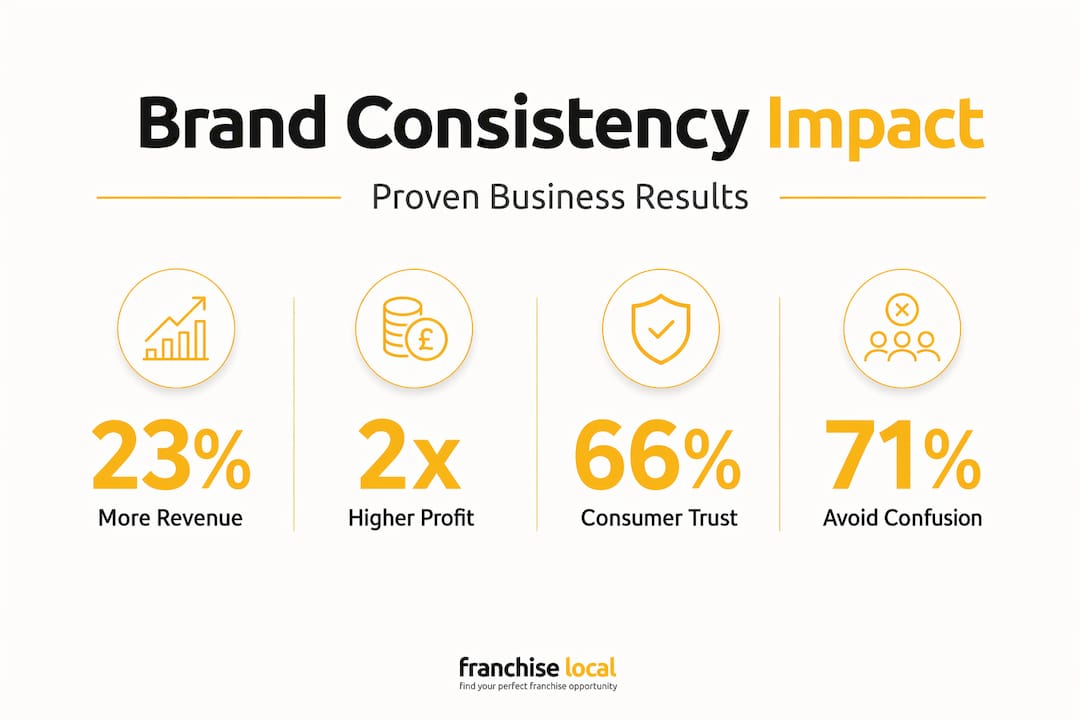
Most business owners think brand consistency means picking a logo and a colour palette, then calling it done. That assumption is costing them customers. Brand consistency is, in fact, one of the most commercially significant disciplines in marketing, and the evidence is compelling. Brands with high consistency achieve between 10% and 23% revenue growth. Yet many entrepreneurs treat it as a cosmetic exercise rather than a growth strategy. This guide explains what brand consistency really means, why it matters more than most people realise, and how to build it into everything your business does.
What brand consistency means
At its core, brand consistency means presenting your business in a recognisable, cohesive way across every single touchpoint. Not just your website or your social media profile. Every email, every invoice, every conversation your team has with a customer. It is the practice of delivering the same visual identity, tone of voice, and customer experience repeatedly, so that your audience knows exactly who you are before you even say a word.
What does brand consistency mean in practical terms? It means three distinct layers working together.
Visual identity is the most visible layer. It includes:
- Your logo and how it is used across print, digital, and packaging
- Your colour palette, applied with precision across all materials
- Typography choices, including which fonts are used for headlines versus body copy
- Imagery style, such as whether your photography is warm and candid or clean and minimal
Verbal identity governs how your brand speaks. This includes:
- Tone of voice, whether that is authoritative, friendly, or reassuring
- Messaging pillars, the two or three ideas your brand always returns to
- Slogans and taglines applied consistently across campaigns
- The language your team uses in customer service interactions
Experiential identity is the layer most businesses overlook. It covers the feeling a customer gets when they interact with you. Does your in-store environment match your website? Does your customer service team sound like your marketing copy? Does the unboxing experience reflect your brand values?
Underpinning all three layers is documentation. A brand guidelines document, sometimes called a style guide, codifies every decision and gives your team a shared reference point. Without it, consistency collapses the moment a second person gets involved in creating content.
Why brand consistency drives growth
The financial case for brand consistency is not theoretical. Consistent brands build twice the profit compared to inconsistent brands and can save significant budget that would otherwise be wasted on contradictory or ineffective media spend.
The reason lies in psychology. Consistent branding reduces cognitive load by creating mental shortcuts that allow customers to recognise and trust your brand almost instantly. When someone sees your colour palette before they read your name, your brand is doing its job. Recognition precedes consideration, and consideration precedes purchase.
“Inconsistent branding triggers suspicion and market confusion, eroding the customer trust that takes years to build.”
Consider how this plays out at scale. Apple, Nike, and IKEA have each built global businesses partly by delivering a consistent brand experience across every market and medium. Apple’s product design, packaging, retail environments, and advertising all feel like they came from the same source. That coherence is not accidental. It is the result of deliberate, disciplined brand governance applied over decades.
A smaller but equally instructive example comes from footwear. New Balance’s consistent use of grey as a signature colour became a genuine market differentiator. A seemingly minor decision, held firm over many years, created instant recognition in a crowded category. That is the compound effect of brand consistency at work.

The trust dimension matters just as much as the recognition dimension. 66% of consumers require brand trust before they will commit to a purchase, and 71% say inconsistent branding causes them confusion. Confusion does not convert. Trust does. If your brand looks and sounds different depending on who created the content or which channel it appears on, you are actively undermining the trust you are trying to build.
There is also a cost efficiency argument. Brands that invest in consistency early spend far less on corrective marketing later. Reworking materials because your visual identity drifted off course, or running a recovery campaign because your tone of voice felt off-brand and caused negative reactions, these are expensive problems with a straightforward preventative solution.
For franchise businesses in particular, consistent brand identity is what separates a scalable network from a collection of loosely related outlets. Every franchisee becomes a brand ambassador, and without consistency across locations, the entire network’s equity is at risk.
Common challenges in maintaining consistency
Knowing what brand consistency means is one thing. Holding it together as your business grows is another challenge entirely. Most entrepreneurs encounter the same obstacles.
The first is organisational silos. Marketing creates one version of the brand, sales presents a slightly different one, and customer service operates on instinct. Without a shared framework, each team interprets the brand through its own lens. The result is fragmentation that customers notice even if they cannot articulate why.
The second challenge is trend chasing. Every year brings new visual trends, new platform aesthetics, and new content formats. The temptation to refresh your brand every time a new style emerges is understandable, but it destroys the accumulated recognition you have worked to build. Updating how you apply your brand is fine. Discarding your brand identity to chase a trend is not.
The third is decentralised asset control. If your team is pulling logos from email attachments, old presentations, or a poorly organised shared drive, inconsistency is inevitable. Someone will use an outdated version of your logo. Someone will pick a colour that is close but not quite right. These small deviations add up.
Living brand manuals are the antidote to the first and third challenges. Unlike a static PDF created once and never updated, a living brand manual evolves with your business. It is hosted somewhere your whole team can access it, updated when decisions change, and referenced as part of your onboarding process for new hires.
Here is a straightforward process for addressing these challenges:
- Audit your current brand touchpoints. Collect samples from your website, social media, printed materials, email signatures, and customer-facing documents. Identify where deviations exist.
- Establish a single source of truth. Centralise your brand assets in one accessible location, whether that is a dedicated platform, a cloud folder with clear naming conventions, or a brand management tool.
- Brief every team. Brand consistency is not a marketing department responsibility. Sales, customer service, operations, and HR all need to understand the brand standards that apply to their work.
- Appoint a brand guardian. In smaller businesses, this might be the founder. As you scale, it should be a designated role. Someone needs to own brand consistency and have the authority to address deviations.
- Schedule regular audits. Regular brand audits identify deviations before they become embedded habits, and help maintain consistency across growing teams and channels.
Pro Tip: When briefing creative agencies or freelancers, send your brand guidelines as the first document, before any brief. Creatives cannot apply a standard they have not been shown.
Practical steps to achieve brand consistency
Building genuine brand consistency requires structure. Here is how to put that structure in place.
Start with documented brand guidelines
Your brand guidelines are the foundation of everything. A well-built guidelines document covers your logo usage rules, colour codes (including hex, RGB, and CMYK values), typography hierarchy, imagery style, tone of voice principles, and examples of correct and incorrect usage. Do not assume your team will intuit these things. Write them down with enough specificity that someone who has never met you could represent your brand accurately.
Centralise your brand assets
A digital asset management system, whether that is a specialist platform or a well-organised shared folder, gives your team one place to find approved, current assets. This alone eliminates a significant proportion of consistency errors. Every logo, template, colour swatch, and font file should live in one place, clearly labelled, with version control in place.
Conduct channel-specific adaptations without losing coherence
Different channels have different requirements. A LinkedIn post and an Instagram story serve different purposes and have different aesthetic conventions. Consistency does not mean identical. It means coherent. Adapt your format and tone to suit the channel, but keep your visual identity, messaging pillars, and overall brand personality stable. The visual cues and messaging that make your brand recognisable should survive the translation to any platform.
Pro Tip: Create channel-specific templates for your most frequent content formats. Templates do not limit creativity. They protect consistency while giving your team a fast, reliable starting point.
Align every team, not just marketing
Brand consistency is an all-team discipline. Your customer service team’s language, your sales team’s pitch materials, your HR team’s job adverts, all of these are brand touchpoints. Franchise marketing strategies that succeed do so because every member of the network understands and applies brand standards, not just the head office marketing team.
The following table summarises the core tools for maintaining brand consistency and what each one does:
| Tool | Primary purpose | Who uses it |
|---|---|---|
| Brand guidelines | Sets rules for visual and verbal identity | All teams, agencies, freelancers |
| Digital asset management | Centralises approved brand files | Marketing, sales, operations |
| Brand audit | Identifies inconsistencies across touchpoints | Brand guardian, marketing lead |
| Onboarding materials | Communicates brand standards to new staff | HR, team managers |
| Channel templates | Speeds up content creation while protecting brand | Marketing, social media teams |
Consistency in evolving and multi-brand organisations
Brand consistency becomes more complex when a business is growing, evolving, or managing multiple sub-brands. This is where many entrepreneurs make costly mistakes.
Brand evolution must be gradual and intentional. PepsiCo’s approach to rebranding offers a useful case study. Rather than overhauling its identity in one dramatic shift, the company made deliberate, incremental changes that preserved brand equity while refreshing relevance. The lesson is that evolution and consistency are not opposites. Gradual, well-communicated change, applied uniformly across all touchpoints, maintains continuity in the customer’s mind.
For businesses managing sister brands or sub-brands, tiered brand architecture offers a structured solution. This approach establishes shared visual anchors, such as a parent brand colour or typography system, while allowing distinct identities for each sub-brand. Customers can recognise the family connection without the brands feeling identical. This is how large consumer goods businesses manage dozens of products under one corporate umbrella without diluting any individual brand’s identity.
The following table illustrates how consistency applies differently depending on the stage and structure of a business:
| Business type | Consistency priority | Key challenge |
|---|---|---|
| Early-stage startup | Build recognition from scratch | Limited resources and team capacity |
| Growing SME | Maintain standards across new hires | Silos and inconsistent asset usage |
| Franchise network | Uniform application across locations | Franchisee interpretation of brand rules |
| Multi-brand organisation | Cross-brand coherence with distinct identities | Balancing differentiation and shared equity |
One principle holds across all stages. Leaders must reinforce core brand values repeatedly, because employee behaviour transmits brand consistency internally and externally. The brand lives in how your team behaves, not just in how your marketing looks.
My view: consistency is the underrated competitive advantage
I’ve seen entrepreneurs spend tens of thousands of pounds on brand identity projects, launching with beautifully crafted guidelines, only to abandon them six months later because a new designer had a different opinion or a new platform demanded a new aesthetic. The investment evaporates. The recognition never accumulates.
What I’ve learned from watching brands succeed and fail is this: consistency builds stronger brands than creativity alone, every time. A mediocre logo applied religiously for five years will outperform a brilliant logo applied inconsistently. Repetition builds meaning. Meaning builds trust. Trust drives purchase.
The entrepreneurs who resist this idea tend to conflate consistency with stagnation. They worry that if they apply the same visual identity and tone of voice across every channel, they will become boring. In my experience, the opposite is true. Clarity is not boring. Recognisability is not boring. What is boring, and commercially damaging, is a brand that looks different every time a customer encounters it.
My practical advice is to treat your brand guidelines not as a creative constraint but as a competitive asset. The discipline required to maintain consistency is exactly what most of your competitors lack. Brand investment in 2026 matters more than ever as markets become noisier and customer attention becomes harder to earn. The brands that win are the ones customers can find, recognise, and trust without effort.
Start with one channel, get the consistency right, then replicate that standard everywhere else. Build the habit before you scale the output.
— Will
Explore franchise opportunities with built-in brand strength
One of the most practical ways to apply everything you have learned about brand consistency is to invest in a franchise. Franchises give you a proven brand identity from day one, with guidelines, assets, and standards already established. You benefit from existing consumer recognition and trust without having to build it from scratch.
At Franchiselocal, you can explore hundreds of UK franchise opportunities across sectors where consistent branding is already embedded in the business model. Whether you are drawn to professional services, financial products, or B2B networking, there is a franchise that aligns with your goals.
Browse networking franchises where reputation and brand recognition drive referrals, or explore business services franchises built around consistent client experiences. Every listing on Franchiselocal comes with the information you need to evaluate brand strength before you invest.
FAQ
What is brand consistency in simple terms?
Brand consistency means presenting your business in the same recognisable way across every channel and customer touchpoint, covering visual identity, tone of voice, and overall customer experience.
Why does brand consistency matter for revenue?
Research shows that consistent brands grow revenue by 10% to 23% and generate twice the profit of inconsistent brands, primarily because consistency builds the trust that drives purchase decisions.
How do I achieve brand consistency across my team?
Start by documenting brand guidelines, centralising your assets in one accessible location, and briefing every team member. Schedule regular audits to catch deviations early before they become habits.
Can a brand evolve and still stay consistent?
Yes. Gradual, intentional changes applied uniformly across all touchpoints preserve brand equity while allowing a brand to stay relevant. Sudden or piecemeal changes are what erode recognition and trust.
What are the biggest risks of inconsistent branding?
Inconsistent branding causes confusion for 71% of consumers and actively erodes trust. It also leads to wasted marketing spend, as conflicting signals require more budget to correct than consistency would have cost to maintain.