

The programme that converts best is stage-based and CRM-triggered: an instant text under 60 seconds for every new enquiry, followed by targeted email sequences mapped to where each candidate sits in your pipeline. Layer in a low-pressure, long-term nurture track for anyone who goes quiet, and you have a system that qualifies faster and loses fewer good candidates to silence.
Which franchise recruitment email sequences to run and when
Every stage of your pipeline needs its own sequence, with its own job and its own channel mix. Treat these as distinct campaigns, not one long drip that fires regardless of where the candidate actually is.
- New inquiry sequence: get a booked intro call. SMS leads, with a follow-up email reinforcing the brand story.
- Intro-call follow-up sequence: keep momentum after the conversation. Email-led, with a recap, next steps, and a validation resource.
- Application sequence: guide the candidate through paperwork without nagging. Mixed SMS/email reminders tied to deadlines.
- FDD-review sequence: reduce doubt during the legal disclosure window. Email-heavy, with SMS check-ins at key moments.
- Discovery Day sequence: confirm logistics and build excitement. SMS reminders plus a detailed email itinerary.
- Re-engagement sequence: bring silent prospects back without pressure. Quarterly email, occasional SMS nudge on strong signals.
The FDD window deserves special attention. It’s the point where candidates have the most legal detail and the most anxiety, and where drip campaigns that stay personalised by stage tend to outperform generic timed emails. A candidate who goes cold here often isn’t losing interest. They’re reading, and possibly worrying, on their own.
Templates and timing for each sequence
Copy these sketches and adapt the specifics to your brand.
- Immediate SMS (inquiry stage): a short opener naming your brand, one qualifying question about their target investment or timeline, and two specific call times offered directly in the thread. Listing exact times rather than a scheduling link tends to convert better because it removes an extra click.
- Intro email (day 1 to 2): a brief brand story, three concrete benefits (territory availability, support structure, financing options), one testimonial link, and a soft call-to-action to confirm the call time already offered.
- FDD check-in one (early window): a reassurance message explaining what the document covers and confirming they have everything they need.
- FDD check-in two (mid window): a short FAQ addressing the two questions every candidate asks, fees and territory boundaries, with plain-English answers.
- FDD check-in three (late window): a reminder about validation calls, including how to reach existing franchisees and what the remaining timeline looks like.
- Discovery Day reminder: logistics, agenda, what to bring, and a calendar invite confirmation sent 48 hours out.
Pro Tip: Use dynamic content tokens for investment band and territory so the same template reads as personal whether the candidate is looking at a £15,000 home-based unit or a £150,000 retail site.
Setting CRM triggers so the right message fires automatically
The sequence should move with the candidate, not with a calendar. Stage-triggered automation fires the next message when the pipeline record changes, rather than on a fixed day count that ignores what’s actually happened.
- Trigger the intro-call sequence the moment a lead enters your CRM, not after a delay.
- Trigger the application sequence only when the intro-booked stage flips to “call completed.”
- Trigger the FDD sequence when the document is sent, and stagger the three check-ins across the review window automatically.
- Trigger Discovery Day reminders from the confirmed date field, counting backwards.
Two rules protect the system from working against your team. First, pause automation the instant a rep sends a manual message, then resume it only when the stage changes again, so nobody gets a robotic follow-up ten minutes after a real conversation. Second, connect your calendar tool so offered times book automatically. Platforms such as HubSpot or ActiveCampaign handle this well, though any CRM supporting stage triggers, SMS, and booking integration will do the job. Segment further by behaviour, a clicked FDD link or a revisited pricing page, and by attributes like investment range, so the content each candidate sees actually matches their situation. Franchiselocal’s own lead qualification guidance covers how to assess franchisee fit before you decide which segment a candidate belongs in.
How to write subject lines and body copy that get replies
Subject lines work best when they’re short, name the candidate’s next action, and carry a light sense of urgency: “Two times for a 20-minute intro, Tuesday or Thursday?” beats “Learn more about our franchise opportunity” because it asks for a decision, not attention.
Inside the email, keep the structure tight:
- One useful fact (a territory update, a financing change, a validation statistic).
- One testimonial or franchisee quote, linked rather than pasted in full.
- One clear next step, stated once.
- Minimal attachments. Link to detailed documents instead of burying them in a PDF nobody opens.
During the FDD window specifically, language should explain rather than sell. Offer validation contacts proactively rather than waiting to be asked, and frame every answer around reducing uncertainty rather than closing a deal. Response-time research across 530 brands found many franchisors respond too slowly at exactly the stage where a candidate most wants reassurance, which is often the FDD window rather than the initial enquiry.
What to measure and how to improve each sequence
Track a KPI at every stage rather than one blended “conversion rate” that hides where candidates actually drop off.
- Response rate on both SMS and email, checked separately since they behave differently.
- Call-booking rate from the intro sequence.
- Application completion rate once paperwork begins.
- Discovery Day show rate, which improves noticeably when reminders are timed and tied to booking tools, rather than sent as a single generic email.
Use engagement signals, a reply, a click, or repeated opens, to raise a lead’s score automatically and flag it to a rep. For testing, start with cheap variants: SMS opener wording, subject-line length, and CTA phrasing (a specific time slot versus an open-ended “let’s chat”). Run these tests over short windows for the early sequences, but monitor FDD and Discovery Day outcomes over longer periods, since those decisions take weeks, not days.
Bringing quiet prospects back without pushing them away
Silence rarely means disinterest. It usually means the candidate is still processing the decision, often discussing finances with a partner or comparing other opportunities quietly.
- Send a monthly or quarterly newsletter with genuine news: new territory openings, a franchisee success story, a financing update, or an upcoming event.
- Watch for behavioural signals, a site revisit, a clicked link, a reopened FDD, and treat any of these as a cue to re-escalate into active outreach.
- Retire leads that show zero engagement across several consecutive touches rather than emailing indefinitely into silence.
Pro Tip: A single well-timed “we’ve just opened three new territories near you” email often outperforms five generic check-ins, because it gives the candidate an actual reason to respond.
How Franchiselocal supports testing and scaling these sequences
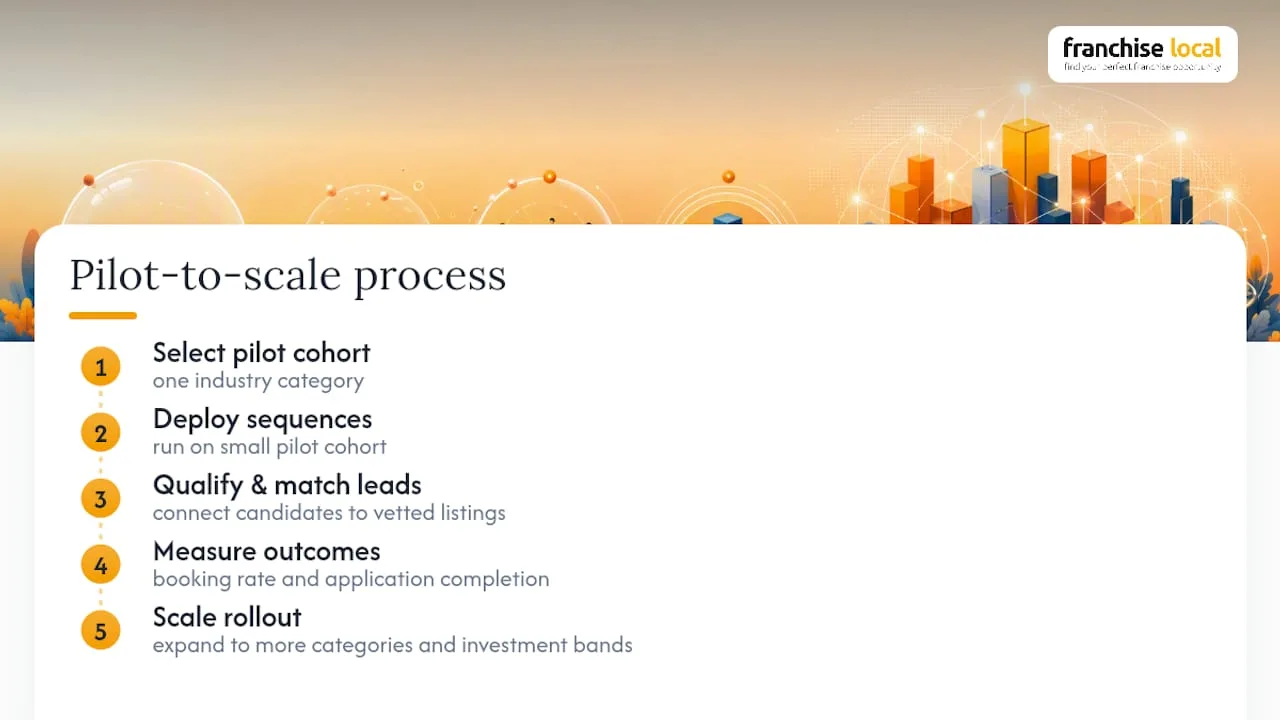
Franchise sales funnels live or die on how quickly leads get qualified and matched to the right opportunity, and that’s the core of what Franchiselocal’s directory aims to connect serious candidates with vetted UK franchise listings across investment bands and industries. If you’re building sequences for the first time, run them on a small pilot cohort first, perhaps one industry category, and measure booking rate and application completion before rolling out further.
Franchiselocal’s search filters and trending franchise opportunities page give you a live view of where candidate demand is shifting, useful context for the segmentation triggers described above. For franchisors wanting a deeper foundation before building sequences, the ultimate guide to franchising covers the recruitment fundamentals these email programmes are built on.
Sources
For deeper reading beyond this guide, three sources stand out. FranFunnel’s franchise follow-up sequence breakdown is built on a study of 530 brands and is the strongest data-backed case for sub-60-second first contact. 1851 Franchise’s drip campaign guide covers practitioner-tested cadence and segmentation. Sparktank’s nurturing campaign walkthrough is useful for booking-tool integration and Discovery Day reminders. For segmentation tactics specifically, Nectar’s email segmentation guide is a solid supplementary read.
- The Franchise Lead Follow-Up Sequence That Actually Converts (And What Most Brands Get Wrong)
- Behind the scenes: building a franchise lead nurturing campaign – Sparktank Franchise Marketing
FAQ
How fast should I respond to a new franchise inquiry?
Aim for an initial text within 60 seconds of the enquiry landing in your CRM, since research across 530 brands found slow first contact is one of the biggest causes of lost candidates.
Should I use SMS or email for franchise recruitment sequences?
Use SMS for immediate, time-sensitive contact like booking the first call, then shift to email for richer content such as testimonials, FDD explanations, and Discovery Day logistics.
How many emails should a franchise nurture sequence include?
A front-loaded structure of around ten emails in the first weeks, tapering into a longer, more spaced-out cadence, is a common practitioner approach that balances urgency with patience.
What should I send during the FDD review window?
Three check-ins work well: an early reassurance message, a mid-window FAQ on fees and territory, and a late-window reminder about validation contacts and remaining timeline.
When should I stop emailing a silent franchise prospect?
Move them to a low-pressure quarterly nurture track after several unengaged touches, and retire them entirely only after repeated non-engagement with no behavioural signals like site revisits or link clicks.