

A franchise listing is a shop window, not a contract. It tells you what the franchisor wants you to notice first, so reading it well means knowing which lines are fixed facts, which are estimates and which are missing altogether. Read the investment figure as a starting point, the fees as a list to complete, the earnings claims as a claim to test, and the territory and support sections as promises to see in writing before you commit.
This guide goes through a typical UK listing from top to bottom. For each section it explains what you should expect to see, what the wording usually means and what to ask next. Use it alongside the filters on a directory, so that every listing you open gets the same checks.
What a good listing should tell you
A useful listing gives you enough to decide whether to ask for more. UK legal guidance on franchise disclosure suggests a full information pack should cover the franchisor’s legal details, business history and key people, the business model, the territory, fees and ongoing costs, and the support and training on offer. A directory listing is shorter than that pack, but it should point towards the same areas.
As you read, tick off these headings:
- Who the franchisor is, and how long it has traded
- What the business does and how a franchisee earns money
- The total investment and what it covers
- The initial fee and ongoing fees
- The territory you would operate in
- Training and support, before and after launch
- The length of the agreement
- Whether earnings or performance figures are given, and on what basis
If a section is thin, that is not a verdict on the brand. It is a prompt for your first call. Our guide to how to research franchise opportunities in the UK shows how to turn those gaps into a shortlist.
The headline investment figure
Most listings lead with a number: “Investment from £X” or a price band such as “Under £10,000”. It is the most useful filter on a directory and the easiest figure to misread.
Ask three things of it.
What does it include? Some figures cover only the initial franchise fee. Others bundle the fee with equipment, vehicle, stock, training and launch marketing. Two listings that both say £30,000 may describe very different packages.
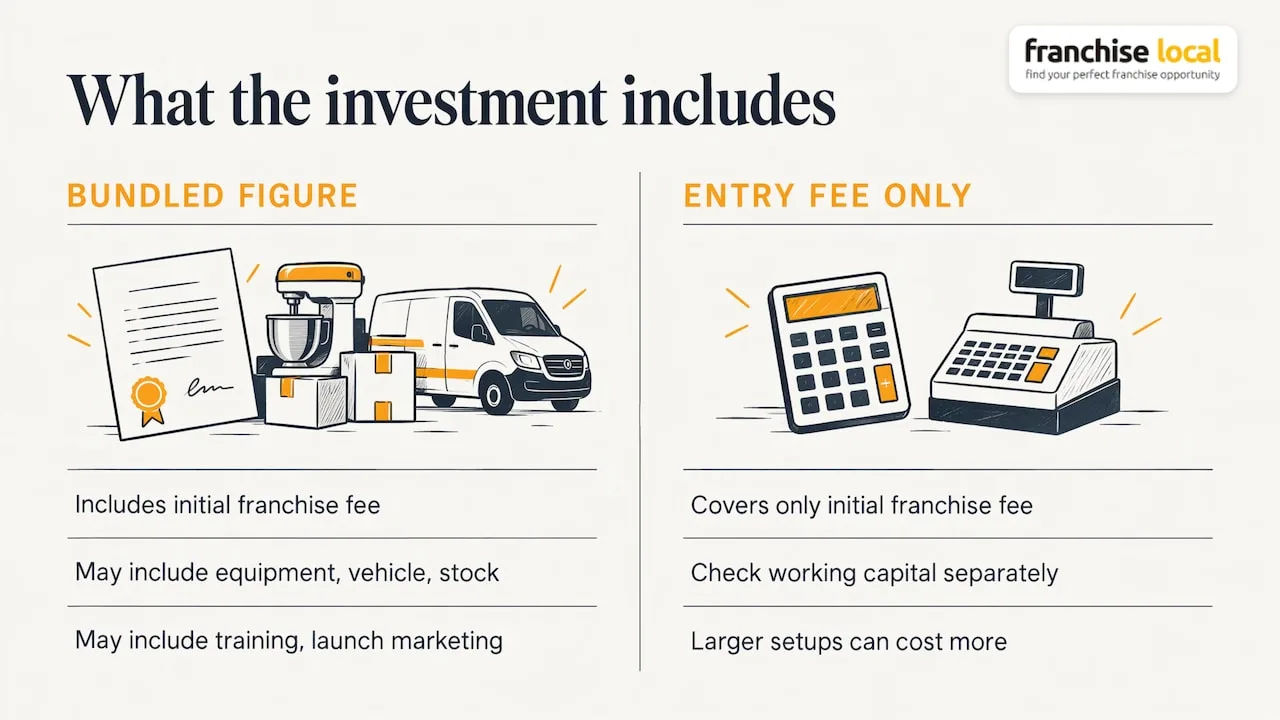
Does it include working capital? Money to run the business until it pays for itself is a separate need. The British Franchise Association (BFA) advises prospective franchisees to ask how much working capital they need, and monthly working capital costs vary from one opportunity to another. A listing that gives only the entry fee leaves this gap for you to fill.
Is it a minimum? “From” means the lowest cost of the cheapest set-up. A full territory, a premises-based format or a larger vehicle fleet can cost more.
Write down the figure as the listing gives it, then write beside it what you still need to find out. Our guide to evaluating franchise costs for UK opportunities goes line by line through what can sit behind that number.
The franchisor behind the brand
A good listing names the company, not only the brand. UK disclosure guidance expects a franchisor’s legal name, company number, registered office, trading name, business history and the experience of its key people. It also expects any relevant litigation or insolvency history to be disclosed.
When the listing gives you a company name, you can look it up on the public register at Companies House. Check how long the company has existed, who the directors are and whether the accounts are filed on time. The Institute of Directors describes buying a franchise as setting up your own business using a tried and tested formula, with the benefit of the franchisor’s experience and support. How tried and tested the formula is depends on the track record, so look for:
- How many franchisees operate in the UK now
- How long the brand has traded
- Whether the franchisor ran its own pilot or company-owned outlet before selling franchises
- Whether it is a member of the BFA
On the last point, the BFA says its accreditation looks for a proven business model, a strong support structure and a satisfied network of existing franchisees. Membership is one signal among several, but it is quick to check and worth noting on your sheet.
The business model and your role
The description of the business should answer a simple question: what would you do on a Monday morning? Look for the franchisee’s journey, from choosing a site or territory, through fit-out or set-up, to opening and the first operating milestones.
Watch for the lifestyle labels that directories use, such as “Home Based”, “Part Time” or “Mobile”. They describe the format, not the workload. A home-based franchise may still mean full-time selling, local networking and evening appointments. Compare the label with the daily tasks the listing describes.
It also helps to ask:
- Are you the operator, a manager or an investor? Some formats expect you to work in the business, others to employ staff.
- Who is the customer: households, businesses or both?
- What does the competition look like locally and nationally? Official UK guidance on assessing a franchise includes the strength of competition at both levels, and a listing seldom covers it.
- Is the business seasonal?
Browsing by franchise industry is a good way to compare similar models side by side, so that differences in set-up and workload stand out.
Fees and ongoing costs
This is the section where listings differ most, and where a small phrase can change your yearly costs.
Business Wales notes that franchisors usually charge an up-front fee, and that they may also take a percentage of sales as a management service fee, or a fixed management fee. The BFA adds that the ongoing fee, called a Management Service Fee or royalty, is often a percentage of gross sales. It can also be a fixed weekly or monthly sum, or the higher of a minimum and a percentage of gross sales.
Those are three different cost structures, and they behave differently when trade is slow:
| Fee structure | What it means for you |
|---|---|
| Percentage of gross sales | Costs rise and fall with turnover. It is calculated on sales, not profit. |
| Fixed weekly or monthly sum | Predictable, but payable even in a quiet month. |
| Higher of a minimum and a percentage | A floor applies however slowly you start. |
Beyond the headline fees, lawyers who advise on franchise agreements point out that the overall cost can extend further. Required refurbishment, equipment, stock, software, marketing contributions, minimum purchasing commitments and renewal costs can all affect profitability. Business Wales also advises checking what you pay if you must buy stock or products from the franchisor, including whether it marks up prices or passes on discounts from its buying power.
A quick test is to list every cost you can find in the listing and mark each as one-off, monthly or per sale. Then add a line for each of the items above that the listing does not mention. Our guide to assessing franchise financials shows how to build that into a simple forecast, and the Franchise ROI and Profitability Estimator lets you test different sales levels against the fees.
Earnings and performance claims
Some listings state turnover, profit or payback figures. Treat each one as a claim to examine, not a promise.
The Advertising Standards Authority (ASA) says marketing for business opportunities should make clear the financial commitment required and give a realistic picture of what new investors can expect to earn, backed by evidence. It has upheld complaints where expected earnings were greatly exaggerated. Legal guidance on UK franchise disclosure adds that any performance data should be accurate and representative, come with its assumptions, and never imply guaranteed earnings.
When you see a figure, ask:
- Whose results are these? An average across the whole network is more meaningful than the best franchisee’s best year.
- Are they actual or projected? The BFA suggests asking whether projections are based on actual network performance.
- What period do they cover? A forecast for year three says little about your first six months.
- Is it turnover or profit? Turnover before fees, staff and costs is not what you take home.
- What are the assumptions? Hours worked, number of customers, price per job and your own wages all change the result.
Franchise Problem Solutions, an adviser to franchisees, says financial projections are the most common source of misrepresentation claims, and that forecasts usually cover the first three years. It also points out that you can rarely check the data behind a projection. You can check the arithmetic, ask how the numbers were reached and compare them with what existing franchisees tell you.
Our article on franchise unit economics explains the few numbers that decide whether a model works, and gives you a way to test any figure a listing quotes.
Territory
The territory line can be a single sentence, such as “exclusive territory available”, yet it shapes your income more than almost any other term.
UK legal guidance warns that “exclusive” means little without detail. The agreement should say whether the franchisor or other franchisees can reach customers in your area through:
- Online orders and website fulfilment
- Third-party delivery platforms
- Targeted social media advertising
- Telephone or app-based sales
- Corporate or key account sales
- Events and concessions
If the agreement says nothing about a channel, the franchisor may argue that it was never included. Other points to check are how the territory is defined, for example by postcode list or map, whether it is based on customer location, delivery address or site location, and how border areas and new-build zones are handled. Solicitors also suggest asking whether the franchisor can open company-owned outlets in your area.
At listing stage, note whether a territory is described by population, postcodes or households. If you have a location in mind, the regions page shows which opportunities are available where you live.
Training and ongoing support
Listings often say “full training and support provided”. Turn that into specifics:
- Where does initial training take place, how long does it last, and do you pay for it?
- What happens after launch: further training, conferences, technical support, a helpline?
- Does the franchisor help you buy supplies at a good price?
- What does it spend on national marketing, and must you contribute?
The BFA suggests asking exactly these questions, including what continuing services the franchisor provides once you are a franchisee. It also notes that agreements usually require you to follow the franchisor’s System and Operations Manual, so ask to see how detailed that manual is and how often it changes.
Support is easier to judge from the network than from the listing. Our guide to questions to ask UK franchisees gives you a script for those conversations.
Contract length, renewal and exit
The term of the agreement is often missing from a listing, and it matters. Ask how long the franchise is granted for, what happens at the end, and what renewal costs. Lawyers also advise checking whether fees can increase during the term, whether they are fixed or linked to turnover, and whether you must keep paying when the business makes a loss.
Also ask what happens if you want to sell the business or leave early. These terms rarely appear in a listing, but they affect your risk. Our guide to assessing franchise risk covers how to weigh them.
A reading checklist for every listing
Use this table to score each listing the same way, so that your shortlist compares like with like.
| Section | What good looks like | Your next question |
|---|---|---|
| Investment | Says what is included and the working capital needed | What is not covered by this figure? |
| Franchisor | Company name, history and track record | How many UK franchisees, and for how long? |
| Business model | Clear daily role and customer type | What does a normal week involve? |
| Fees | Initial fee, ongoing fee and how it is calculated | What other costs are required? |
| Earnings | Basis, period and assumptions stated | Are these actual network results? |
| Territory | Defined area with channels addressed | Who else can sell in my area? |
| Support | Specific training and ongoing help | What happens after the first year? |
| Contract | Term, renewal and exit terms | What does renewal cost? |
For a longer version, our franchise selection checklist and franchise business checklist cover the wider decision.
Checking the listing against real people
A listing is the franchisor’s account. To test it, speak to people who have no reason to polish it.
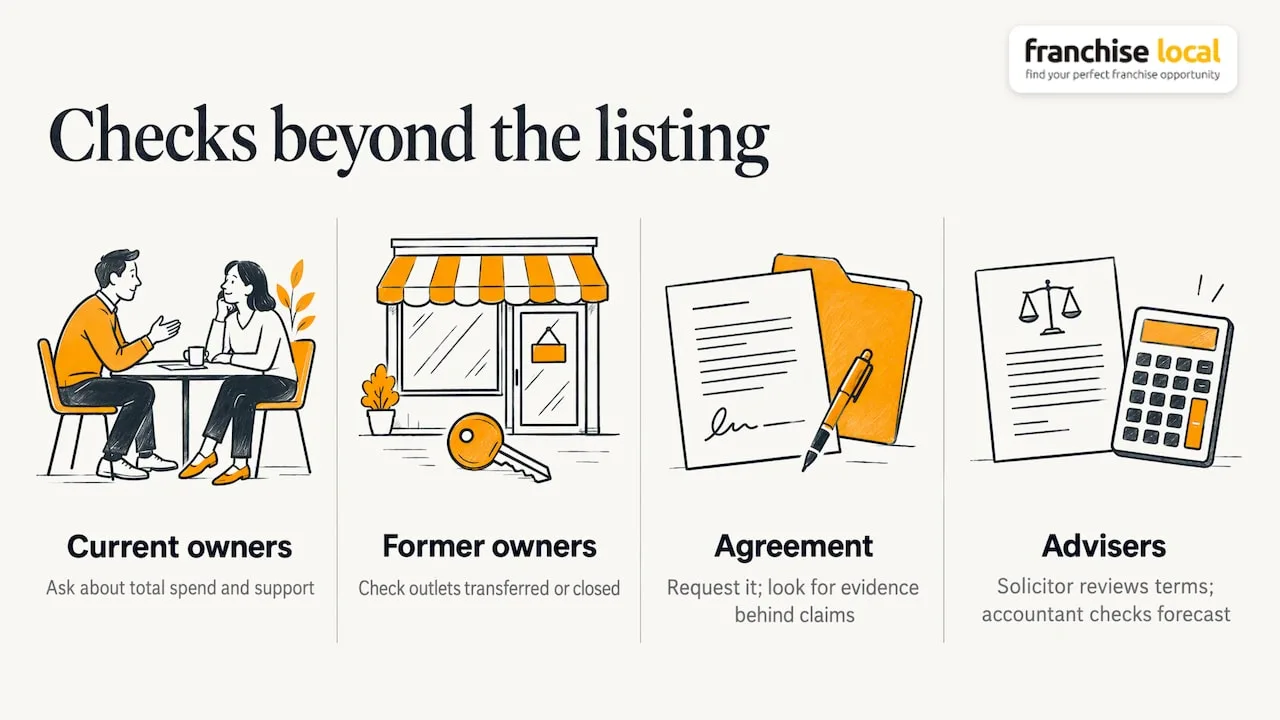
Current franchisees. The BFA advises asking whether you can speak to existing franchisees. Talk to more than the ones the franchisor suggests, and include owners in areas like yours and owners who joined recently. Ask what they spent in total, how long it took to cover costs and whether the support matched the promise.
Former franchisees. If the franchisor can tell you who has left and why, that is useful information. Ask the network how many outlets have changed hands or closed.
The agreement itself. The BFA advises asking to see a copy of the franchise agreement. UK public guidance says not to rely on the franchisor’s information pack alone: ask questions and look for evidence behind its claims.
Independent advisers. Before you sign, take the agreement to a solicitor with franchise experience, and have an accountant review the financial forecast. Neither is a formality. They read the terms for your benefit, not the franchisor’s.
Our guide to evaluating franchise opportunities for secure UK investment covers the full process from first enquiry to signing.
Put the checklist to work on Franchise Local
Once you know what to look for, a directory saves time. Franchise Local lets you filter UK franchise opportunities by investment level, industry, lifestyle and region, so you compare listings against the same criteria. Start with the best UK franchise opportunities, see what other buyers are looking at on the trending franchises page, or check the newest franchise listings. When a listing fits, you can send an enquiry and take your questions straight to the franchisor.
FAQ
What is the most important thing to check in a franchise listing?
Start with what the investment figure includes. Many listings show only the initial fee, while equipment, stock, marketing and working capital can sit outside it. Once you know the full cost, compare it with the fees and any earnings claims.
Can I trust the earnings figures in a listing?
Treat them as claims to test. UK advertising rules expect marketing for business opportunities to show a realistic picture of earnings and to hold evidence. Ask whether the figures are actual or projected, what period they cover and how they were calculated, then compare them with what current franchisees tell you.
What does “exclusive territory” mean?
It should mean no one else in the network sells in your area, but the wording alone is not enough. The agreement needs to say whether online sales, delivery platforms, corporate accounts and company-owned outlets are included. Ask for the territory map or postcode list in writing.
Do I need a solicitor before signing a franchise agreement?
Yes, it is sensible to use a solicitor who knows franchising, and an accountant to review the forecast. The agreement sets your fees, territory, term and exit terms, so independent advice before signing protects your investment.
Is a franchisor that belongs to the British Franchise Association a safer choice?
Membership is a useful signal. The BFA says its accreditation looks for a proven model, strong support and a satisfied franchisee network. It does not replace your own checks, so still speak to franchisees and have the agreement reviewed.