

A home-based franchise usually costs less to open and run, needs no shop lease and gives you more control over your hours. A retail franchise gives you a visible shop, walk-in customers and a bigger revenue ceiling, but it comes with rent, staff and fixed opening times. Neither model is better in general. The right one depends on your budget, your appetite for fixed commitments and how you prefer to win customers.
This guide compares the two models on the points that decide most purchases: set-up costs, premises, staffing, daily routine, customer acquisition, UK legal checks and who each model suits. You can then move to a shortlist with a clearer idea of what you are looking for.
What each model means in practice
A home-based franchise is a business you run from your home, often with a vehicle, a small amount of equipment and a laptop or phone. Many are service businesses: care, cleaning, training, consultancy, property services, recruitment, tutoring, marketing and similar. Some franchisors call them “operator” or “job” franchises because the owner does much of the work personally, at least at the start. Some are run entirely from a spare room. Others use your home as a base while you work at customers’ premises.
A retail franchise is built around a premises: a shop, a kiosk, a café, a restaurant or a unit in a retail park. Customers come to you, so location matters a great deal. Think of high streets, shopping centres and busy roads where footfall is strong. Food, coffee, fashion, convenience and homeware brands often work this way.
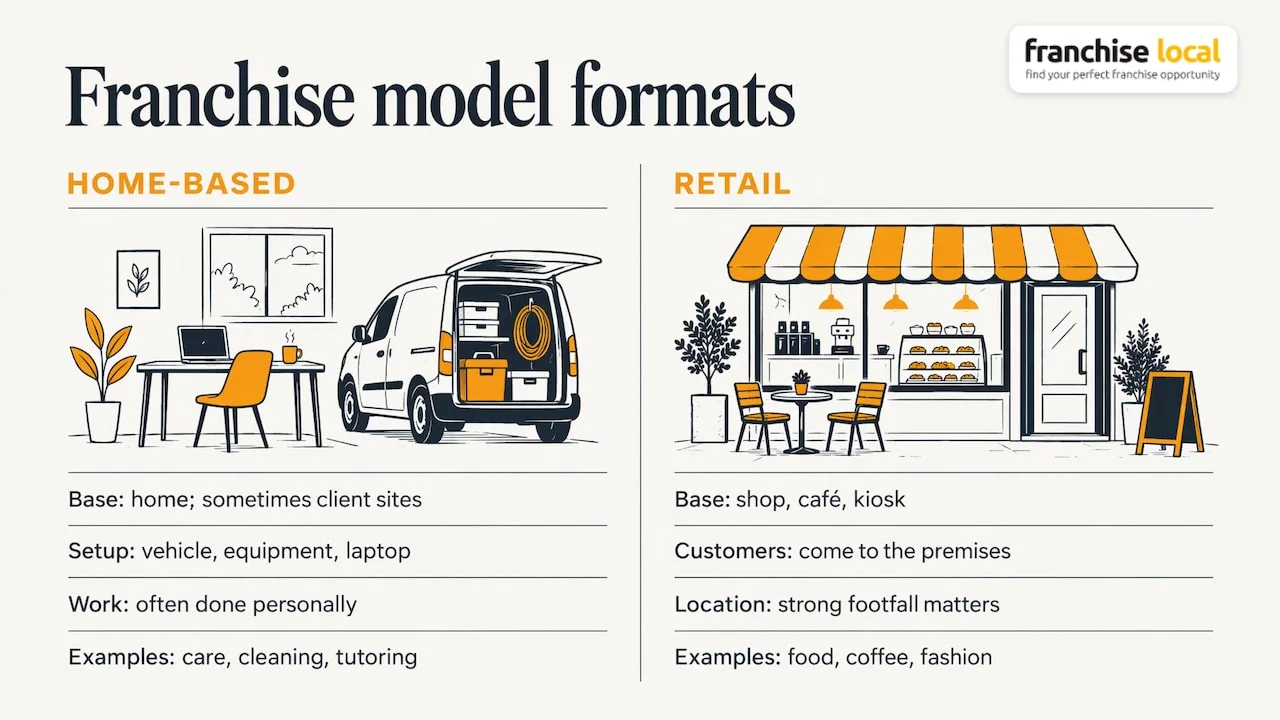
There is also a middle ground. Some service franchises use a small office or light industrial unit. Some retail brands offer smaller formats or online elements. When you browse, treat the labels as a spectrum, not two boxes.
Home-based vs retail franchise at a glance
| Factor | Home-based franchise | Retail franchise |
|---|---|---|
| Premises | Your home, plus a vehicle if the brand uses one | Shop, kiosk or unit, usually leased |
| Typical start-up outlay | Often lower, with less to fit out | Often higher, with fit-out, stock and deposits |
| Ongoing overheads | Lower fixed costs | Rent, rates, utilities, repairs |
| Staff | Often just you at first | Usually a team to cover opening hours |
| Working hours | Flexible, set around client work | Set by trading hours and brand standards |
| How customers find you | Local marketing, networking, referrals, franchisor lead generation | Footfall, location, brand recognition |
| Growth route | Hire staff, add territories or vans | Add staff, extend hours, open more outlets |
| Main risk | Depends on your ability to win work | Fixed costs continue even in quiet months |
The table is a guide, not a rule. Individual brands differ, so check the details in each franchisor’s information pack.
Start-up costs and running costs
The first question most readers ask is how much each model costs. There is no single UK figure for either, because investment varies widely by brand and sector. What stays consistent is the shape of the costs.
Home-based franchises
A home-based model usually concentrates the cost in the franchise fee, training, initial marketing, and any equipment or vehicle. There is no shop to fit out and no commercial deposit to pay. Many home-based opportunities sit at the lower end of the investment scale, which is why they appear so often in searches for franchises under a set budget.
Running costs are typically modest: insurance, vehicle costs if relevant, software, marketing, ongoing franchise fees or royalties, and your own tax and National Insurance. Because fixed overheads are small, a slow month hurts less than it would in a shop.
Retail franchises
A retail franchise adds several layers. You will normally pay the franchise fee and also fund the premises: deposit, legal costs for the lease, fit-out to the brand’s specification, signage, equipment and opening stock. Then come the recurring bills: rent, business rates, utilities, insurance, repairs and wages.
Because retail franchisors often set strict standards for signage, layout and approved suppliers, you have less room to economise on the fit-out. That is part of what protects brand consistency, and you should budget for it from the start.
Check the real figures on each listing
Every listing on Franchise Local shows the investment level the franchisor gives. Use it as your starting point, then ask the franchisor what it does and does not cover: working capital, stock, vehicle, marketing launch and the months before the business breaks even. Our guide on how to assess franchise financials walks through projections, margins and break-even in more detail.
A typical working week
The daily reality is where the two models feel most different.
Running a home-based franchise
In a home-based service franchise, your week revolves around winning and delivering work. You might spend mornings with clients, afternoons on admin and calls, and one evening a week on networking or marketing. You decide when to start and finish, within the limits of client demand. Flexibility is the main attraction, and it suits people with family commitments, those moving from a corporate career, or anyone who wants to build a business around their life.
The trade-off is self-direction. Nobody opens the doors for you. If you do not generate enquiries, nothing happens, so you need to be comfortable with regular outreach and follow-up.
Running a retail franchise
Retail owners work to the shop’s rhythm. The business has to be open when customers expect it, and that means rotas, deliveries, stock checks, cash-ups and customer service. Depending on the brand, you may be on the shop floor yourself or managing a team while you handle the back office. A good example is a convenience-store franchise, where owners continue to run their stores, deal with customers and manage both front-of-house and back-office tasks.
Many owners like this structure. There is a clear place to go to work, a team around you and a steady flow of customers who come in without being chased. Opening hours are not negotiable, though, so your time off needs planning.
Premises, leases and planning rules
This is where UK-specific checks matter most, and where mistakes cost real money.
If you will work from home
GOV.UK sets out the main points for anyone running a business from home. Depending on your circumstances, you may need:
- Permission from your landlord or mortgage provider, if you rent or have a mortgage. Check your tenancy agreement or mortgage terms before you sign a franchise agreement.
- Planning permission, if you plan major alterations or if the business changes the character of the property. Heavy traffic, visitors, noise or disturbance can signal a change of use. Local councils publish their own guidance, and many say that planning permission is not normally needed when the business use is incidental to the home. Contact your local planning authority to confirm your own case.
- Business rates on the part of the property used for business, in some cases.
- Capital Gains Tax on the business portion of your home when you sell it, if part of the home was used exclusively for business.
That last point catches people out. If you plan to dedicate a room solely to the business, think about the possible tax consequences on a future sale and take advice from an accountant or a specialist adviser before you set it up. Our guide to franchise planning permission and lease checks lays out a step-by-step checklist.
Insurance is the other home-based essential. A standard home policy may not cover business equipment, client visits or business use, so tell your insurer and ask what cover you need.
If you will take a retail unit
A commercial lease is a major liability and it can outlast the franchise agreement itself. That is why legal review matters before you sign. A solicitor with franchise and property experience should check:
- the length of the term and any break clauses;
- who is responsible for repairs and for reinstating the unit at the end;
- rent review terms;
- whether the franchisor is involved as landlord, tenant or guarantor;
- what happens to the lease if the franchise agreement ends or is terminated.
That last question deserves its own attention. If the franchise ends early, you could still owe rent. Read how to avoid paying rent after your franchise ends and how termination works before committing to any premises.
Staffing and growth
Home-based service franchises often start with the owner alone, or with one helper. Staff come later, as work grows and you need more capacity. Growth might mean employing people to deliver the work, adding vans, or taking on an adjacent territory.
Retail franchises usually need a team from the first day, because the shop has to be staffed during all trading hours. That means recruiting, training, rotas, payroll and employment law from the outset. It also means more people to manage and more scope to build something larger. Some food and coffee brands expect owners to build up to several outlets over time, and the franchisor may encourage that.
Ask yourself how much you want to manage people. If you enjoy leading a team, retail offers that early. If you prefer to start lean and add staff only when the numbers support it, home-based models fit better.
Winning customers and getting support
Customer acquisition
A retail franchise benefits from visibility. A well-sited shop with a recognised brand draws people through the door. Your key decisions are location, opening hours and in-store performance, and the franchisor’s national marketing helps bring the brand to mind.
A home-based franchise has no shop window, so you go to the customer. Typical routes include local networking, referral partnerships, social media, directory listings, leaflet campaigns and any lead generation the franchisor provides. Some brands supply a steady flow of enquiries. Others give you the tools and training and expect you to generate leads yourself. Ask each franchisor exactly how new customers reach their franchisees, and how many leads a typical franchisee in your area receives.
Franchisor support
Support differs by brand rather than by model, but the content tends to follow the format:
- Home-based: training on the service itself, sales and marketing coaching, software and systems, brand materials, and ongoing help with pricing and customer care.
- Retail: site selection and lease guidance, fit-out specifications, supplier arrangements, staff training, stock systems and in-store operating standards.
In both cases, ask what is included in the initial fee, what continues for the length of the agreement, and what costs extra.
Risks and advantages of each model
Home-based franchise: advantages
- Lower start-up outlay and lower fixed costs.
- Flexible hours that suit different lifestyles.
- No commute and no lease.
- Easy to run part-time while you build up.
- Simple to start small and scale.
Home-based franchise: points to manage well
- Income follows the work you win, so a consistent sales routine matters.
- You need a workable space and the right permissions at home.
- Working alone calls for self-discipline and a support network.
Retail franchise: advantages
- A visible premises and walk-in trade.
- Strong brand recognition from day one with established names.
- A team and a clear structure around you.
- A bigger revenue ceiling and multi-site potential.
Retail franchise: points to manage well
- Higher investment and a lease to negotiate.
- Rent, rates and wages continue through quiet periods, so cash-flow planning is central.
- Opening hours and brand standards leave less flexibility.
A sensible way to read these lists is to match them to your own situation, not to ask which side wins.
Which model suits you?
Use these pointers as a starting framework.
A home-based franchise tends to suit you if:
- you have a smaller budget, or you want to keep your capital in reserve;
- you want flexible hours around family or another job;
- you have a professional background in sales, management, care, training or trades that transfers well to a service business;
- you are comfortable picking up the phone and building relationships.
A retail franchise tends to suit you if:
- you have a larger investment budget and funding in place;
- you enjoy customer-facing work and leading a team;
- you want a recognised brand and a shop where customers come to you;
- you plan to grow to more than one outlet;
- you are comfortable with set hours and strict brand standards.
If you are stuck between the two, consider a hybrid: a service franchise that uses a small office or unit, or a home-based brand that also runs events and pop-ups. You can also look at the stay-at-home parent franchise options if flexibility around childcare is your priority.
Compare opportunities on Franchise Local
Our directory lets you filter UK franchises by investment level, industry, lifestyle and location, so you can set home-based and premises-based opportunities side by side. Start with the home-based franchise opportunities if you want to see what is available to run from home, or check trending franchise opportunities to see what other prospective owners are searching for. If you would rather see what a retail-style sector looks like, browse the fashion franchises or the homewares and DIY franchises. When you find a brand you like, you can send an enquiry directly from its listing.
For a wider introduction to how franchising works, read the ultimate guide to franchising. To understand what a home-based franchise involves in more detail, see what a home-based franchise is and why it matters.
How to compare opportunities before you commit
Whichever model you lean towards, the same checks apply. Take them in order.
- Set your budget and your limits. Decide how much you can invest, how much working capital you need to keep back, and how long you can go without drawing a full income.
- Shortlist by fit. Use lifestyle, industry and location filters to narrow the field to a handful of brands.
- Read the franchise information in full. Check what the fee covers, the length of the agreement, the royalties and any ongoing charges.
- Speak to existing franchisees. The British Franchise Association advises talking to current franchisees and examining the franchisor’s financial projections before you enter an agreement. Our list of questions to ask UK franchisees is a practical place to start, and the franchisee interview page shows what an owner’s experience can look like.
- Run due diligence. Our pages on franchise due diligence, a 30-day background check plan and how to assess franchise risk give you a structure.
- Take legal advice on the agreement. A franchise agreement sets the rules of the system. Have a solicitor who knows franchising review it, with particular attention to exit, termination and non-compete clauses.
- Sort funding and permissions. Confirm finance, plus landlord, mortgage, planning or lease approvals, before you sign.
If you would like help narrowing your list, Mr Franchise is a franchise consultancy that helps people find the opportunity that fits them.
A worked comparison
Take two imaginary buyers with the same goal: a business that replaces a salary within a couple of years.
The first has a modest budget and a background in account management. A home-based business-services franchise suits her. She starts from a spare room, with a laptop and a small marketing budget. Her costs are low, her diary is flexible, and her success depends on the networking and follow-up she is already good at. She checks her mortgage terms, confirms her insurance cover and asks the franchisor how leads are generated in her territory.
The second has more capital and manages a team in his current job. A coffee or food franchise appeals, because he wants a brand customers already know and a shop he can grow into several sites. He budgets for the fit-out, deposit and working capital, and has a solicitor review the lease, break clauses and reinstatement duties before signing anything. He accepts that opening hours and brand standards come with the territory.
Both choices are sound. Each matches the buyer’s money, skills and preferences. That match is the thing to aim for.
FAQ
Is a home-based franchise cheaper than a retail franchise?
Often, yes. A home-based franchise usually avoids the shop deposit, fit-out and rent that make up much of a retail investment, and its fixed overheads are lower. The exact amount depends on the brand, so compare the investment level and what it includes on each listing.
Do I need planning permission to run a franchise from home?
Not always. Councils commonly say planning permission is not needed when the business use is incidental to the home, but major alterations or changes such as regular visitors, traffic or noise may require it. Check GOV.UK’s guidance on running a business from home and ask your local planning authority about your own case. Also check your tenancy or mortgage terms.
Which is better for part-time or flexible working?
Home-based franchises generally offer more flexibility, because you set your hours around client work. Retail franchises follow shop opening hours, so they are harder to fit around another job. You can narrow your search by lifestyle on Franchise Local to find part-time and home-based options.
What should I check before signing a retail franchise lease?
Have a solicitor review the term, break clauses, repair and reinstatement duties, rent reviews and what happens to the lease if the franchise agreement ends. A lease can run longer than the franchise agreement, so these points affect your exposure after you leave the brand.