

Franchise supply chain management is the strategic coordination of procurement, inventory, and distribution activities tailored specifically for franchise systems, designed to deliver consistent quality and operational efficiency across all locations. Unlike a single-site business, a franchise network must balance centralised control with the operational realities of dozens or hundreds of individual outlets. Methods like Distribution Requirements Planning (DRP), consolidated inbound logistics, and pricing governance tools such as RELEX are now central to how leading franchise systems manage costs and protect margins. This guide explains the core components, the real challenges, and the practical steps you can take to optimise your network’s supply chain performance.
What are the unique challenges of franchise supply chain management?
Franchise supply chain management sits at the intersection of brand control and franchisee autonomy, and that tension creates problems you will not find in a standard retail operation. The most significant constraint is the required vendor policy. Franchisors typically mandate that franchisees purchase from an approved list of suppliers, which protects brand standards but removes the flexibility that independent operators rely on when conditions change.

The consequences of this rigidity become visible during supply disruptions. Supply disruptions from logistics failures or global events can force franchisees to wait for the required vendor, with no option to switch suppliers. This means a single vendor’s warehouse fire, port delay, or production shortfall can shut down multiple franchise locations simultaneously. The risk is not theoretical. Post-pandemic supply chain volatility exposed this vulnerability across food service, retail, and service franchises in the UK and globally.
Beyond disruption risk, required vendor policies create pricing pressure. When a franchisee cannot shop the market, the approved vendor faces limited competitive pressure to hold prices down. Vendor rebates create potential conflicts of interest, since franchisors may receive payments from approved vendors, raising legitimate questions about whether vendor selection prioritises franchisee profitability or franchisor revenue. This is a structural issue worth examining carefully before signing any franchise agreement. You can read more about how these dynamics affect costs in Franchiselocal’s guide on franchise fee structures.
The key challenges facing franchise owners in this area include:
- Vendor lock-in: Inability to source alternatives when approved suppliers fail or increase prices significantly
- Price transparency: Limited visibility into whether vendor pricing reflects market rates or inflated margins subsidising franchisor rebates
- Disruption exposure: Single points of failure across the network when one approved vendor experiences operational problems
- Compliance monitoring: Tracking whether all franchisees are purchasing from approved sources without creating excessive administrative burden
- Resilience planning: Building contingency protocols within the constraints of approved vendor lists
“Franchise supply chain resilience depends critically on vendor risk monitoring due to the limited flexibility imposed by required vendor policies.”
Pro Tip: Review your franchise agreement’s vendor approval clause carefully. Some agreements allow franchisees to petition for alternative approved vendors if the primary supplier fails to meet service levels. Knowing this process before a disruption occurs can save weeks of operational downtime.
How do franchise systems coordinate replenishment across multiple locations?
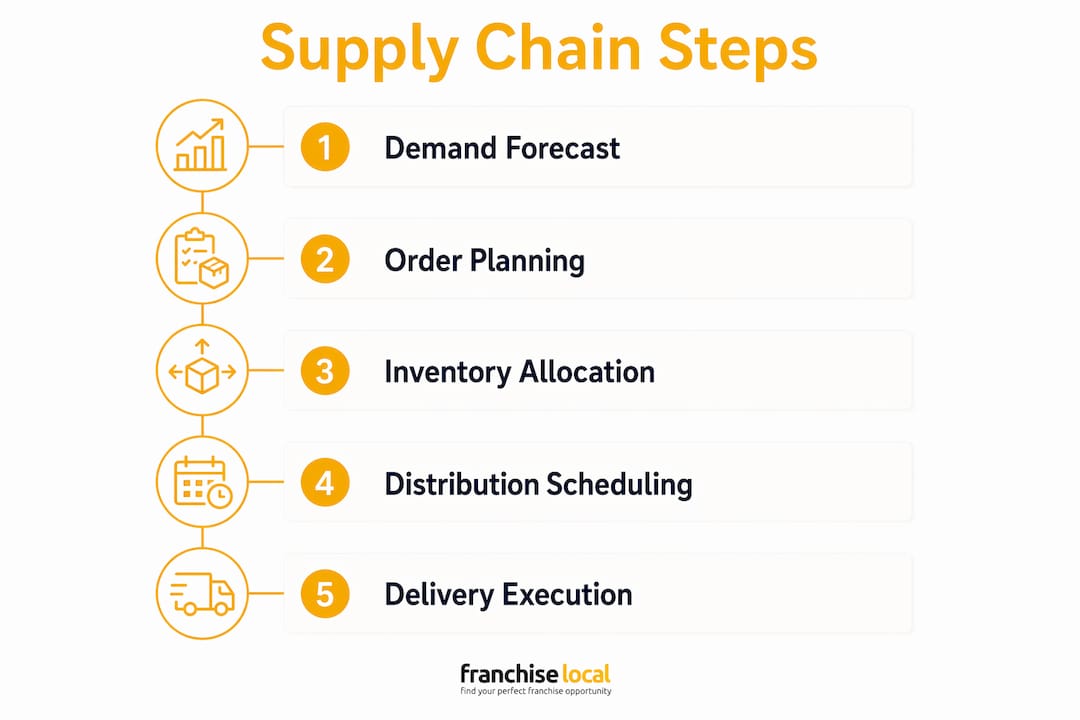
Coordinating inventory replenishment across a multi-location franchise network requires a fundamentally different approach from managing a single warehouse. The method that best fits this structure is Distribution Requirements Planning, commonly known as DRP. DRP calculates when, where, and how much inventory moves by working backwards from downstream demand, integrating transportation schedules and warehouse capacity into a single time-phased plan.
The practical difference between DRP and simpler reorder-point systems is significant. A reorder-point system triggers a purchase when stock falls below a fixed threshold, regardless of what is happening at other locations or in the supply pipeline. DRP, by contrast, looks at actual consumption rates, lead times, and network-wide demand signals to generate replenishment orders that arrive at the right location at the right time. This prevents the twin problems of localised stockouts and network-wide overstocking.
Dynamic safety stock calibration is a core feature of modern DRP implementations. Rather than applying a uniform safety stock figure across all franchise locations, franchise replenishment planning requires designing inventory targets that reflect each location’s demand variability, lead time exposure, and local sales patterns. A high-volume urban franchise and a lower-volume rural outlet should carry different safety stock levels for the same product, even within the same network.
Multiechelon replenishment planning takes this further by coordinating inventory decisions across every tier of the supply chain simultaneously. This planning approach propagates demand from the lowest echelon upward and supply downward, balancing constraints across the entire network rather than optimising each location in isolation. Oracle’s supply chain documentation describes this as enabling holistic visibility across echelons, which is precisely what a franchise network with a central distribution centre and multiple outlets requires.
The table below summarises the key differences between common replenishment approaches used in franchise networks:
| Replenishment method | Trigger mechanism | Network visibility | Best suited for |
|---|---|---|---|
| Reorder point | Fixed stock threshold | Location only | Small, simple networks |
| DRP | Time-phased demand signal | Full network | Multi-location franchises |
| Multiechelon planning | Cross-tier demand propagation | All echelons | Large franchise chains |
| Vendor-managed inventory | Supplier-driven replenishment | Partial | High-trust supplier relationships |
Combining DRP with a Transportation Management System (TMS) reduces overstocking and improves on-time delivery across franchise networks. The DRP layer handles product allocation decisions while the TMS manages physical movement, carrier selection, and receiving. Together, they create a supply chain that responds to real demand rather than lagging indicators. Franchiselocal’s overview of franchise support systems covers how TMS tools coordinate product movement across UK franchise operations.
Pro Tip: When evaluating DRP software for your franchise, ask vendors specifically how their system handles demand signals from individual outlet locations rather than aggregating to a regional level. Forecasting at the lowest echelon prevents the smoothing effect that causes local stockouts even when network-wide stock appears adequate.
What are effective franchise distribution strategies to reduce costs?
Inbound logistics is one of the most overlooked cost levers in franchise operations. Most franchise networks focus on outbound delivery to customers, but the cost and complexity of getting products from suppliers into the distribution network has an equally large impact on margins and replenishment accuracy.
The most instructive recent example comes from Walmart’s 2026 Prepaid Consolidation Programme. Suppliers send products under one national purchase order to a consolidation centre, after which Walmart distributes to 42 regional distribution centres. This approach removes the complexity of managing hundreds of individual supplier shipments and replaces it with a single, standardised inbound flow. The transportation efficiency gains are substantial, and the reduction in receiving errors at distribution centres is a secondary benefit that compounds over time.
Franchise networks can apply the same logic at a smaller scale. Here is a practical sequence for implementing a consolidation-based distribution strategy:
- Audit current inbound flows. Map every supplier, shipment frequency, order size, and delivery destination across your network. Most franchise managers discover significant duplication and inefficiency at this stage.
- Identify consolidation candidates. Products from multiple suppliers that share delivery destinations or timing windows are the first targets for consolidation. Fast-moving consumables typically offer the highest return.
- Establish a consolidation point. This may be a central distribution centre, a third-party logistics provider, or a cross-docking facility. The right choice depends on your network’s geographic spread and volume.
- Standardise ordering formats. Network-level control over inbound logistics combined with standardised ordering formats and consolidation lanes is a key resilience tactic. Inconsistent purchase order formats between franchisees and suppliers create reconciliation errors that erode the efficiency gains from consolidation.
- Phase supplier participation. Start with your highest-volume approved vendors and expand the consolidation programme as processes stabilise. Attempting to onboard all suppliers simultaneously creates implementation risk.
- Measure replenishment accuracy. Track fill rates and lead time variance before and after consolidation. These metrics confirm whether the distribution strategy is improving inventory performance at the outlet level.
Eliminating ordering complexity at the supplier-network boundary via consolidated inbound logistics reduces friction and improves franchise supply chain efficiency. For UK franchise owners managing multiple locations, even a partial consolidation programme covering your top ten suppliers can meaningfully reduce both cost and administrative workload. Franchiselocal’s article on cost-saving logistics models covers additional approaches applicable to multi-location franchise chains.
How can technology and governance improve franchise supply chain performance?
Technology alone does not fix a franchise supply chain. The governance processes that sit around the software determine whether the investment delivers results. This is a distinction that many franchise managers learn the hard way after spending months implementing a planning platform and finding that forecast accuracy has not improved.
Franklin Sports’ experience with GAINS demand planning is instructive. Franklin Sports took nine months to implement GAINS demand planning, including a full Sales and Operations Planning (S&OP) process, to prevent forecast-driven inventory spikes. The nine-month timeline reflects not just software configuration but the organisational work of establishing governance: who owns the forecast, how discrepancies between forecast and actual orders are resolved, and how the S&OP cycle connects demand signals to purchasing decisions. Successful adoption of supply chain planning tools hinges more on governance processes like S&OP and forecast-to-order reconciliation than on software installation alone.
For franchise networks, the governance challenge is amplified because demand data originates at individual outlet level but purchasing decisions are often made centrally. The gap between these two points is where forecast accuracy degrades. Closing that gap requires:
- Outlet-level data collection: Point-of-sale data from every franchise location feeding directly into the planning system, not aggregated weekly summaries
- S&OP cadence: A regular cycle, typically monthly, where franchise operations, procurement, and finance review forecast versus actual performance and adjust purchasing plans
- Forecast ownership: Clear accountability for who updates demand forecasts when local conditions change, such as a new competitor opening near a franchise outlet
- Compliance dashboards: Real-time visibility into whether franchisees are ordering from approved vendors and within agreed volume parameters
On the pricing side, RELEX’s 2026 Franchise Pricing capability addresses a specific governance gap. RELEX centralises pricing governance to reduce margin leakage across franchise networks by aligning retail prices, wholesale transfer prices, and franchisee margins using market intelligence with automated workflows. This matters because pricing inconsistency across a franchise network is not just a revenue problem. It creates franchisee dissatisfaction when some outlets appear to receive better transfer pricing than others, which undermines the collaborative relationship that effective supply chain governance depends on.
Pro Tip: Before selecting any demand planning or inventory management software, map your current S&OP process on paper first. If you cannot describe the governance process clearly without software, the software will not create it for you. The technology should automate a process that already works, not substitute for one that does not exist yet. You can compare leading options in Franchiselocal’s guide to franchise management software.
The supply chain lesson most franchise owners learn too late
Having spent considerable time examining how franchise networks operate across different sectors, the pattern I see most often is this: franchisors invest heavily in brand standards and marketing systems, but treat supply chain governance as a secondary concern until something goes wrong. By the time a vendor fails or margins compress unexpectedly, the governance infrastructure to respond quickly simply does not exist.
The required vendor debate is more nuanced than it first appears. Mandated suppliers do deliver real benefits: consistent product quality, negotiated volume pricing, and simplified compliance monitoring. But the resilience cost is real. A franchise network with no approved alternative for a critical ingredient or component is one supplier failure away from a network-wide operational problem. The required vendor policies in franchising deserve scrutiny not because they are inherently wrong, but because they need to be paired with vendor risk monitoring and contingency protocols that most franchise agreements do not currently mandate.
The demand data point that consistently separates high-performing franchise supply chains from average ones is where forecasting originates. Networks that aggregate demand to regional or national level before feeding it into replenishment systems consistently experience local stockouts even when total network inventory looks adequate. The fix is not more inventory. It is forecasting at the outlet level and letting those signals drive the entire upstream replenishment process.
My honest view on consolidation programmes is that they are underused in UK franchise networks relative to their potential. The administrative friction of managing dozens of individual supplier relationships is a hidden cost that rarely appears on a P&L but consumes significant management time. Even a modest consolidation programme covering your five highest-volume suppliers can free up that time and improve replenishment accuracy simultaneously.
The collaboration point matters more than any specific tool or method. Franchise supply chains work best when franchisors share vendor performance data openly with franchisees, and when franchisees provide accurate outlet-level demand signals back to the central planning team. That exchange of information is the foundation everything else is built on.
— Will
Find franchise opportunities with strong operational support
If you are evaluating franchise opportunities with well-structured supply chain frameworks, Franchiselocal is the UK’s leading directory for connecting prospective franchisees with the right opportunities. The platform allows you to filter by industry, investment level, and location, making it straightforward to identify franchises that offer genuine operational support alongside brand strength. Strong supply chain management is a mark of a mature franchise system, and the best opportunities reflect that. Explore UK franchise opportunities across sectors, or browse networking franchise listings to find businesses built with operational efficiency at their core.
FAQ
What is franchise supply chain management?
Franchise supply chain management is the coordinated planning and execution of procurement, inventory, and distribution activities across a franchise network, designed to maintain consistency and control costs at every location. It covers vendor management, replenishment planning, inbound logistics, and pricing governance.
What is Distribution Requirements Planning in franchising?
DRP is a time-phased, consumption-driven replenishment method that calculates when, where, and how much inventory to move by working backwards from actual outlet-level demand. It is particularly suited to franchise networks because it coordinates replenishment across multiple locations simultaneously rather than managing each site in isolation.
Why do required vendors create supply chain risk for franchisees?
Required vendor policies remove the ability to switch suppliers during a disruption, meaning a single vendor failure can halt operations across multiple franchise locations at once. Vendor rebates also create conflicts of interest, since franchisors may have financial incentives to retain specific approved vendors regardless of their performance.
How long does it take to implement supply chain planning software?
Large multi-location supply chains typically require around nine months to implement demand planning software fully, including the governance processes needed to make it effective. The timeline reflects both technical configuration and the organisational work of establishing S&OP cycles and forecast ownership.
What is the role of consolidation in franchise distribution strategy?
Consolidation reduces inbound logistics complexity by routing supplier shipments through a central point before distribution to individual franchise locations. This approach, used at scale by Walmart’s Prepaid Consolidation Programme, lowers transportation costs, reduces receiving errors, and improves replenishment accuracy across the network.