

Franchise agreement termination is the formal, legally binding process by which the contractual relationship between a franchisor and franchisee is brought to an end under defined conditions. In the UK and across most common law jurisdictions, this process is not simply a matter of giving notice and walking away. The franchise termination process involves specific notice periods, documented grounds, cure periods, and post-termination obligations that carry real financial consequences if ignored. Whether you are a current franchisee considering an exit or a prospective buyer reviewing a franchise agreement before signing, understanding Item 17 of the FDD and equivalent contractual disclosure terms is the single most important step you can take before any decision is made.
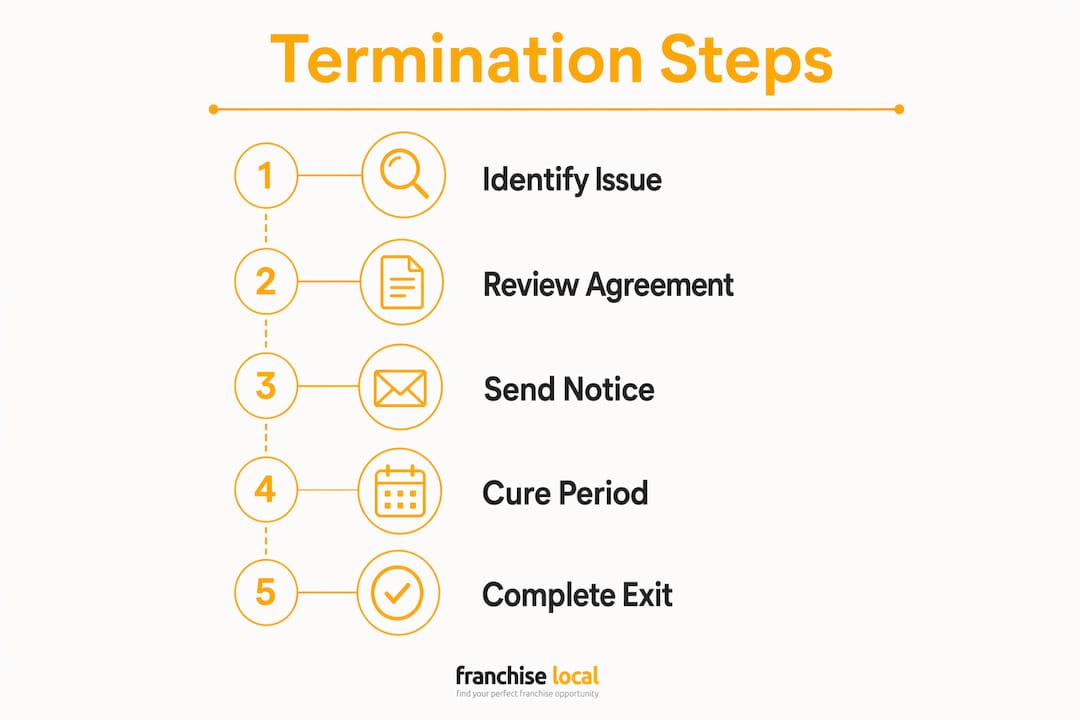
What are the typical notice periods in franchise agreement termination?
Franchise agreements typically require 60–180 days advance written notice for termination, with some agreements extending that requirement to 12 months. That range is not arbitrary. It reflects the time a franchisor needs to find a replacement operator, protect territorial integrity, and wind down shared systems without disruption. For franchisees, it means you cannot simply decide in January that you want out by February.
Notice periods vary significantly depending on the franchise brand, the sector, and the jurisdiction. A large, established franchise network such as McDonald’s or Subway will typically impose longer notice requirements than a smaller regional operator. Before you sign any agreement, reviewing franchise agreement essentials gives you a clear baseline for what standard UK terms look like.

How must termination notice be delivered?
Delivery method matters as much as timing. Most franchise agreements specify that termination notice must be delivered in writing, via recorded post or a recognised courier service, to a named address. Email alone is rarely sufficient unless the agreement explicitly permits it. Sending notice by the wrong method can invalidate the entire termination attempt, leaving you contractually bound and potentially liable for continued royalty payments.
Key procedural requirements to check in your agreement include:
- Written notice requirement: Confirm whether email, recorded post, or courier is accepted.
- Named recipient: Notice must often be addressed to a specific officer or legal department, not just the company address.
- Notice period start date: Many agreements state the period begins only when notice is received, not sent.
- Simultaneous obligations: Some agreements require you to continue trading and paying royalties throughout the notice period.
- FDD Item 17 review: This section discloses termination triggers and post-termination duties in US-based franchise systems, and equivalent clauses appear in UK agreements.
In the UK, there is no single statute equivalent to the US franchise relationship laws that impose minimum cure periods. Approximately 20 US states mandate statutory cure periods of 30–90 days by law. That protection does not automatically apply in England and Wales, which makes reviewing your specific contract terms with a qualified franchise solicitor non-negotiable.
Pro Tip: Request a copy of the franchise agreement and FDD before signing, and pay particular attention to the termination and renewal clauses. Reviewing these with a specialist solicitor costs a fraction of what a disputed termination will.
What are the lawful grounds for terminating a franchise agreement?
Franchise agreement cancellation reasons fall into two broad categories: immediate termination triggers and defaults that carry a cure period. Understanding which category applies to your situation determines how much time you have to respond and whether termination can be avoided entirely.
Immediate termination triggers
Some breaches are so serious that the franchisor can terminate without any notice or cure period. These typically include:
- Criminal conviction of the franchisee or a key person in the business.
- Fraud or deliberate misrepresentation in the original franchise application.
- Abandonment of the franchised business without consent.
- Insolvency or the appointment of a liquidator or administrator.
- Wilful breach of health and safety obligations that endangers the public.
These triggers exist because the franchisor’s brand reputation is directly at risk. A franchisee convicted of fraud cannot continue trading under a trusted brand name, and no cure period would be appropriate in that context.
Defaults with a cure period
The more common scenario involves a default that the franchisee has an opportunity to remedy. Non-payment of royalties, failure to meet sales targets, or breaching operational standards typically fall into this category. Resolving breaches during the cure period frequently prevents termination and avoids litigation entirely.
Cure periods vary from 30 to 90 days depending on the jurisdiction and the specific agreement. In practice, this window is your most valuable protection as a franchisee. Use it.
“Cure periods are strategic opportunities to resolve breaches and prevent termination if properly leveraged. Franchisees who treat a default notice as a crisis rather than a starting point for negotiation consistently achieve worse outcomes.”
One area that catches franchisees off guard is vague “system standards” violations. Franchisors sometimes use broadly worded standards clauses to justify termination when the underlying issue is a commercial dispute rather than a genuine breach. Scrutinising these definitions at the point of signing is the only reliable way to protect yourself. If the agreement defines “system standards” without specificity, push back before you sign.
Pro Tip: If you receive a default notice, respond in writing within 48 hours to acknowledge receipt and confirm your intention to remedy the breach. Silence is often interpreted as abandonment.
What happens after franchise termination?
Post-termination obligations are where many franchisees encounter the most painful surprises. The franchise termination process does not end when the agreement expires or is cancelled. A set of binding obligations continues, often for years.
Comparing key post-termination obligations
| Obligation | Typical Timeframe | Consequence of Non-Compliance |
|---|---|---|
| Remove all signage and branding | 30–90 days post-termination | Injunction and damages claim |
| Non-compete clause enforcement | 6–24 months post-termination | Court injunction, financial penalties |
| Return of operations manuals | Immediate on termination | Breach of contract claim |
| Cease use of trademarks and IP | Immediate on termination | Trademark infringement proceedings |
| Final royalty and fee settlement | Within 30 days typically | Debt recovery proceedings |
Non-compete restrictions post-termination typically last 6–24 months and are enforceable in both UK and US courts, provided they are reasonable in scope and geography. A clause preventing you from operating any business within a 10-mile radius for 24 months is likely enforceable. One preventing you from working in any capacity in your industry for five years is not, and a court would likely reduce it to a reasonable scope rather than strike it entirely.
The financial reality of early exit
Early termination without penalty is rare. Most franchise agreements impose liquidated damages for premature exit, often requiring 12–36 months of royalty payments. That figure can represent a substantial sum. For a franchise generating £5,000 per month in royalties, a 24-month liquidated damages clause means a £120,000 liability on top of any other costs.
Liquidated damages clauses are designed to compensate the franchisor for lost future income, not to punish the franchisee. Courts in England and Wales will generally enforce them if the amount is a genuine pre-estimate of loss rather than a penalty. The distinction matters, and it is worth taking legal advice before assuming a clause is unenforceable.
Pro Tip: If you are considering early exit, calculate your liquidated damages exposure before any conversation with your franchisor. Knowing your worst-case financial position gives you a realistic negotiating baseline.
How can franchisees minimise risk when terminating a franchise agreement?
The most effective approach to how to terminate a franchise agreement is one that prioritises negotiation over confrontation. Negotiating an amicable release with documented systemic issues often avoids costly litigation and preserves your ability to operate in the same sector after exit.
Steps to a controlled exit
Follow this sequence to reduce your exposure:
- Document everything first. Before raising termination with your franchisor, compile a clear record of any systemic failures on their part, including missed support commitments, supply chain failures, or marketing fund misuse. This documentation becomes your negotiating position.
- Seek specialist legal advice early. A franchise solicitor experienced in UK franchise law will identify clauses that may be unenforceable and advise on the realistic cost of different exit routes.
- Open a formal dialogue in writing. Verbal conversations carry no legal weight. All communications about termination should be in writing, dated, and retained.
- Avoid self-help termination. Ceasing operations without formal process invokes immediate breach of contract claims and restricts your future franchise interactions. It is the single most costly mistake a franchisee can make.
- Explore a negotiated release or resale. Many franchisors prefer a clean transfer to a new franchisee over a contested termination. If your territory has value, a resale may eliminate your financial liability entirely.
- Review your franchise legal obligations before taking any formal step. UK-specific statutory considerations differ from US protections and must be factored into your exit plan.
The role of a qualified franchise attorney or solicitor cannot be overstated here. Franchise agreements are drafted by the franchisor’s legal team and are designed to protect the franchisor’s interests first. Having your own adviser review the termination provisions before you act is not optional if you want to protect your financial position.
Pro Tip: Ask your solicitor to draft a formal termination proposal letter rather than using a template. A well-drafted letter signals that you are serious, legally informed, and prepared to negotiate, which changes the dynamic of the conversation immediately.
What i have learned from watching franchisees exit badly
After years of observing franchise disputes and exits across the UK market, one pattern stands out clearly. The franchisees who suffer the worst outcomes are not the ones in the most difficult situations. They are the ones who act before they understand their position.
The most critical mistake franchisees make is assuming they can walk away without costs. I have seen operators simply close their doors, return the keys, and believe the matter is settled. It never is. The franchisor’s legal team is typically far better prepared for this scenario than the franchisee, and the resulting damages claims can be financially devastating.
What works is the opposite approach. Franchisees who take time to document the franchisor’s failures, engage a solicitor before any formal communication, and approach the exit as a negotiation rather than a resignation consistently achieve better outcomes. Some secure full releases from non-compete clauses. Others negotiate liquidated damages down to a fraction of the contractual amount. A few manage to transfer their franchise at a profit, eliminating liability entirely.
The other observation worth sharing is this: the franchisees who understand their termination provisions at the point of signing are the ones who are never surprised by them later. Reviewing how to evaluate franchise agreements before you commit is not pessimism. It is the most commercially sensible thing you can do. A franchise is a long-term commitment, and knowing your exit options from day one is simply good business practice.
Continuous communication with your franchisor throughout the life of the agreement also matters more than most franchisees realise. Disputes that escalate to termination proceedings almost always involve a breakdown in communication that happened months or years earlier. Keeping that dialogue open, even when trading is difficult, is the best way to avoid reaching the point where termination becomes the only option.
— Will
Find your next franchise opportunity with Franchiselocal
If you are reassessing your franchise position or exploring a fresh start after a difficult exit, Franchiselocal is the UK’s leading directory for franchise opportunities across every sector and investment level. Whether you are drawn to financial business franchises or want to explore networking franchise opportunities, the platform connects you with vetted listings that match your budget, location, and lifestyle. Franchiselocal also provides guidance resources to help you evaluate agreements, understand your obligations, and make informed decisions before you commit. Browse the full range of UK franchise opportunities and find the right fit for your next chapter.
FAQ
What is franchise agreement termination?
Franchise agreement termination is the formal ending of the legal contract between a franchisor and franchisee, triggered by expiry, mutual consent, or a breach of contractual terms. It carries binding post-termination obligations for both parties.
How much notice is required to terminate a franchise agreement?
Notice periods commonly range from 60 to 180 days, with some agreements requiring up to 12 months’ written notice. The specific requirement is set out in your franchise agreement and must be followed precisely.
What are the most common grounds for franchise termination?
Common franchise agreement cancellation reasons include non-payment of royalties, breach of operational standards, abandonment, insolvency, and criminal conviction. Some triggers allow immediate termination; others require a cure period of 30–90 days.
What are franchise rights after termination?
After termination, franchisees must cease using the franchisor’s trademarks and branding immediately, comply with non-compete restrictions for up to 24 months, and settle all outstanding financial obligations. Failure to comply risks injunctions and damages claims.
Can a franchisee terminate a franchise agreement early without penalty?
Early exit without penalty is rare. Premature termination typically triggers liquidated damages equivalent to 12–36 months of royalty payments. Negotiating an amicable release with documented evidence of franchisor failures offers the best chance of reducing this liability.