

Effective franchise lead magnets can include low-barrier qualification tools, transparent investment guides, and invitation-based discovery days. Used together, they attract, qualify and move high-intent prospects faster. The 2026 Franchise Recruitment Benchmark Report shows average leads per brand rising from 345 to 663, while cost per lead fell from £75 to £63. The priority now is quality over volume.
Why tailored lead magnets matter for franchise recruitment
Franchise sales cycles run long. According to the British Franchise Association, prospects typically take between 6 and 12 months to move from first enquiry to signature, often requiring staged nurturing so candidates progress without feeling rushed or ignored. Buying a franchise is a career decision, not an impulse purchase, which is why trust matters more here than in most consumer marketing.
Transparent financials and honest franchisee stories do the heavy lifting. Prospects who see real numbers and real experiences self-select earlier, which means:
- Fewer unqualified enquiries reach your sales team.
- Franchisees who do apply to understand the commitment before they call.
- Your recruitment team spends time on candidates with genuine fit.
Early qualification is not a filter that reduces your pipeline. It is what makes a pipeline worth having.
Practical lead magnet ideas, grouped by barrier and intent
Different magnets suit different stages of interest. Matching the asset to the candidate’s readiness avoids wasting a high-trust tool on someone who has not yet decided franchising is right for them.
- Investment checklist: captures budget range in exchange for a simple PDF; fast to build, high capture rate, best for cold traffic.
- Lifestyle-fit quiz: a short interactive quiz asking about working hours, team size preference and industry interest; delivers a personalised result page and collects email plus preferred territory.
- Downloadable investment guide: a longer PDF covering fees, support structures and typical timelines; qualifies financial seriousness by asking for an investment bracket upfront.
- Sample profit and loss template: shown as an illustrative example (not a guarantee of earnings), this helps candidates model their own numbers and signals genuine commercial interest.
- ROI calculator: an interactive tool where candidates enter their own assumptions; the qualifying field here is business experience, since it reveals how realistic their inputs are.
- Franchisee case studies: video or written profiles of existing operators; ask for availability to commit full-time or part-time, since case studies tend to attract serious, later-stage prospects.
- Discovery day invitation: the highest-trust asset, gated behind a short application form that captures territory preference and funding readiness.
Cafe2U’s approach illustrates the top of this funnel well. Its discovery days, run both virtually and face-to-face, give candidates behind-the-scenes operational detail and clear financial information without a sales pitch, positioning the event as mutual assessment rather than persuasion.
Pro Tip: Match the delivery format to the asset: a checklist works as a simple PDF, a calculator needs an interactive web tool, and a case study performs best as a short video with a transcript underneath.
How to design lead magnets that qualify: forms, questions, consent and testing
The form behind your lead magnet matters as much as the content. Keep it short but purposeful:
- Investment budget bracket (not an exact figure, a range).
- Relevant business or management experience.
- Preferred territory or region.
- Availability to commit full-time or part-time.
A simple flow works well: capture the enquiry, nurture with relevant content over several weeks, then invite qualified candidates to a discovery day once they show sustained engagement.
UK marketing rules apply at every stage. ICO guidance on electronic mail marketing requires specific, recorded consent before sending electronic marketing to individuals, and sole traders must be treated as individuals under these rules. Record how and when consent was given, and keep that record alongside the lead data itself. Our guide to how franchise lead forms work covers field-level detail if you are rebuilding a form from scratch.
Some franchisors introduce a short psychometric or self-assessment tool after the initial enquiry. Used well, this adds a layer of self-selection: candidates who complete it tend to be more serious, which can improve leads-to-close ratios without adding friction to the first form.
Where and how to promote lead magnets to reach prospective franchisees
Placement determines whether a well-built lead magnet ever gets seen. Prioritise:
- Your own brand website, where intent is already established.
- Franchise directories and portals, where candidates are actively comparing options.
- Existing franchisee referral programmes, which tend to produce higher-fit leads.
- Targeted search and social ads aimed at specific investment brackets or regions.
Landing pages convert best with a single clear call to action, a short form, a visible consent statement and mobile-friendly layout, as explained in this step-by-step guide for referral-only agents. Given the 6 to 12 month funnel, nurture emails should arrive on a steady but unhurried cadence, with discovery day invitations timed as the accelerator once a candidate shows real engagement. CRM automation helps keep this consistent, triggering relevant follow-ups without over-contacting anyone. Our piece on lead generation strategies for franchises goes deeper on channel mix.
KPIs and benchmarks: what to track and the numbers to aim for
Track leads generated, cost per lead, leads-to-close ratio, time-to-signature and conversion rate by channel. These metrics tell you whether your lead magnets are working or just generating noise.
The 2026 Franchise Recruitment Benchmark Report shows brands recruiting an average of 7 new franchisees over 12 months, with prospects evaluating around 2.19 brands before deciding. That narrow comparison window is exactly why early trust-building content matters so much.
Run small experiments rather than overhauling everything at once: A/B test one headline, one form length, or one landing page layout at a time, then reallocate budget towards whichever version lowers cost per lead or improves leads-to-close. Our breakdown of UK franchise cost-per-lead benchmarks gives a useful range to judge your own figures against.
Examples of successful franchise lead magnet campaigns with case studies or data
Discovery days remain the clearest example of a lead magnet that compounds trust and data at once. Cafe2U’s face-to-face and virtual sessions are built around transparency, giving candidates real financial figures and operational walkthroughs in a no-pressure setting rather than a pitch. That format gives franchisors a natural qualifying checkpoint: candidates who book a discovery day after engaging with earlier content have already self-selected as serious.
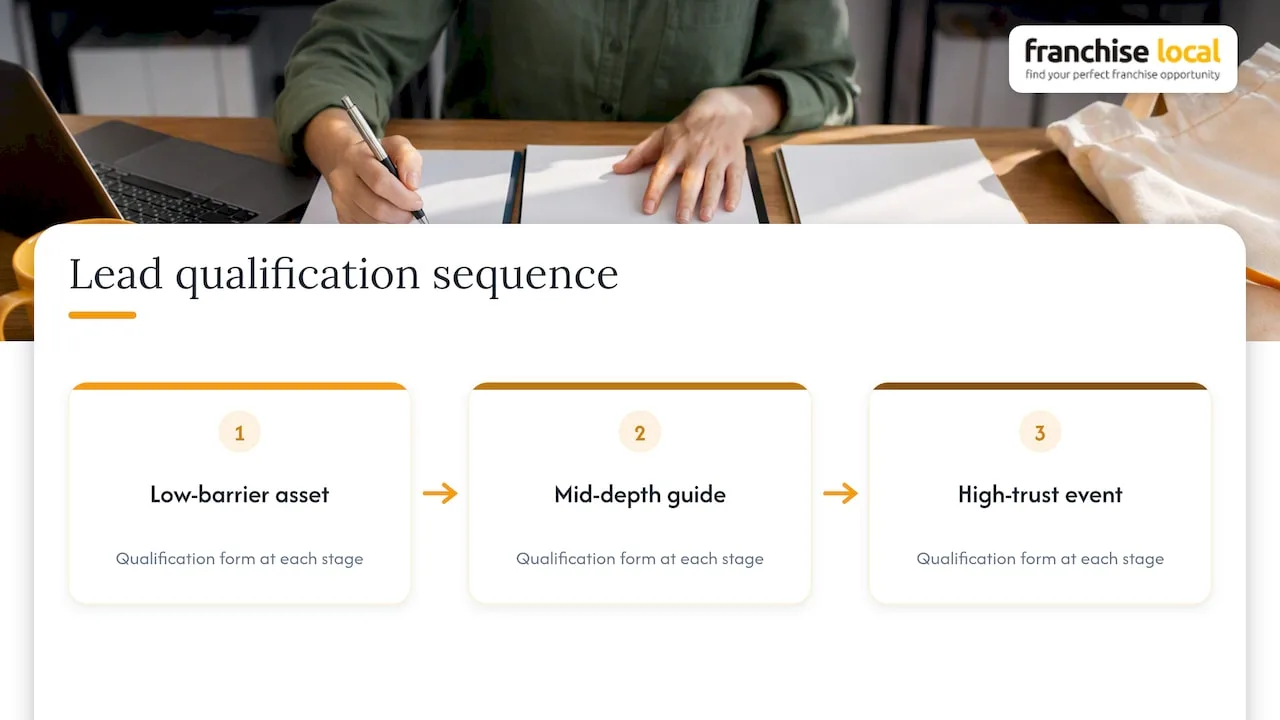
Seminar guidance from the BFA echoes this pattern: a recruitment seminar resource recommends combining traditional advertising with your own website’s qualification forms, then measuring where candidates drop out of the funnel to spot bottlenecks early. The lesson across these examples is consistent: the campaigns that work are not the flashiest, they are the ones that layer a low-barrier asset, a mid-depth guide, and a high-trust event in sequence, with a form at each stage doing quiet qualifying work in the background. Our guide to franchise lead qualification strategies walks through how to structure that sequence for your own brand.
How Franchise Local can help publish and expose your lead magnets
We run a directory of franchise opportunities, helping prospects find options that fit their interests. That means the candidates browsing our listings have already done some self-qualifying before they ever see your brand.
- Add a call to action to your listing to encourage prospects to make an enquiry.
- Use our trending franchise opportunities page to put your brand in front of prospects.
- Pair your listing with a focused lead magnet rather than a generic enquiry form, since specificity tends to produce better-fit applicants.
If you are ready to put a lead magnet to work, update your listing with a call to action, then review our industries directory to see where your brand sits alongside comparable opportunities.
FAQ
What is a lead magnet in simple terms?
A lead magnet is a free, useful resource, such as a guide, checklist or quiz, offered in exchange for a prospect’s contact details. In franchise recruitment, it typically also captures a qualifying detail like investment budget or preferred territory.
What are the 7 types of leads in sales?
Sales teams commonly describe leads as cold, warm, hot, marketing-qualified, sales-qualified, referral and repeat leads, though exact definitions vary between organisations. For franchise recruitment specifically, the practical distinction that matters most is between unqualified enquiries and those who have shown budget readiness and territory interest through a form or discovery day.
How do I generate my own leads?
Combine low-barrier assets like checklists or quizzes with mid-depth guides and high-trust events such as discovery days, placed across your website, franchise portals and referral programmes. Listing your opportunity on a franchise directory alongside a gated lead magnet is a direct way to reach prospects already comparing options.
What is B2B lead generation?
B2B lead generation is the process of attracting and qualifying business buyers rather than individual consumers, often through content, referrals and targeted outreach. Franchise recruitment sits close to this model, since prospective franchisees are evaluating a business investment and respond to the same kind of transparent, evidence-led content.