

Break-even is the point where a franchise’s revenue covers its running costs and recovers your initial outlay. There is no fixed UK timeframe, because it depends on the model, the territory and how much you invest. For context, the British Franchise Association reports that most franchised units are profitable, and HMRC sets the tax rules for fees.
How do you calculate franchise break even step by step?
The maths is simple. The discipline is in gathering honest inputs. Work through it in this order:
- List your fixed costs: rent, salaries, insurance, loan repayments and the monthly share of any equipment you buy.
- List your variable costs: stock, materials, card fees and royalties that move with sales.
- Work out your contribution margin, which is the price of a sale minus its variable costs, either per unit or as a percentage of sales.
- Divide fixed costs by the contribution margin to find the sales you need each month.
- Divide your total initial outlay by monthly profit once you pass that line to estimate payback time.
Keep the two ideas apart. Monthly break-even tells you when you stop losing money each month. Payback tells you when you have recovered what you put in.
Here is an illustrative example, not market data. Say monthly fixed costs are £6,000 and the average job brings in £150, with £60 of variable costs including royalty. The contribution margin is £90 per job, so you need about 67 jobs a month to cover costs. If the initial outlay was £30,000 and you then clear £3,000 a month above break-even, payback takes ten months after reaching that volume.
HMRC position: an initial franchise fee and related legal costs are generally capital expenditure, while annual management or royalty fees are generally revenue expenses. Model them separately.
Cash and accounting timing rarely match. A fee paid on day one hits your bank balance immediately, even if it is spread across years in the accounts. Our guide to franchise start-up expenses helps you build the cost side properly.
What changes how fast a franchise reaches break even?
Two franchises with identical fees can reach break-even years apart. These are the levers that matter most:
- Capital intensity: a shop fit-out needs far more sales to recover than a home-based service round.
- New start or resale: a resale arrives with customers and revenue, which usually shortens the path.
- Territory and local demand: a strong site or well-sized territory fills the diary faster than a weak one.
- Operational efficiency: how quickly you recruit, train and keep staff productive drives margin.
- Marketing ramp-up: franchisor-supplied leads and a clear launch plan shorten the quiet first months.
The British Franchise Association reports that many franchisees work from home. That points to lower fixed costs for many, though home-based models still need steady marketing. Our piece on key franchise profitability factors goes deeper on each lever.
How do disclosure packs and franchise agreements affect your estimate?
A franchisor’s break-even claim is only as good as the assumptions behind it. The UK has no formal US-style disclosure document, but UK practice expects a disclosure pack well before you sign. Look for:
- A full breakdown of fees and ongoing charges
- Timeframes from signing to opening
- The territory model and how exclusivity works
- Financial information with the assumptions stated
- Any average unit performance data and the number of units it covers
Training, launch marketing and permitted suppliers all affect how quickly you can open and sell. Insist on written evidence of promised support, with milestones for opening dates.
Pro Tip: have a franchise-experienced solicitor read the disclosure pack and the agreement together, so verbal promises that never reached the contract are caught early.
Which UK tax and accounting rules change your break-even model?
Tax treatment shapes both your profit figure and your cash. In most cases the initial fee and related legal costs are capital, so they do not reduce taxable profit as a normal expense. Ongoing royalties and management fees are usually allowable revenue expenses and do reduce it.
HMRC toolkit: an initial franchise payment is usually capital expenditure, and revenue deductions for parts of it apply only where the agreement and facts support that split.
For a limited company, that affects how the fee appears in the accounts. Sole traders and partnerships need to plan cash carefully, since a large upfront fee gives no immediate tax relief. Speak to an accountant before you commit, not after.
What should you check before trusting a break-even projection?
Work through this list and keep every answer in writing:
- Ask for historic profit and loss accounts, VAT returns, balance sheets and cash flow statements, especially for a resale.
- Request a breakdown of the initial fee and a schedule of ongoing fees showing what each covers.
- Ask for proof of how the marketing fund has been spent.
- Check staff rosters, supplier contracts, lease terms and local competition.
- Review termination, renewal, transfer and non-compete clauses.
- Confirm tax liabilities, permits, insurance, payroll and operational systems, as the British Business Bank checklist sets out.
Pro Tip: ask to speak to several existing franchisees chosen by you, not only those the franchisor suggests, and ask each how long their own break-even took.
What do realistic UK timelines look like?
Treat the examples below as cautious planning scenarios, not promises. Your own figures should replace them.
Sector context: the BFA reports average turnover of about £400,000 per franchised unit, with 89% of units profitable.
- Home-based service: lower fixed costs mean a shorter climb, often limited by how fast you win customers.
- Retail or high-capex: fit-out and stock stretch the payback period well beyond the monthly break-even point.
- Resale: existing revenue can bring you to break-even soonest, provided the accounts hold up.
Averages hide a wide spread. The BFA’s 2026 survey reports strong confidence among members, but your result depends on your own inputs. Test them with the sensitivity approach later in this guide.
How can you shorten the path to break even?
Several steps help before and after purchase:
- Consider a resale and verify the revenue history against bank statements and tax returns.
- Negotiate staged payments, opening support or a marketing contribution.
- Build a rolling cash flow forecast and review it weekly.
- Keep tight control of working capital, stock and supplier terms.
- Plan hiring, training and local marketing before you open.
Many founders also need an affordable online presence early on. Monthly-plan websites can get you visible quickly without a large upfront bill.
Pro Tip: set written targets for enquiries and sales during your early trading period, so you spot a slow start while you can still change tactics.
How do initial fees and ongoing royalties affect your break-even figure?
The two charges act in different parts of the model. The initial fee sits in your outlay and extends payback. Royalties sit in the variable or semi-variable cost line and shrink your contribution margin on every sale.
Take the earlier illustration. That £12 is already inside the £60 of variable costs. A change in the royalty percentage moves the target.
Some agreements add a minimum monthly royalty or marketing levy. A minimum behaves like a fixed cost in a quiet month, so include it in the fixed side when sales are low. HMRC treats ongoing fees as revenue expenses, which means they reduce taxable profit once you are trading profitably.
Ask the franchisor for the full fee schedule and read what each charge buys. Our franchise fee explainer breaks down typical charges and how each one affects timing.
What cash flow strategies work during the break-even period?
Cash, not profit, decides whether you survive the first year. A business can look healthy on paper and still run short when customers pay late and suppliers want payment now.
Build a rolling cash flow forecast and update it regularly with actuals. Practical guidance on cash flow forecasting methods shows how UK founders structure this and avoid shortfalls.
Beyond forecasting, a few habits make the biggest difference:
- Invoice promptly and chase overdue payments within days.
- Negotiate longer supplier payment terms where you can.
- Keep a cash reserve covering several months of fixed costs.
- Delay non-essential spending until sales prove steady.
- Separate money set aside for VAT and tax so it is never spent by accident.
Review the forecast against your break-even sales target. If actual volume consistently trails the target, act early: trim costs, push marketing or talk to your franchisor about support.
What do UK franchise break-even examples look like by industry?
We cannot quote verified break-even timelines for named UK brands, because individual networks rarely publish them and each case differs. What we can do is describe how the pattern tends to run by type of model, using the same logic as the calculation above.
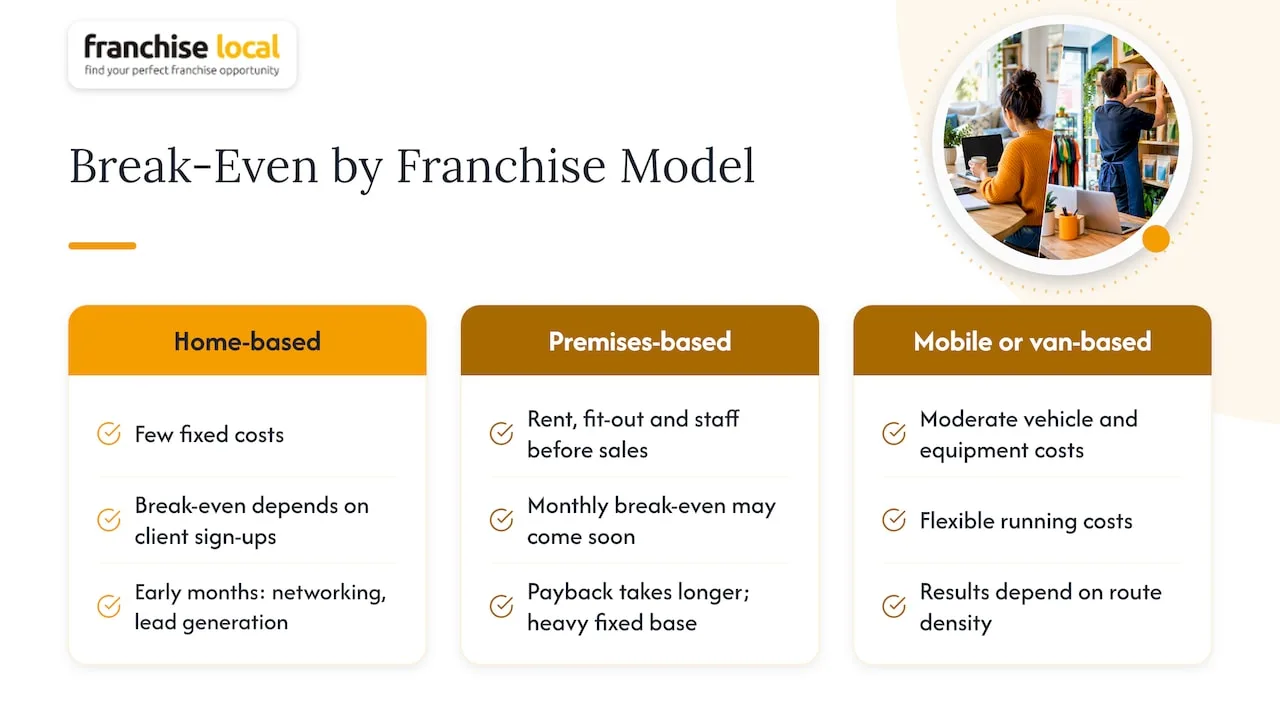
A home-based business services franchise carries few fixed costs. Break-even is mostly a question of how quickly you sign clients, so the first months turn on networking and lead generation. You can browse examples in our business services franchises and networking franchises listings.
A premises-based franchise, such as a shop, café or fitness site, adds rent, fit-out and staff before the first sale. Monthly break-even may come reasonably soon, but payback of the outlay takes longer because the fixed base is heavy.
A mobile or van-based service sits between the two: moderate vehicle and equipment costs, flexible running costs, and results driven by route density.
When a franchisor quotes a timeline, ask for the number of units behind it, whether they were new starts or resales, and the year they opened. Our guide to franchise unit economics explains the four numbers that sit behind any such claim.
What financing options affect break-even, and what do they cost?
How you fund the purchase changes your fixed costs and therefore your break-even. Debt adds a repayment to your monthly fixed costs. Equity from your own savings adds no repayment but ties up your money and extends the personal payback period.
Common routes include:
- Personal savings: no interest, but your capital is exposed.
- Bank term loans: fixed repayments that raise the monthly break-even target.
- Asset finance: spreads the cost of equipment or vehicles, with the asset as security.
- Franchisor-linked finance: some networks arrange funding, so compare it with independent offers.
- Government-backed lending schemes: terms and eligibility change, so check current details before relying on them.
Add loan repayments to the fixed side of the calculation. For example, a loan with monthly repayments raises the fixed costs in our illustration and increases the break-even volume. Interest, arrangement fees and any personal guarantee all belong in your model.
Borrowing more can also buy a faster opening, which sometimes shortens the time to first revenue. Weigh that against the heavier monthly burden, and compare options with a qualified adviser. Browse financial business franchises if you want to see how networks in this space operate.
How does sensitivity analysis change your break-even timing?
A single break-even number gives false comfort. Sensitivity analysis shows what happens when reality drifts from your plan. Change one input at a time, then record the new break-even volume and the new payback period.
Use the earlier illustration: £6,000 fixed costs, £150 average sale, £90 contribution margin, 67 jobs a month. Now test how the model responds to changes in price, fixed costs and variable costs. Lower prices or higher costs reduce the contribution margin or raise the sales needed to cover costs.
The lesson is plain: price and margin changes bite harder than modest rent or cost rises. Run a downside case with sales below plan and check whether your cash reserve covers the gap until volumes recover. If it does not, either lower your fixed base or raise more funding before you start.
Our ROI and profitability estimator lets you test your own scenarios in minutes.
Where can you find UK franchises to test your break-even numbers?
Once your model is ready, you need real opportunities to run it against. We list UK franchises with filters for investment level, industry and lifestyle, so you can match your budget and capital model quickly.
Start with our trending franchise opportunities to compare likely investment ranges, or browse by industry to find the capital model that suits you. Shortlist a few, request each disclosure pack, and run the same break-even maths on every one. Then enquire directly through the listings when a figure stacks up.
This article is general information, not a substitute for advice from a qualified financial advisor. Consult a qualified financial professional about your own circumstances before acting on anything here.
FAQ
What is the failure rate of franchises in the UK?
The British Franchise Association discusses the sector’s historically low failure rate. That finding covers the BFA’s member network, so it does not describe every franchise brand in the market.
Which franchise is profitable in the UK?
Profitability depends on the model, the territory and your own costs, not just the brand name. The BFA reports that 89% of franchised units are profitable, so compare disclosure packs and run your own break-even calculation before choosing.
How long does a franchise take to break even?
There is no single answer, because capital intensity, territory and sales ramp-up all differ. Home-based models and resales tend to be quicker than premises-based new starts, so model your own figures rather than rely on an average.
How are initial franchise fees treated for tax in the UK?
HMRC guidance treats an initial franchise fee as capital expenditure in most cases, and ongoing royalty or management fees as revenue expenses. Confirm your own position with an accountant.