

Most UK franchisors pay varying amounts per lead, depending heavily on the channel and how tightly the campaign is targeted. Directories tend to sit at the lower end and stay more stable; Google and Meta campaigns have climbed higher and become less predictable. The one budgeting rule that matters: work backwards from the number of franchisees you need to recruit, not forwards from whatever media budget you happen to have spare.
What is franchise cost per lead UK, and which metrics matter?
Cost per lead (CPL) is simply the total spend on a recruitment campaign divided by the number of enquiries it generates. It is the metric everyone quotes, but it is also the least useful one on its own. A franchisor buying leads at £40 each and converting one in fifty into a signed franchisee is spending far more per recruit than a competitor paying £90 per lead who converts one in twelve.
That is why serious franchise marketers track three linked figures rather than one:
- Cost per lead (CPL): spend divided by raw enquiries, regardless of quality.
- Cost per application (CPA): spend divided by enquiries who complete a formal application or discovery call.
- Cost per recruited franchisee: the true end metric, spend divided by signed agreements.
Mapping the funnel from lead to application to signed franchisee exposes where money actually leaks. A campaign with a low CPL but a weak application rate often costs more per recruit than one with a higher CPL and tighter targeting. Despite this, only around 59% of franchise brands track CPL consistently, and just 46% track cost per sale at all. That gap in measurement is precisely why so many recruitment budgets get set on gut feeling rather than data, and why boards end up questioning marketing spend without the numbers to defend it.
How much does franchise lead generation cost by channel?
Channel choice is the single biggest driver of franchise lead generation costs, and the gap between channels has widened recently. Franchise directories and portals grew their share of recruitment activity and reported smaller cost increases than paid digital channels, according to the Franchise Insights survey on 2025 lead generation costs.
Many franchise systems reported increased cost per lead recently., with paid search and Meta campaigns cited most often as the channels where costs climbed fastest.
Rough UK banded ranges, based on current market patterns rather than a single fixed rate:
- Franchise directories: typically £20 to £60 per lead, with more consistent quality year to year.
- Google Ads (search): often £50 to £120 per lead, rising in competitive sectors like food and care.
- Meta (Facebook/Instagram): usually £30 to £90 per lead, but with wider swings in lead intent.
- LinkedIn: frequently £80 to £200 per lead, aimed at higher-investment, higher-calibre candidates.
- Franchise brokers: commonly £150 to £400 per qualified introduction, reflecting pre-screening work.
Take these bands as orientation, not gospel. Sample sizes vary by sector, and a single-unit cleaning franchise will see very different numbers from a multi-unit hospitality brand. Combining a directory presence with paid search and social remains the most common practical approach among UK franchisors, precisely because no single channel covers both volume and quality reliably on its own.
What factors change your franchise CPL?
Two franchises in the same sector can pay wildly different rates per lead, and the difference rarely comes down to luck. It comes down to a handful of controllable factors worth auditing before you touch your media budget.
Brand recognition does more heavying lifting than most franchisors credit. A well-known name attracts organic search traffic and direct enquiries that never touch a paid channel, which pulls the blended CPL down without any extra spend. Investment level matters too: a £15,000 franchise attracts high enquiry volumes at low intent, while a £250,000 investment attracts fewer, more serious candidates who cost more to reach but convert at a higher rate.
Beyond that, four practical levers shift your numbers directly:
- Geographic targeting: national campaigns dilute intent; postcode-level targeting around proven territories sharpens it.
- Campaign setup: poor keyword match types or broad Meta audiences waste spend on unqualified clicks.
- Landing-page friction: a ten-field enquiry form filters out serious candidates and inflates your effective CPL.
- Lead qualification rules: deciding upfront what counts as a “billable” lead stops you paying full price for tyre-kickers.
How do you budget from CPL to a recruited franchisee?
Model your budget from the outcome backwards, not the spend forwards. Boards want to know cost per recruit, not cost per click, so the calculation has to start with how many franchisees you actually need to sign this year.
- Set the recruit target. Say you need 10 new franchisees this year.
- Apply your lead-to-sale conversion rate. If historically one in fifty leads becomes a signed franchisee, you need 500 leads.
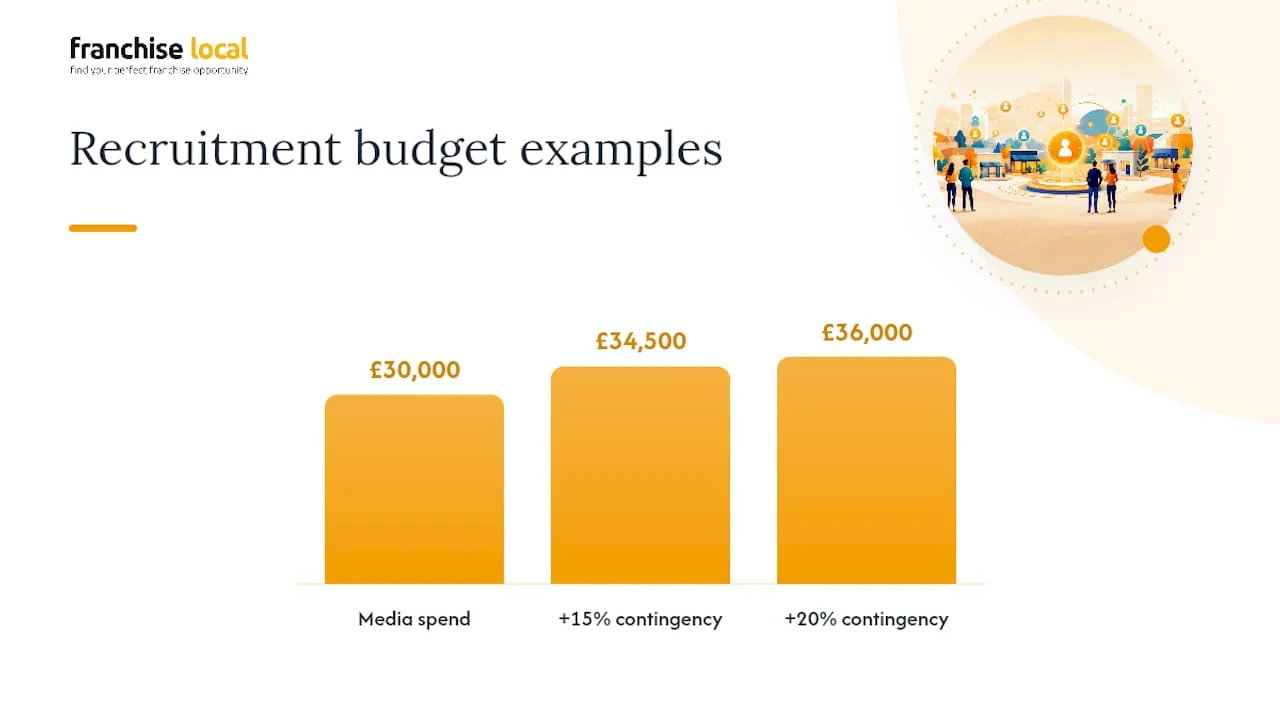
- Multiply by your blended CPL. At an average £60 per lead across your channel mix, that is £30,000 in media spend.
- Add contingency. Budget an extra 15 to 20% for testing new channels and creative before you know what converts.
- Phase the spend. Run a smaller test budget across two or three channels for the first quarter, then scale into whichever channel proves cheapest per qualified application.
This is exactly the kind of calculation a free UK recruitment calculator is built for. Sample outputs from that tool illustrate example budgets that may be required to recruit a modest number of franchisees under typical assumptions, though the exact figure moves with your conversion rate and channel mix.
Pro Tip: Build your model with a deliberately pessimistic conversion rate first. It is far easier to explain an underspend to a board than to explain why the recruitment budget ran out in September.
How can you reduce CPL and improve lead quality?
Lowering your cost per lead without cutting lead quality usually comes from friction, not from bigger budgets.
- Cut form fields. Every extra field on your enquiry form loses candidates; ask for only what you need to qualify a lead.
- Refine targeting continuously. Add negative keywords weekly and cut underperforming audiences before they drain the budget.
- Add a qualification layer. A short pre-screening call or questionnaire before a full discovery call filters out low-intent enquiries early.
- Nurture rather than discard. Not-yet-ready leads often convert months later with the right follow-up sequence.
- Test in pairs. Run A/B tests on landing pages and hold back one channel at a time to isolate what is actually moving your numbers.
Pro Tip: Pair your best-performing directory listing with one paid channel at a time, rather than testing three channels simultaneously. You will never know which one moved the needle otherwise.
Where do Franchise Local’s tools fit into a CPL strategy?
Franchiselocal’s directory works as the stabilising piece of a UK recruitment mix. Extensive filtering by industry, investment level, and lifestyle means candidates arriving through a listing have already self-selected on fit, which tends to lift application rates compared with colder paid traffic. Featured placements add visibility among franchisees actively comparing options rather than scrolling generic ad inventory.
For the modelling itself, Franchise Local’s affordability calculator and ROI estimator give franchisors a starting point for translating CPL assumptions into a realistic recruitment budget before committing spend. Used alongside a channel benchmark, they turn a rough estimate into a defensible board figure.
How long before a UK franchise recruitment campaign shows results?
Expect the first genuine signal within four to six weeks, not days. Paid search and Meta campaigns typically generate enquiries within the first week, but that early data is noisy. Directory listings often take slightly longer to build momentum because they depend on organic search visibility and candidate browsing behaviour rather than an ad auction.
The realistic timeline breaks into three phases. Weeks one to two involve campaign setup, tracking installation, and initial ad delivery, during which CPL figures are unreliable because volumes are low. Weeks three to six deliver your first statistically useful read on channel performance, enough to see which sources are producing applications rather than just clicks. By week eight to twelve, you should have enough signed or advanced-stage franchisees to judge true cost per recruit rather than cost per lead.
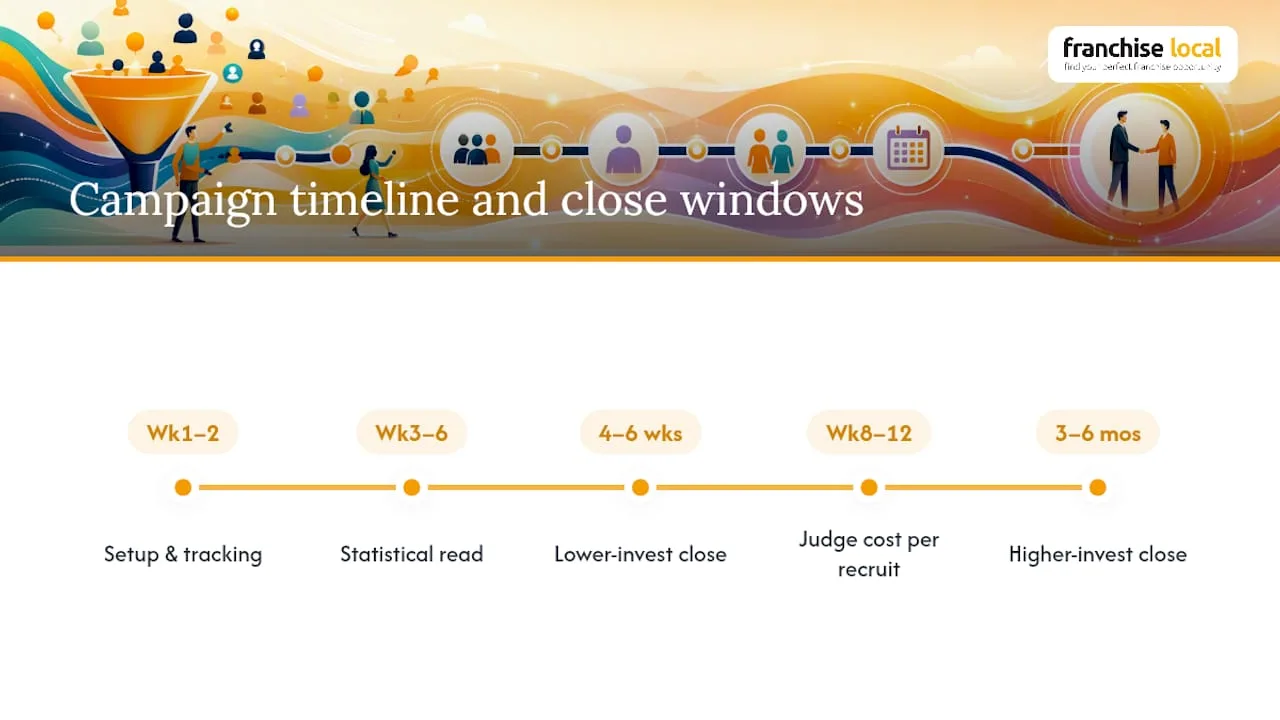
Sectors with longer sales cycles, particularly higher-investment franchises above £100,000, routinely take three to six months from first enquiry to signed agreement. Lower-investment, home-based franchises can close in four to six weeks. This matters for budgeting: judging a campaign’s success at the four-week mark, before the funnel has had time to mature, is one of the most common reasons franchisors abandon channels that would have worked given more time.
Set your review cadence to match the sales cycle of your specific franchise model, not a generic marketing calendar. A campaign that looks expensive at week four can look entirely reasonable by week twelve once applications start converting.
What hidden costs sit beyond your headline CPL?
The quoted CPL is rarely the whole bill. Franchisors budgeting purely on a per-lead rate routinely underestimate total recruitment spend by a third or more once the supporting costs are added in.
Agency or broker management fees are the most common addition, typically charged as either a flat monthly retainer or a percentage of ad spend on top of the media cost itself. Platform and account fees follow: some directories charge listing or featured-placement fees separately from any pay-per-lead component, and paid search platforms carry their own account management overheads if run through a third party.
Creative production is the cost most franchisors forget entirely. Video content, photography, and landing-page design for a recruitment campaign are not one-off costs. Ad fatigue sets in within weeks on Meta in particular, meaning creative needs refreshing every four to six weeks to hold CPL steady, and each refresh has a production cost attached.
CRM and lead-tracking software is another line item, particularly once a franchisor moves beyond a spreadsheet and needs proper attribution across five or six channels simultaneously. Add in the time cost of internal marketing staff managing the campaigns, and the effective cost of a recruited franchisee often sits considerably above the headline CPL figure quoted by any single channel.
Building these into your budget from the outset avoids the uncomfortable conversation of explaining a budget overrun to a board partway through the year.
Start reducing your franchise recruitment costs today
A traditional agency retainer locks you into monthly fees whether or not leads convert, and broker introductions carry a premium for pre-screening you could achieve more cheaply with a well-built landing page. Franchiselocal offers a different route: a directory built specifically for UK franchise seekers who are already filtering by industry, investment level, and lifestyle before they ever reach your listing, which tends to produce more qualified enquiries than cold paid traffic at a comparable spend.
Featured placements on trending franchise opportunities put your brand in front of candidates actively comparing options right now. If you operate in a specific sector, dedicated category pages such as the business services franchise listings or the B2B franchise directory put your opportunity alongside relevant competitors rather than generic search results.
Start by running your own numbers through the affordability calculator or browse the full search directory to see how a listing fits into your recruitment mix before committing further paid spend.
Sources
- Changes in Cost Per Lead for Top Paid Franchise Development Lead Generation Sources
- Free franchise recruitment calculator – Leads 4 Franchises
FAQ
How much does it cost to open a franchise in the UK?
Total investment ranges from under £10,000 for home-based franchises to several hundred thousand pounds for larger retail or hospitality brands, separate from the recruitment marketing costs covered in this article.
What is the cheapest franchise to start in the UK?
Home-based and service franchises, such as cleaning, mobile car valeting, and consultancy models, tend to sit at the lower end of the investment scale, often starting under £10,000.
Which franchise is best for beginners?
There is no single best option; beginners generally do better with established brands offering strong training and support, which is why comparing multiple opportunities by industry and investment level on a directory like Franchiselocal is worth doing before committing.
Why do franchise CPLs vary so much between channels?
Directories tend to attract candidates who have already self-selected on fit, keeping costs lower and more stable, while paid search and social platforms compete on auction pricing that has risen for many franchisors in 2025.
How often should I review my franchise recruitment CPL?
Review headline CPL weekly for early warning signs, but judge true cost per recruit only after eight to twelve weeks, once enough leads have had time to move through the application stage.