

A proper franchise background check confirms four things: the franchisor’s exact legal identity, its filed accounts and financial claims, the contract terms you’re about to sign, and whether real franchisees back up the pitch. Start at Companies House and the British Franchise Association, browse verified opportunities on franchise directories, then request the full disclosure pack and instruct a franchising solicitor and an accountant before you sign anything.
Quick checklist: essential checks to run first
Before you spend a penny on legal fees, run through these checks yourself. Most take an afternoon and several are free.
- Confirm the exact legal entity. Match the company name and registration number in your franchise agreement against Companies House filings. Franchisors sometimes trade under one name and contract under another.
- Request the core paperwork. Ask for the franchise agreement, operations manual, approved supplier lists and the last two to three years of accounts.
- Check British Franchise Association standing. BFA membership involves a vetting process, and the association publishes questions every prospective franchisee should ask before signing.
- Get a franchisee contact list. A franchisor confident in its network will let you speak to several existing operators, not just the two they hand-pick.
- Search public records. Look for county court judgments, insolvency notices or trading standards enforcement tied to the entity or its directors.
If a franchisor resists any of these, treat that resistance itself as data.
How to verify a franchisor’s financials and commercial claims
Companies House is your starting point for any franchisor screening process. Search the registered entity and pull its filed accounts, which show turnover, net profit, director loans and any related-party transactions buried in the notes. Government guidance points prospective business owners toward these filings precisely because they’re free, public and reasonably current.
Not all accounts carry equal weight. Audited accounts have been independently checked and offer the strongest assurance. Management accounts are unaudited internal figures, useful but softer evidence. Projections are simply forecasts, no matter how polished the spreadsheet looks. Where a franchisor claims substantial network turnover or backing from a larger group, ask for audited figures rather than accepting a management summary at face value.
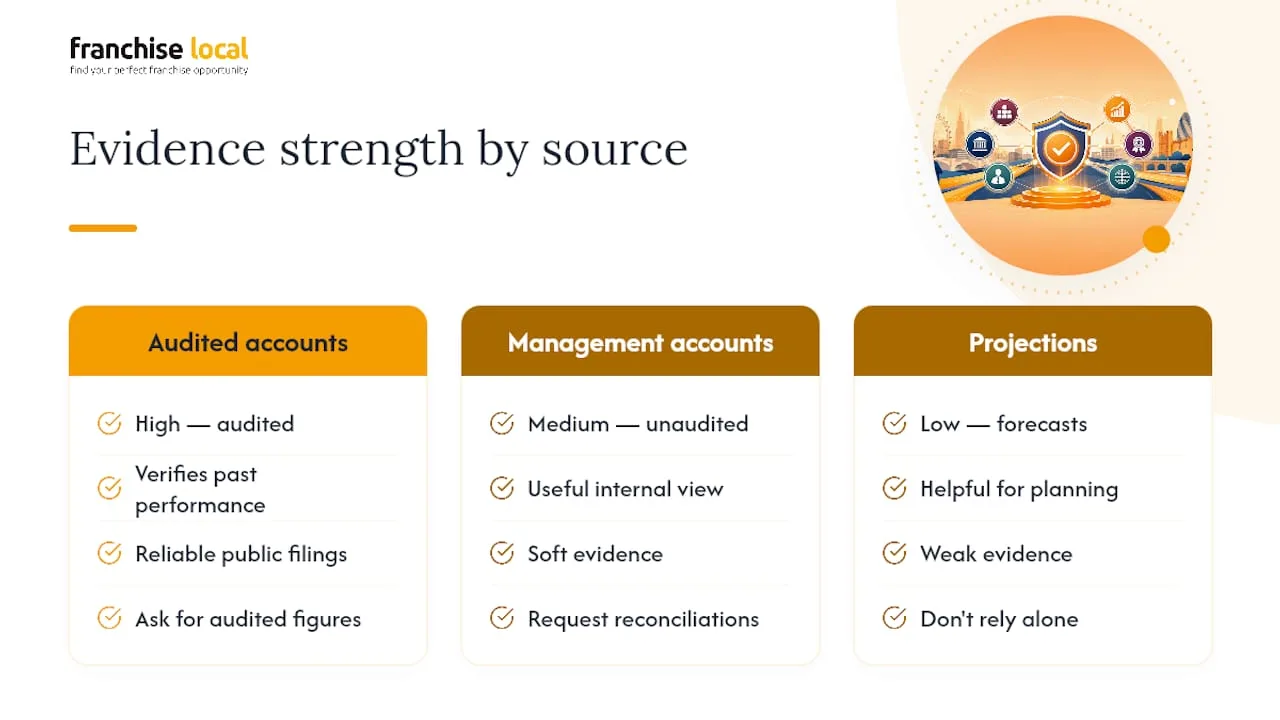
Push further than the headline numbers. Ask the franchisor to reconcile its own revenue claims against actual franchisee performance data, such as average unit turnover across the network. A franchisor claiming an average annual profit per site should be able to show you the workings, not just the assertion.
This is where a chartered accountant earns their fee. They’ll spot disguised liabilities, unusual director loans or revenue recognition that flatters the top line. Our guide to assessing franchise financials walks through the specific line items worth interrogating before you commit.
Key legal documents to review and which advisers to hire
The franchise agreement is a binding commercial contract, and franchising solicitors consistently stress that early legal involvement prevents expensive surprises when things go wrong at termination or transfer. Prioritise these clauses:
- Territory and exclusivity. What exactly is protected, and for how long?
- Termination rights. What triggers it, on either side, and what happens to your assets and goodwill afterwards?
- Renewal terms. Is renewal automatic, or does the franchisor hold discretion to refuse?
- Transfer and sale restrictions. Can you sell the business, and does the franchisor take a cut or right of first refusal?
- Variation rights. Can the franchisor change fees, territory or operating standards unilaterally?
- Dispute resolution. Arbitration, mediation, or the courts, and in which jurisdiction?
Also read the operations manual and any supplier contracts referenced within it. Legal guidance from LexisNexis highlights how the choice of business vehicle, resale conditions and contractual obligations all carry real legal risk that a signature can’t undo later.
Pro Tip: Some franchisors operate through group structures where the entity signing your agreement isn’t the entity holding the brand’s assets. Ask your solicitor to confirm precisely who you’re contracting with, and whether that entity has the financial substance to honour its obligations.
A franchising solicitor should verify the signing entity and flag onerous liabilities; an accountant should vet the accounts and stress-test any projections. Our piece on why legal advice is vital before buying a UK franchise sets out what that review should actually cover.
How to speak to franchisees and what to look for on visits
Franchisee due diligence lives or dies on this step. Franchisors curate their best-performing operators for you to meet, so work harder to get an honest sample.
- Speak to a spread of franchisees. Include someone newly signed, someone two or three years in, and a long-standing operator if the network has one.
- Ask about the gap between pitch and reality. Start-up costs, actual revenue against the franchisor’s projections, how useful training was, and how quickly support responds when something breaks.
- Visit sites in person. Watch customer footfall, stock levels, staffing and whether the outlet actually matches brand standards on the franchisor’s own website.
- Ask why franchisees have left. Non-compete clauses and resale restrictions matter more once you’re the one trying to exit.
- Cross-check every answer. Inconsistent stories, or a franchisor who won’t let you visit a site unaccompanied, are themselves a signal worth acting on.
Elite Franchise Magazine’s guidance suggests also asking how many franchisees have failed and whether the model was piloted before being sold, questions that separate a mature network from a hastily assembled one.
Common red flags and when to stop the process
Certain warning signs recur across UK franchise screening cases, and none of them should be ignored individually, let alone in combination.
- Evasive answers, or outright refusal to share franchisee contacts or recent accounts.
- A franchisor claiming strong financial backing but unable to produce audited accounts to support it.
- High franchisee churn, unexplained payments to related parties, or mandatory suppliers priced well above market rate.
- Franchisor variation rights that let it change fees or territory terms without your consent.
Pro Tip: Set yourself a simple rule before you start: if two or more red flags surface, pause the process and bring in formal legal and accounting due diligence before spending another penny. Some franchisors also insist on personal guarantees even where you’re trading through a limited company, which quietly removes the liability protection that structure was meant to give you.
30 day due diligence dewelopera: who does what and when
UK franchise compliance checks don’t need to drag on for months. A focused month, split across three phases, gets you to a defensible decision.
- Days 1 to 7: Verify the legal entity, request the full document pack, check Companies House filings and BFA membership, and start informal outreach to franchisees.
- Days 8 to 21: Your accountant reviews the accounts and any projections while you carry out site visits and franchisee interviews.
- Days 22 to 30: Your solicitor reviews the agreement and negotiates protections, then you make the final call and confirm financing.
Three conditions should halt the clock immediately: the franchisor refuses franchisee contact details, accounts don’t reconcile with claimed performance, or the agreement contains unilateral variation rights your solicitor can’t get removed. Our franchise due diligence primer expands on pacing this properly if 30 days feels tight for your circumstances.
Use FranchiseLocal to shortlist and prepare checks
Franchiselocal exists to shorten the search that comes before all this due diligence, not to replace it. Filtering by industry, investment level, lifestyle fit and location on trending franchise opportunities narrows a market of hundreds of brands down to a handful worth your verification time, whether you’re drawn to networking franchises or financial business franchises.
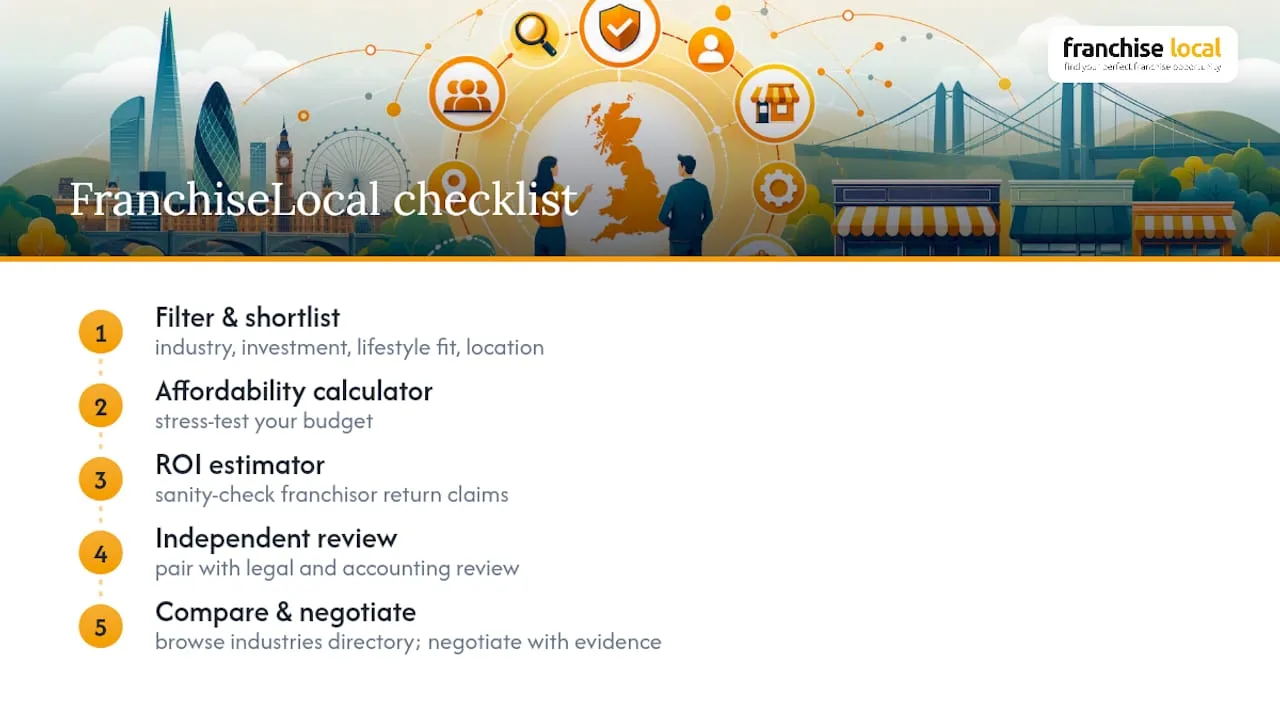
Once you’ve shortlisted, use the affordability calculator to stress-test your budget and the ROI estimator to sanity-check a franchisor’s return claims before your accountant digs into the actual accounts. Pair FranchiseLocal’s discovery tools with the independent legal and accounting review outlined above, browse the full franchise industries directory to compare alternatives, and you’ll walk into any negotiation with a shortlist you chose and evidence you verified yourself.
Sources
- Important questions to ask your prospective franchisor – British Franchise Association
- Considerations for a franchisee when entering into a new franchise or purchasing an existing one – LexisNexis UK
- Business
FAQ
What Does a Franchise Background Check Actually Cover?
It covers the franchisor’s legal identity, its filed accounts, the franchise agreement’s key clauses, and verification from existing franchisees, ideally supported by a solicitor and accountant review.
Where Do I Find a UK Franchisor’s Filed Accounts?
Filed accounts are public on Companies House, which shows turnover, profit, and any director loans or related-party notes worth questioning.
Is British Franchise Association Membership Required?
BFA membership isn’t a legal requirement, but it involves a vetting process, so its absence or a lapsed membership is worth asking the franchisor to explain directly.
How Long Should Due Diligence on a Franchise Take?
A focused verification process can realistically run across 30 days, split between document and entity checks, accountant and franchisee review, and final legal negotiation.
Can Franchiselocal Help With Background Checks?
Franchiselocal helps you shortlist verified UK franchise opportunities by industry, investment and location, but the legal and financial verification itself should always sit with an independent solicitor and accountant.