

A franchise’s digital presence is the complete set of online assets and signals that make each location discoverable, credible, and capable of generating leads: the website architecture, Google Business Profile listings, social channels, paid media, directories, reviews, and the CRM infrastructure that ties them together. For investors, it is one of the most revealing due-diligence indicators available. A network with verified location pages, active Google Business Profiles, and measurable lead flows is demonstrably easier to scale and commands stronger valuations than one with fragmented, inconsistently managed online assets.
What does a franchise digital presence actually include?
The concept covers more ground than most investors initially expect. Think of it as a layered system where each component either amplifies or undermines the others.
Website architecture is the foundation. A well-structured franchise site uses a single central domain with dedicated location pages, for example brandname.co.uk/locations/manchester, rather than separate domains for each franchisee. That structure consolidates domain authority, supports internal linking between location and service pages, and avoids the canonicalisation headaches that come with fragmented domains. Each location page should carry LocalBusiness schema markup so search engines can correctly attribute address, hours, and service data to the right territory.

Local SEO and Google Business Profile sit directly above the website layer. Search engines treat each franchise location as a unique entity, so accurate addresses, opening hours, photos, and local reviews all feed into ranking signals independently for each outlet. A verified, actively managed Google Business Profile is often a customer’s first encounter with a location before they ever visit the website.
Social media (primarily Meta: Facebook and Instagram for most UK consumer franchises), paid media, directories such as Trustpilot and Yell.com, and reputation management complete the visibility layer. Below that sits the operational layer: a centralised CRM capturing leads from every channel, plus analytics and tag management to attribute those leads accurately.
“A website is a core business asset and must be built with architecture that supports internal linking, distinct location pages and integration with local content — generic templates for new locations limit visibility.”
— Priority Pixels
Franchise SEO works best as a two-tiered strategy: national content builds brand authority while location-level landing pages capture nearby customers with specific intent. Weak implementations collapse both tiers into a single homepage, leaving individual locations invisible in local search.
Why does digital presence matter to franchise investors?
The commercial logic is direct. Local discovery drives footfall or enquiries; enquiries convert to customers; customers retained over time reduce acquisition costs per sale. A network where each location ranks well locally, holds a clean Google Business Profile, and captures leads into a central CRM produces measurable, auditable revenue per location. That auditability affects both day-to-day performance and exit valuation.
Poor digital presence has the opposite effect. Thin location pages, unclaimed Google Business Profiles, and scattered review profiles all increase the cost of acquiring each customer because the network cannot be found organically. Franchisors then compensate with paid media spend, which compresses unit economics. For an investor modelling returns, that pattern is a direct drag on profitability.
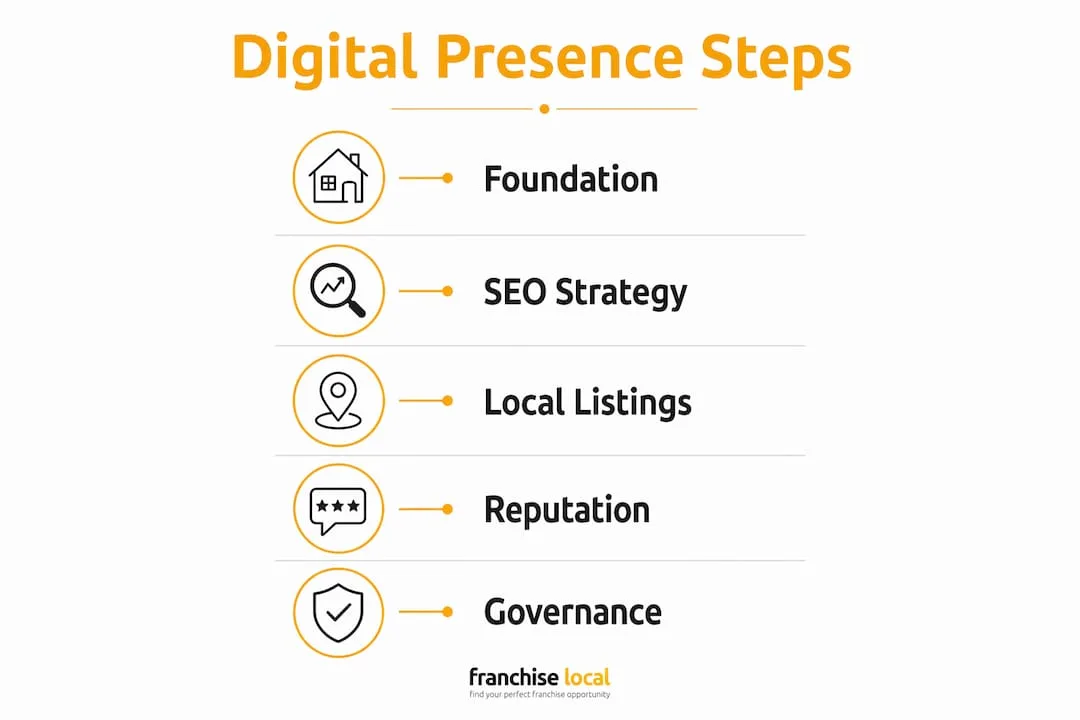
The importance of digital presence for franchises also shows up in customer trust signals. Fresh local photos, recent reviews, and prompt responses to negative feedback all affect conversion from search results before a prospect ever makes contact.
How do franchisors govern digital presence across a network?
Governance is where most franchise networks either protect or erode their brand equity online. Three broad models exist.
Centralised publishing gives the franchisor full control: the head office team manages all location pages, Google Business Profiles, and social content. Brand consistency is high, but local responsiveness is slow and franchisees have little ability to reflect genuinely local activity.
Hybrid models are the most common approach for mid-size networks. The franchisor provides a template CMS with locked brand elements (logos, colour palettes, approved copy blocks) and unlocked zones where franchisees can add local team photos, community news, or location-specific offers. Permissions are set centrally, and a review workflow ensures nothing goes live without approval.
Franchisee-led models carry the highest risk. Without guardrails, individual franchisees create their own domains, run their own ad accounts, and post inconsistently. The result is a fragmented brand that confuses both customers and search engines.
Successful franchise systems balance brand guardrails with local franchisee engagement rather than forcing a binary choice between control and freedom. Practically, that means a template CMS with permissions, a centralised listings manager for directories and Google Business Profile, a shared reputation platform for review monitoring, and a central ad account structure with territory-level campaigns.
Pro Tip: During due diligence, open five or six location pages at random. If the brand assets differ, the contact details are inconsistent, or some pages are clearly thinner than others, the governance model has gaps that will cost money to fix.
A due-diligence checklist for evaluating a franchise’s digital presence
Run through these points before committing to any opportunity.
- Domain structure. Does the network use one central domain with location subfolders, or are there multiple franchisee-owned domains? Multiple domains signal governance risk.
- Location page quality. Are pages unique, with local team details, specific services, and local photography? Thin pages with only the town name changed attract duplicate-content penalties.
- Google Business Profile verification. Search each location on Google Maps. Are profiles verified, complete, and recently updated? Unverified or sparse profiles are a red flag.
- Review counts and response rates. Check Trustpilot, Google, and Yell.com. A healthy network shows consistent review volume and timely franchisor or franchisee responses to negative feedback.
- CRM and lead capture. Ask who owns the lead data. Leads should flow into a central CRM, not into individual franchisee inboxes with no visibility for the franchisor.
- Paid media structure. Are campaigns run from a central ad account with territory targeting, or are franchisees running independent campaigns? Fragmented paid activity wastes budget and creates brand inconsistency.
- Analytics access. Request read-only access to Google Analytics (GA4) and Google Search Console during due diligence. Absence of tracking or inconsistent UTM use suggests measurement gaps.
- Cookie and consent setup. Check that the site carries a compliant cookie consent banner and that the privacy policy references data processing correctly under UK GDPR.
Key questions to ask the franchisor: Who manages local ad spend and who pays for it? Who owns the Google Business Profile login? What happens to lead data if a franchisee exits the network?
Red flags that warrant deeper investigation include franchisee-owned domains, missing review responses, duplicate location pages, and paid campaigns with no territory structure. Remediation for a mid-size network typically runs across several phases over three to six months, with costs scaling by the number of locations requiring individual attention.
Which KPIs and tools should you expect to see?
A credible franchisor can produce location-level data, not just network aggregates. The KPIs that matter most are local organic traffic per location (from Google Search Console), Google Business Profile impressions and direction requests, leads per location per month, call or form conversion rate, review sentiment and response rate, and paid media return on ad spend by territory.
The tools that generate this evidence are Google Search Console, GA4, Google Business Profile Insights, and advertising platform reports (Meta Ads Manager for social, Google Ads for search). For reputation, a centralised platform that aggregates Trustpilot, Google, and Yell.com reviews into one dashboard is the standard for networks of any scale. A multichannel approach to measurement that separates national brand traffic from local discovery traffic gives the clearest picture of where each location actually stands.
Good baseline signals: location pages generating organic impressions within 90 days of launch; Google Business Profile click-through rates above the category average for the sector; review response time under 48 hours. Missing tracking, no UTM conventions, and GA4 showing direct traffic as the dominant channel all suggest the measurement infrastructure needs rebuilding.
What UK legal and compliance requirements apply?
- ICO and UK GDPR. The franchise agreement should include data-processing clauses that clarify whether the franchisor acts as data controller or processor for leads captured through the network’s digital assets. Cookie consent must be implemented correctly on every location page, not just the homepage.
- ASA advertising rules. Any claims made in paid ads or on location pages (pricing, availability, results) must be substantiated and not misleading. The ASA’s CAP Code applies to online advertising in the UK.
- Review moderation. Incentivising reviews without disclosure breaches both ASA guidance and the terms of most review platforms. Franchisors should have a written policy on how franchisees may request reviews.
- Franchisee training. Digital transformation in franchising requires formalising franchisee requirements for social media and digital activity in the franchise agreement, not just in an operations manual.
Ask franchisors to show evidence of compliance training, a data-processing agreement, and a cookie audit. Breaches typically surface through ICO complaints, review platform flags, or ASA investigations, all of which carry reputational and financial cost.
Typical rollout phases and cost ranges
| Phase | Typical duration | Notes |
|---|---|---|
| Discovery audit | 2–4 weeks | Technical site audit, GBP audit, competitor gap analysis |
| Technical fixes | 4–6 weeks | Schema, canonicalisation, site speed, consent setup |
| Location page builds | 4–6 weeks | Scales with number of locations; unique content per page |
| GBP verification | 2–4 weeks | Postcard or video verification per location |
| Paid media setup | 2–3 weeks | Central account, territory campaigns, conversion tracking |
| CRM integration | 3–6 weeks | Lead routing, attribution, franchisee access permissions |
| Measurement setup | 1–2 weeks | GA4, Search Console, UTM framework |
Cost bands vary considerably by network size. A small network (under 10 locations) can expect a lower total outlay than a mid-size network (10–50 locations), where the marginal cost per additional location page and GBP verification adds up quickly. Franchisors typically absorb the central infrastructure costs (CMS, CRM, ad account structure), while franchisees may be expected to contribute to local content production or local ad spend. Confirm this split in the franchise agreement before signing.
How Franchiselocal helps you verify digital presence in practice
Franchiselocal is a UK franchise directory that lists opportunities across industries, investment levels, and regions, with filters for price, lifestyle, and location. For investors assessing digital presence, it serves as a practical starting point in two ways.
- Live listings as evidence. A franchisor’s listing on Franchiselocal gives you a snapshot of how they present their brand digitally: the quality of their description, imagery, and the coherence of their messaging. Weak or incomplete listings often reflect the same gaps you will find on their location pages.
- Guidance resources. Franchiselocal publishes practical articles covering franchise marketing strategy, community engagement ideas, and how to improve franchise visibility in the UK, all useful reference points when benchmarking what good looks like.
- Opportunity discovery. Use the directory’s search filters to identify franchises in sectors where digital presence is central to the model. Browse current UK opportunities and cross-reference what you find there against the due-diligence checklist above.
When you find a candidate franchise, run its brand name through Google Maps, Trustpilot, and Yell.com alongside your Franchiselocal research. The combination gives you a fast, verifiable picture of whether the network’s digital presence is an asset or a liability before you request a formal disclosure document.
This article is general information for research purposes. Confirm current regulatory requirements with the ICO, ASA, or a qualified legal adviser before making investment decisions.