

If you are facing a franchise territory dispute right now, the most important thing you can do in the first 72 hours is this: stop, document, and follow your contract. Do not send aggressive communications, do not take unilateral action, and do not assume your position is watertight until you have read your territory clause carefully. The practical steps below apply whether you are a franchisee whose territory has been encroached upon or a franchisor managing a disputed allocation.
Immediate actions to take right now:
- Document everything with dates. Note when you first observed the encroachment or dispute trigger, and save all relevant communications.
- Preserve sales and operational data. Export postcode-level sales reports, CRM records, and customer enquiry logs before any data is overwritten.
- Read your territory clause. Locate the exact wording: is it exclusive, non-exclusive, or a “primary marketing area”? Check the dispute resolution clause for notice requirements and timescales.
- Send a formal written notice. Most franchise agreements require written notice before any dispute process begins. Miss this step and you may lose procedural rights.
- Propose mediation promptly. The British Franchise Association runs a mediation and arbitration scheme that many franchise agreements already reference. Requesting it early signals good faith and protects your costs position in any later court proceedings.
- Seek urgent legal advice if termination is threatened or injunctive relief is needed. Some situations cannot wait for mediation.
When to go straight to a solicitor: if the other party has already opened a competing outlet, is actively diverting customers, or has served a termination notice, instruct a specialist franchise solicitor immediately rather than waiting for internal escalation to run its course.
Courts in England and Wales expect parties to attempt mediation before commencing formal proceedings, and unreasonably refusing ADR can lead to adverse costs orders even for the winning party. Starting with mediation is not weakness; it is the procedurally correct and commercially sensible first move.
What franchise territory disputes actually look like in practice
Franchise territory disputes rarely begin with a formal legal letter. They tend to start with a suspicion: a customer mentions they were served by another franchisee, an online order arrives from a postcode you thought was yours, or a new outlet opens three miles from your patch without warning.
The most common flashpoints in the UK are:
Encroachment by the franchisor. A franchisor opens a company-owned branch or grants a new franchisee a territory that overlaps with an existing one. This is the most litigated category and often turns on whether the original agreement granted true exclusivity or merely a “protected area” with carve-outs.
Online and passive-sales conflicts. A neighbouring franchisee fulfils orders from customers in your postcode via the brand’s central website. This is increasingly contentious as e-commerce grows, and the legal position on passive sales is not always what franchisors claim it is.
Ambiguous boundary definitions. Agreements that describe territory by county name, town, or vague radius rather than specific postcodes or GIS coordinates are a reliable source of conflict. Two franchisees can each read the same clause and reach opposite conclusions about who owns a particular trading estate.
Change-control disputes. The franchisor restructures the network, merges territories, or introduces a new format (a smaller kiosk model, for example) that effectively competes with existing franchisees without their consent.
Underperformance-triggered reallocation. The franchisor argues a franchisee has not met sales targets and uses that as justification to reduce or reassign territory. The franchisee disputes either the targets or the measurement methodology.
Why early action matters: territory encroachment does not just reduce turnover in the short term. It can permanently diminish the goodwill value of your franchise, making it harder to sell or exit on favourable terms. A dispute left to fester for 12 months is significantly harder and more expensive to resolve than one addressed within the first few weeks.
The practical consequences extend beyond lost sales. Franchisees who have invested in local marketing, staff, and premises find that encroachment directly erodes the return on that investment. Franchisors, meanwhile, face reputational risk within their own network if other franchisees observe that territorial commitments are not enforced.
The UK legal principles that decide territory disputes
Three legal concepts do most of the work in UK franchise territory disputes. Understanding them before you negotiate or litigate is not optional.
Non-derogation from grant is the most powerful implied protection available to franchisees. Under English law, a grantor cannot take back with one hand what it has given with the other. If a franchise agreement grants a franchisee the right to operate in a defined territory, the franchisor cannot subsequently act in a way that substantially deprives the franchisee of that benefit, even if the agreement does not expressly prohibit the specific conduct. Courts may imply terms to give effect to this principle. As ICLG notes for England and Wales, there is no statutory bar on exclusive territories, but non-derogation from grant and competition law are the primary legal constraints that shape what franchisors can and cannot do.
The Braganza duty is an increasingly important concept in franchise disputes. English law does not impose a general duty of good faith, but courts have recognised that where a contract gives one party a discretionary power that affects the other’s rights, that discretion must be exercised honestly and for a proper purpose. Pinsent Masons’ franchising guidance confirms that courts scrutinise franchisor discretionary decisions under this principle, which means a franchisor who allocates a new territory or removes exclusivity for commercially motivated but contractually thin reasons faces real litigation risk. For franchisees, this is a powerful argument against arbitrary decisions dressed up as performance management.
Competition law adds a further layer. Clauses that restrict a franchisee from responding to unsolicited orders from outside their territory (passive sales) can be void under the Vertical Agreements Block Exemption Order (VABEO) and related competition rules. The Competition and Markets Authority has published guidance on vertical agreements, and a blanket prohibition on passive internet sales is one of the restrictions most likely to be unenforceable. Franchisors relying on such clauses to justify territorial enforcement should take specialist advice before asserting them.
Key legal principles at a glance:
- Non-derogation from grant: courts may imply protective terms even where the agreement is silent.
- Braganza duty: franchisor discretion must be exercised honestly and for a proper purpose, not arbitrarily.
- Competition law: passive-sales restrictions risk being void; active-sales restrictions are generally permissible within defined territories.
- Misrepresentation Act 1967: pre-contract representations about territory size or exclusivity can found a claim if they were false.
- Relational contract doctrine: franchise agreements are increasingly treated as relational contracts, attracting implied duties of fair dealing.
Scotland note: the substantive legal principles are broadly similar across the UK, but Scottish procedure differs. Scotland has its own pre-action requirements and cost rules, and the Court of Session handles significant commercial disputes. If your franchise operates in Scotland, instruct a solicitor admitted in Scotland or a firm with a Scottish practice.
How to read your franchise agreement: the clauses that matter
The franchise agreement is the primary document in any territory dispute. UK franchise disputes are governed by general contract law, not a dedicated franchise statute, so the written words carry enormous weight. Work through this checklist before you do anything else.

Territory definition clause. How is your territory described? Postcodes and GIS coordinates are precise and defensible. County names, town names, or radius descriptions are ambiguous and frequently disputed. Note whether the definition is fixed or whether the franchisor has a contractual right to vary it.
Exclusivity wording. There is a significant legal difference between “exclusive territory,” “primary marketing area,” and “non-exclusive territory.” Exclusive means no other franchisee or company outlet may operate there. A primary marketing area typically means you are expected to focus there but others may still trade. Non-exclusive offers the least protection.
Online and passive-sales clause. Does the agreement address how online orders are allocated? Does it restrict you from fulfilling orders from outside your territory, or restrict others from fulfilling orders from inside it? Any clause that prevents you from responding to unsolicited orders may be unenforceable under competition law.
Change-control and allocation rules. Can the franchisor open new outlets, introduce new formats, or restructure territories without your consent? Look for provisions that require franchisee approval, consultation, or compensation before territory changes take effect.
Performance covenants and remedies. What happens if you miss sales targets? Does underperformance give the franchisor the right to reduce your territory, appoint a sub-franchisee, or terminate? Understand the trigger conditions and the notice requirements before assuming you are protected.
Dispute resolution clause. Does the agreement require mediation or arbitration before litigation? What notice periods apply? Which body administers the process (BFA, CEDR, or another)? Failing to follow this clause can be costly, as LexisNexis practice notes confirm that active management of these provisions is essential to minimising conflict.
Side letters matter. Experienced franchisees often negotiate bespoke territory protections via side letters rather than seeking changes to the master agreement. A side letter can carve out additional exclusivity, extend a protection period, or commit the franchisor to specific marketing obligations in your area. Always check whether any side letters exist and whether they are expressed to take precedence over the master agreement.
Pro Tip: When reviewing your agreement, look for an “entire agreement” clause. If one exists, it may override verbal assurances or informal emails about territory protection — unless a side letter is expressly carved out. Bring any side letters and pre-contract disclosure documents to your solicitor at the same time as the main agreement.
Practical dispute-resolution pathway: what to do and when
The correct pathway runs from internal escalation through ADR to litigation, in that order. Skipping stages is expensive and procedurally risky.
Step-by-step pathway
- Internal escalation. Raise the dispute formally with your franchise development manager or the franchisor’s designated contact. Put it in writing. Set a reasonable response deadline (typically 14–21 days). Keep records of all responses.
- Preserve evidence and send formal notice. Freeze all relevant data (sales by postcode, customer records, marketing spend). Send the formal dispute notice required by your agreement, citing the specific clause and the specific conduct complained of.
- Propose mediation. Reference the BFA mediation scheme or CEDR if your agreement does not specify a body. Mediation can often be arranged within four to eight weeks of a request.
- Expert determination or arbitration (if your agreement requires it). Some franchise agreements specify expert determination for specific questions (territory boundary interpretation, for example) before full arbitration or litigation.
- Court proceedings as a last resort. Issue a claim in the Business and Property Courts (England and Wales) or the Court of Session (Scotland) only after ADR has genuinely failed or been refused by the other party.
Timeline and cost overview
| Stage | Typical timescale | Indicative cost range | Notes |
|---|---|---|---|
| Internal escalation | 2–6 weeks | Minimal (own time and legal review) | Outcome depends on franchisor’s willingness to engage |
| Mediation (BFA / CEDR) | 4 weeks from request | a moderate mediation cost shared between parties | Mediator fees shared; legal prep adds cost |
| Arbitration | 3 months | mediation and arbitration costs can vary widely depending on complexity | Depends on complexity and arbitrator fees |
| Court proceedings | 12 months | court proceeding costs can be substantial and vary greatly with case complexity | Costs follow the event; injunctions accelerate timeline and cost |
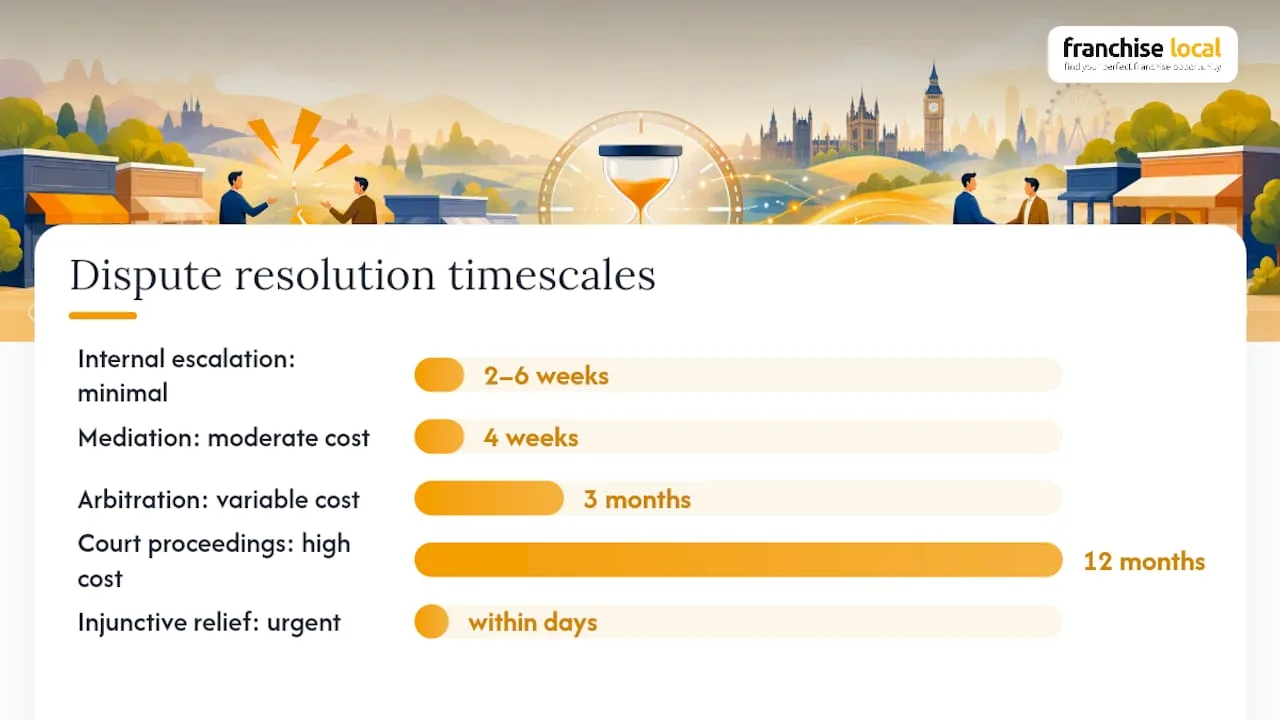
Injunctive relief, when needed urgently, compresses this timeline dramatically. An application for an interim injunction can be heard within days, but requires strong evidence and carries significant cost risk if refused.
Pro Tip: Ask your solicitor about fixed-fee arrangements for discrete stages, such as a fixed fee for reviewing the agreement and drafting the formal notice, and a separate fixed fee for mediation preparation. This gives you cost certainty at each decision point without committing to open-ended retainer costs.
Why mediation usually outperforms litigation in franchise territory disputes
Mediation is faster, cheaper, and more likely to preserve a working franchise relationship than court proceedings. Courts in England and Wales expect parties to attempt ADR before litigation, and a party that refuses mediation without good reason risks an adverse costs order even if it wins on the merits.
Stevens & Bolton LLP advise that the best mediation outcomes come from treating the process as a commercial negotiation rather than a rehearsal for trial. Creative remedies available through mediation include staggered new-outlet openings, exclusive marketing zones that differ from the trading territory, revenue-sharing arrangements for overlapping areas, and agreed customer-origin protocols for online orders. None of these are outcomes a court can order.
Mediation preparation checklist:
- Postcode-level sales data for the disputed period, showing customer origin.
- Local marketing spend records with dates, demonstrating investment in the territory.
- A territory map with your claimed boundary clearly marked, ideally using GIS or postcode data.
- A schedule of lost sales or diverted customers, with a supporting calculation of financial impact.
- Your proposed remedies, ranked from ideal to acceptable, so you can negotiate in real time.
- A clear fall-back position: what is the minimum outcome you need to make the relationship workable?
- Evidence of any pre-contract representations about territory size or exclusivity.
BFA mediation is administered by the British Franchise Association and is widely recognised in the sector. Many franchise agreements already reference it. CEDR (Centre for Effective Dispute Resolution) offers a more general commercial mediation service with experienced mediators who handle franchise disputes regularly. Both are credible options; the right choice depends on what your agreement specifies and whether both parties are BFA members.
Arbitration, by contrast, produces a binding award but is more formal, more expensive, and less flexible than mediation. It is appropriate where the parties need a definitive ruling on a point of contractual interpretation rather than a negotiated commercial settlement.
Pro Tip: Bring a professional valuation of the goodwill impact of the encroachment to mediation. A credible figure, supported by sales funnel data and local marketing spend, changes the commercial dynamic and gives the other party a concrete number to respond to rather than a vague claim of loss.
What a court or arbitrator can actually order in a territory dispute
Courts have a broad range of remedies available, but the right remedy depends entirely on the legal basis of the claim and the evidence supporting it.
Injunctions are the most urgent remedy. An interim injunction can prevent a franchisor from opening a new outlet or a competing franchisee from trading in your territory while the dispute is resolved. To obtain one, you must show a serious question to be tried, that damages would not be an adequate remedy, and that the balance of convenience favours the injunction. The evidence threshold is real but not insurmountable if the encroachment is clear.
Damages compensate for financial loss already suffered. Courts calculate damages for territory encroachment by reference to lost profits, diminution of goodwill, and wasted marketing expenditure. Mitigation is expected: you cannot sit back and let losses accumulate if you could reasonably have reduced them.
Declarations of rights clarify what the contract means without ordering either party to do anything specific. They are useful where the dispute is primarily about boundary interpretation and both parties need certainty to continue trading.
Rescission for misrepresentation is available where the franchisee was induced to enter the agreement by a false representation about territory size, exclusivity, or the absence of competing outlets. This is a more drastic remedy and requires clear evidence of the misrepresentation.
On arbitration remedies: arbitration panels can award damages and declarations, and some arbitration clauses also permit injunctive relief. However, arbitration awards are generally not public, which limits their deterrent effect on franchisors. Courts retain jurisdiction to grant urgent interim injunctions even where the underlying dispute is subject to arbitration.
Typical outcomes in practice tend to be negotiated rather than litigated to judgment. Where courts have been asked to rule, outcomes have included injunctions restraining new outlet openings pending trial, damages awards based on lost profit calculations, and in some cases termination of the franchise agreement where the franchisor’s conduct amounted to repudiatory breach. For franchise territory rights guidance specific to English law, including how the Braganza duty has been applied in practice, Franchiselocal’s resource section provides further context.
How to prevent territory disputes before they start
The most cost-effective dispute is the one that never happens. Both franchisors and franchisees can take concrete steps to reduce the risk of territory conflicts arising.
For franchisors:
- Define territories using postcodes or GIS coordinates, not vague geographic descriptions. Ambiguity in territory drafting is a leading cause of encroachment disputes, and measurable boundaries are the single most effective preventive measure.
- Include a clear change-control clause that specifies the process, notice period, and any compensation mechanism before territory changes take effect.
- Document the commercial rationale for every new outlet opening in writing, including the territory analysis that justified it.
- Set transparent, measurable KPIs for exclusivity protection, so franchisees know exactly what performance standard they must maintain and what the consequences of underperformance are.
- Establish an explicit online-sales allocation policy that addresses passive orders, central website fulfilment, and cross-territory enquiries.
For franchisees:
- Negotiate for a minimum protection period during which exclusivity cannot be removed regardless of performance.
- Seek a first right of refusal on any new territory adjacent to yours before it is offered to a third party.
- Ask for performance-linked protections: if exclusivity can be reduced for underperformance, define precisely how performance is measured and what the cure period is.
- Consider a side letter for any verbal commitments made during pre-contract negotiations about territory size or marketing support.
Governance and monitoring matter as much as drafting. Schedule annual territory reviews, maintain a customer-origin dashboard using postcode data, and log any complaints or observations about cross-territory activity as they arise. LexisNexis practice notes confirm that active management of franchise agreement provisions, rather than filing them away after signing, substantially reduces the number of disputes that escalate.
Pro Tip: Use customer postcode data from your CRM or EPOS system to build a monthly heat map of where your sales originate. If you spot a pattern of orders from postcodes outside your territory, or a sudden drop in orders from postcodes that should be yours, you have early evidence of a potential encroachment before it becomes a formal dispute.

Evidence checklist: what to collect before you negotiate, mediate or litigate
Strong evidence is the difference between a credible claim and an unresolved argument. Collect and preserve the following before any formal process begins.
Primary documents:
- Signed franchise agreement, including all schedules and annexures.
- Any side letters, comfort letters, or ancillary agreements.
- Territory maps referenced in or attached to the agreement.
- Pre-contract disclosure documents and any sales forecasts provided by the franchisor.
- All written communications (email, letter, messaging apps) relating to territory allocation or complaints.
Operational evidence:
- Sales reports broken down by postcode for at least 24 months prior to the dispute.
- CRM exports showing customer origin, enquiry source, and order fulfilment location.
- Online order logs, including any orders fulfilled by another franchisee or the franchisor from your territory.
- Local marketing spend records with dates, channels, and geographic targeting.
- Staff records showing headcount and hours, relevant to demonstrating investment in the territory.
- Supplier invoices and delivery records that corroborate trading volume.
Evidence retention timeline:
| Document type | Minimum retention | Priority action |
|---|---|---|
| Franchise agreement and side letters | Permanently | Locate and secure immediately |
| Sales and CRM data | 6 years (contract limitation period) | Export and back up promptly |
| Email and messaging records | 6 years | Preserve; do not delete or archive |
| Marketing spend records | 6 years | Collate by date and channel |
| Territory maps and boundary data | Permanently | Print and store digitally |
A critical warning on electronic evidence: do not delete, overwrite, or “tidy up” any digital records once a dispute is in prospect. Courts treat the destruction of relevant evidence (spoliation) very seriously, and it can result in adverse inferences being drawn against the party responsible. If you use a cloud-based system, check whether automatic deletion policies are running and suspend them immediately.
When to instruct a solicitor and how to choose the right one
Instruct a specialist franchise solicitor early, not as a last resort. The right moment is when any of the following apply: injunctive relief may be needed, a termination notice has been served, the contractual interpretation is genuinely complex, or the other party has already instructed lawyers.
Selection criteria for a franchise disputes specialist:
- Demonstrable experience in franchise law specifically, not just general commercial litigation.
- A track record with territorial disputes and ADR in franchise contexts.
- Familiarity with the BFA mediation scheme and CEDR processes.
- Transparent, staged fee arrangements with fixed-fee options for discrete steps.
- Ability to coordinate expert evidence, including goodwill valuations and retail analytics.
Where to find specialists: firms with published franchise practice notes are a reliable starting point. Pinsent Masons publishes detailed UK franchising guidance and has a recognised franchise disputes practice. Stevens & Bolton LLP has published specific guidance on mediation in franchise disputes. Harper James is a specialist commercial law firm with a dedicated franchise disputes practice that covers both franchisee and franchisor-side work. BFA membership is also a useful indicator: firms that advise BFA members are generally familiar with the sector’s norms and the BFA’s own dispute resolution processes.
On fee arrangements: fixed fees for discrete stages (agreement review, formal notice drafting, mediation preparation) give you cost control at each decision point. Staged retainers work well for longer disputes. Conditional fee arrangements are rarely appropriate for franchise territory disputes because the outcome is rarely binary enough to make the risk calculation work for either party.
Pro Tip: Before instructing any firm, ask specifically whether they have acted in franchise territory disputes (not just franchise disputes generally) and whether they have experience with the BFA mediation scheme. A solicitor who has sat in a BFA mediation will prepare you very differently from one who has not.
For broader context on franchise legal requirements in the UK, including how competition law affects agreement terms, Franchiselocal’s guidance section covers the regulatory framework in accessible detail.
Sources
The following bodies and practice resources are the most relevant primary references for franchise territory disputes in the UK.
- FRANCHISE
- Pinsent Masons — Franchising (UK guidance)
- Franchise laws and regulations — England & Wales (ICLG)
- LexisNexis practice note — Reducing the risk of disputes arising in franchise agreements
- British Franchise Association — How to manage franchise disputes
If you are at the stage of evaluating franchise opportunities and want to understand how territory models work across different sectors, Franchiselocal’s franchise opportunities by industry directory lets you filter by sector and investment level, giving you a clear picture of how territory structures vary before you commit.
This article is general information, not a substitute for advice from a qualified lawyer. Consult a qualified legal professional about your own circumstances before acting on anything here.