

Turnover rent is now a standard feature of UK franchise leases in retail, hospitality and leisure, structured as either a pure percentage of sales or a base rent topped up once trading passes a set threshold. The single biggest risk for franchisees is that rent is calculated on gross turnover, not profit, so a strong sales month can trigger a rent bill that outpaces your margin. Before signing, check exactly how turnover is defined and what audit rights the landlord holds.
What is turnover rent and how do franchise leases structure it?
Turnover rent ties some or all of the rent a franchisee pays to the sales the outlet actually generates, rather than fixing it as a flat annual sum. It shifts part of the landlord’s income risk onto the tenant’s trading performance, and part of the tenant’s downside risk onto the landlord when sales fall.
UK commercial leases generally use one of two structures:
- Pure turnover rent — rent is calculated solely as a percentage of gross turnover, with no separate base rent charged.
- Base plus top-up (hybrid) rent — a fixed base rent covers the landlord’s minimum return, with an additional percentage payable once turnover clears an agreed threshold.
These structures originated in shopping centre retail but now appear widely across food and beverage, gyms and leisure franchises, where footfall and trading volume vary sharply by site.
What percentage rent and base-rent ratios are typical?
Turnover rent percentages in the UK usually sit somewhere between 1% and 15% of gross turnover, and the figure moves a lot depending on sector, location and how much base rent (if any) is layered underneath it.
Percentages typically range from 1% to 15% of gross turnover, with around 7% commonly cited as an average across UK commercial leases. Base rent in top-up arrangements is often set at 75% to 85% of open-market rent, leaving the turnover top-up to make up the remainder of the landlord’s expected return.
A few points worth flagging when you’re comparing offers:
- High-footfall retail and shopping-centre units tend to sit at the lower end of the range; specialist leisure and food-and-beverage sites can command higher percentages given stronger margins.
- Caps (a ceiling on the maximum rent payable) and collars (a floor below which rent won’t fall) are increasingly standard protective mechanisms for both sides.
- Staircasing, where the percentage rate rises in bands as turnover increases, rewards landlords for strong trading years without penalising a slow first year.
Franchise lease terms rarely publish these figures upfront, so ask your franchisor or their property adviser for benchmark data from comparable units before you negotiate.
How is turnover defined, reported and audited?
The definition clause is where most disputes start, and it deserves far more attention than franchisees typically give it. A lease should set out precisely what counts, what’s excluded, how often you report, and what audit rights the landlord holds.
Common exclusions worth checking for, and pushing for if absent:
- VAT charged on sales (almost always excluded, but confirm it’s stated).
- Customer refunds and returns.
- Staff tips, where these pass through the till.
- Discounts and promotional vouchers redeemed at face value, not full price.
- Gift card sales at the point of issue (versus redemption, which is when turnover is usually recognised).
Online sales attribution causes particular friction for franchises with click-and-collect or delivery models. Some leases apportion online orders to the physical store by distance (an order placed within a defined radius counts as store turnover); others only count orders collected or fulfilled on-site. Get this mechanism written into the lease explicitly rather than left to later negotiation.
Reporting is typically monthly or quarterly, with an annual reconciliation and landlord audit rights attached.
Pro Tip: Negotiate a narrow audit window (say, once per year, with 14 days’ notice) and insist the landlord’s auditor is a qualified accountant bound by confidentiality. Open-ended audit rights can disrupt trading and expose commercially sensitive sales data to a landlord who may also be your competitor’s landlord.
How does payment timing and reconciliation work in practice?
Turnover rent is usually paid in arrears, commonly settled annually in line with your financial year, but that doesn’t mean nothing changes hands until year end.
- On-account payments. Most landlords require monthly or quarterly payments based on estimated turnover, smoothing cash outflow across the year rather than leaving one large bill.
- Year-end reconciliation. Actual turnover is calculated once accounts close, and a balancing payment (or, less commonly, a refund) settles the difference against what you’ve already paid on account.
- Look-back periods and caps. Some leases limit how far back a landlord can adjust figures, or cap the maximum balancing payment in a single year to prevent shock bills.
The practical risk is straightforward: a strong final quarter can generate a reconciliation bill you haven’t budgeted for. Build a rolling forecast that flags likely balancing payments before your financial year closes, and hold a cash provision equivalent to at least one quarter’s estimated top-up. Franchise Local’s cash flow visualiser is a useful way to model different turnover scenarios against your on-account payment schedule.
What franchise-specific risks affect royalties, keep-open clauses and assignment?
Franchise agreements layer extra complexity onto standard turnover rent because royalties, brand rules and resale terms all interact with the rent calculation in ways a generic retail lease doesn’t anticipate.
- Royalties don’t reduce your rent base. Turnover rent is calculated on gross turnover rather than profit, and royalty or IP payments to your franchisor will not reduce that figure unless the lease explicitly excludes them. Pay 8% royalty to your franchisor and 8% turnover rent to your landlord on the same gross sales, and 16% of every pound in the till is gone before overheads.
- Keep-open clauses can clash with legitimate closures. Landlords frequently insist on keep-open obligations to protect their turnover income, but these can conflict with a franchisor’s own refit schedule, essential repairs, or an insured loss event. Get explicit carve-outs written in.
- Assignment gets harder. A new operator’s projected turnover changes the landlord’s risk assessment, so assignment and alienation clauses tend to be stricter under turnover rent, which matters enormously if you plan to sell the business on.
- Lenders scrutinise turnover-linked income. Because future rent isn’t fixed, lenders assessing a refinance or acquisition may discount projected cash flow more heavily than they would against a flat lease.
Ask your franchisor whether royalty exclusion is a standard clause they’ll support in landlord negotiations. It rarely comes free, but it’s one of the highest-value asks available.
A negotiating checklist before you sign a turnover-rent lease
Work through these steps in order, ideally with your solicitor and accountant both reviewing drafts before you commit.
- Pin down the turnover definition. Get VAT, refunds, royalties (where possible) and staff tips explicitly excluded in writing, not left to interpretation later.
- Limit audit scope. Agree a fixed audit window, a reasonable notice period and a cap on how far back the landlord can retrospectively adjust figures.
- Negotiate on-account levels carefully. Push for on-account payments calibrated to realistic first-year trading, with an early-years cap to avoid a shock reconciliation bill before the site has built its customer base.
- Secure carve-outs for legitimate closures. Refits, essential repairs and insured losses should not trigger keep-open penalties or turnover assumptions based on a closed period.
- Protect your exit route. Agree a clear reassessment mechanism for assignment rather than leaving the landlord unrestricted discretion to reject or reprice on transfer.
- Model the worst case before you sign. Run a forecast for balancing payments across a strong trading year and a weak one, and get both your solicitor and accountant to sign off on the final terms.
Pro Tip: Ask for a “no worse off” comparison against a straightforward fixed rent for the same unit. If the turnover deal only wins in your best-case trading scenario, you’re carrying disproportionate downside risk for an upside that mostly benefits the landlord.
Turnover rent: pros and cons for landlords and franchise tenants
Turnover rent isn’t inherently good or bad. It suits some franchise situations far better than others, and the trade-offs run in opposite directions for each side of the lease.
Benefits for tenants:
- Lower fixed cost burden in a slow trading period or during a new site’s ramp-up phase.
- Rent scales with income rather than sitting fixed regardless of footfall.
Benefits for landlords:
- Shares in the upside when a strong franchise brand or location drives high sales.
- Aligns landlord interest with tenant success, encouraging joint marketing or footfall initiatives.
Key drawbacks:
- Rent tracks gross turnover, not profit, so margin-thin franchises can find the percentage biting harder than expected.
- Less predictable rent makes budgeting and lender assessment more complicated for tenants.
- Audit and reporting obligations add administrative overhead most fixed leases don’t require.
Turnover rent tends to fit best for franchises with strong margins, seasonal or footfall-dependent trading, or a genuine need to reduce fixed costs during launch. It fits poorly for low-margin, high-volume models where a percentage of sales eats disproportionately into thin profit.
How does turnover rent affect franchise profitability and cash flow?
The profitability impact depends almost entirely on your margin structure. A franchise running at 20% net margin can absorb an 8% turnover rent charge far more comfortably than one running at 8% margin, where the same rent effectively erases most of the year’s profit in a strong trading period.
This creates a counterintuitive dynamic that catches new franchisees off guard: your best sales month can be your worst month for cash flow, because it generates the largest turnover rent liability alongside royalty payments, stock costs and staff overtime, all landing in the same period.
Cash flow management under turnover rent requires a different discipline than fixed-rent budgeting. Rather than a flat monthly figure you can set and forget, you need rolling forecasts that flag the point in each quarter where on-account payments might undershoot actual liability. Franchisees who build a reserve equivalent to one quarter’s estimated turnover top-up rarely get caught by reconciliation bills; those who treat rent as a fixed line item in their budget often do.
Franchisors with multi-site experience of turnover leases can usually tell you what percentage of turnover their existing franchisees actually pay in rent across a typical year, which is far more useful than the headline percentage rate quoted in the lease. Ask for that figure before you sign, not after your first reconciliation notice arrives. It’s the single most practical due diligence step available to a prospective franchisee weighing a turnover-rent site against a fixed-rent alternative.
Turnover rent versus fixed rent: which suits a franchise better?
Fixed rent gives certainty. You know the exact liability twelve months out, which makes budgeting, loan servicing and personal drawings far easier to plan. Turnover rent trades that certainty for flexibility, lowering the entry cost when trading is slow but raising it precisely when you might prefer to reinvest surplus cash into stock, staff or marketing rather than hand a slice to the landlord.
For a franchisee opening a first site in an unproven location, turnover rent (particularly the hybrid base-plus-top-up model) can reduce the risk of a fixed cost outrunning early trading. For an established franchisee taking on a second or third site in a location with strong, predictable footfall data, fixed rent often makes more sense, since the trading pattern is already known and the flexibility turnover rent offers has less value.
The comparison isn’t purely financial. Fixed rent leases are simpler to administer, involve no reporting obligations, and carry no audit risk. Turnover rent leases require ongoing sales reporting, expose commercially sensitive figures to your landlord, and add a layer of dispute risk around definitions and online sales attribution that a fixed lease simply doesn’t carry.
Some franchisors steer new licensees toward fixed rent specifically to protect predictability for lenders and for the franchisee’s own peace of mind during the crucial first two trading years, then leave turnover rent as an option once the site has an established sales history. If your franchisor offers both structures, ask what their existing network data shows about which performs better for a site your size.
Legal considerations and recent case law on turnover rent
UK case law on turnover rent specifically is thinner than the volume of commercial activity might suggest, since most disputes settle privately rather than reaching judgment, and the wording of individual lease clauses tends to determine outcomes more than any single point of established principle. That makes the drafting itself the primary legal risk, not case precedent.
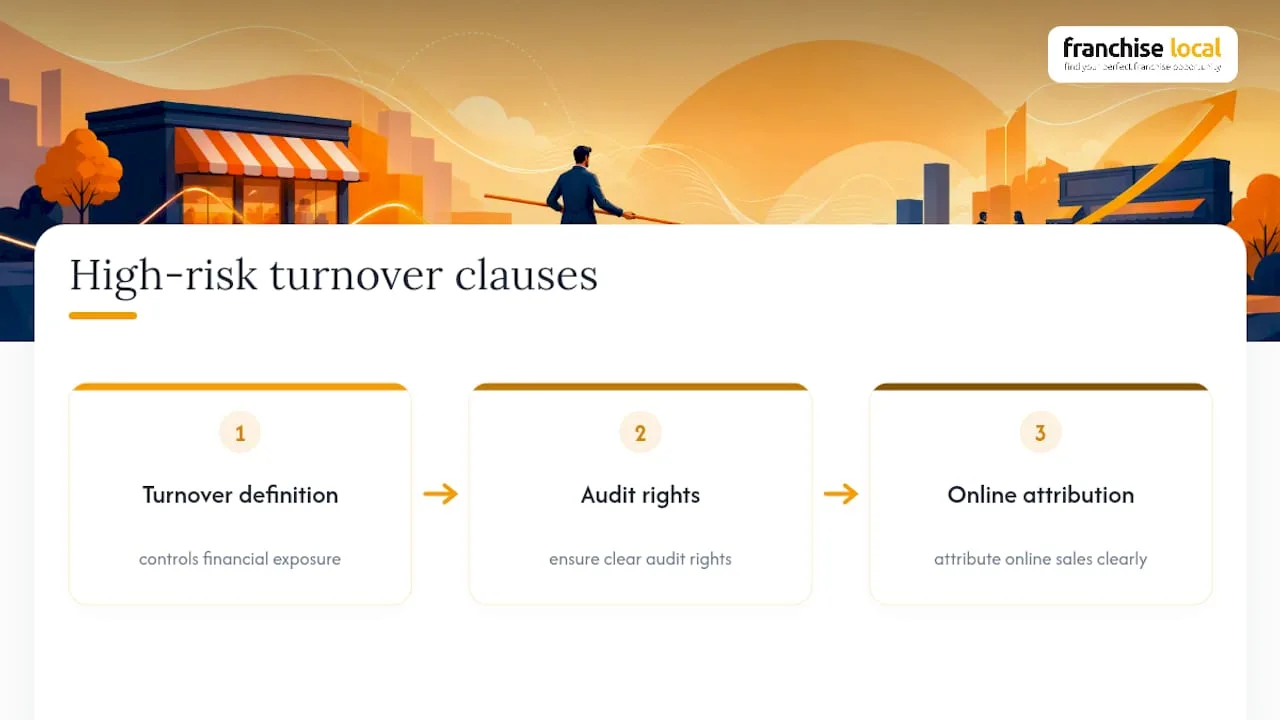
Practical Law and other professional drafting resources consistently flag the same handful of clauses as high-risk: the turnover definition, the audit rights clause, and the online sales attribution mechanism. Ambiguity in any of these three areas is what tends to generate disputes and, occasionally, litigation.
Market practice has also shifted noticeably. Retail rents tied to turnover have become more common in recent years, and with that growth has come a corresponding rise in the sophistication of protective drafting, caps, collars and look-back periods designed specifically to prevent the kind of disputes earlier, looser turnover leases generated. A well-drafted 2026 turnover lease looks considerably more balanced than a comparable lease from a decade ago, largely because both landlords and tenant solicitors have learned from earlier disputes.
Because so much depends on precise wording rather than settled precedent, generic lease templates are a poor starting point for a franchise turnover rent clause. Specialist commercial property solicitors with specific turnover lease experience, ideally with sector experience in your franchise category, are worth the additional fee given how much financial exposure sits inside a handful of contractual definitions. Legal advice before signing isn’t a formality here; it’s the mechanism that actually controls your downside risk.
How does turnover rent affect franchise valuation and exit strategy?
Turnover rent complicates franchise valuation in ways fixed rent simply doesn’t. A buyer assessing your business has to model future rent as a variable tied to projected sales, rather than plugging in a known fixed figure, which introduces uncertainty into every valuation calculation downstream.
This matters most at the point of sale or assignment. Landlords frequently reserve the right to reassess rent terms on assignment, sometimes reverting to open-market rent, sometimes recalculating the turnover base against the incoming operator’s projected sales rather than the outgoing tenant’s actual trading history. A buyer who assumed they were acquiring your existing rent terms can find those terms renegotiated the moment the transfer completes.
That uncertainty depresses achievable sale price. Prospective buyers, and their lenders, tend to apply a more conservative multiple to a business operating under turnover rent than to a comparable business on fixed terms, precisely because the future cost base is harder to pin down. If you’re planning an exit within a few years of signing, negotiate an explicit assignment mechanism into the original lease, ideally one that transfers your existing terms rather than triggering a full reassessment.

Lenders financing an acquisition apply similar caution. Turnover-linked rent income makes cash flow projections less reliable, and underwriters often discount projected profitability accordingly, which can reduce the loan amount a buyer is able to secure against your business. Building a clean reassessment formula into your original lease, rather than leaving the landlord unrestricted discretion, is one of the few levers you control at the point of signing that protects value years later at the point of sale.
Finding franchise opportunities that fit turnover-rent structures
Not every franchise category suits a turnover-rent lease equally well, and matching the right business model to the right lease structure starts before you ever sit down with a landlord’s solicitor. Franchiselocal’s trending franchise opportunities page lets you filter by industry, investment level and location, useful groundwork if you’re weighing a retail, leisure or hospitality franchise where turnover rent is most likely to appear.
Before committing to a site, model the numbers rather than relying on gut feel. The cash flow visualiser helps you test how different on-account payment levels and reconciliation scenarios would affect your working capital across a full trading year, while the affordability calculator gives a broader picture of what a franchise investment (including likely rent structures) means for your finances overall.
These tools are a starting point for due diligence, not a substitute for it. Use them alongside proper legal advice on the actual lease you’re offered, and alongside the franchisor’s own network data on typical turnover rent liability, before you sign anything.
Sources
For deeper drafting detail, LegalVision’s guide on turnover lease models covers pure and top-up structures with worked figures. Brodies LLP’s analysis of payment timing and reconciliation explains arrears mechanics in practical detail, while SO Legal’s overview of turnover rent clauses is a solid primer on drafting pitfalls around definitions and audits.
- Models of turnover leases | LegalVision UK
- Turnover leases: landlord and tenant considerations – Brodies LLP
- Turnover rent in commercial leases and how it works | SO Legal
FAQ
What is turnover rent in a franchise lease?
Turnover rent ties some or all of a tenant’s rent to the gross sales generated at the site, either as a pure percentage of turnover or as a base rent topped up once trading passes an agreed threshold. It’s now common across UK retail, hospitality and leisure franchises.
How much can a commercial landlord increase rent in the UK?
Rent review terms depend entirely on the individual lease rather than any fixed statutory limit, and turnover rent adds a further layer since the percentage rate itself, plus any caps or collars, is negotiated at the outset. Recent market practice has seen more turnover-linked increases, though protective caps and collars are increasingly standard to limit how far rent can move in either direction.
What is a typical percentage for turnover rent in the UK?
Turnover rent percentages typically fall between 1% and 15% of gross turnover, with roughly 7% commonly cited as an average. Where a base rent applies, it’s often set at 75% to 85% of open-market rent, with the turnover element making up the balance.
Is being a landlord under a turnover rent lease still profitable?
Turnover rent can be more profitable than fixed rent for landlords when tenant sales are strong, since income scales with trading performance rather than staying flat. It carries more variability than fixed rent, however, which is why caps, collars and audit rights have become standard tools for managing that risk on both sides.
Do franchise royalties reduce the turnover rent I pay?
No. Turnover rent is calculated on gross turnover, and royalty or franchise fee payments do not reduce that figure unless the lease explicitly says otherwise. Negotiating an express royalty exclusion before signing is one of the most valuable asks available to a franchisee.