

Franchising suits you if you want to run your own business inside a proven system, follow processes rather than invent them, and can genuinely afford the fees involved. It’s the wrong route if you need full creative control or can’t commit real time and capital for at least two to three years. Take the self-assessment below, then speak to current and former franchisees before you go further.
What is franchising, and how do I know if it fits my personality?
Franchising works as “self-employment with support”: you buy the right to trade under an established brand, follow its operating system, and receive training and ongoing guidance in exchange for fees. That structure suits people who want the safety net of a tested model rather than the blank page of building everything from nothing.
Score yourself honestly against the six prompts below. Rate each from 1 (strongly disagree) to 5 (strongly agree), then add up your total.
- I’m comfortable following a documented system, even when I’d personally do it differently.
- I can handle a slow first year without losing confidence in the business.
- I enjoy talking to customers and building relationships, not just running operations behind the scenes.
- I’m ready to recruit, train, and manage staff if the model requires it.
- I can commit consistent hours (often 50+ a week early on) without resenting the workload.
- I have accounted for the total investment, including working capital, and it wouldn’t cripple me if year one underperforms.
Scoring bands:
| Total score | What it means | Recommended next step |
|---|---|---|
| — | Strong fit | Start shortlisting franchisors and book discovery days |
| — | Borderline | Speak to several franchisees before committing; test one weak area first |
| — | Rethink franchising | Consider an independent start-up or employment route instead |
Take a hypothetical reader scoring 4 on system discipline, 3 on resilience, 5 on customer focus, 2 on staff management, 4 on time commitment, and 3 on financial tolerance. That’s 21, borderline. The honest next move isn’t to force a decision. It’s to test the weakest score, in this case staff management, by talking to franchisees who manage teams before applying anywhere.
Pro Tip: Score yourself twice, a week apart, without looking at your first answers. If the two scores drift by more than four points, you’re probably answering from mood rather than honest reflection.
Which traits do franchisors actually look for?
Franchisors aren’t hunting for entrepreneurs who want to reinvent the model. They’re hunting for people who’ll run their system well and represent the brand consistently. Five traits come up again and again in franchisor interviews and BFA guidance.
- Motivation that survives routine. Franchising rewards consistency over flashes of inspiration. If you burn out on repetitive tasks, a franchise with heavy daily process (fast food, cleaning, courier work) will grind you down fast.
- System discipline. The most successful franchisees align their own strengths with what the model demands rather than fighting the playbook. Discipline beats improvisation here.
- Customer focus. Retail and food franchises live and die on front-line service. If you find customer-facing work draining rather than energising, a business-services or B2B model run more from behind a desk suits you better.
- Managerial competence. Home services and education franchises often scale through hiring tutors, technicians, or cleaners. If managing people isn’t your strength yet, a single-operator model (mobile services, consultancy-style franchises) reduces that risk.
- Financial discipline. Royalties and marketing levies come out whether you had a good month or not. Franchisees who track cashflow weekly, not monthly, catch problems early.
Map yourself against a model before you fall in love with a brand. A gregarious extrovert with weak admin habits will likely thrive in a retail franchise with a strong back-office support team, but struggle running a solo consultancy franchise where the paperwork is entirely on them. A red flag worth taking seriously: if you find yourself wanting to rewrite the operations manual before you’ve even opened, franchising probably isn’t your model.
What does franchising actually cost, and can I afford it?
Franchise investment breaks into four categories, and franchisors often lead with the smallest one.
- Initial franchise fee. This buys the licence, initial training, and brand rights. It varies enormously by sector, from a few thousand pounds for home-based models to well into six figures for established retail or food brands.
- Fit-out and equipment. Shops, salons, and food outlets carry the heaviest capital costs here. Service-based and mobile franchises usually need far less.
- Working capital. This is the figure most new franchisees underestimate. You need enough to cover living costs and business overheads for months, not weeks, before the business turns a reliable profit.
- Ongoing royalties and marketing levies. Most franchisors charge a percentage of turnover, often alongside a separate marketing contribution, regardless of how the month actually went.
A conservative test before you sign anything: model six to twelve months of runway using turnover assumptions well below the franchisor’s own projections, not their best-case figures. If the business can’t survive a slow start under your own conservative numbers, the fees are too tight for your circumstances, whatever the sales brochure promises.
Funding usually comes from personal savings, specialist bank lending for franchise purchases, or, less commonly, outside investors. Government-backed business advice recommends requesting three years of accounts where they exist and speaking directly to banks about franchise-specific loan products rather than accepting a franchisor’s cashflow projection at face value.
Statistic callout: franchising is positioned by industry bodies as offering a faster route to operational readiness than an independent start-up, because the brand assets, training, and know-how already exist. That head start doesn’t remove the requirement to fund working capital yourself, and royalties apply whether or not the first year goes to plan.
Who should I talk to before signing anything?
The single most valuable thing you can do before committing is speaking to people already running the franchise, and not just the ones the franchisor introduces you to.
- Request a full list of current franchisees, not a curated shortlist of top performers. A franchisor reluctant to share this is a warning sign in itself.
- Contact former franchisees too. People who left the network, whether by choice or not, tend to describe support gaps and hidden costs that current franchisees under contract may soften.
- Ask about real profitability, not projected profitability. Ask what year one actually looked like against what they were told to expect.
- Ask what support genuinely arrives when things go wrong, not what the sales pack lists as “ongoing support.”
- Ask directly why people leave the network. Poor performance, disputes over territory, and unexpected costs are the three answers to listen for.
- Request three years of accounts where the franchise structure allows it, and check the franchisor’s own filings at Companies House against what they’ve told you verbally.
- Check the operations manual and supplier contracts before signing, not after, since these define what you’re actually locked into day to day.
Beyond conversations, do some physical verification. Visit more than one site if the model has multiple locations, ideally unannounced. A mystery-shop visit tells you more about real customer experience than any pitch deck. Speaking to a genuine range of franchisees, including those who’ve exited, avoids the selection bias that comes from only hearing from a franchisor’s chosen success stories.
Pro Tip: Ask every franchisee the same question, worded identically: “What would you tell a friend thinking about buying into this network?” The pattern in the answers matters more than any single glowing or damning review.
What contract terms should I check with a solicitor?
A franchise agreement is a binding commercial contract, and UK franchise agreements are governed primarily by ordinary contract law rather than any franchise-specific statute. That means the wording in front of you, not the franchisor’s verbal promises, is what actually protects or exposes you.
Most agreements cover the same core ground:
- Term and renewal. How long the initial agreement runs, and on what terms (if any) it renews. Some networks reserve the right to change fees at renewal.
- Territory. Whether you get exclusive rights to an area, and how the franchisor can adjust boundaries as the network grows.
- Fees and change powers. Royalty percentages, marketing levies, and crucially, whether the franchisor can unilaterally alter these during the term.
- Non-compete clauses. What you’re restricted from doing both during the agreement and for a period after it ends.
- Exit and transfer conditions. Whether you can sell the business on, under what approval process, and what happens if you want out early.
Legal guidance consistently flags non-compete clauses, automatic renewal terms, and unilateral change powers as the areas that cause the most disputes, because they’re often written broadly in the franchisor’s favour and only become a problem years into the relationship.
This is why having a solicitor experienced in franchise law review your agreement isn’t optional caution, it’s a minimum step. Ask the solicitor to walk through likely scenarios specifically: what happens if you want to exit early, what happens in a dispute, and what happens if the franchisor changes the system significantly during your term. The BFA Code of Ethics sets baseline expectations around disclosure and fair contract terms, and BFA membership is a reasonable indicator that a franchisor has agreed to be held to them.

What’s a realistic timeline from interest to opening day?
Your self-assessment score points to a specific next move. A strong score means start shortlisting and booking discovery days. A borderline score means test your weakest area with real franchisees before applying anywhere. A low score means an independent start-up, or simply staying employed a little longer, may serve you better than forcing a franchise decision.
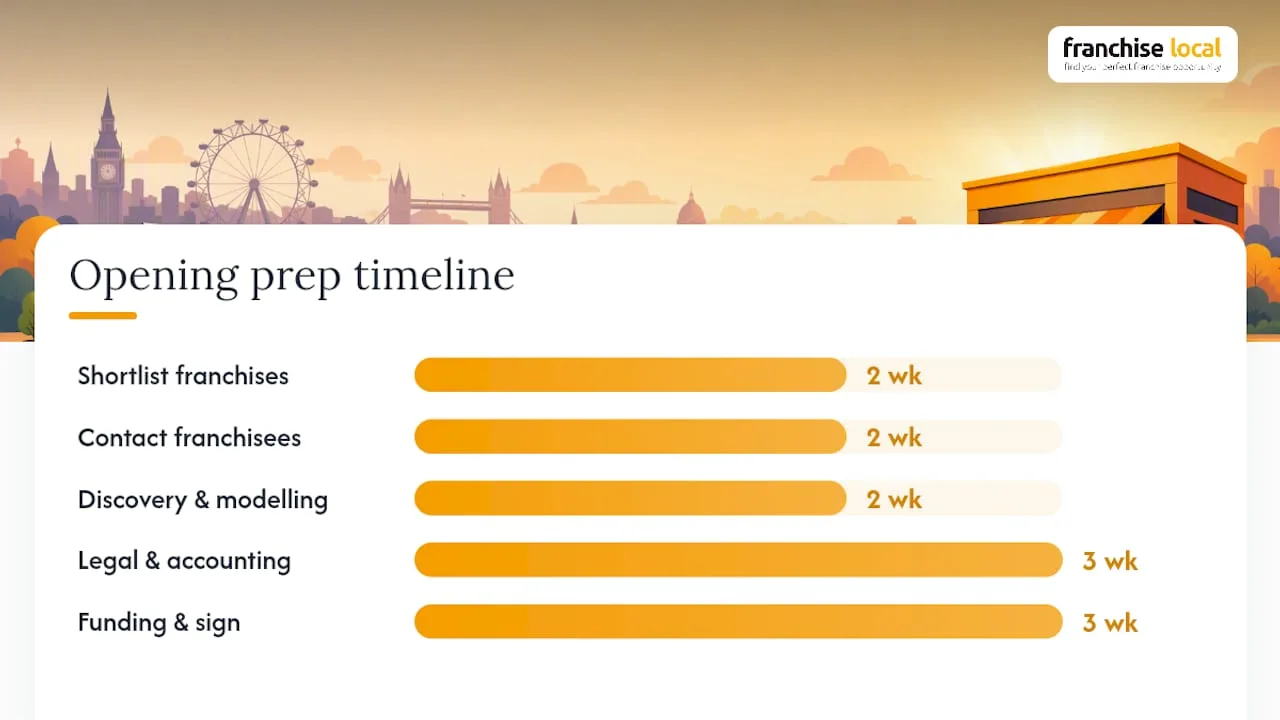
For anyone moving ahead, a realistic first six to twelve weeks looks like this:
- Weeks 1 to 2: Shortlist three to five franchises matching your self-assessment strengths and budget realistically.
- Weeks 3 to 4: Contact multiple current and former franchisees from each shortlisted network, not just the ones offered to you.
- Weeks 5 to 6: Attend a discovery day, request the full disclosure pack, and begin modelling your own conservative cashflow.
- Weeks 7 to 9: Instruct a solicitor experienced in franchise law and an accountant to review the agreement and financial projections independently.
- Weeks 10 to 12: Finalise funding, sign only once every legal query is resolved, and agree a realistic fit-out and training schedule with the franchisor.
From there, milestones typically run through fit-out, initial training, and a soft launch, with most brands giving a rough opening window rather than a fixed date. Franchisees who actively engage with their network, feeding back and drawing on head office support rather than working in isolation, tend to report stronger performance once trading begins.
How can FranchiseLocal help once I know my fit?
Once your self-assessment points you towards a type of model, FranchiseLocal’s filters let you narrow the field by investment level, industry, and lifestyle rather than scrolling through every franchise brand on the market. That’s the practical value of a directory: it turns a vague sense of “something in home services” into an actual shortlist you can start researching properly.
The site’s guides, including its step-by-step franchise agreement guidance, help frame the questions worth asking before you contact a franchisor directly, and the background check plan gives you a structured timetable for the due diligence covered above.
None of this replaces the legwork. Filters and guides speed up discovery, but they don’t verify a franchisor’s claims for you. Treat FranchiseLocal as the front door into serious research, then apply the same standard: speak to franchisees, get the accounts checked, and get the contract reviewed by a solicitor before you commit.
Start shortlisting franchises that match your assessment
There are other ways to research franchises, cold-calling brands from trade press, attending generic exhibitions, or relying on a single broker’s shortlist. Each narrows your options before you’ve had a chance to compare properly. FranchiseLocal’s advantage is breadth combined with control: you filter by investment level, industry, and lifestyle yourself, rather than being steered towards whichever brand pays the best commission.
If your self-assessment score pointed towards customer-facing retail or food, the trending franchise opportunities page is a sensible starting point for live listings. If your strengths run towards business services or B2B relationships, browse the business services franchise category or the B2B franchise listings instead. Use the full search tool to cross-reference by price and location once you’ve narrowed the sector.
Use the directory to build your shortlist, then run every candidate through the due diligence steps above before you pick up the phone to a franchisor. Start with the search filters today and see what actually matches your budget and lifestyle, rather than what’s simply being advertised loudest.
Sources
- Franchisee training — The BFA
- Assessing a franchise opportunity — SprintLaw
- Playing to your strengths – the key to franchise success — BFA
FAQ
Is it smart to franchise your business, or buy into one?
For a prospective franchisee, it’s smart when you value a tested system over full creative control and can afford both the upfront fees and a slow first year. It’s a weaker choice if you can’t commit sustained time and capital, or you’d resent following someone else’s operating manual.
What is a downside of franchising?
Ongoing royalties and marketing levies apply regardless of how well your month actually went, and your growth is constrained by the franchisor’s system and territory rules. You also carry non-compete and exit restrictions written into the agreement, which is why a solicitor experienced in franchise law should review it before you sign.
Is franchising a good or bad idea?
Neither, on its own. It’s a good idea for someone whose personality and finances match the model’s demands, and a poor one for someone chasing full independence or unwilling to fund realistic working capital. The self-assessment checklist above is the fastest way to find out which camp you’re in.
What is the success rate of franchises?
Precise UK-wide success rate figures vary by source and sector, so treat any single number with caution. What’s consistently reported is that franchisees who align their strengths with the model and engage actively with their network tend to outperform those who don’t, which is why fit matters more than the brand name on the sign.