

There are no routinely available national grants set aside specifically for franchise start-ups, so chasing the phrase “franchise grant” is largely a dead end. Your first move should be checking GOV.UK’s Find a Grant service and your Start Up Loan eligibility, then looking at your local council’s business grant page. Some councils fund capital projects, including new franchise units, if the project meets local job-creation or growth criteria.
Where to look for franchise grants UK funding
Two national portals do most of the heavy lifting. GOV.UK’s Find a Grant service currently lists well over a hundred live schemes covering everything from net-zero retrofits to high street regeneration, and it’s searchable by sector, region, and applicant type. The companion “Finance and support for your business” tool on GOV.UK pulls in loans, guarantees, and regional programmes alongside grants, which matters because a franchisee’s realistic options often sit closer to finance than free money.
Below that national layer, the real activity happens locally. Councils, regional growth hubs, and Investment Zone or UK Shared Prosperity Fund (UKSPF) allocations frequently fund capital projects, shopfront improvements, or job-creating start-ups, and a franchise unit can qualify if it ticks the right boxes.
Practical search tactics that actually work:
- Set an alert on Find a Grant rather than checking manually, since new pots appear and close quickly.
- Subscribe to your local authority’s business newsletter, where discretionary grants often get announced before they hit search engines.
- Contact your regional growth hub directly. Many run one-to-one funding diagnostics that surface schemes you’d never find by searching alone.
- Check neighbouring council areas too. Grant catchments rarely match your postcode assumptions.
Pro Tip: Ring the growth hub before you write a business plan, not after. They’ll often tell you within minutes whether your franchise concept fits any live pot, saving you from tailoring a document to a scheme you were never going to qualify for.
Are there grants specifically for franchise startups?
No. National, franchise-specific grant schemes are not standard practice in the UK, and nothing resembling a permanent “franchise grant” programme exists at government level. Grants are almost always targeted at outcomes, not business models: job creation, innovation, decarbonisation, or capital investment in a defined local area.
A franchise project can still qualify if it happens to meet those tests. A coffee franchise fitting out a vacant high street unit might tick the “town centre regeneration” box. A cleaning or care franchise creating five new local jobs might satisfy an employment-focused scheme. Capital costs like shopfitting, specialist equipment, or even intellectual property protection sometimes qualify under scheme rules, but the franchise label itself is never the qualifying factor. The underlying economic impact is.
Typical eligibility, award sizes and what grants will (and won’t) fund
Local schemes tend to follow similar patterns. Awards are usually modest, part-funded rather than covering full cost, and capped per project.
- Intervention rates commonly sit around 50%, meaning the scheme covers half the eligible spend and you find the rest.
- Award sizes at local level often run in the low thousands. The Suffolk Business Grant Scheme, for example, has offered grants in the £5,000 to £10,000 range.
- Subsidy-control rules set maximum award thresholds and require that funded activity be “additional”, meaning it wouldn’t happen without the grant.
- Match funding is standard. If a scheme covers 50%, you need to evidence the other half from your own resources or existing finance.
- Procurement quotes, usually two or three, are often required before a grant is approved, to prove you’re not overpaying a connected supplier.
What grants generally won’t touch: ongoing rent, stock replenishment, staff wages beyond a defined job-creation grant, or franchise fees themselves. What they tend to fund, when eligible: capital fit-out, equipment purchase, and sometimes professional fees tied to a specific growth project.
How to apply for a franchise grant UK step by step
Getting from interest to award follows a fairly consistent sequence, whichever local scheme you’re targeting.
- Prepare your paperwork first. Draft a project budget, gather evidence of your match funding, and get two or three supplier quotes ready before you approach anyone. Schemes move fast and incomplete applications get parked.
- Contact your growth hub and council economic development team. Ask directly whether franchise projects have been funded before and what exclusions apply. Some local schemes explicitly exclude franchise businesses, so this question saves wasted effort.
- Check British Business Bank guidance for repayable alternatives while you wait, since grant timelines are unpredictable and a Start Up Loan application can run in parallel.
- Submit the local application, showing measurable outcomes such as jobs created or capital invested, and follow procurement rules to the letter.
- Stay on top of compliance afterwards. Most awards carry reporting obligations, spending deadlines, and conditions on how the money is used.
Pro Tip: Budget your own funding for the franchise regardless of whether the grant lands. A clear budget breakdown treats any grant as a bonus rather than a dependency, which keeps your launch on schedule if the application is unsuccessful or delayed.
Alternatives to grants for franchise startups and scaling
Given how narrow the grant landscape is, most franchisees end up financing their launch through repayable routes instead.
- Start Up Loan: a government-backed personal loan of £500 to £25,000 per individual, up to £100,000 per business, repayable over one to five years at a fixed rate, with twelve months of free mentoring included. It’s designed for exactly the situation most new franchisees face: no trading history to show a bank.
- Growth Guarantee Scheme: aimed at established businesses scaling up, this British Business Bank programme supports facility sizes up to £2 million, covering term loans and asset finance for franchisees opening additional units.
- Asset finance and invoice finance: useful for funding vehicles, equipment, or smoothing cash flow once a franchise is trading, without giving up equity or waiting on a grant decision.
- Specialist franchise lenders: several high street and challenger banks run dedicated franchise lending desks that understand brand-specific unit economics better than generalist small business teams.
British Business Bank guidance is direct on this point: lenders favour proven trading history, which creates a real barrier for brand-new franchisees, and Start Up Loans exist specifically for founders who can’t access traditional lending. If a bank has already turned you down, that’s the scheme built for you, not a consolation prize. For a fuller comparison of loan types available to franchisees, see this complete guide to franchise loan types.
Regional examples and what they tell you
Local schemes vary enormously, which is exactly why blanket assumptions about “franchise grants” go wrong. The Suffolk Business Grant Scheme has offered awards of £5,000 to £10,000 at up to 50% intervention, with procurement quotes required above certain thresholds. South Derbyshire’s scheme guidance goes the other way, explicitly excluding franchise businesses from eligibility in some rounds.
Grant terms differ so sharply between neighbouring councils that the same franchise concept can be fully eligible in one authority and excluded outright in the one next door. Reading the scheme’s own FAQ document, not a summary of it, is the only reliable way to know which applies to you.
This is where matching your investment level to realistic funding matters. Franchiselocal’s search filters let you narrow opportunities by investment band and industry, so you can gauge upfront what capital gap any grant or loan would actually need to close.
How grant funding affects your franchise agreement
Accepting grant money doesn’t just add cash to your launch; it adds obligations that sit alongside your franchise agreement, and the two don’t always align neatly. Grant conditions typically specify how funds must be spent, often down to the invoice line, and require you to keep the funded asset (a fitted kitchen, specialist equipment, signage) in use for a minimum period. Franchise agreements, meanwhile, dictate brand standards, supplier lists, and sometimes refurbishment cycles set by the franchisor.
Conflicts show up in practical ways. A grant might require three competitive quotes for shopfitting work, but your franchise agreement could mandate an approved contractor with no competing quotes permitted. A grant’s job-creation target might assume permanent local hires, while your franchisor’s staffing model leans on flexible or part-time roles. Reporting timelines can clash too. A council grant might demand quarterly evidence of continued trading, while your franchisor’s own reporting cycle runs to a completely different calendar.
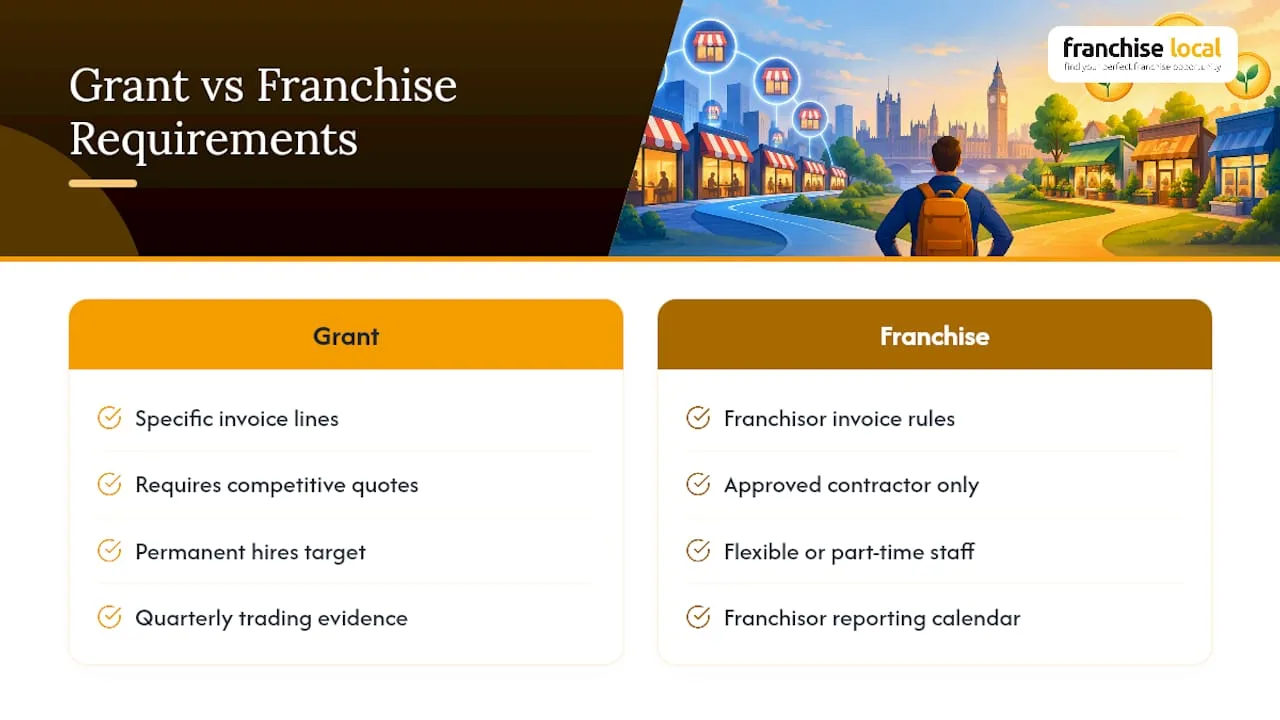
None of this makes grants and franchising incompatible. It means you should send the grant’s terms and conditions to your franchisor before you sign anything, not after the funding lands. Most franchisors have seen this before and can flag clauses that will cause friction, but only if you ask early enough to adjust either the grant application or your unit’s build-out plan.
Preparing a strong application without the common mistakes
The applications that succeed share a specific shape: a tight project plan, measurable outputs, and evidence that the money is genuinely needed rather than merely welcome. Vague statements like “this will help us grow” get rejected. Specific ones like “this funds a new fit-out creating three jobs within six months” get funded.
The most common pitfall is applying before checking exclusions. If a scheme’s guidance document explicitly rules out franchise businesses, as some do, no amount of polish on your application will change the outcome. Read the FAQ document line by line before you invest hours drafting.
The second pitfall is underestimating match funding. If a scheme covers 50% of costs, assessors want to see the other half is genuinely available, not aspirational. A bank statement or an agreed loan offer carries far more weight than a promise to “find the money somewhere.”
The third pitfall is missing procurement requirements. Grants requiring two or three supplier quotes will reject applications where you’ve already committed to a single contractor, even a good one, because it breaks the competitive process the funder needs to see.
Finally, don’t treat the application as a one-off document. Build in the reporting obligations from day one, because failing to evidence outcomes after the money lands can trigger clawback in some schemes.
What successful franchise grant recipients tend to have in common
Public case studies naming specific franchise brands and their exact grant amounts are rare, largely because most funded projects sit within broader local scheme reporting rather than individual press releases. What does emerge consistently from council and growth hub guidance is a pattern in the kind of project that gets funded.
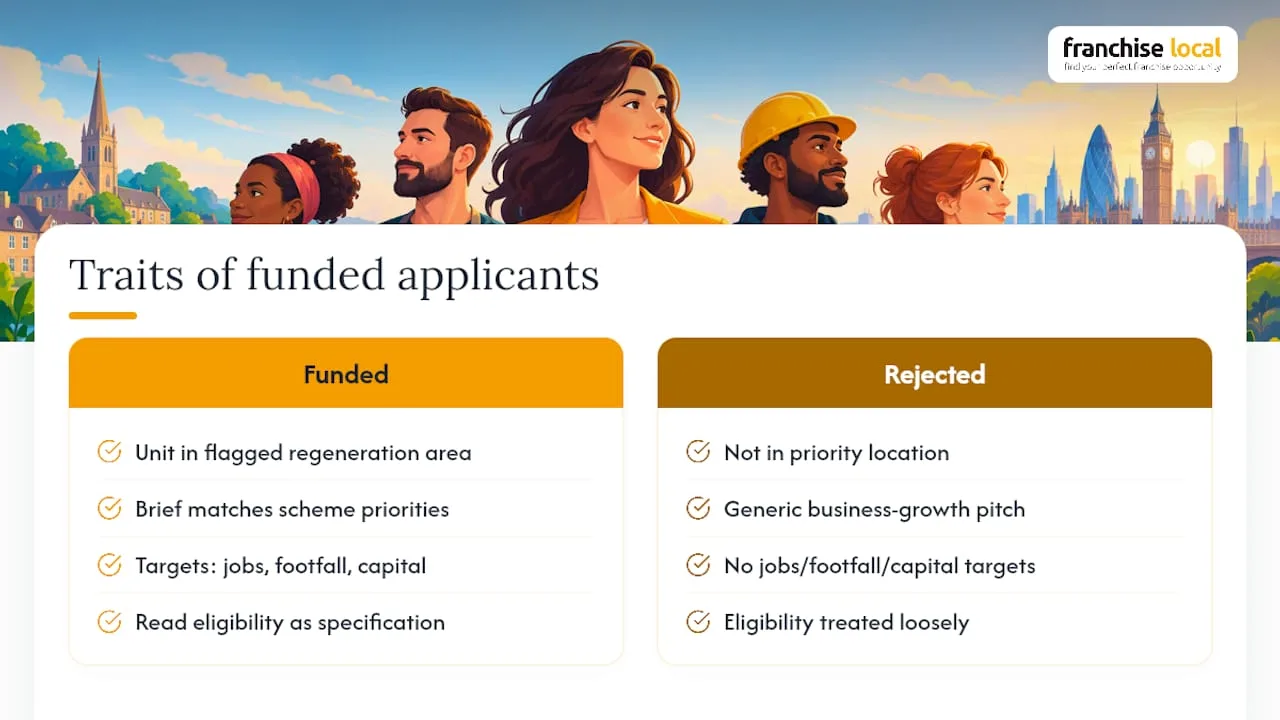
Successful applications tend to come from franchisees opening a physical unit in a location the council has already flagged for regeneration, such as a struggling high street or a designated Investment Zone. The project brief matches the scheme’s own stated priorities almost word for word: job numbers, footfall targets, or specific capital investment figures.
The common denominator isn’t the franchise brand. It’s a business owner who read the scheme’s eligibility criteria as a specification to meet, gathered procurement quotes early, and built a project plan around measurable local outcomes rather than general business growth. That discipline, more than the sector or brand, is what separates funded applications from rejected ones.
If your own search for the right franchise concept is still in progress, browsing trending franchise opportunities on Franchiselocal is a sensible way to compare investment levels against what local schemes are realistically likely to fund, before you commit to a specific brand or location.
Sources
- Gov
- Searching for all grants, 114 results – Find a grant – GOV.UK
- Suffolk business grant scheme – scheme FAQ document
FAQ
How do I get funding for a franchise in the UK?
Most franchisees combine personal savings with a Start Up Loan of up to £25,000 per individual, then top up with asset finance or a specialist franchise lender if needed. Grants are worth checking via GOV.UK’s Find a Grant service, but they’re the exception rather than the default route.
Can I get a grant to start my own business in the UK?
Possibly, if your project matches a local council or growth hub scheme’s specific criteria, such as job creation in a targeted area. There’s no universal small business start-up grant, so eligibility depends entirely on which local schemes are live and whether your project fits their stated priorities.
Can I get a franchise loan in the UK?
Yes. The Start Up Loan scheme explicitly covers new business launches including franchises, offering up to £25,000 per individual with fixed repayments and included mentoring. Larger, established franchise groups may also access the Growth Guarantee Scheme for facilities up to £2 million.
Can I get free money to start a business?
Genuinely free money is rare and usually comes with strings: match funding requirements, spending restrictions, and reporting obligations. Treat any grant as a partial contribution to a plan you’d fund anyway, not as a replacement for having your own capital or loan in place.