

Leasing usually wins for businesses that need equipment with a short useful life, want to protect cash flow, or upgrade kit every few years. Buying or hire purchase suits businesses that plan to use an asset for its full working life and want to claim capital allowances against profits. The right answer depends on your cash position, tax situation, and how the 2026 accounting and capital allowance changes affect your numbers.
Lease vs buy equipment: the UK definitions that matter
Before comparing costs, get the terminology straight, because “leasing” covers several distinct products with different ownership outcomes. Under a lease, your business uses the equipment while the finance company keeps legal ownership throughout. Hire purchase works differently: you typically pay a deposit followed by fixed instalments, and ownership transfers to you once the final payment clears. Buying outright means you own the asset from day one, using cash reserves or a business loan rather than a finance company’s money, according to the British Business Bank.
What happens at the end of the term varies by route:
- Operating lease: return the equipment, renew, or occasionally buy at fair market value.
- Finance lease: often continue at a low nominal rent or arrange a sale to a third party.
- Hire purchase: you already own it once the last instalment is paid.
- Outright purchase: you own it from the start, so the only decision is when to replace or sell it.
Each route carries a different risk profile. Leasing shifts residual value risk to the lender. Buying and hire purchase leave that risk with you.
Types of leasing arrangements and what they mean in practice
Finance leases and operating leases split risk and reward differently, and that split shapes your monthly payment. A finance lease effectively spreads the full cost of the asset plus interest across the agreement, so payments tend to cover most or all of its value. An operating lease covers only part of the asset’s useful life, which usually means lower monthly costs but no automatic path to ownership.
Contract hire, common for vans and company cars, usually bundles maintenance into the payment, so servicing and tyres become the provider’s problem rather than yours. Hire purchase behaves more like a deferred purchase: you commit early to owning the asset, and once the final payment clears, it is legally yours.
- Manufacturing plant and machinery: often suits hire purchase or purchase, since the equipment tends to have a long working life and holds resale value.
- Vehicles and IT hardware: often suits leasing or contract hire, given rapid depreciation and frequent technology refreshes.
- Specialist medical or catering equipment: depends heavily on usage intensity and whether newer models bring genuine efficiency gains.
Treat every “leasing” quote with caution until you know exactly which of these products is on the table. The FLA notes that agreement type, residual value basis and maintenance terms drive the real cost far more than the headline label does.
What are the UK tax and accounting implications?
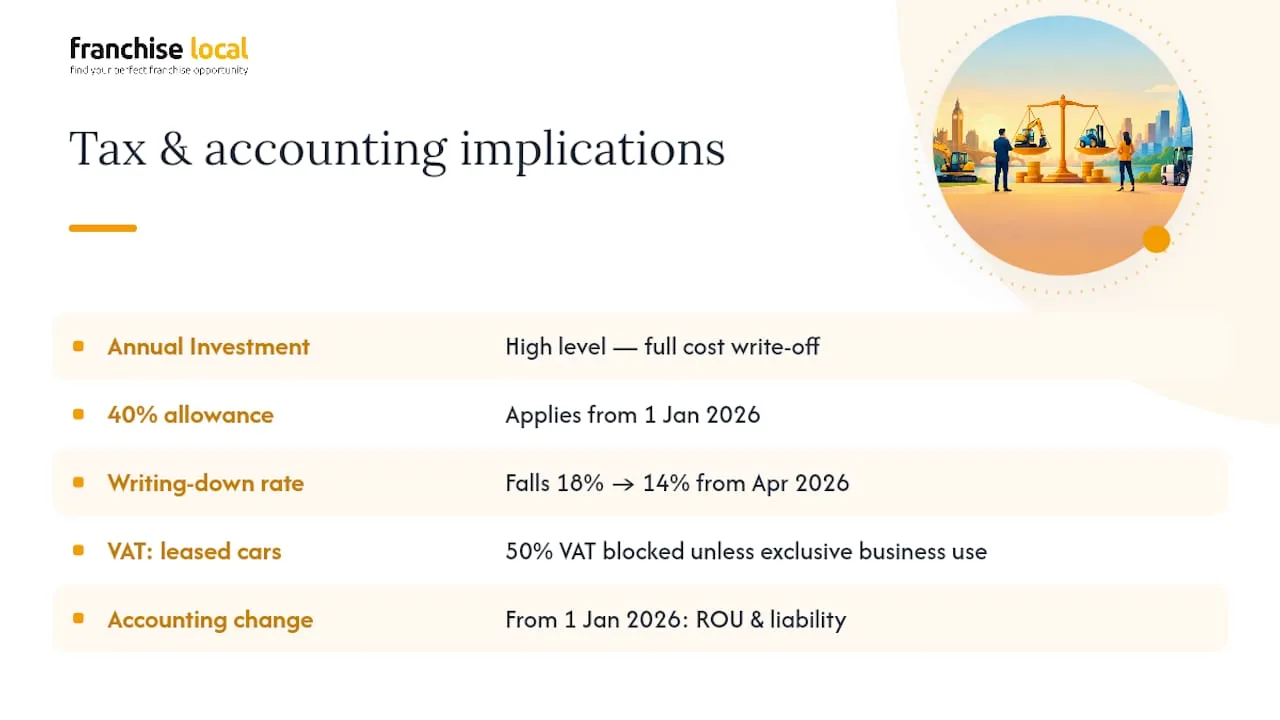
Buying and qualifying hire purchase can generally access capital allowances, and the rules shifted meaningfully for 2026. The Annual Investment Allowance remains at a high level for most qualifying plant and machinery, meaning many businesses can write off the full cost of equipment against profits in the year of purchase. A new 40% first-year allowance also applies from 1 January 2026, while the main pool writing-down rate falls from 18% to 14% for qualifying periods from April 2026, according to HMRC’s capital allowances guidance.
The gap that catches businesses out: leasing is often assumed to be “the tax efficient option”, but that claim depends entirely on who incurs the expenditure, whether the asset qualifies, and whether it is new or used. HMRC’s own guidance makes clear this needs checking case by case, not assuming.
VAT adds another layer. Leased cars typically face a 50% block on VAT recovery unless the vehicle is used exclusively for business purposes, and the rules differ between contract hire and finance lease arrangements, per HMRC’s internal VAT manual. Equipment VAT recovery follows separate, asset-specific rules.
The accounting picture changed too. From 1 January 2026, most businesses applying FRS 102 must recognise a right-of-use asset and a matching lease liability on the balance sheet, according to ICAEW. Short-term and low-value leases carry optional exemptions, but judging whether an asset qualifies takes care. Speak to your accountant before assuming any lease sits off balance sheet.
Comparing real costs: use total cost of ownership, not the monthly figure
A monthly payment tells you almost nothing about which route actually costs less. Total cost of ownership (TCO) forces you to compare like with like.
For buying or hire purchase, add together:
- Purchase price or hire purchase total, including deposit and interest.
- Installation and commissioning costs.
- Maintenance and servicing across the expected life.
- Insurance premiums.
- Downtime costs during breakdowns or repairs.
- Disposal costs, minus expected resale value.
For leasing, add rental payments across the full term, any upfront payment, service package costs if bundled, and end-of-term fees for excess wear or mileage. The British Business Bank recommends checking whether payments are genuinely fixed and what happens if you want to exit early.
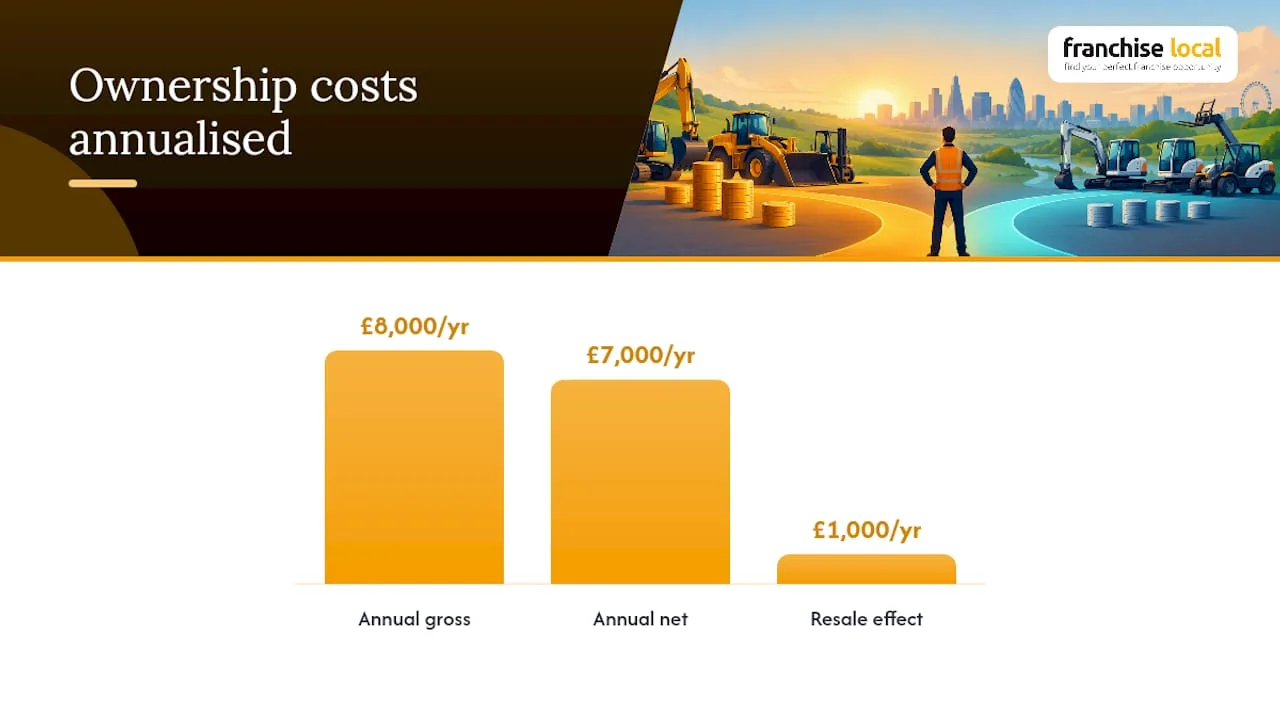
The most common mistake is comparing a lease quote’s monthly rental against a purchase price without annualising both across the same period, and ignoring the resale value you would recover from an owned asset. A machine costing £40,000 with a five-year working life and a £5,000 resale value has a very different annual cost than the same figure suggests when quoted as a bare purchase price.
Pro Tip: Ask any lender or lessor how they calculated the residual value baked into your quote. An optimistic residual makes monthly payments look artificially low, then hits you with a large balloon or end-of-term charge.
How to choose the right route: checklist and questions to ask
Run through this before signing anything:
- Does the cash impact suit your current working capital position?
- Do you need to own the asset for balance sheet, resale, or covenant reasons?
- How will the FRS 102 changes affect your reported assets and liabilities?
- Can you actually use the capital allowances a purchase would generate?
- How often will you realistically want to upgrade this equipment?
- Who carries maintenance and insurance responsibility under each option?
- What does exiting early actually cost you?
When you speak to a provider, ask directly: how was the residual value calculated, how is VAT handled on this specific agreement, what maintenance is included versus billed separately, and what does the early termination or purchase-option wording actually say in the contract.
Watch for red flags: fees disclosed only in the small print, residual calculations the provider won’t explain, and wear-and-tear conditions so strict that normal use triggers penalty charges.
Pro Tip: Get the end-of-term clause read by someone other than the salesperson quoting you the deal, ideally your accountant or a broker with no stake in which product you choose.
How the application process works and what lenders check
Getting approved for equipment finance follows a fairly consistent pattern across UK lenders, whether you go direct or through a broker.
- Choose the asset and decide which finance structure fits your needs.
- Obtain quotes from at least two or three providers to compare terms properly.
- Supply business accounts, bank statements, and credit history to demonstrate repayment capacity.
- Review security, deposit requirements, and any personal guarantee the lender wants.
- Sign the agreement and arrange delivery or installation.
Lenders typically want recent company accounts, several months of bank statements, a credit report, and director identification, similar to the documentation checks covered in what UK lenders expect from franchisees. Weak business credit can limit your options or push up pricing, so it’s worth checking and improving your credit position before you approach lenders. Default carries real consequences: the lender can recover the asset, and missed payments damage your credit profile for future finance applications, whether through a direct lender or a broker.
Which route fits your business right now?
A retailer refreshing till systems or laptops every three years typically does better leasing. A manufacturer buying a machine tool it will run for fifteen years usually does better buying or using hire purchase to capture capital allowances. A haulage firm replacing vans regularly often finds contract hire removes maintenance headaches worth paying for.
Whichever camp you fall into, don’t decide on the monthly figure alone. Run the TCO checklist, get your accountant to model the FRS 102 and capital allowance impact on your specific numbers, and collect two or three comparable quotes before committing.
If your next investment decision is a franchise that comes with its own equipment requirements, browse trending franchise opportunities or explore financial business franchises on Franchiselocal to see what capital outlay each model actually demands before you commit.
Sources
- Leasing & hire purchase checklist | British Business Bank
- Gov
- Bringing leases on balance sheet: common pitfalls and issues | ICAEW
This article is general information, not a substitute for advice from a qualified financial advisor. Consult a qualified financial professional about your own circumstances before acting on anything here.
FAQ
Is it better to buy or lease equipment?
It depends on your cash position and how long you’ll use the asset. Buying or hire purchase suits equipment you’ll run for its full working life and where you can use capital allowances, while leasing suits equipment you’ll replace frequently or where preserving cash matters more than ownership.
What is the 90% rule in leasing?
There’s no single universal “90% rule” in UK equipment leasing regulation, and definitions vary depending on which accounting standard or lender is being referenced. If a provider cites this figure to you, ask them to explain exactly what threshold they mean and how it affects your specific agreement.
What is a key disadvantage of leasing equipment?
You never build equity in the asset, and end-of-term fees for excess wear or mileage can add unexpected costs. Leasing companies also retain ownership throughout the agreement, according to the British Business Bank, so you have no resale value to recover when the term ends.
Are leases cheaper than buying?
Not automatically. Monthly lease payments often look lower than loan repayments, but a proper total cost of ownership comparison, including resale value on an owned asset and end-of-term lease fees, frequently narrows or reverses that gap. Sector and asset type matter more than any blanket claim that leasing costs less, based on FLA data.