

For most rural UK territories, mobile and van-based services, home care, pet care and other low-fixed-cost, recurring-revenue franchise models offer the strongest chance of success. These formats follow customers rather than waiting for footfall, scale cleanly across spread-out territories, and build repeat income instead of one-off sales. The rest of this guide covers how to choose between them, what they cost, and how to run one well.
Which franchise models actually work in rural territories
Rural economics reward businesses that come to the customer and bring in repeat bookings rather than passing trade. A handful of models consistently suit this pattern.
- Mobile and van-based franchises cut premises costs almost entirely and let you chase demand across several villages rather than relying on one high street.
- Home care franchises benefit from steady local authority and private commissioning, and rural areas with older populations tend to generate consistent referral volumes.
- Pet care and home-management franchises often run from a spare room or a small office, keeping overheads low while serving a wide catchment.
- Seasonal and tourism-linked models (events, markets, outdoor leisure) can work well where a local calendar of fairs, festivals or visitor seasons creates predictable peaks.
- Service and maintenance franchises, such as those covering appliance repair, landscaping or vehicle care, profit from travel because each visit carries its own charge.
The common thread is low fixed overhead paired with a model that doesn’t depend on passing footfall, since rural communities simply don’t generate much of it.
How to choose the right franchise for a rural UK territory
Picking a model is only half the job. The franchise itself needs scrutiny before you commit any capital.
- Read the disclosure pack properly. The UK has no statutory requirement for a formal disclosure document, but reputable franchisors provide one anyway, and it should set out territory boundaries, all fees, realistic cost estimates and risk factors in plain terms, according to guidance on UK disclosure practice.
- Check how the territory is defined. In low-density areas, a map based on population catchment and typical drive times tells you far more than a simple area in square kilometres, and the Statistical Digest of Rural England is a useful cross-check against the franchisor’s own figures.
- Weigh recurring revenue against one-off sales. A model built on repeat bookings, such as care visits or pet services, tends to absorb quiet weeks better than one relying on single transactions.
- Confirm the support on offer. Ask what the franchisor does for local marketing, recruitment and lead generation, since rural franchisees often need more of this help than their urban counterparts.
- Map the finance. Note the upfront fee, ongoing royalty, marketing levy and the working capital you’ll need before income catches up with outgoings.
- Ask for proof. Request confirmation of British Franchise Association membership, an audited profit and loss example, and contact details for an existing rural franchisee.
Pro Tip: Ask any rural franchisee reference specifically about travel time between appointments, not just turnover, since that’s usually the real constraint on rural profitability.
Our guide to researching franchise opportunities and our step-by-step guide to choosing a franchise walk through this process in more depth.
Investment, costs and a realistic launch timeline
Costs vary widely by sector, but rural-friendly models tend to cluster at the lower and mid end of the market.
- Low-cost entry points: cleaning and domestic service franchises can start from around £5,000 and run past £30,000 depending on what’s included in the package, according to BFA guidance on cleaning franchise costs.
- Working capital: budget for a reliable vehicle, fuel, rural-specific marketing and recruitment, since these costs bite harder when territories are large.
- Ongoing fees: most franchises charge a royalty percentage plus a marketing contribution, both of which affect cashflow most in the early months before bookings build up.
- Launch timeline: home care franchises, for example, often quote a three to six month path from signing to first trading, covering training, CQC registration support and local commissioning.
- Funding sources: speak to high street lenders familiar with franchise lending and, for care-related models, ask local commissioning bodies about contract opportunities before you launch.
Our home care franchise listings show current investment levels and launch support across that sector.
Sectors and demand signals worth checking before you commit
Rural England’s older population is growing faster than its urban counterpart, with ONS analysis projecting some of the largest increases in the 65+ age group in rural local authorities. That shift underpins steady, long-term demand for home care and support services in exactly the territories where footfall-dependent businesses struggle.
A few other signals are worth checking before you settle on a sector:
- High household pet ownership keeps pet-care franchises relatively resilient, since recurring service demand holds up even when discretionary spending tightens elsewhere.
- Local tourism and event calendars can multiply demand for seasonal or mobile models well beyond what the resident population alone would support.
- Farming and small business clusters generate steady work for landscaping, vehicle maintenance and agricultural support services.
- The Statistical Digest of Rural England publishes population, employment and connectivity indicators by area, letting you test demand for a specific territory before you sign anything.
Running a rural franchise well day to day
Once you’re trading, the margin between a profitable rural franchise and a struggling one usually comes down to logistics and local trust.
- Plan routes tightly. Cluster appointments geographically and avoid double-backing across the same roads twice in a day.
- Recruit flexibly. Part-time rotas, local advertising and links with training providers or apprenticeship schemes widen your pool in areas with fewer applicants.
- Build visible local trust. Sponsoring a village event or partnering with a local charity does more for reputation in a small community than a wide advertising spend.
- Negotiate supplier terms for distance. Remote areas often mean higher delivery costs, so agree terms that reflect your actual order volume and location.
- Track the right numbers. Cost per visit, vehicle utilisation and travel hours matter more in rural territories than headline revenue alone.
Pro Tip: Review your route plan monthly, not just when it stops working, since small changes in client clusters can quietly add hours to your week.
Local visibility also depends on how you’re found online across several small towns at once, an area covered well in PRYDE Designs’ guide to local keyword targeting.
Using FranchiseLocal to find and validate rural opportunities
We built our search tools around exactly this kind of filtering. Start with our industries page to shortlist mobile, home care, pet care or service-based models, then narrow by investment level and lifestyle (home-based, part-time, full-time) to match your circumstances.
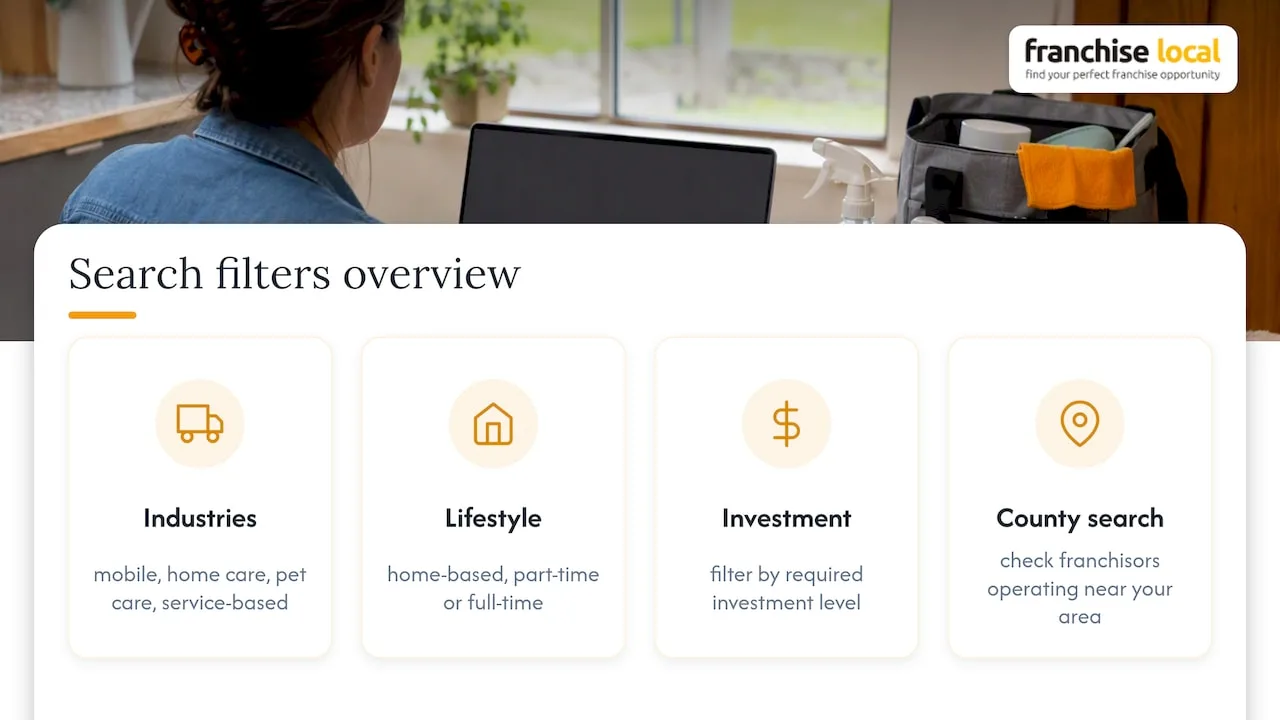
Our county search pages let you check which franchisors already operate near your target area, which matters for understanding how territories have been carved up locally. Curated and trending lists surface models that are already gaining traction, which is a useful early signal of rural demand.
When you reach a discovery call, ask for a territory map, a rural franchisee reference and evidence of local marketing support, then save your shortlist and submit enquiries directly through the listing.
Franchiselocal: start your rural franchise search here
It is straightforward to turn this research into a shortlist you can act on. Rather than searching sector by sector across scattered websites, you can filter by investment level, industry and lifestyle in one place and see which franchisors already operate near your target county.
- Browse our trending franchise opportunities to see which models are gaining traction right now.
- Check our business services and van-based listings if a mobile model suits your territory.
- Look at our hidden gem franchises for niche, lower-profile options that often suit smaller catchments well.
Ageing rural populations and thin local competition mean genuine gaps exist right now in many territories. Request territory maps and rural references during your discovery calls, and use our county pages to check availability before someone else takes the patch you had in mind.
FAQ
What is the most profitable franchise to own in the UK?
Profitability varies by sector and territory, but national data shows the large majority of UK franchise units report being profitable, with 89% profitable according to the 2024 BFA national franchise survey. Home care and service-based models tend to perform consistently well in rural areas because of recurring demand rather than one-off sales.
What is the cheapest franchise to open in the UK?
Entry costs vary widely, but domestic and cleaning service franchises sit at the lower end, with some starting from around £5,000 before working capital and other costs are added. Always check what’s included in the headline fee, since training, equipment and initial marketing support can be bundled differently between franchisors.
What are the top profitable franchise sectors in the UK?
Home care, pet care, cleaning and other service-based sectors consistently rank among the stronger performers, partly because 89% of UK franchise units report profitability overall. Our industries directory groups current opportunities by sector so you can compare investment levels directly.
Which franchise is best for beginners?
Franchises with strong franchisor training, a lower upfront investment and a simple, repeatable service model tend to suit first-time owners best. Home-based or mobile formats in sectors like cleaning, pet care or home care often work well for beginners because the operating model is straightforward and support from the franchisor is usually substantial.
Sources
- Living longer: trends in subnational ageing across the UK – Office for National Statistics
- Statistical Digest of Rural England (Rural Economic Bulletin) – Defra (PDF)
- The results are out – 2024 National Franchise Survey is live! – British Franchise Association
- Franchise disclosure document in the UK: what to include – Sprintlaw