

Health and safety is a legally enforceable duty that sits with you as a franchisee, not just your franchisor, so it belongs at the top of your due diligence. Among UK service franchises, ServiceMaster Clean, Minster Cleaning, Metro Rod and Drain Doctor each show different strengths in how they manage this risk. Before you sign anything, ask for the operations manual, sample risk assessments and training records, and read them closely.
Shortlisted UK franchises where health and safety is central
Four service franchises come up repeatedly when UK buyers weigh health and safety alongside commercial fit. Each handles the same statutory duties differently, and the differences show up in training depth, supplier vetting and how prepared technicians are for higher-risk tasks.
| Franchise | Best for | Set-up cost | H&S support from franchisor | Competence/certificates noted |
|---|---|---|---|---|
| ServiceMaster Clean | Commercial cleaning contracts | Medium | Formal training programmes, vetted supplier network | Site-specific induction for commercial clients |
| Minster Cleaning | Regional domestic and small commercial cleaning | Medium | PPE protocols, vehicle-safety procedures | Manual handling and chemical-use training |
| Metro Rod | Drainage and planned maintenance contracts | High | Confined-space and rescue procedures | Specialist competence for confined spaces |
| Drain Doctor | Local drain-unblocking and repair | Medium | Technician training, vehicle-operation checks | Technician certification for drainage work |
ServiceMaster Clean leans on established training programmes and a vetted supplier network, which matter most once you are managing commercial contracts with their own site rules and client-specific inductions. Minster Cleaning operates across domestic and small commercial work, and its practical PPE and vehicle-safety protocols reflect a franchise built around teams moving between multiple premises each day.
Metro Rod works in drainage and reactive infrastructure, where confined-space entry and rescue planning are not optional extras but core operating procedure. Drain Doctor covers similar ground at a more local scale, with trained technicians and vehicle-operation checks built into day-to-day work rather than treated as a separate compliance layer.
Watch for a few warning signs as you compare:
- A franchisor who cannot produce a current operation manual on request.
- Training records that cover sales and customer service but say little about risk assessment or incident response.
- No evidence of audits, inspections or refresher training beyond the initial induction.
How UK health and safety law applies to franchisees
As a franchisee, you take on the same statutory duties as any other employer. The Health and Safety Executive’s policy guidance sets out the core requirement: identify hazards, assess the risks they pose, and either eliminate them or control them to an acceptable level, keeping proportionate records as you go.
The written-policy threshold matters in practice. Once your number of employees reaches the threshold set by current regulations, you must have a written health and safety policy and documented risk assessments. Below that threshold, a written policy is not mandatory, but keeping basic records is still good practice and useful evidence if anything goes wrong.
- Identify hazards specific to your premises and activities, not just generic ones from head office.
- Assess likelihood and severity before deciding on controls.
- Record significant findings even if you are not yet legally required to.
HSE’s website carries templates and sector guidance that go well beyond what any franchise pack will give you.
Fire safety and shared premises: who answers for what
Fire safety responsibility sits with the “responsible person”, a role defined under Gov. In a unit you lease or share with other occupiers, that responsibility can split between you, your landlord and a managing agent, and the split is not always obvious until something forces the question.
Before you open, confirm who holds which duty and get it in writing. At minimum, you need to understand the fire-door safety precautions as part of your fire safety responsibilities.
- A current, suitable fire-risk assessment for the premises you will occupy.
- A written emergency plan covering evacuation and who raises the alarm.
- Staff fire-safety training, including refreshers.
- Maintenance logs for alarms, extinguishers and emergency lighting.
Franchisors sometimes assume the landlord covers fire safety, and landlords sometimes assume the franchisor has briefed their tenant. Get the boundary agreed and documented before you commit to the lease.
Sector hazards and the controls that actually fit them
Hazards vary sharply by sector, and the controls should match the actual risk, not a generic checklist.
- Mobile drainage and home improvement: confined spaces, manual handling and lone working call for specific competence and often a buddy system or check-in protocol.
- Commercial cleaning: chemical handling, slips and work at height on ladders or platforms need COSHH-style controls and basic training.
- Food-related franchises: food hygiene certification and temperature control sit alongside standard workplace risks.
- Care and childcare premises: safeguarding training and medication handling add a layer most other sectors never face.
Mobile models in particular need lone-working check-ins and vehicle-safety checks as standard, not optional extras.
Pro Tip: Ask any franchisor to name the specific competence or certificate their technicians hold for the highest-risk task in the job, not just their general induction.
Budgeting for health and safety as part of your franchise plan
Ongoing health and safety costs rarely show up clearly in a franchise prospectus, yet they shape your real return. Build these into your financial plan from day one:
- Initial and refresher training for you and any staff.
- PPE, replaced on a cycle rather than bought once.
- Specialist risk assessments for higher-hazard tasks such as confined-space or work-at-height jobs.
- Insurance that actually matches your activities, not a generic policy.
- Vehicle, equipment and premises maintenance and inspection costs.
- Audit visits, whether run by the franchisor or an external body.
Franchisors often cover the big start-up items, induction training and the initial manual, but local variation shifts ongoing costs onto you. A mobile drainage installer covering several postcodes carries different vehicle and PPE costs than a shop-based cleaning franchise with one fixed site and lighter travel demands. Use a franchise affordability calculator to stress-test these figures against your actual territory before you commit.
Due diligence checklist built around health and safety evidence
Treat this as the document list you take into every franchisor conversation.
- Request the current operations manual and read the health and safety sections in full.
- Ask for sample risk assessments relevant to your intended premises or vehicle type.
- Review the training syllabus and confirm refresher frequency, not just initial induction.
- Ask to see incident logs and how past incidents were handled and communicated.
- Request audit reports from the last 12 months, where they exist.
- Check insurance schedules match the actual activities you will perform.
Speak to existing franchisees directly and ask how often they are audited and what happens when something goes wrong. Our franchise compliance checklist for UK franchisors sets out the equivalent standard from the franchisor’s side.
Pro Tip: Treat a franchisor’s reluctance to share incident logs or audit reports as a red flag worth walking away from, not a detail to chase later.
Franchisor support for health and safety and how to judge it
Most franchisors offer some mix of induction training, written procedures, audit visits and vetted suppliers or contractors. The quality varies enormously between brands, and the paperwork alone will not tell you which is which.
Look for documented audit cycles with a fixed frequency, not vague promises of “regular checks”. A clear escalation route for incidents, and evidence that procedures are aligned with HSE’s own approach, both suggest a franchisor who treats this as a management discipline rather than a box-ticking exercise.
- Induction plus scheduled refresher training, not a one-off session.
- Written procedures that match the actual work, not a generic template.
- Audit visits with a stated frequency and a record of findings.
- Vetted suppliers and contractors where subcontracted work is involved.
Where the franchise agreement is silent on training or audit frequency, ask for it to be added in writing. A verbal assurance is worth little once you are trading.
Where to find authoritative UK guidance and how to use our tools
HSE’s Plan-Do-Check-Act guidance and the fuller HSG65 management guidance give you the operational framework behind everything a good franchisor should already be doing: plan your policy and risk assessments, put controls and training in place, monitor performance, then act on what you find.
- Use our industry filters to shortlist franchises by sector before you start asking H&S questions.
- Run numbers through the affordability calculator to see where ongoing H&S costs sit in your budget.
- Pair regulator guidance with the franchisor’s own evidence rather than taking either alone.
Health and safety responsibilities: franchisor versus franchisee
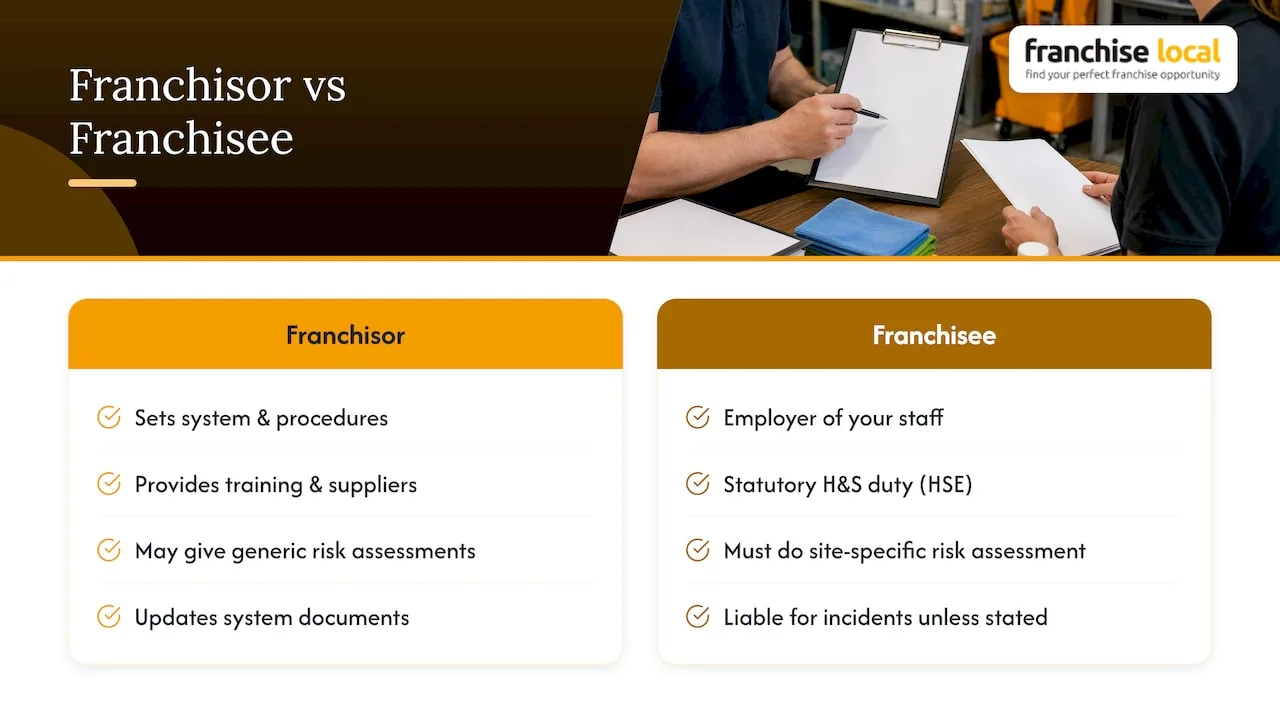
A franchise agreement rarely draws a clean line between what the franchisor owns and what falls to you, and that ambiguity is where risk hides. In practice, franchisors typically set the system: the operations manual, standard procedures, initial training and often the supplier relationships. You, as the franchisee, remain the employer for anyone you take on, which means the statutory duties under HSE guidance on writing a health and safety policy sit with you directly, whatever the manual says.
This matters because a franchisor’s manual supports but never replaces your own duty to carry out a suitable and sufficient risk assessment for your actual premises, vehicles and staff. A generic risk assessment written for a model site elsewhere in the country will not cover a confined space specific to your drainage contract or a fire exit layout unique to your leased unit.
Good franchise agreements state this split explicitly: who writes which procedures, who updates them, who pays for specialist assessments, and who is liable when something goes wrong. Weak agreements leave it implied, which tends to surface only after an incident. Before you sign, ask your franchisor to point to the exact clause that assigns health and safety responsibility, and compare it against what their training actually covers.
Legal compliance risks specific to franchise businesses
Franchising adds a layer of legal exposure that an independent small business does not carry in quite the same way. You are bound by both general employment and health and safety law and by the terms of your franchise agreement, and the two do not always align neatly.
A franchisor’s standard procedures might lag behind HSE’s current approach, or simply not match your specific trading circumstances. Following the manual to the letter will not protect you if it fails to cover a hazard HSE guidance says you should have identified yourself. Liability for an incident rarely stops at the franchisor’s door, because you are the employer on record and usually the named dutyholder for your premises.
Franchise agreements sometimes include indemnity clauses that shift financial responsibility onto you for breaches, even where the underlying procedure came from head office. Read these clauses carefully, and where anything is unclear, get independent legal advice before signing rather than after an incident forces the question. Our franchisee responsibilities guide sets out the broader legal picture beyond health and safety specifically.
Audits and inspections written into franchise agreements
Audit frequency and scope should appear in your franchise agreement, not just in a verbal promise during the sales process. A well-run network builds in scheduled visits, usually annual at minimum for lower-risk operations and more frequently for higher-hazard work such as drainage or confined-space tasks.
What the audit actually checks matters more than how often it happens. A useful audit reviews training records, incident logs, PPE condition, vehicle safety checks and whether risk assessments have been updated to reflect any change in premises or personnel. A superficial audit that only checks branding compliance and paperwork completion tells you little about real safety performance.
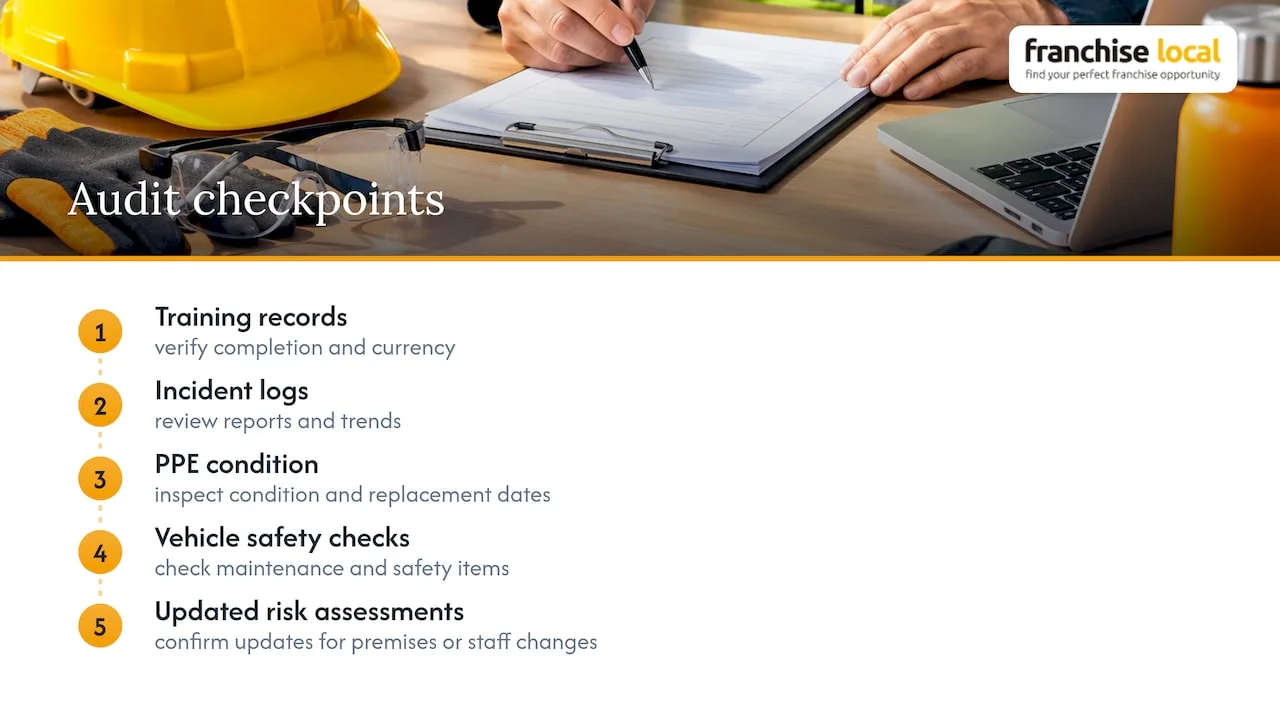
Ask to see a redacted sample audit report from an existing franchisee before you sign. If a franchisor cannot produce one, or the audit clearly focuses on commercial metrics rather than safety, treat that as a gap you will need to fill yourself, at your own cost, once you are trading.
Incident reporting across a franchise network
How incidents get reported and shared across a franchise network tells you a lot about how seriously health and safety is taken at head office. A good system has a clear, simple reporting route: who you tell, how quickly, and what happens with that information afterwards.
The stronger networks treat incidents as something to learn from across the whole group, not just locally. If one franchisee reports a near-miss with a confined-space entry, that lesson should reach other franchisees doing similar work, not stay filed in one unit’s paperwork. Ask whether incident data is reviewed centrally and whether findings get communicated back to the network as updated procedures or alerts.
Weak systems tend to have reporting routes that exist on paper but are rarely used, with no evidence of lessons feeding back into training or procedures. That absence is as telling as a bad incident itself, because it suggests nobody above franchisee level is actually watching the pattern of what goes wrong.
Training tailored to franchise-specific operations
Generic health and safety training rarely matches what a franchisee actually needs, because the risks in a drainage franchise differ enormously from those in a cleaning franchise, even though both might use the same induction template from a parent company with multiple brands.
Look for training that covers the specific tasks your technicians or staff will actually perform: confined-space entry for drainage work, chemical handling and manual handling for cleaning contracts, or lone-working protocols for any mobile service. HSE’s Plan-Do-Check-Act approach treats training as one part of an ongoing cycle, not a one-off event completed at induction and then forgotten.
Refresher frequency is worth asking about directly. Annual refreshers for standard risks and more frequent updates for higher-hazard tasks suggest a franchisor managing this properly. A franchise that only trains once at the start, with nothing scheduled afterwards, is relying on you to notice gaps yourself, usually without the resources head office has to fix them.
Our directory enables filtering by sector, investment level and lifestyle fit, helping you move directly into gathering relevant evidence covered in this article.
- Filter listings by industry to shortlist sectors like cleaning or drainage services where health and safety is central.
- Use our ROI estimator and affordability calculator to weigh ongoing H&S costs against projected returns.
- Use contact forms on franchise listings to request operations manuals and training outlines before progressing discussions.
Start with our trending franchise opportunities page to see which UK service franchises are attracting serious interest right now, then work through the document checklist above with each one before you shortlist further.
FAQ
Which franchise is most profitable in the UK?
Profitability depends heavily on sector, location and how well a franchisee runs the business, so no single brand holds a universal answer. Service sectors with steady repeat demand, such as cleaning and drainage, tend to offer more predictable income than seasonal or highly discretionary sectors.
What are the top 20 franchises in the UK?
There is no single official ranking of UK franchises, and lists vary by publisher and criteria used. Our industries directory lets you compare opportunities by sector, investment level and lifestyle fit rather than relying on one fixed list.
What are the top 3 franchises?
As with any “top” franchise list, rankings shift depending on the criteria used, whether that is turnover, franchisee satisfaction or growth rate. Rather than chasing a fixed top three, compare opportunities against your own budget, sector interest and the health and safety evidence covered in this article.
How much does a franchise cost in the UK?
Franchise costs in the UK vary widely by sector and brand, from relatively low-cost home-based models to six-figure investments for premises-based or specialist operations. Use our affordability calculator to model set-up and ongoing costs, including training, PPE and insurance, against your own budget.