

A franchise compliance checklist is a structured document covering every legal, operational, and contractual obligation a franchisor must meet to protect their network and maintain regulatory standing. In the UK and across international franchise systems, this checklist functions as the backbone of responsible franchise management. The Franchise Disclosure Document (FDD), governed by the FTC Franchise Rule in the United States and referenced widely in UK franchise due diligence, sits at the centre of any credible compliance framework. Getting compliance right from the outset protects your brand, builds franchisee trust, and prevents costly legal exposure. This guide covers every component you need, in the order you need it.
What does a franchise compliance checklist legally require?
The legal foundation of any franchise regulatory compliance checklist starts with the Franchise Disclosure Document. The FDD is a federally mandated document in the United States containing 23 disclosure items, covering everything from litigation history and audited financials to franchisee obligations and territory rights. For UK franchisors expanding into the US market, or those working with US-based franchise systems, understanding FDD requirements is non-negotiable.
The single most critical legal rule is the 14-day delivery requirement: franchisors must deliver the FDD to a prospective franchisee at least 14 calendar days before any agreement is signed or any payment is made. Missing this window exposes franchisors to rescission claims, meaning a franchisee can legally unwind the entire deal. That is not a theoretical risk. It is the most litigated compliance failure in franchise law.

Annual FDD updates are equally binding. Franchisors operating on a calendar year must update their FDD by 30 April each year, within 120 days of fiscal year-end. Missing this deadline triggers a legal obligation to halt all franchise sales until the updated document is filed and approved. For a growing network, a sales freeze of even two weeks can cost tens of thousands of pounds in lost deals.
State-level registration adds another layer. 14 US states including California, New York, and Illinois require franchisors to register their FDD separately with state authorities before offering franchises in those jurisdictions. Each state demands tailored addenda addressing local disclosure rules. Attorney Anthony Lopes emphasises budgeting and planning for state registrations entirely separately from federal Franchise Rule compliance, because the timelines, fees, and documentation requirements differ significantly.
The table below compares federal FDD requirements with notable state-specific mandates:
| Requirement | Federal (FTC Rule) | State-specific (e.g. California, New York) |
|---|---|---|
| FDD delivery timing | 14 calendar days before signing | Same minimum; some states require earlier |
| Annual update deadline | 120 days after fiscal year-end | Varies; registration renewal required |
| Registration filing | Not required federally | Mandatory in 14 registration states |
| State addenda | Not required | Required; content varies by state |
| Approval before sales | No federal pre-approval | Yes, state approval required before offering |
| Penalties for non-compliance | Rescission, civil penalties | State-level fines, injunctions, rescission |
Key legal items your franchise compliance checklist must include:
- Completed FDD with all 23 disclosure items current and accurate
- Proof of FDD delivery with timestamps and method of delivery documented
- Signed receipt from the prospective franchisee acknowledging delivery
- Annual update filed within 120 days of fiscal year-end
- State registration applications and approvals for all applicable jurisdictions
- State-specific addenda reviewed and attached to the FDD
- Franchise agreement signed no earlier than 14 calendar days after FDD delivery
How to implement operational audits across your franchise network
Operational audits are the mechanism by which franchisors verify that franchisees are actually meeting the standards set out in the franchise agreement and operations manual. Without a structured audit programme, compliance exists only on paper.
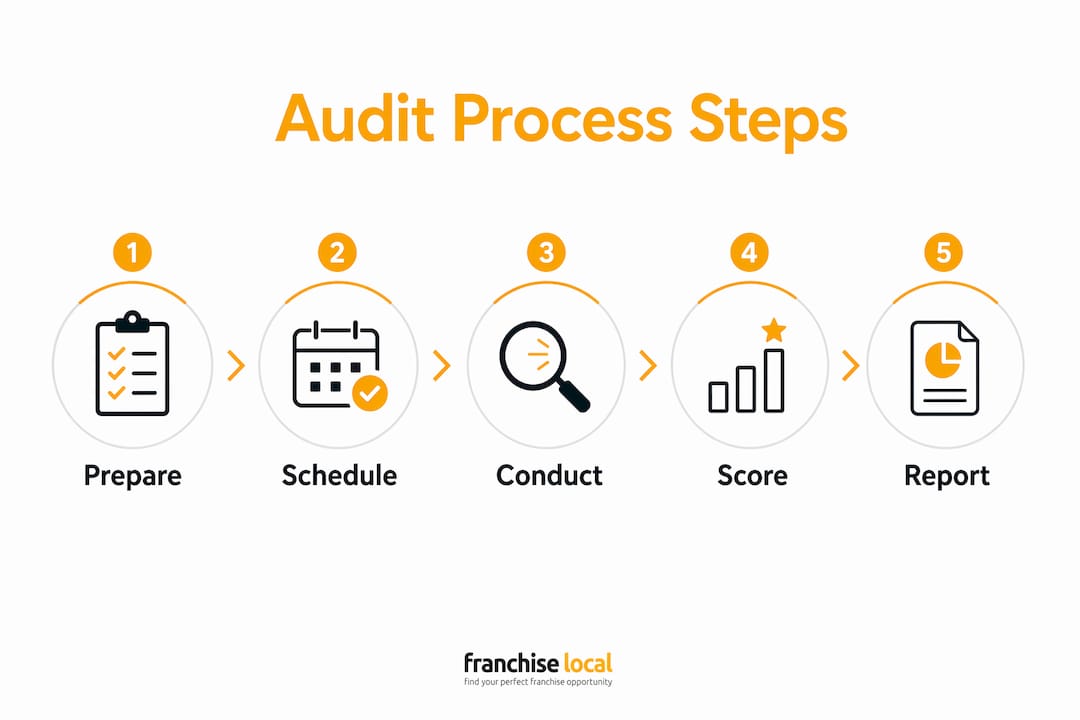
Audits fall into three main categories. Operational audits assess day-to-day procedures, staffing, and customer service standards. Financial audits review royalty reporting accuracy, sales figures, and fee payments. Brand standards audits check physical presentation, signage, uniforms, and marketing materials. Each type serves a distinct purpose, and a thorough franchise audit checklist incorporates all three.
The announced versus unannounced audit debate matters more than most franchisors realise. Announced audits give franchisees time to prepare, which produces cleaner results but may mask chronic compliance gaps. Unannounced audits reveal the true operating standard. Best practice is to combine both: one announced audit annually and at least one unannounced visit, particularly for franchisees with prior compliance issues.
Standardised audit scoring rubrics with weighted violation categories are the gold standard for audit consistency. Food safety violations in a food service franchise, for example, carry heavier penalties than signage discrepancies. Weighted scoring means a franchisee cannot offset a critical health and safety failure with a perfect score on marketing compliance. Corrective action timelines typically run from 30 to 90 days depending on severity, with critical violations requiring immediate remediation.
Digital audit tools with GPS and timestamp technologies have become the standard for audit defensibility and operational oversight. Platforms that capture photo evidence, record inspector location, and auto-generate audit reports create a legally defensible paper trail. If a franchisee disputes a compliance finding, timestamped photographic evidence is far more persuasive than handwritten notes.
Pro Tip: Schedule your annual audit kickoff in November or early December. Franchisor consultant Jason Stowe recommends early audit planning as the single most effective way to avoid delayed FDD renewals. Clean financials from completed audits feed directly into your annual FDD update, and starting late is the most common cause of missing the April deadline.
Key elements of an effective audit programme:
- Written audit policy covering frequency, scope, and scoring methodology
- Separate scoring rubrics for operational, financial, and brand standards audits
- Weighted violation categories with defined corrective action timeframes
- Digital audit platform capturing timestamped photos and GPS location data
- Formal corrective action plan process with sign-off from both parties
- Escalation procedure for repeat non-compliance or critical violations
- Annual audit schedule published to franchisees at the start of each year
What contractual elements belong on a franchise compliance checklist?
Beyond the FDD, the franchise agreement itself contains the contractual obligations that define the day-to-day compliance relationship between franchisor and franchisee. Understanding franchise agreement essentials is not optional. It is the foundation of an enforceable compliance framework.
Franchise agreements commonly carry terms of 10 to 20 years. Fee structures above 12 to 15 per cent of projected revenue are considered aggressive and may signal financial risk for the franchisee. Reviewing fee structures carefully during the agreement stage protects both parties and reduces the likelihood of fee-related disputes later in the relationship.
The operations manual deserves particular attention. Operations manuals often allow unilateral franchisor updates after the agreement is signed, meaning the franchisor can change daily operating requirements without renegotiating the primary contract. This clause governs most of the practical compliance obligations a franchisee faces. Reviewing the current version of the manual during due diligence gives franchisees a clear picture of what they are actually committing to, beyond the headline terms of the agreement.
Training acknowledgements and compliance certifications form another layer of contractual compliance. Franchisees and their key staff should sign training completion records, confirming they have received instruction on brand standards, health and safety, and operational procedures. These records serve as evidence of the franchisor’s duty of care and the franchisee’s acceptance of operating standards.
Contractual compliance checklist items include:
- Franchise agreement reviewed by a qualified franchise solicitor before signing
- Term length, renewal rights, and exit conditions clearly documented
- Territory rights and any exclusivity provisions confirmed in writing
- All fees (initial, ongoing royalties, marketing levies) itemised and agreed
- Operations manual version number recorded at the time of signing
- Training completion certificates signed and stored for all key personnel
- Compliance certification schedule agreed, covering annual and ad hoc reviews
- Document storage policy covering minimum retention periods for all compliance records
How to maintain ongoing compliance: record-keeping and amendments
Maintaining compliance between formal annual updates is where many franchisors fall short. The franchise compliance process is not a once-a-year exercise. It requires continuous record-keeping, proactive tracking, and a clear process for handling material changes.
Automated delivery tracking systems are the most reliable way to manage FDD receipt documentation. These systems timestamp the exact moment a prospective franchisee receives the FDD, record the delivery method (email, portal, or physical delivery), and lock the agreement execution function until the 14-day waiting period has elapsed. Lack of receipt documentation is the most common FDD compliance failure, and automating this step removes the human error that causes it.
Material changes to the franchise system require prompt FDD amendments outside the annual update cycle. A change in litigation status, a new fee structure, or a significant alteration to the franchise system all trigger an amendment obligation. Franchisors should schedule quarterly compliance reviews to assess whether any operational or legal changes since the last update qualify as material disclosures.
The table below summarises key record-keeping and compliance checkpoints:
| Checkpoint | Frequency | Responsible party |
|---|---|---|
| FDD delivery and receipt documentation | Every new prospect | Franchisor / compliance team |
| 14-day waiting period verification | Every new agreement | Franchisor / legal counsel |
| Annual FDD update filing | Within 120 days of fiscal year-end | Franchisor / franchise attorney |
| State registration renewals | Annually per state | Franchisor / state-registered attorney |
| Material change amendments | As triggered | Franchisor / legal counsel |
| Operational audit completion | Annually (minimum) | Franchisor / field team |
| Training record updates | Per training event | Franchisee / franchisor HR |
| Quarterly compliance review | Every quarter | Compliance officer / legal team |
Pro Tip: Build a shared compliance calendar accessible to your legal team, operations director, and finance lead. Colour-code deadlines by risk level: red for FDD filing deadlines, amber for state renewals, and green for internal audit milestones. This single change eliminates the coordination failures that cause most compliance delays.
Quarterly reviews should also cover franchise legal requirements specific to the UK context, including any updates to the British Franchise Association (BFA) code of ethics, data protection obligations under the UK GDPR, and employment law changes affecting franchisee operations. UK franchisors do not operate under the FTC Franchise Rule domestically, but the discipline of FDD-style disclosure and structured compliance management translates directly into stronger UK franchise governance.
What I have learned from applying a franchise compliance checklist in practice
The most consistent mistake I see franchisors make is treating compliance as a legal formality rather than an operational discipline. They invest heavily in the FDD, get the agreement signed, and then leave compliance to chance. The audit never happens on schedule. The operations manual sits unread. The 14-day rule gets observed once and then forgotten in the rush to close deals.
Starting compliance planning early in the franchise lifecycle changes everything. When you build the audit programme before you sign your first franchisee, you create a culture of accountability from day one. Franchisees who are audited from the start accept it as normal. Franchisees who are audited for the first time after three years of independence often push back hard.
Digital tools genuinely transformed the consistency of compliance management in the networks I have worked with. Moving from paper-based audit forms to a digital platform with GPS verification and photo capture cut dispute resolution time significantly. When a franchisee challenges a compliance finding, the timestamped evidence closes the conversation quickly.
The state registration challenge is real for any UK franchisor expanding into the US market. Each of the 14 registration states has its own timeline, fee schedule, and addenda requirements. Trying to manage this without a US-qualified franchise attorney is a false economy. The cost of a missed registration deadline, measured in halted sales and legal fees, far exceeds the cost of proper legal support upfront.
The most practical advice I can offer is this: treat your franchise compliance checklist as a living document. Review it quarterly, update it when the law changes, and assign clear ownership for every item on it. Compliance without ownership is just a list of good intentions.
— Will
Find compliant franchise opportunities on Franchiselocal
Franchiselocal is the UK’s leading franchise directory, connecting entrepreneurs with vetted franchise opportunities across every sector and investment level. The franchises listed on the platform operate with established operational systems, clear franchise agreement terms, and structured support frameworks that make compliance management far more straightforward from day one. If you are ready to explore opportunities where compliance is built into the model, browse the best business services franchises currently available in the UK, or explore the full franchise directory to filter by industry, investment level, and location. Strong compliance starts with choosing the right franchise partner.
FAQ
What is a franchise compliance checklist?
A franchise compliance checklist is a structured document listing every legal, operational, and contractual obligation a franchisor must meet to maintain regulatory standing and protect their franchise network. It covers FDD delivery, audit schedules, training records, and state registration requirements.
How long before signing must a franchisor deliver the FDD?
The FDD must be delivered at least 14 calendar days before any franchise agreement is signed or any payment is made. Failure to observe this rule exposes the franchisor to rescission claims and significant financial penalties.
Which US states require separate franchise registration?
14 states including California, New York, and Illinois require franchisors to register their FDD with state authorities before offering franchises locally. Each state has distinct timelines, fees, and addenda requirements that must be managed separately from federal compliance.
How often should franchisors conduct compliance audits?
Franchisors should conduct at least one announced and one unannounced audit per franchisee per year. Audit scheduling should begin in November or December to align with annual FDD update deadlines and maintain clean financial records.
What happens if a franchisor misses the annual FDD update deadline?
Missing the 120-day FDD update deadline after fiscal year-end creates a legal obligation to halt all franchise sales until the updated document is filed and approved. For calendar-year franchisors, this means the 30 April deadline is a hard stop with no grace period.