

A home-based franchise is run from your own property, with no shop, unit or office to rent. A mobile franchise is run from a van, car or trailer, and you travel to your customers. The two are not opposites. Many UK franchises are both: you handle bookings and admin at home, then deliver the service in your territory. The real question is where most of your working hours go, and that decides your costs, your routine and the franchise that fits.
This guide compares the two models on the points that matter: daily routine, set-up costs, equipment, territory, lifestyle and agreement checks. Use it to narrow your search, then explore the options on Franchise Local’s home-based franchise directory.
Home-based and mobile: the difference in plain terms
The two labels describe different things.
- Home-based describes your base of operations. Your home is the business address. You answer calls, plan your diary, send quotes, keep records and manage marketing from there.
- Mobile describes how you deliver. A vehicle or mobile set-up takes the product or service to the customer, at their home, workplace or an event.
So a franchise can be home-based only, mobile only, or a mix. A business coach who sees clients online from a spare room is home-based. A mobile coffee van that you park up overnight on your drive is mobile, and also run from home. A dog trainer who does paperwork at the kitchen table and spends the day visiting clients is both.
A third meaning of “mobile” confuses some searchers. Here it means the business moves. It does not mean a mobile-phone shop or mobile-phone franchise. If you want that sector, search for it by name. This article is about businesses that travel.
Why the overlap matters
Because most mobile franchises are managed from home, the choice is rarely “home or van”. It is usually “how much of my week is spent at my desk, and how much is spent on the road?” Answer that honestly and the shortlist gets much smaller.
A typical week in each model
A home-based week
A home-based franchise puts you at a desk or on calls for most of the day. Typical work includes:
- Contacting local businesses or households to generate enquiries
- Delivering services remotely, by phone or video, where the sector allows
- Quoting, invoicing and bookkeeping
- Managing social media and local marketing
- Occasional meetings, networking events or client visits
The pattern is flexible. You set the hours, and you can fit work around school runs, a part-time job or other commitments. That freedom also means nobody opens the door for you. You are responsible for filling your own diary and keeping momentum.
Home-based sectors often include business services, recruitment, financial and consultancy-style roles, tutoring, and digital or marketing services. Browse examples in our business to business franchises and mobile app franchises categories.
A mobile week
A mobile franchise is built around appointments and routes. A typical job runs like this:
- A customer books or requests a quote.
- You schedule the visit and plan the route.
- You travel to the customer with the right equipment and stock.
- You carry out the work on site, invoice and take payment.
- You return home, restock, clean the vehicle and handle admin.
Your income depends on how many productive visits you fit into a day. Good route planning, a tight territory and reliable scheduling matter more than they do in a desk-based business. You are also physically active, often outdoors, and you meet people all day.
Mobile sectors include cleaning and valeting, property maintenance, care visits, tutoring and activity classes, mobile food and drink, and delivery. See the courier and delivery franchises, driving franchises and home care franchises lists for UK examples.
Side-by-side comparison
| Factor | Home-based franchise | Mobile franchise |
|---|---|---|
| Where you work | Mostly from home | Mostly at customers’ locations or in your territory |
| Vehicle needed | Often not | Usually yes, sometimes fitted out or branded |
| Premises | None, a home office is enough | None, but you need space to store equipment and stock |
| Start-up costs | Typically lighter: no lease, no shopfitting | Depend on the vehicle, fit-out, equipment and stock |
| Running costs | Marketing, software, insurance, phone and internet | Fuel, vehicle insurance, servicing, equipment upkeep, plus the above |
| Daily rhythm | Self-directed, desk-based | Appointment-driven, active |
| Income driver | Lead generation and client relationships | Number of jobs per day and territory demand |
| Best for | Planners, networkers, people who value flexibility | People who like being out and about and hands-on work |
Use the table as a starting framework. The exact picture depends on the brand, so always compare the franchisor’s own figures for investment, fees and support.
Costs to compare before you choose
Both models avoid the largest costs of a traditional high-street franchise: a lease or purchase of premises, and the refurbishment that follows. That is why home-based and mobile franchises appeal to first-time buyers.
The differences sit in the detail. When you compare two opportunities, build a simple budget with these headings.
Start-up costs
- Initial franchise fee. What you pay for the licence, training and launch support.
- Vehicle. Does the franchisor require a van, a car or a branded vehicle? Is it bought, leased or supplied? Is a wrap or livery included?
- Equipment and stock. Specialist tools, a trailer, uniforms and starter stock.
- Home office. A decent laptop, a phone line, software and a tidy workspace.
- Insurance and licences. Public liability insurance is common in service businesses. Mobile businesses also need the right vehicle cover for business use. Some sectors require extra permits or checks, so ask the franchisor which apply.
- Working capital. Money to cover living costs and running expenses while the business builds up.
Ongoing costs
- Ongoing franchise fees, such as a management service fee or royalty and any marketing contribution
- Fuel, servicing, tax and breakdown cover for vehicles
- Consumables and replacement equipment
- Software for booking, invoicing and accounts
- Local marketing
Franchisors set out their investment level in their listings. Our directory lets you filter by budget, so you can start with what you can afford and work outward. If you are not sure what your budget should be, the Franchise Affordability Calculator is a practical first step.
A worked comparison
Imagine two people with a similar budget.
Priya wants to keep her job for the first few months. She picks a home-based business-services franchise. She needs a laptop, a phone and some evenings. Her costs are mostly marketing, software and insurance. Her biggest task is generating enquiries.
Tom wants to leave office life and work outdoors. He picks a mobile franchise. He has a van to buy or lease, equipment to carry and fuel to pay for. His biggest task is filling each day with efficient, well-planned visits.
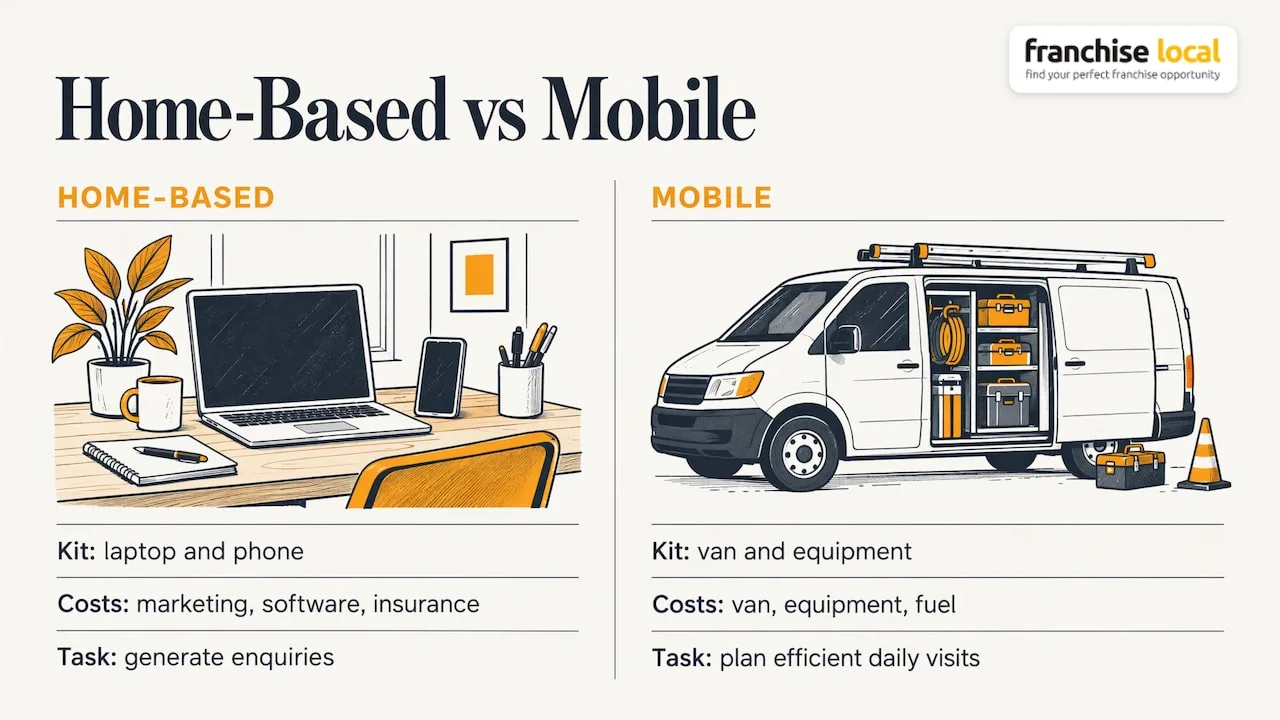
Neither choice is better. Each fits a different person and a different cash position. The mistake is choosing on price alone and ignoring how the working day feels.
Advantages of each model
Why choose a home-based franchise
- Lower overheads. There is no rent, no business rates on a unit and no fit-out.
- Flexibility. You can organise your hours around family or other commitments. Our guide to reasons to buy a home-based franchise goes deeper.
- No commute. Time and travel costs drop.
- Easy to start alongside other work. Many people build up gradually before going full time.
- Proven framework. A franchise gives you a tested business model, training and a brand, so you are not starting from scratch.
For more on this route, read our guide to starting a work-from-home franchise in the UK.
Why choose a mobile franchise
- Go where the customers are. You do not wait for people to walk in.
- Active, varied days. Different locations and different people each day.
- Visible branding. A liveried vehicle advertises the business as you work.
- Lighter than premises. You still avoid a lease and shopfitting.
- Clear territory. Many mobile franchises give you a defined area to build up.
Practical points to plan for
Good planning turns either model into a steady business.
Home-based: structure and discipline
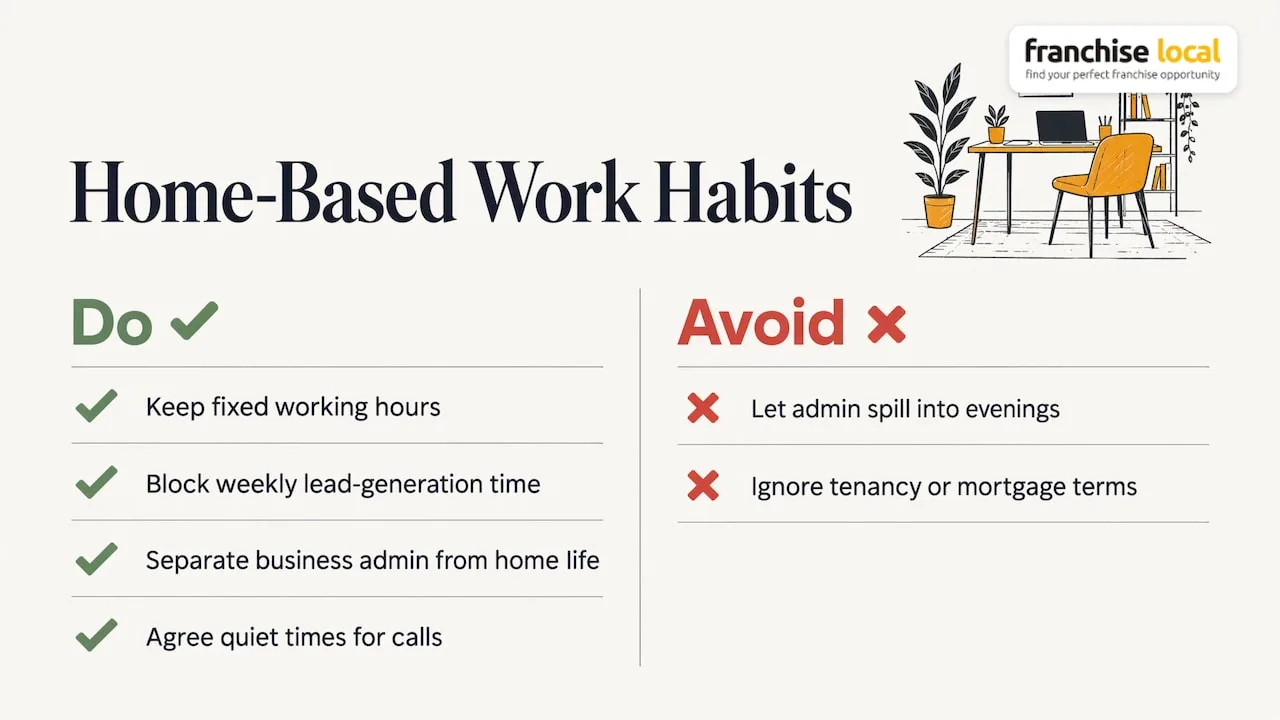
With no premises setting your hours, you set the structure. Keep a dedicated workspace and fixed working hours. Block out time each week for lead generation, because enquiries rarely arrive without effort. Keep business admin separate from home life so it does not spill into evenings. If you live with others, agree when you need quiet for calls.
Check your practical set-up too. Look at your tenancy agreement or mortgage terms to see whether running a business from the property is allowed. Think about deliveries, client visits and storage. If you are unsure about the rules for your home, take advice from your landlord, lender or an accountant.
Mobile: routes, vehicle and equipment
For mobile businesses, efficiency is the profit lever. A few habits help:
- Cluster appointments in the same area on the same day to cut driving time.
- Keep a service schedule for the vehicle so breakdowns do not cancel jobs.
- Store equipment securely, at home and in the vehicle.
- Use a booking system that sends confirmations and reminders to reduce missed appointments.
- Plan for the weather if your work is outdoors.
Because you are on the road, make sure your insurance reflects business use of the vehicle and the equipment you carry. Ask the franchisor what cover it recommends, and confirm the details with an insurer.
When the two combine
If a franchise is both home-based and mobile, split your week into two blocks. Keep one for fieldwork and one for the desk: quoting, calling, marketing and bookkeeping. Owners who skip the desk block often find their diary runs dry.
Which model suits you?
Answer these questions honestly.
- Where do you do your best work? If you like quiet focus and calls, lean home-based. If you hate sitting still, lean mobile.
- How much can you invest? Lower budgets often point to home-based models. A mobile business may need extra funds for a vehicle and equipment, unless the franchisor supplies them.
- How do you feel about driving? Daily driving suits some people and exhausts others.
- Do you enjoy selling? Home-based owners usually spend more time generating their own leads. Mobile owners also need customers, but the franchisor’s brand and local marketing may carry some of that load.
- How flexible does your week need to be? Both offer flexibility, but appointments with customers fix some of your hours in a mobile model.
- Are you keeping another job at first? Home-based businesses can be easier to start part-time.
- Do you want to employ people? Some mobile franchises grow by adding vehicles and staff. Some home-based ones grow by adding associates or a team. Ask each franchisor what growth looks like.
If your answers are mixed, a franchise that combines both elements is likely to suit you. If you are also weighing a shop or unit, our comparison of home-based vs retail franchises will help you see the wider picture.
What to check in the agreement and support package
Whichever model you pick, the contract decides what you actually get. The British Franchise Association advises that a franchise agreement should explain the support you will receive from the franchisor, and that ongoing support such as further training and technical help should be set out. Read both parts closely.
For home-based and mobile franchises, these checks matter most.
Territory
- How is your territory defined: by postcode, local authority area or population?
- Is it exclusive, and can that change if you miss targets?
- Can the franchisor or other channels, such as online sales or national accounts, sell in your area?
- Is the territory big enough to keep you busy, but small enough to cover efficiently?
Territory matters even more for mobile owners, because it sets your driving distances and customer pool.
Training and launch support
- What does initial training cover, and how long does it last?
- Is there help with marketing in the launch period?
- Who do you call when something goes wrong?
Our franchise training programme guide explains what good training looks like.
Equipment, vehicle and suppliers
- What must you buy, and from whom?
- Is the vehicle specification fixed, and who pays for branding?
- What happens to the equipment or vehicle if you leave?
Fees, term and exit
- Initial fee, ongoing fees and marketing contributions
- Length of the agreement and renewal terms
- Resale and exit rules
As with any legal contract, have a solicitor with franchise experience review the agreement before you sign. The British Franchise Association’s guidance and its member listings are also a good starting point for checking a franchisor’s standing.
How to search for the right model
A structured search saves time. Here is a simple route.
- Set your budget range with the affordability calculator.
- Decide how much driving you want: none, some or most of your week.
- Choose a sector that matches your skills and interests.
- Filter the directory by investment level, lifestyle and location.
- Shortlist three to five franchises and request information from each.
- Speak to existing franchisees and ask about a typical week, real costs and support quality.
- Review the agreement with a professional adviser.
Start on the industries page to browse by sector, or look at trending franchise opportunities to see what other buyers are exploring.
Find your franchise on Franchise Local
Franchise Local is a UK franchise directory built around how you want to work. Filter by industry, investment level, lifestyle and location to see home-based, mobile and combined opportunities side by side. Compare them, send enquiries and speak directly to the franchisors. Use the franchise directory search to start your search today, or see the best franchises in the UK for a wider view.
FAQ
Can a franchise be both home-based and mobile?
Yes. Many are. You run bookings, accounts and marketing from home, then travel to customers in your territory to deliver the service. Home is your base, and the vehicle or mobile set-up is how you deliver.
Is a mobile franchise more expensive than a home-based one?
It depends on the brand. A mobile franchise may include a vehicle, equipment and stock, while a home-based franchise may need little more than a laptop and a phone. Compare the total investment each franchisor lists, including the vehicle and working capital, rather than the franchise fee alone.
Do I need a van for a mobile franchise?
Often, but not always. Some mobile franchises use a car, a trailer or a branded vehicle, and some supply or lease the vehicle as part of the package. Ask each franchisor what is required, who pays for it and what the vehicle insurance must cover.
Can I run a home-based franchise alongside a job?
Many people do, particularly in the early months. Choose a model with flexible hours and check how much time the franchisor expects you to commit. Mobile franchises with fixed appointment slots can be harder to fit around set working hours.
Does mobile franchise mean a mobile-phone franchise?
No. In this context, a mobile franchise is a business that travels to customers by van, car or trailer. Mobile-phone franchises are a separate sector.