

Franchise reviews and research are most useful when you treat them as a starting point for your own checks. Reviews show how franchisees say they feel. Surveys show patterns across a network. Neither replaces speaking to franchisees, reading the agreement and testing the numbers against your own budget. This guide shows you which sources to use, how to read them, how to judge whether they are reliable, and how to turn them into a shortlist you can act on.
It is written for UK buyers: first-time franchisees, existing business owners weighing a second income stream, and advisers supporting clients.
What franchise reviews can tell you
A good review answers questions that a brochure cannot. Franchisor marketing explains what the business offers. Reviews and research show how that offer works day to day for the people who paid for it.
Used well, they help you judge four things:
- Support and training. Did the franchisor deliver what was promised before launch and in the first year?
- Trading reality. Did franchisees reach the turnover and profit they expected, and how long did it take?
- Relationship with head office. Is communication open, and are problems fixed?
- Fit. Do the people already in the network look like you in terms of hours, lifestyle, budget and experience?
Official UK guidance for business owners points the same way. It says assessing a franchise should include understanding how successful the concept is in the UK and how much competition it faces. It also names visiting other franchisees and talking to them as a key step before you decide. Reviews help you decide who to call and what to ask. They do not replace the call.
The main types of franchise review and research
Not all research carries the same weight. Knowing where a piece of information comes from tells you how far to lean on it.
| Source type | What it gives you | Best used for | Watch for |
|---|---|---|---|
| Industry-wide surveys | Sector-level figures on satisfaction, profitability and trading | Understanding the market as a whole | Averages hide big differences between brands |
| Network satisfaction surveys | Scores on training, support, leadership and culture for one brand | Comparing brands on the same measures | Response rate and who ran the survey |
| Awards and accreditation schemes | A signal that a brand met a set standard | Building a first shortlist | Criteria differ from scheme to scheme |
| Online reviews and forums | Individual experiences in franchisees’ own words | Spotting themes and questions to ask | Single opinions, very positive or very negative |
| Franchisee interviews and case studies | Detailed accounts of the first year and beyond | Realistic expectations of workload | Often chosen by the franchisor |
| Direct conversations with franchisees | Unfiltered, current answers | Final validation | Only as good as your questions and your sample |
The strongest research picture comes from using several of these together. One source can mislead. Four that point the same way rarely do.
Industry-wide research
The British Franchise Association publishes a National Franchise Survey. Its 2024 results reported that 82% of franchisees were satisfied with their franchisors and that 60% felt their franchisor had met their expectations. The same announcement reported that 89% of franchise units were profitable.
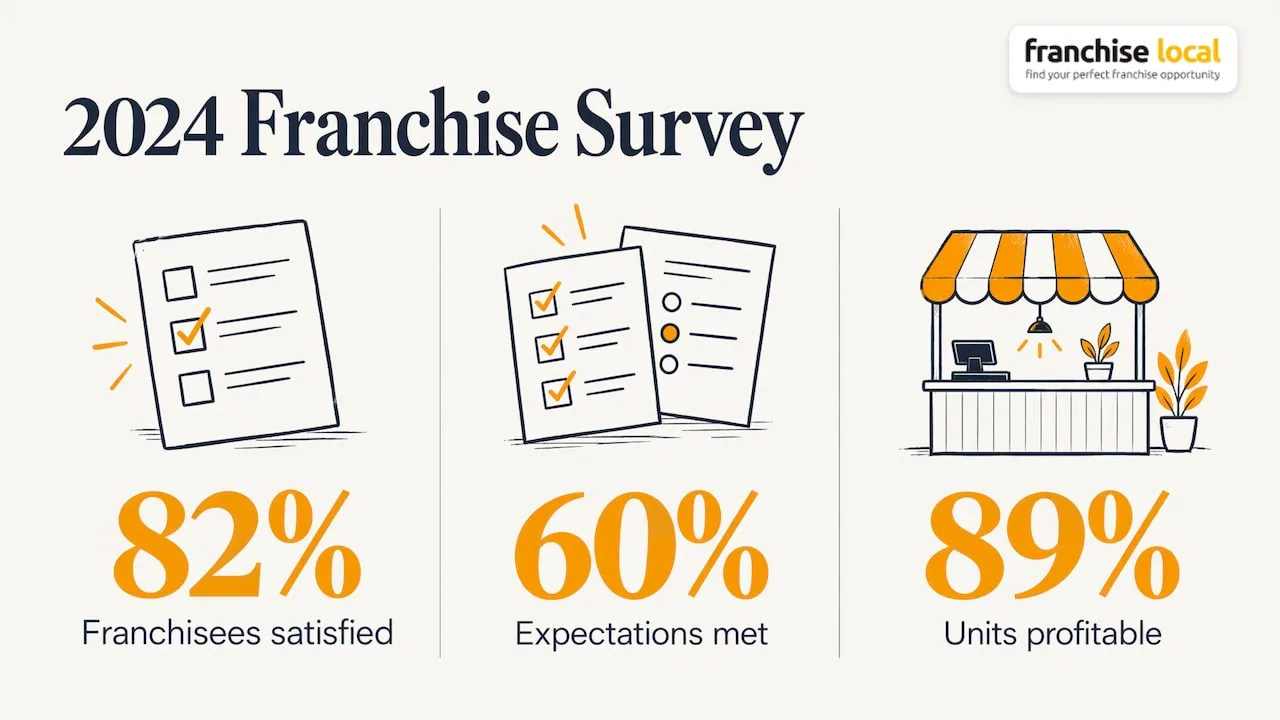
Take these as a picture of the sector, not a promise about any single brand. They show that satisfaction is generally high, and they also show that expectations are not always met. That gap is exactly why brand-level research matters.
Brand-level surveys and awards
Some networks commission independent satisfaction surveys, and some awards schemes invite franchisees to rate their franchisor in a confidential online survey. These can be valuable because every brand is measured on the same questions. A brand that takes part in independent research is usually comfortable being measured, and that is a positive sign worth noting on your shortlist.
Online reviews and forums
Online reviews give you colour and detail. A franchisee describing a difficult first six months, and how head office responded, tells you more than a score does. Read them for repeated themes rather than individual verdicts. If five different people mention the same strength, such as an excellent launch programme, it is probably real. The same applies to a recurring question.
How to read a franchisee satisfaction survey
Satisfaction surveys are the most structured form of franchise research, so they repay close reading. Check these points every time.
What the survey measures
A well-designed survey covers more than a single overall score. A typical framework looks at:
- training and support
- the franchise system itself
- culture and relationships
- leadership
- overall satisfaction
Look at the individual areas. A brand might score very well on leadership and less well on ongoing support. Which of those matters most depends on you. A first-time franchisee with no sector experience will lean heavily on training and support. A seasoned manager may care more about the system and the freedom to run it.
Response rate
A survey is only as representative as the share of the network that answered. Some satisfaction programmes set a minimum response rate of 60%, and smaller networks must also provide a minimum number of responses. That kind of threshold exists for a reason: if only a handful of happy franchisees reply, the result says little about everyone else.
When you see a score, look for how many franchisees took part and what proportion of the network that represents.
Confidentiality and independence
Many franchisees will not criticise head office if they think they could be identified. That is why surveys run by an independent provider, with confidential responses, tend to produce more candid results than a form sent out by the franchisor itself. The British Franchise Association describes its National Franchise Survey as an independent survey, combining an online questionnaire with further interviews with franchisors and franchisees.
So ask who ran the survey, whether responses were anonymous, and whether the full result or only highlights are shown.
It is a snapshot
A survey describes one moment. A network that scored modestly two years ago and has since changed its support model may look very different today. A network with a glowing score may have grown quickly since. Check the date, and look for brands that repeat the survey regularly, since a trend over several years is more informative than a single result.
Time in the network
A franchisee who has traded for two months has an early view, not a full one. Research that draws on people who have been trading for longer gives a better read on profitability, support over time and the renewal experience. When you speak to franchisees yourself, include both newer and established ones.
How to judge whether a review is reliable
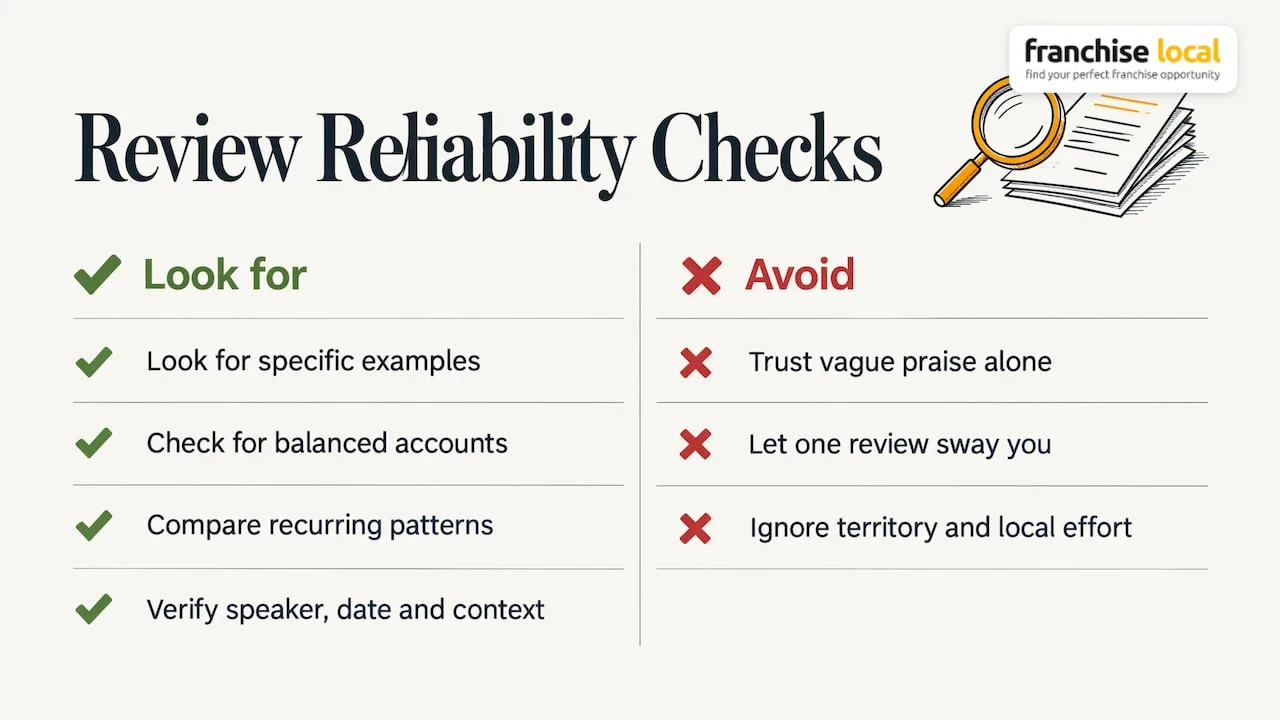
Reviews vary in quality, and a little scepticism protects your decision. This is about reading carefully, not about distrusting everything. Most reviews are honest. A few habits help you separate the useful from the unhelpful.
Look for specifics. “Great franchisor” tells you little. “Our area manager visited monthly in year one and helped us set up supplier accounts” tells you a lot.
Look for balance. A review that mentions a challenge and how it was resolved is often more credible than one that is entirely glowing.
Look for patterns, not outliers. One angry review or one rave review is a single data point. Ten reviews that say the same thing are a pattern. Cross-checking what you read online against direct conversations helps you avoid being swayed by a single outlier, and it helps you spot any positive reviews that look written to order.
Check who is speaking. Is this a current franchisee, a former one, or someone who never signed? Each has a different view and each is useful, provided you know which you are reading.
Check the date. A review from several years ago may describe a different franchise package, different leadership or a different market.
Check the context. Territory, local competition and the owner’s own effort all affect results. A franchisee who struggled in a crowded area may say little about how the brand performs in yours.
Build your own franchise research file
Working through a repeatable process keeps you from being led by the loudest review. Use these steps for each brand on your shortlist.
- Set your criteria first. Decide your budget, preferred hours, home-based or premises-based, industry experience and income target. The Franchise Affordability Calculator is a practical way to fix the budget before you start comparing.
- Collect the public research. Gather industry survey results, brand-level satisfaction scores, awards, accreditation details and online reviews. Note the date and source of each.
- Read the franchisor’s own information. Study the information pack, then look for evidence behind each claim. Official UK guidance advises that you should not rely only on the franchisor’s pack, and that you should ask questions and look for supporting evidence.
- Speak to franchisees. Aim for a sample that includes new and established owners, different locations and different levels of success.
- Test the numbers. Compare what franchisees tell you with the figures in the business plan, and have an accountant review the projections.
- Have the agreement reviewed. A solicitor with franchise experience should read the agreement before you sign.
- Score and decide. Rank your shortlist against the criteria you set in step one.
Our guide on how to research franchise opportunities in the UK covers the early stages in more depth, and the 30 day UK franchise background check plan gives you a schedule if you are balancing research with a job.
Speaking to current and former franchisees
Conversations are where reviews turn into evidence. Franchisors usually provide a list of franchisees to contact. That is a good starting point, and you can widen it by asking each person you speak to who else you should call.
Who to speak to
- Recent joiners. They remember the launch and can tell you how well training matched the reality.
- Established franchisees. They can speak about profitability, support over time and how the relationship with head office develops.
- Franchisees in different territories. This shows how the model performs across locations.
- Franchisees at different performance levels. Ask the franchisor to include owners who are doing well and those still building.
- Former franchisees, where you can find them. They can tell you why they left, whether that was a retirement, a sale or a problem with the model. Treat each account as one view and look for how it fits with the others.
What to ask
Keep questions open, specific and practical:
- What did the initial training cover, and how prepared did you feel at launch?
- How long did it take to reach break-even, and how did that compare with the projection you were given?
- How many hours do you work in a typical week?
- What support do you receive now, and how quickly does head office respond to problems?
- Which costs were higher than you expected?
- What would you do differently if you were starting again?
- Knowing what you know now, would you join this franchise again?
That last question is one of the most revealing. Pay attention to how quickly and how fully people answer it.
Our guides on questions to ask UK franchisees and questions to ask a franchisor before you sign give fuller lists. You can also read how real owners describe the experience in our franchisee interviews and hear from brands directly in our franchisor interviews.
How to compare what you hear
Write up each call straight afterwards. Record the same headline points every time: launch experience, time to break-even, weekly hours, quality of support, surprises and whether they would join again. After five or six calls, you will see the pattern. If the stories agree with the information pack, you have strong validation. If they differ, you have found exactly the questions to put to the franchisor.
Compare brands on the same criteria
A fair comparison needs the same yardstick for every brand. UK business guidance suggests comparing franchise opportunities on concept success, location, competition, market research, costs, training and support, and agreement terms. A simple scorecard keeps this consistent.
| Criterion | What to look for in reviews and research |
|---|---|
| Concept success | Number of UK franchisees, years in business, how the brand has grown |
| Franchisee satisfaction | Independent survey results, response rates, repeat surveys |
| Training and support | Franchisee comments on launch, field support and ongoing help |
| Financial performance | Franchisee accounts of turnover and break-even compared with the business plan |
| Costs | Initial fee, total start-up investment, ongoing fees and any extras |
| Competition and territory | Local competitors, exclusivity, how territories are defined |
| Agreement terms | Length, renewal, exit and resale conditions |
| Lifestyle fit | Hours, home-based or premises-based, ability to run alongside other work |
Score each from one to five and add brief notes explaining the score. The notes matter more than the total, because they remind you why you gave the score when you come back to it weeks later.
You can narrow the field before you start scoring by filtering by budget, lifestyle and sector in the UK franchise directory, or by browsing franchises by industry.
UK checks that sit alongside reviews
Reviews and research tell you how a franchise feels to its owners. Due diligence tells you whether the deal is sound for you. Do both.
- Financial checks. Ask an accountant to review the franchisor’s projections and your own funding plan. Our guide on how to assess franchise risk explains how to weigh the numbers.
- Legal checks. Have a solicitor experienced in franchising read the franchise agreement before you sign, and ask them about territory, term, renewal, restrictions and exit.
- Background checks. Look into the franchisor’s track record, how long it has operated and its leadership. See our overview of franchise due diligence in the UK and the six-step due diligence checklist.
- Training checks. Find out who you will meet during training and what you will learn. Our article on who you’ll meet at franchise training lists the questions worth asking.
Do not feel rushed. A reputable franchisor expects careful buyers and will give you time to complete your checks. Take that time, and make your decision when the evidence supports it.
Start your search with a shortlist
Good research starts with a focused list of brands that fit your budget and lifestyle. Franchise Local brings UK franchise opportunities together in one directory, where you can filter by industry, investment level, lifestyle and location. Browse the best UK franchise opportunities to see what is available, then use the steps in this guide to research each brand on your shortlist. Searching is free for individuals and entrepreneurs.
FAQ
Are franchise reviews reliable?
Many are, but each one is a single viewpoint. The most dependable picture comes from combining independent survey results, several online reviews that show the same themes and direct conversations with franchisees. Look at the date, the specifics and who wrote the review.
Where can I find research on UK franchises?
The British Franchise Association publishes its National Franchise Survey, which reports sector-wide satisfaction and profitability. For individual brands, look for independent satisfaction surveys, awards and accreditation, franchisee interviews and online reviews. Then speak to franchisees directly. Our guide on researching franchise opportunities sets out the full process.
How many franchisees should I speak to before investing?
There is no fixed number, but a sample of five or six, including new and established owners across different locations, usually shows a clear pattern. Keep going if the answers disagree with each other or with the information pack. Ask each person for a further contact.
What does a franchisee satisfaction survey measure?
A well-designed survey covers areas such as training and support, the franchise system, culture and relationships, leadership and overall satisfaction. Check the response rate, whether it was run independently and confidentially, and the date, because a survey is a snapshot of one moment.
Is a high satisfaction score enough to choose a franchise?
It is a positive sign and a good reason to add a brand to your shortlist. Combine it with your own checks on costs, territory, the agreement and the fit with your lifestyle. Have an accountant and a franchise solicitor review the details before you sign.