

For most UK franchisors, online leads should carry the day-to-day recruitment load, with exhibitions used selectively for brand presence. Online enquiries are cheaper to generate, easier to measure and available all year. Exhibitions give you face-to-face time, but they are costly and concentrated into a few days. A directory listing sits in the online camp and puts your brand in front of people who are already searching for a franchise to buy. Franchise Local is a UK franchise directory where franchisors list their brands and receive enquiries through direct enquiry forms.
This guide compares the two channels on cost, lead quality, measurement and follow-up. It uses the latest UK benchmark data, then shows how to combine them. It is written mainly for franchisors and brokers deciding where to put a recruitment budget. Prospective franchisees will also find a section on what each channel means for them.
The short answer: what the UK benchmark data says
The British Franchise Association (BFA) and WorkBuzz 2026 benchmark report is the most useful current evidence. It surveyed 95 franchisors and looked at recruitment over the previous 12 months, with comparisons to 2024 and 2025. Its main findings for this question:
- The franchisor’s own website was the top lead source, franchisee referrals came second and franchise portals third.
- Franchise Local was named among the top three portals.
- Average cost per lead fell to £63, from £75 in 2024.
- Leads rose 92.2%, from 345 to 663, while total marketing spend fell from £4.88m to £4.03m.
- The average cost of recruiting a franchisee rose from £5,000 to £8,900, with a median of £2,500.
- On average, franchisors recruited 7 franchisees, and the conversion rate was 1.1% in 2025, against 1.4% in 2024.
Two lessons follow. Online channels are generating more enquiries for less money per enquiry. But the cost of turning those enquiries into signed franchisees is rising, because enquiry volume and genuine commitment are not the same thing. The report argues that digital advertising is very good at creating interest and much weaker at filtering serious buyers. So the real comparison is not exhibitions against online leads on price per lead. It is how each channel feeds a recruitment process that qualifies, educates and supports a buyer through a decision that often involves their savings or a loan.
How each channel reaches prospective franchisees
Franchise exhibitions
A franchise exhibition gathers hundreds or thousands of would-be franchisees in one venue over a day or a weekend. A franchisor takes a stand, staffs it and talks to visitors. The visitor gets to meet many brands in one place and can judge the people behind a franchise in person. The organiser attracts the footfall, and the franchisor pays for the space, the build, the staff and the follow-up.
A 2022 industry benchmark reported in Franchise World Magazine found that nearly half of franchisors still relied on exhibitions and events. They were often used for brand awareness and trust, even though online leads were easier to measure. That matches how the channel is best used: as a place to be seen and to meet people, rather than a pure lead-count exercise.
Online lead generation
Online recruitment covers several routes:
- Your own website, supported by search and paid advertising.
- Paid social and search campaigns, which push people to a landing page or enquiry form.
- Franchise directories and portals, where buyers browse and filter listings and submit an enquiry to the brands that interest them.
- Referrals and content, including guides, email follow-up and nurture sequences.
The directory route is different from advertising in one important way. A visitor to a directory has already decided they want a franchise and is comparing brands by budget, industry, lifestyle and location. Franchise Local lets visitors filter by those criteria, and franchisors reach them through a paid listing or a featured placement. Enquiries arrive through direct enquiry form submissions, so each one is a named person who chose to ask about your brand. For how those forms work, see our guide to how franchise lead forms work.
Cost: what you actually pay
Cost is where the two channels differ most, but the numbers need careful reading.
Cost per lead
The BFA benchmark puts the average online cost per lead at £63 in 2026. Individual results vary a lot by channel, brand and investment level. Our own breakdown of UK franchise cost per lead benchmarks shows how widely figures spread, and why a headline average is a starting point rather than a target.
Exhibition costs
An exhibition has fixed costs before a single conversation takes place. They typically include:
- the stand space, which ranges from a basic shell scheme to a custom build;
- transport, installation and storage;
- graphics, furniture and screens;
- staff time, travel and accommodation;
- follow-up resources after the show.
For a national show, a total budget in the thousands of pounds is normal, and a large bespoke stand can reach five figures. Check the organiser’s current price list and package terms for the event you are considering, because rates change from year to year. The key difference from online is the risk profile. A stand fee is paid whether or not the visitors you meet are serious. Online enquiry costs scale up or down with activity, so you can pause when your pipeline is full.
A worked example
The figures below are illustrative, not benchmarks, and show how to compare the channels fairly. Suppose a franchisor spends £12,000 in total on an exhibition and collects 80 contact details. That is £150 per lead. Now suppose £3,000 of online spend produces 48 enquiries at about £63 each. The online leads look more than twice as cheap. But cost per lead is only the first number. If the exhibition leads have already met the team and 6 reach a franchise discovery day, while 4 of the online leads do, the cost per discovery day is £2,000 for the exhibition and £750 online. The online channel still wins on cost, though the exhibition leads may close at a higher rate. Only your own records over several months will show whether that holds.
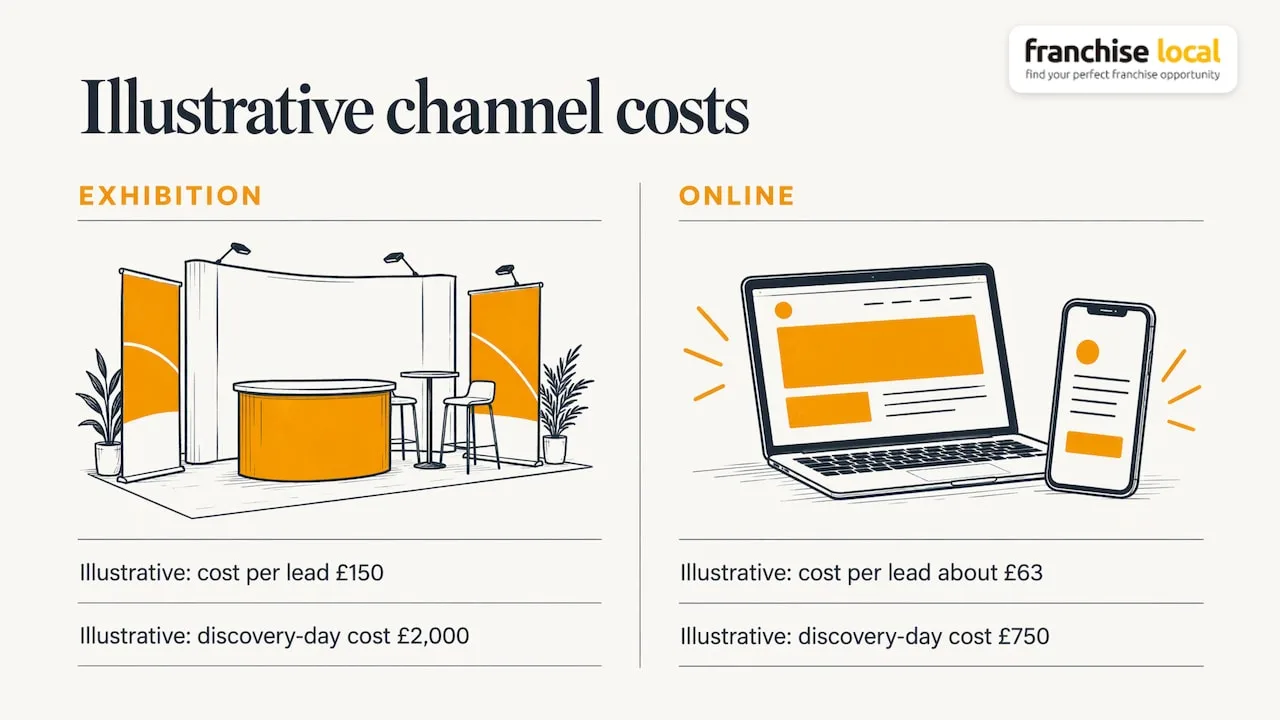
The lesson is to compare cost per qualified lead, cost per discovery day and cost per signed franchisee, never cost per lead alone. That is also why the benchmark’s rising £8,900 average recruitment cost matters more than its falling cost per lead.
Lead quality: volume versus commitment
The 2022 benchmark reported by Franchise World found that franchisors generated an average of 318 recruitment leads in 2021, that 9 in 10 were ruled out at the start, and that 1.3% eventually invested. That is roughly one franchisee for every hundred enquiries. The 2026 BFA data follows the same pattern: 663 leads and a 1.1% conversion rate.
Neither channel escapes this funnel. Whatever the source, most enquiries are not ready to buy. They may lack the capital, be exploring several options, or be at a very early stage of thinking about self-employment. What changes is the type of lead:
| Factor | Exhibitions | Online leads |
|---|---|---|
| Timing | A few days a year | All year round |
| First contact | Face to face, unscripted | Form, call or email |
| Volume | Limited by the venue and the footfall | Scales with budget and visibility |
| Measurement | Harder: conversations, cards, notes | Easy: source, cost and stage tracked in a CRM |
| Typical strength | Brand trust, meeting the team | Reach, speed, cost control |
| Typical weakness | Fixed high costs, travel, staff time | Many low-intent enquiries |
| Best for | Brand awareness and relationship building | Steady pipeline and targeted recruitment |
The weakness in the online column is the one you can do most about. Intent is the difference between a casual click and a serious enquiry. A visitor browsing a directory filtered by budget and sector has already narrowed the field, which is why a listing in front of the right audience reaches people at the stage where they compare brands. Franchise Local filters by industry, price, lifestyle and location. A franchisor with a home-based model under a set investment level can appear to the people searching for exactly that. Our guide to franchise lead qualification strategies shows how to sort enquiries by budget, timeline and fit before you spend time on calls.
Measurement and return on investment
Online channels make measurement far simpler, and the 2022 benchmark coverage noted this as a reason franchisors favour them. Every enquiry can carry a source tag, a date and a stage in your pipeline. Over a quarter you can see how many enquiries from each source reached a call, a discovery day and a signed agreement.
Exhibitions need more discipline. Before the show:
- Decide what success looks like: number of qualified conversations, discovery days booked, or franchisees signed within a set period.
- Agree a qualification routine so staff ask the same questions of every visitor: budget, location, timing, experience, and who else is involved in the decision.
- Prepare the follow-up before you arrive. Emails, calls and discovery day invitations should be ready to send the day after the show.
- Record each lead against the event in the same CRM as your online enquiries.
That last step is what makes a fair comparison possible. Without it, exhibition leads sit in a box of business cards while online leads sit in a dashboard, and the dashboard always looks better. For a model of how to connect sources to a pipeline, see our UK franchise sales funnel guide.
Track three ratios for each channel across at least six months:
- Enquiry to qualified lead. What share meets your minimum investment and location criteria?
- Qualified lead to discovery day. How many accept an invitation to see the business?
- Discovery day to signed franchisee. This is where the final cost per recruit is decided.
Then divide the total channel spend by the number of signed franchisees. That figure, not cost per lead, tells you which channel earns its budget. Allow for the long sales cycle: a franchise decision can take months, so judge a channel on leads from six to twelve months ago, not last week.
Follow-up decides both channels
The benchmark’s message is that the recruitment journey matters more than the number of enquiries. Qualification, education, relationship building and decision support are what move a 1% conversion rate upward. That applies equally to an exhibition card and a web form.
Some practical rules:
- Respond fast. An enquiry from a directory is a person comparing several brands. The first brand to reply with something useful has an advantage.
- Educate before you sell. Send clear information on investment, support, training and what a typical week looks like. Our guide to franchise lead nurturing covers the sequence.
- Qualify early and kindly. A prospect who cannot fund the investment should hear so early, and be pointed to a better-fitting option in your range if you have one.
- Keep one record. Every contact from every source should sit in the same system with the same stages.
For the whole process from first enquiry to signing, the franchise recruitment guide sets out the steps in order.
Why a directory listing earns the first slot in your plan
Put together, the evidence points to a clear order of priority:
- Your own website and a directory listing form the base. The benchmark places the franchisor’s website first and franchise portals third as lead sources, and both work all year round.
- Referrals from existing franchisees come second in the benchmark and are worth building into your support programme.
- Paid advertising adds volume when you need to fill territories quickly, as long as you have the capacity to qualify what arrives.
- Exhibitions come in as a planned, limited investment for awareness, for meeting prospects in person, and for launching in a new region.
There are three reasons a directory leads this list. First, you reach people who are already searching, instead of interrupting people who are not. Second, enquiries arrive as named form submissions you can respond to immediately and record by source. Third, the commitment is flexible: you pay for a listing or featured placement rather than a stand, travel and a team away from the business for several days.
For franchisors who also run paid search, the same logic applies to quality. Our guide to Google Ads franchise leads that close explains how to steer campaigns towards buyers who can actually invest. And our piece on why 663 leads still need qualification explains why more volume is only useful when it is sorted.
How to combine the two in a UK plan
A practical approach for a franchisor recruiting across the UK:
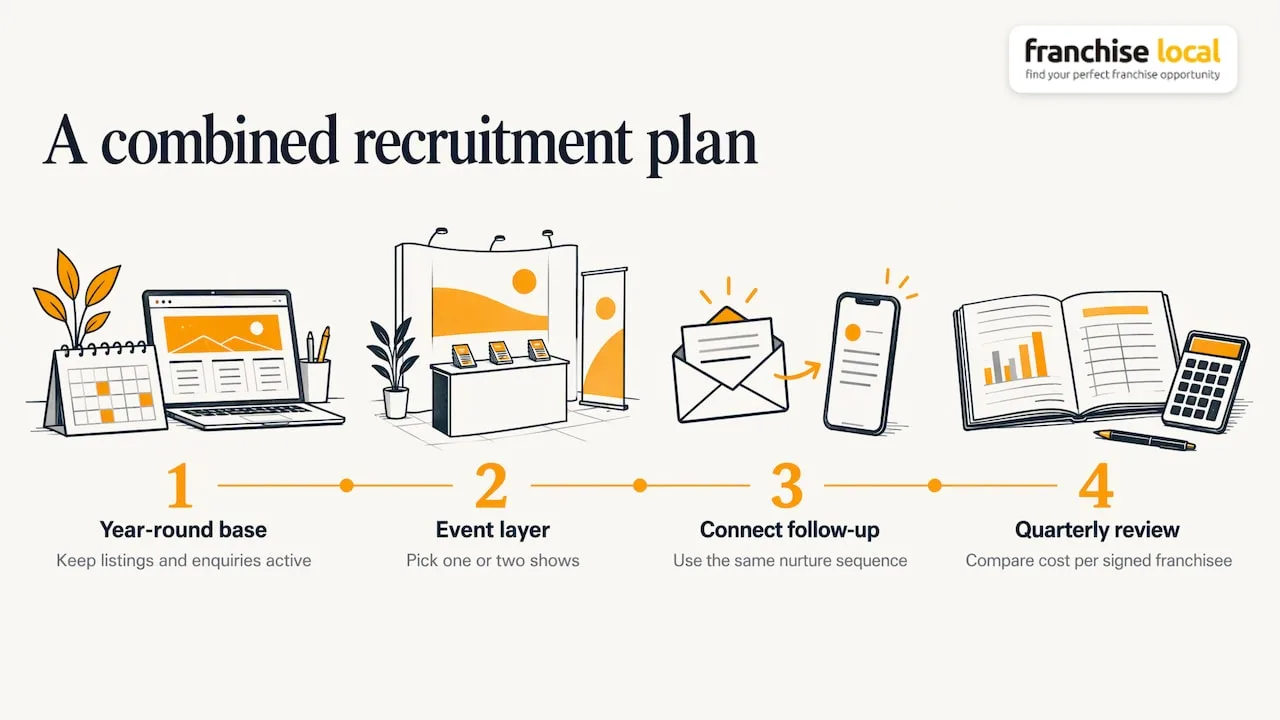
Year-round layer. Keep your listing, website content and enquiry handling running continuously. Use featured placement when you are actively seeking franchisees in specific territories or at a specific price point.
Event layer. Pick one or two exhibitions that match your investment level and target buyer, rather than attending everything. A regional show may suit a lower-cost, local model. A national show may suit a higher investment brand wanting a wide audience. Use the show to meet people who have already seen your listing and to invite them to a discovery day.
Join them up. Mention the show in your directory profile and emails beforehand. After the event, send every contact into the same nurture sequence as your online enquiries. A prospect who has met your team and read your material is much more likely to take a call.
Review every quarter. Look at cost per signed franchisee by source. If exhibition-sourced franchisees consistently cost more than online ones, cut back. If they sign faster or stay longer, give the channel more weight.
A caution on the benchmark itself: its authors note that its figures may be slightly optimistic, since franchisors with poor recruitment results were reluctant to take part. Treat the averages as a guide and your own numbers as the answer.
What this means if you are buying a franchise
If you are a prospective franchisee, the channel you meet a brand through changes how you research it. At an exhibition you can meet many brands in a day, but time on each stand is short and the setting encourages quick decisions. Online, you can compare franchises by budget, industry and lifestyle at your own pace, then contact the ones that fit.
On Franchise Local you can filter listings by those criteria and browse the trending franchise opportunities. Using the directory costs buyers nothing. Our ultimate guide to franchising covers the questions to ask, the costs to expect and the support you should look for before you commit. Whichever route you take, take your time and speak to existing franchisees before signing.
List your franchise where buyers are searching
Franchise Local is a UK franchise directory that categorises opportunities by industry, investment level, lifestyle and location. Franchisors and brokers can list their brands through paid listings and featured placements and receive enquiries from people searching for a franchise. If you are weighing an exhibition against an online approach, a listing gives you an always-on channel to build your plan around. Visit Franchise Local to see how listings work and to start the conversation.
FAQ
Are franchise exhibitions still worth it in the UK?
They can be, as part of a wider plan. Nearly half of franchisors in the 2022 benchmark coverage still used exhibitions and events, often for awareness and trust. They work best when you set targets, qualify visitors consistently and have follow-up ready before the show.
Which gives better quality franchise leads, exhibitions or online?
Neither wins automatically. Exhibition contacts have met your team, but volumes are limited. Online enquiries are more plentiful and cheaper, but many are early stage. Qualifying every lead on budget, location and timing matters more than the source.
How much does a franchise lead cost online?
The BFA and WorkBuzz 2026 benchmark found an average cost per lead of £63, down from £75 in 2024. Your own figure depends on channel, investment level and territory. Track cost per signed franchisee as well, since the same report puts the average cost of recruiting one at £8,900.
How many enquiries become franchisees?
Very few. The 2026 BFA benchmark reports a 1.1% conversion rate from 663 leads, and the 2022 benchmark found about 1 in 100. This is normal, and it is why qualification and nurturing deserve as much attention as lead generation.