

In a UK franchise, the franchisee is normally the employer and is responsible for paying staff at least the National Minimum Wage or National Living Wage. The franchisor, the brand behind the business, usually has no employment duties towards your team. From 1 April 2026 the National Living Wage for workers aged 21 and over is £12.71 an hour. Wage costs are therefore a fixed starting point for your budget, and you can plan them before you sign anything.
This guide covers the rates, who is liable, how the rules apply to you as an owner, what counts towards pay, and what happens if a business gets it wrong. It is written for people buying a franchise, owners expanding through franchising, advisers and franchisors.
The rates from 1 April 2026
The government sets the National Minimum Wage and National Living Wage rates each year, and they change every April. The rates in force from 1 April 2026 are:
| Worker | Hourly rate from 1 April 2026 | Rate from 1 April 2027 |
|---|---|---|
| Aged 21 and over (National Living Wage) | £12.71 | £13.21 |
| Aged 18 to 20 | £10.85 | £11.27 |
| Under 18 | £8.00 | £8.31 |
| Apprentice (under 19, or 19 and over in the first year) | £8.00 | £8.31 |
The rates for the year before, up to 31 March 2026, were £12.21 for those aged 21 and over, £10.00 for 18 to 20 year olds, and £7.55 for under 18s and apprentices. The 21 and over band is called the National Living Wage. It started in 2016 for workers aged 25 and over, then extended to 23 and over in 2021, and covered everyone aged 21 and over from 1 April 2024.
Two points catch new owners out:
- Age bands depend on the worker’s age on the day, so rates change with birthdays. A 20-year-old who turns 21 moves to the higher rate from their birthday, and your payroll needs to reflect that.
- Apprentices have their own rule. An apprentice is on the apprentice rate if they are under 19, or 19 or over and in the first year of the apprenticeship. After the first year they move to the rate for their age. A 21-year-old apprentice who has finished their first year is owed the full £12.71.
The government’s own rates page is the one to check for the live figures each April, because the rates above will be replaced on a set schedule.
Who pays: the franchisee is the employer
A franchise is a licence to run a business under another company’s brand and system. You pay for that licence, and you run the operation as your own company. If you take on staff, you hire them, you sign their contracts and you run their payroll. That makes you the legal employer, and minimum wage compliance is yours.
This is widely understood in the sector. Franchised businesses employ more than 615,000 people in the UK, and the customer may assume that the big name on the shopfront is the employer. In law, the franchisor does not normally employ your staff, so it is not the party that pays them.
The Employment Appeal Tribunal looked at the question in a case about a Papa John’s pizza franchise in Norwich (Aftala Norfolk Ltd, 2019). A worker had been paid below the minimum wage and had been moved between two franchise sites. The award for unpaid minimum wage was £478.36. The tribunal held that two separately owned franchisees were not jointly liable, because the evidence pointed to only one of them being the employer. The lesson for you is simple: each franchisee company is its own legal employer, with its own payroll duties.
If you are comparing opportunities, our guides to the franchisee role in the UK and what UK franchisees must know set out the wider duties that come with ownership.
When a franchisor could share the liability
There is a narrow exception. A franchisor can become liable as a joint employer if it exercises real control over your workforce. The kinds of control that point that way include:
- deciding who is hired or dismissed
- setting the specific wage rates workers receive
- controlling work schedules
- managing workers directly
In that situation the franchisor could be exposed to claims for minimum wage, holiday pay, unfair dismissal, discrimination and pension auto-enrolment. A well-run network avoids this by keeping brand standards (how the product is made, how the shop looks, how customers are treated) separate from employment decisions, which stay with the franchisee.
For franchisors listing a brand, this is the reason operations manuals should recommend standards without dictating pay or rotas. For franchisees, it is a reminder that day-to-day staffing decisions are yours, and so is the responsibility. Our article on avoiding joint liability covers how networks draw that line.
Does the minimum wage apply to you as the owner?
Many buyers ask whether they must pay themselves the minimum wage. The answer turns on status.
The minimum wage applies to a “worker”, meaning someone working under a contract of employment or a contract to perform work personally. It does not apply to someone who is genuinely self-employed and running their own business. Status is decided on the real situation, not on the label in a contract. A contract that says “self-employed” does not settle it.
For a franchise owner who runs the business through a limited company or as a sole trader, the practical position is as follows:
- As a sole trader, you are self-employed. Your income is the profit left after costs, and there is no minimum wage to pay yourself.
- As a director of your own company, company directors are not entitled to the minimum wage in that role. Many owners pay themselves a mix of salary and dividends. Your accountant can advise on the best split for your tax position.
- If you also work as an employee in your own company, take advice on how your pay is structured.
The point that matters most for budgeting: the minimum wage is owed to your team, and your own earnings come from what the business makes after wages, royalties and other costs. That is why the wage bill belongs in your forecast from the first day.
The same status test applies to anyone you bring in. Casual, zero-hours, agency, probationary and commission-based staff are all entitled to the minimum wage. So are workers in small or start-up businesses. Volunteers, company directors, the armed forces, work-experience students and people under school leaving age are not. Calling someone self-employed does not remove the duty if they are in fact a worker.
What counts towards minimum wage pay
The check is not as simple as comparing a rate on a payslip with the table above. Pay is averaged over a pay reference period, normally a month or a shorter period if you pay more often. The calculation looks at total pay against total hours.
What is included in pay
- basic pay
- commission and bonuses
- gratuities paid through payroll
What is left out
- overtime and shift premiums
- unsocial-hours allowances and London weighting
- stand-by payments
- tips paid directly by customers
What counts as working hours
- time spent on business travel
- on-call time at or near the workplace
- employer-approved training at the worker’s normal place of work, during hours when they would otherwise be working
Rest breaks and absences do not count as hours worked. Government guidance on labour supply chains also stresses that workers should be paid for actual working time, not only the scheduled shift. Early arrival, end-of-shift security checks and similar tasks can add unrecorded minutes that push pay below the line.
Deductions
Deductions from pay must not take a worker below the minimum wage. This matters in franchising because uniforms, branded kit, till shortages and training costs are common items to deduct. Before you take any money out of wages for these, check the effect on the hourly average.
Citizens Advice flags travel time, unpaid training, on-call time and accommodation deductions as the areas where the rules are most likely to trip up an employer. If your franchise involves mobile work, split shifts or early starts, build those hours into your timekeeping from day one.
Budgeting wages before you buy
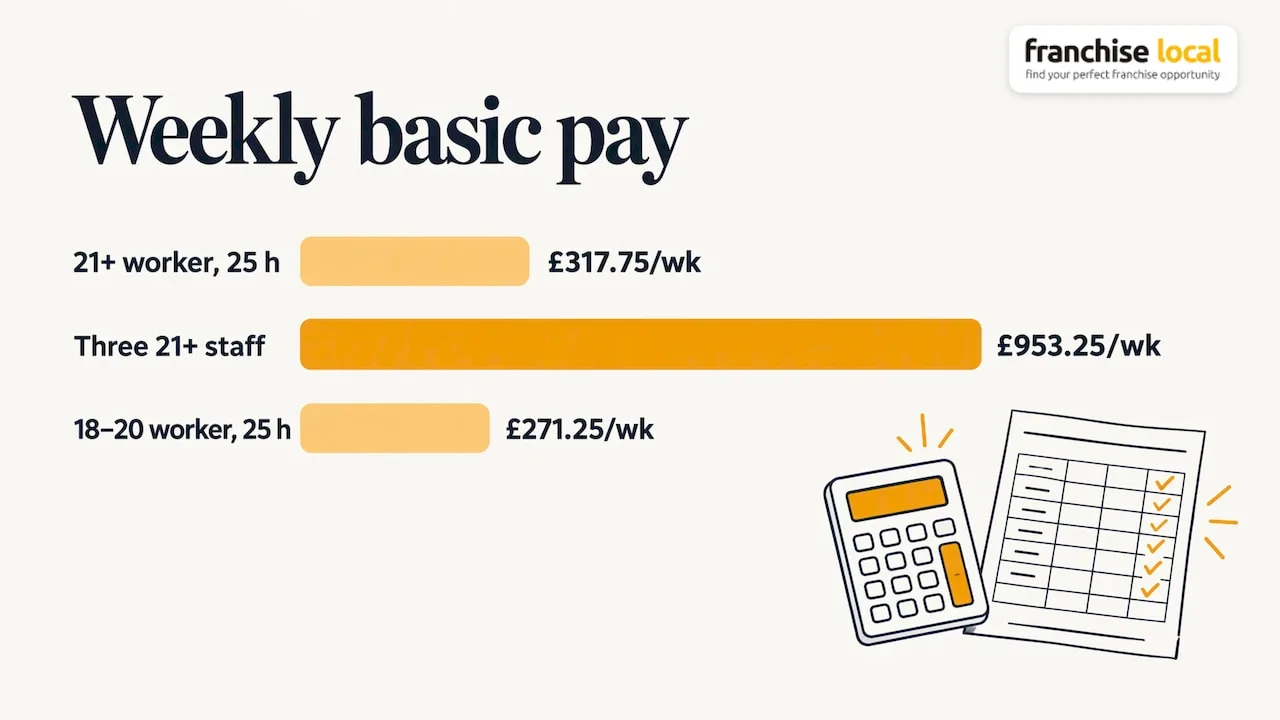
Wage cost is one of the largest running costs in a franchise with a team, and the hourly rate is only the starting point. A worked example shows the scale.
Suppose you plan to employ three staff aged 21 or over, each working 25 hours a week:
- 25 hours at £12.71 is £317.75 a week per person.
- Three people cost £953.25 a week.
- Over 52 weeks that is £49,569 a year in basic pay.
That figure leaves out employer National Insurance, workplace pension contributions, holiday pay and any bonus or commission. Build those on top. If you employ 18 to 20 year olds, the hourly rate is £10.85, so 25 hours costs £271.25 a week for each person.
Two habits help when you plan:
- Budget at the next rate, not just this one. The rate for workers aged 21 and over rises to £13.21 on 1 April 2027, and the rate will change again each April after that. A plan that works at £12.71 should still work at £13.21.
- Ask each franchisor for a typical staffing model. Established networks usually know how many hours a unit needs and how that changes with trading levels. Ask how many staff a typical unit has, and the hours they work, then price that against the rates above.
The quickest way to cut staffing risk is to choose a model that matches your appetite. Owner-operated and home-based franchises often need little or no payroll in the early stages, while retail, food and care models rely on a team. Franchise Local lets you filter opportunities by lifestyle, budget and location, so you can narrow your list to models whose labour needs suit you.
Records, checks and penalties
As the employer, you must keep records that show each worker was paid at least the minimum wage for every pay reference period. Keep pay records for three years. HMRC compliance officers can inspect your records without giving a reason.
If HMRC finds underpayment, you must repay the arrears, calculated at the current rate for the worker’s age band. HMRC can then issue a notice of underpayment with a penalty of 200% of the shortfall, with a minimum of £100 and a maximum of £20,000 per worker. The penalty is halved if you pay within 14 days. Serious or repeated non-compliance can lead to criminal proceedings.
Workers have options of their own. A worker who has been paid too little can complain to HMRC or bring a claim to an employment tribunal, but not both for the same issue. A tribunal claim for unpaid minimum wage can recover money owed going back two years.
A simple monthly routine keeps you safe:
- Calculate each worker’s total pay and total hours for the pay period.
- Divide pay by hours and compare with the rate for their age band that month.
- Check any deductions for uniform, equipment or shortages against that result.
- Re-check when someone has a birthday that moves them into a higher band, or when an apprentice finishes their first year.
- Review all pay every April when new rates start.
For pay and payroll questions specific to your situation, a qualified accountant or employment solicitor is the right person to ask. The same applies to employment contracts and to anything that touches pension auto-enrolment.
What has changed recently
The main changes for franchised employers in the last two years are the rates themselves and the enforcement landscape.
- April 2024: the National Living Wage extended to everyone aged 21 and over, which raised the cost of staff in their early 20s.
- April 2026: every band rose, with the 21 and over rate going from £12.21 to £12.71, the 18 to 20 rate from £10.00 to £10.85, and the under 18 and apprentice rate from £7.55 to £8.00.
- Enforcement: the government’s plan is for a new Fair Work Agency to bring minimum wage enforcement together with other workers’ rights, with wider civil penalties, inspection powers and the ability to bring tribunal cases on behalf of workers. Check the official pages for the date it takes effect and its detailed powers.
The direction of travel is towards more proactive enforcement. For a franchise owner with good records and a monthly check, that is an advantage: it rewards businesses that run payroll properly.
What franchisors should take from this
If you are a franchisor, or considering franchising your business, the minimum wage has two practical effects.
First, it shapes the unit economics you show to candidates. Prospective franchisees will test your forecast against the current rates and the next scheduled rise. A staffing model that is realistic at £12.71 and still sound at £13.21 is more credible.
Second, it affects how you write your manual and support. Keep guidance on pay to what the law requires, and leave hiring, firing, pay rates and rotas with the franchisee so that you do not drift towards joint-employer risk. Our franchise compliance checklist for UK franchisors and guide to essential steps for franchise legal compliance cover the wider framework, and the franchise legal requirements guide sets out what matters most.
Find a franchise whose staffing fits your plan
Franchise Local is a UK franchise directory where you can filter opportunities by industry, investment level, lifestyle and location. It costs nothing to search. If wage costs are a concern, start with the models that suit the way you want to work, such as home-based opportunities, and compare each brand’s setup costs against your budget. Our Ultimate Guide to Franchising walks through the buying process, and the Franchise Planning Toolkit helps you build your numbers, including a staffing line, before you speak to a franchisor.
FAQ
Does the franchisor pay the minimum wage to my staff?
No. As the franchisee you are normally the legal employer, so you pay your staff and run the payroll. A franchisor only takes on employer duties if it takes control of hiring, pay or rotas, which a well-structured network avoids.
What is the minimum wage for a franchise employee in 2026?
From 1 April 2026 the rates are £12.71 an hour for workers aged 21 and over, £10.85 for ages 18 to 20, and £8.00 for under 18s and apprentices in their first year. The rates change each April, with scheduled rises to £13.21, £11.27 and £8.31 from 1 April 2027.
Do I have to pay myself the minimum wage as a franchise owner?
Not as a self-employed owner running your own business. Company directors are also outside the minimum wage in that role. Your income comes from the profit left after wages, royalties and other costs, so ask your accountant how to structure your own pay.
What happens if I underpay a member of staff?
You must repay the arrears at the current rate for their age band. HMRC can also add a penalty of 200% of the shortfall, between £100 and £20,000 per worker, halved if you pay within 14 days. Keep three years of pay records so you can show your calculations.