

Bold ambitions often start with a search for stability and long-term growth rather than quick wins. For aspiring franchise owners in the UK, the appeal of B2B franchise opportunities lies in their ability to build revenue through lasting business relationships with corporate clients. Unlike retail franchises, B2B models focus on supplying services or products to other businesses, offering a path built on expertise, negotiation, and measurable value rather than foot traffic. This introduction breaks down how these opportunities work and why they promise both predictability and professional fulfilment for entrepreneurial first-time investors.
What Are B2B Franchise Opportunities?
B2B franchise opportunities represent a fundamentally different investment model from the retail franchises most people recognise. Rather than serving consumers directly, B2B franchises operate by selling products or services to other businesses. Think of it this way: whilst a coffee shop franchise serves individual customers, a B2B franchise might supply that coffee shop with accounting software, cleaning services, or marketing support. You’re building a business that generates revenue from corporate clients rather than footfall and walk-in customers.
The core distinction lies in your customer base and sales approach. In a B2B franchise, your revenue comes from securing contracts with other companies, negotiating service agreements, and maintaining long-term business relationships. This means your daily work involves connecting with business decision-makers, understanding their operational challenges, and demonstrating measurable value. For instance, if you own a B2B franchise providing staffing solutions to manufacturing plants, you’re not serving individual job seekers but rather helping factories solve their labour shortages. The relationships you build tend to be deeper and longer-lasting than retail transactions, often spanning years or even decades once a contract is established. Understanding franchising fundamentals gives you the foundational knowledge needed to evaluate whether B2B or other franchise models suit your business objectives.

What makes B2B franchises particularly attractive to first-time franchise investors is the revenue potential and business stability they offer. Because you’re selling solutions that directly impact a business’s bottom line, your clients are typically willing to pay premium prices. A company will invest significantly in software that saves them 50 hours of administrative work per month. They’ll commit to long-term contracts because switching providers disrupts their operations. This contrasts with retail customers who can walk away from a purchase on a whim. Additionally, B2B franchises often require lower initial overheads than retail operations. Many operate from office-based locations rather than premium high street sites, meaning your property costs remain manageable. You’re competing on expertise and relationships rather than location appeal, which reduces your dependency on foot traffic or prime retail real estate.
The franchise model itself provides structure and support that matters when you’re building B2B client relationships. Your franchisor supplies proven sales techniques, operational systems, marketing materials, and access to established supplier networks. Instead of reinventing the wheel, you inherit a tested business formula that’s already working elsewhere. You benefit from the brand recognition the franchisor has built, which carries weight when approaching potential business clients. Many B2B franchisors also provide ongoing training on industry-specific knowledge, helping you understand the technical aspects of what you’re selling. This structured support accelerates your learning curve significantly compared to starting an independent B2B business from scratch.
However, success in B2B franchises demands a different mindset than retail ownership. You need comfort with sales processes that take weeks or months to close. You must build genuine professional relationships and demonstrate expertise. Your success depends on your ability to identify which businesses actually need your services and persuade their decision-makers to choose you over competitors. This requires patience, communication skills, and resilience when facing rejection. Unlike a retail franchise where customers visit your premises daily, a B2B franchise requires you to actively pursue business opportunities continuously.
Pro tip: Before committing to a B2B franchise, spend time understanding the sales cycle for that specific industry, as some contracts take three months to secure whilst others close within two weeks. Request references from existing franchisees and ask specifically about their average sales process length and typical contract values.
Main Types of B2B Franchises in the UK
The UK B2B franchise market spans diverse sectors, each serving specific business needs. Understanding the main categories helps you identify where your expertise and interests align. The landscape is far broader than most people realise, extending well beyond what you see in typical high street locations.
Service-based B2B franchises form one of the largest segments. These businesses solve operational problems for other companies. Cleaning services represent a prime example, where franchisees contract with corporate offices, hospitals, and manufacturing facilities to maintain their facilities. Similarly, payroll processing franchises handle employee compensation for small to medium-sized enterprises that lack in-house HR departments. Recruitment and staffing franchises connect businesses with temporary or permanent employees, earning commission or fees from both parties. You might also find business consulting franchises that advise companies on marketing, financial management, or operational efficiency. These services generate recurring revenue because businesses need continuous support, not just one-off transactions.
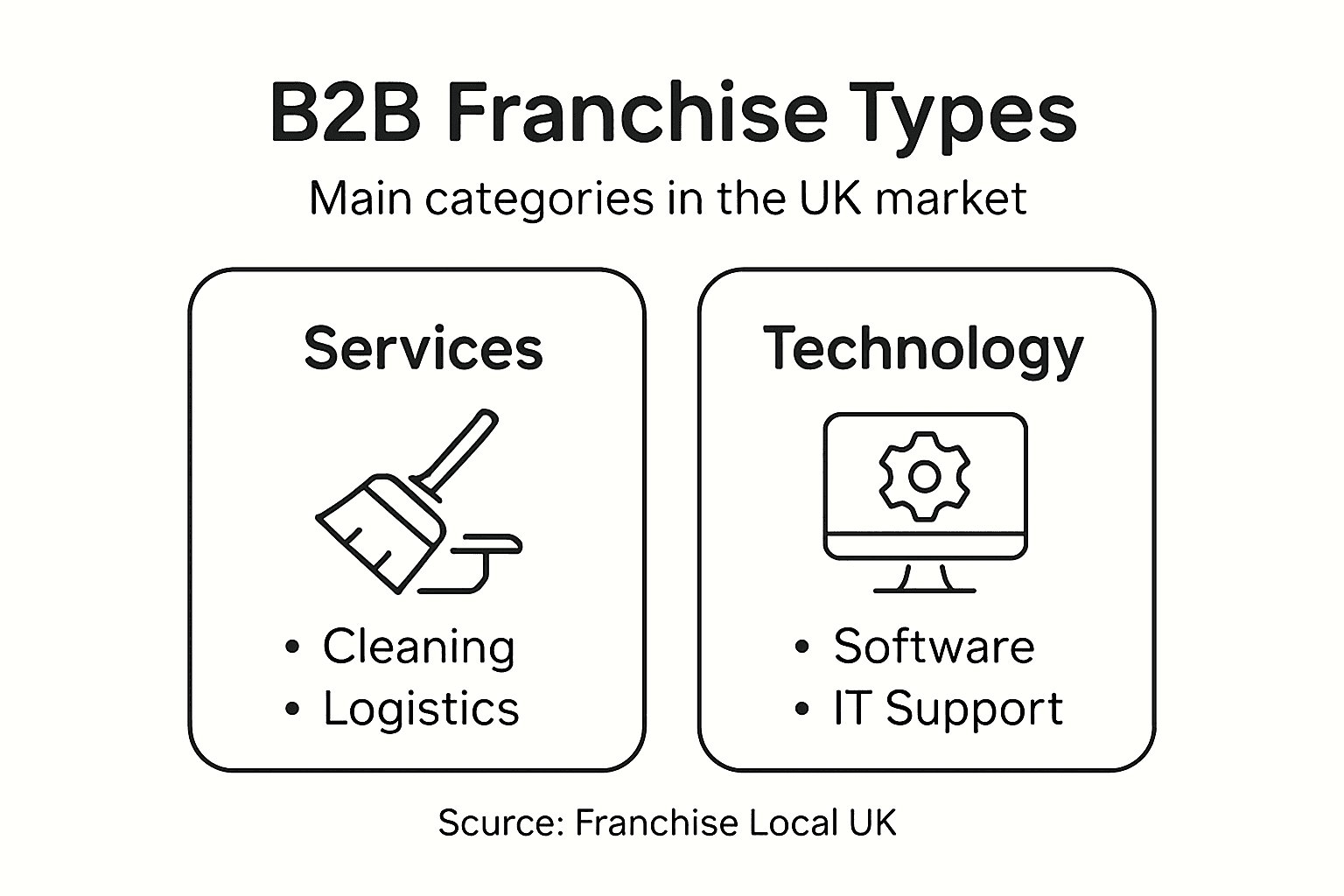
Technology and software B2B franchises represent another significant category. Rather than building software from scratch, franchisees licence established platforms and sell them to businesses requiring specific solutions. Accounting software franchises, for instance, target small business owners struggling with financial management. Cloud-based storage solutions, project management platforms, and cybersecurity tools all operate under franchise models in the UK. The advantage here is clear: you’re not inventing the product, you’re connecting it with buyers. Your role involves identifying which businesses need the solution and demonstrating its return on investment. What makes the franchise model valuable becomes particularly evident in technology franchises, where the franchisor handles development whilst you focus entirely on sales and client relationships.
Specialist trade and industrial franchises cater to manufacturing, construction, and maintenance sectors. These might include equipment rental services, industrial waste management, specialist training programmes, or quality assurance auditing. A franchise providing factory maintenance solutions, for example, would negotiate contracts with manufacturing plants to handle everything from machinery servicing to compliance inspections. Printing and copying services for corporate clients also fall into this category. These franchises typically require deeper technical knowledge but reward you with substantial contract values and long client retention.
Financial and professional services B2B franchises are particularly popular among UK investors. Tax advisory franchises, bookkeeping services, and business insurance broker franchises all operate on B2B models. You’re providing expertise that businesses require by law or by necessity. The professional nature of these services commands premium pricing because the cost of getting it wrong is substantial for your clients. A business cannot simply ignore tax obligations, making these services non-negotiable expenses.
Marketing and advertising franchises help other businesses reach their customers. This includes digital marketing agencies, search engine optimisation services, social media management, and graphic design studios operating under franchise agreements. These franchises thrive because most small businesses lack in-house marketing expertise but recognise they need professional support to compete.
The common thread across all these types is predictability. B2B clients commit to recurring contracts, creating stable revenue streams. Unlike retail where a customer makes a one-off purchase, your B2B clients return monthly, quarterly, or annually. This stability attracts first-time franchise investors who want to reduce business risk. Additionally, many B2B franchises can operate from office or home-based settings, eliminating the need for expensive retail premises that consume capital and carry high overhead costs.
When evaluating which B2B franchise type suits you, consider your existing professional network and industry experience. Your credibility in a sector accelerates client acquisition significantly. Someone with ten years in human resources will find recruitment franchising more accessible than someone entering that field completely cold. Similarly, your comfort with technology or preference for face-to-face relationship building should guide your choice. Some B2B franchises operate almost entirely through phone and email, whilst others require regular on-site visits to client premises.
Here is an overview of the main B2B franchise categories and the typical clients they serve:
| Franchise Type | Example Clients | Typical Services Provided |
|---|---|---|
| Service-based | Offices, hospitals, factories | Cleaning, payroll, recruitment |
| Technology & software | Small businesses, retailers | Cloud platforms, accounting tools |
| Trade & industrial | Manufacturers, construction firms | Equipment hire, compliance audits |
| Financial & professional | SMEs, professionals | Tax advice, bookkeeping, insurance |
| Marketing & advertising | Local businesses, SMEs | Digital marketing, SEO, graphic design |
Pro tip: Choose a B2B franchise category where you already possess relevant industry knowledge or professional connections, as this dramatically reduces your learning curve and accelerates your ability to win your first clients.
How the B2B Franchise Model Works
The B2B franchise model operates on a straightforward principle of partnership. A franchisor, who has developed a successful business system, partners with franchisees to expand that system across different regions or market segments. Franchising is a mutually beneficial business model where the franchisor licences its brand, technology, and business methodology to franchisees in exchange for fees and ongoing royalties. The franchisor provides marketing support, training, and operational guidance, whilst franchisees invest their own capital and manage day-to-day operations locally. This arrangement allows the franchisor to expand rapidly without carrying the full capital burden, whilst you gain access to an established, proven business system rather than building from scratch.
Here is how the financial relationship typically functions. When you sign a franchise agreement, you pay an initial franchise fee to the franchisor, usually ranging from £5,000 to £50,000 depending on the sector and brand strength. This fee grants you the right to operate under their brand name and use their systems. Beyond this, you pay ongoing royalties, typically calculated as a percentage of your revenue, usually between 5 and 15 percent. Some franchisors also charge marketing contribution fees to fund brand-wide promotional campaigns. In return, you receive ongoing support including staff training, marketing materials, operational manuals, and regular guidance from their support team. You handle all the work of securing clients, delivering services, and managing your specific territory. The franchisor focuses on developing new systems, marketing the brand nationally, and supporting franchisees across their network. This separation of responsibilities creates efficiency: you become a specialist in client relationships and local operations, whilst the franchisor becomes a specialist in innovation and brand development.
The real power of the B2B franchise model emerges through access to proven systems and established operational frameworks. Rather than spending months or years developing your own sales processes, client management systems, and operational procedures, you inherit ones already refined across multiple locations. A B2B recruitment franchise, for instance, provides you with candidate sourcing methods, client vetting processes, placement matching algorithms, and compliance procedures all tested and validated by the network. You save time by not reinventing these wheels. You also gain faster entry to profitability because your learning curve compresses dramatically. A franchisee often reaches break even faster than an independent business owner tackling the same market because the systems reduce costly mistakes. Additionally, the franchisor’s national brand recognition gives you credibility when approaching potential corporate clients. A business is more likely to trust a franchisee operating under an established brand than an unknown independent operator.
The support structure distinguishes franchise operations from simply buying a licence to operate. Your franchisor provides ongoing training for you and your staff, typically through initial onboarding and regular refresher courses. They supply marketing templates, sales collateral, and digital marketing resources tailored to B2B client acquisition. Critically, they offer business mentorship and problem-solving support. When you face challenges securing clients in your territory or encounter operational issues, the franchisor’s support team works with you to resolve them. Many franchisors also facilitate peer networking amongst franchisees, allowing you to learn from others’ experiences and share best practices. This built-in support network becomes invaluable, particularly for first-time business owners navigating unfamiliar territory.
However, the franchise model comes with trade-offs. You operate within boundaries set by the franchisor. Your marketing must align with brand guidelines. Your pricing may be recommended or controlled by the franchisor to maintain brand consistency. You cannot unilaterally pivot your business model or service offerings without approval. Understanding franchise agreements thoroughly helps you recognise exactly which decisions remain yours and which require franchisor consent. Some franchisees find this structure liberating because it removes decision paralysis. Others experience it as restrictive. Your comfort level with following established systems versus creating your own approach matters significantly when choosing a franchise.
The territory dynamics also warrant understanding. Most B2B franchises assign you a specific geographical territory or client market segment. You might receive exclusive rights to serve all businesses within a postcode area, or alternatively, rights to serve a particular industry sector like manufacturing or professional services. This territorial arrangement protects you from competing against other franchisees whilst ensuring the franchisor reaches customers efficiently. However, it also caps your growth potential geographically. If your territory becomes saturated, you cannot simply expand into neighbouring areas without negotiating with the franchisor and potentially other franchisees.
Pro tip: Before signing any franchise agreement, request a list of current franchisees in similar territories and speak with at least three about their actual income, support experiences, and any conflicts with the franchisor; this reveals whether the model genuinely works as promised in your specific market.
Essential Requirements and Start-Up Costs
Starting a B2B franchise demands careful financial planning and understanding exactly what you’ll need to invest before your first client pays you. The total investment varies dramatically depending on the franchise type you choose, ranging from as little as £15,000 for some service based franchises to over £200,000 for technology or staffing intensive operations. Beyond the obvious franchise fee, numerous other costs accumulate quickly, and many first time investors underestimate them significantly. Understanding the full financial picture before committing protects you from nasty surprises mid way through your setup phase.
The initial franchise fee represents just the starting point. This typically ranges from £5,000 to £50,000 and grants you the right to operate under the franchisor’s brand and use their systems. However, you’ll also need capital for working capital, which covers your operating expenses during the crucial months before revenue flows consistently. This includes staff salaries if you’re hiring, software subscriptions, insurance, marketing launch costs, and your own living expenses whilst building your client base. Most franchisees need between three to six months of runway capital before reaching break even. For a service based B2B franchise, this might mean £8,000 to £20,000. For technology franchises requiring dedicated sales support staff, expect £25,000 to £60,000 minimum. You’ll also need professional fees for legal review of your franchise agreement (£500 to £2,000), accounting setup (£300 to £1,000), and potentially business consulting if you’re navigating unfamiliar territory. Equipment and technology costs depend entirely on your sector. Some franchises operate almost entirely remotely with minimal equipment needs. Others require office space, specialist software, vehicles, or industry specific machinery. Your franchisor should provide a detailed breakdown of these requirements during discovery.
Insurance and compliance costs deserve specific attention. Professional indemnity insurance protects you if your advice or services cause financial loss to clients, an essential protection in B2B operations. Expect to pay £500 to £3,000 annually depending on your sector and turnover projections. Public liability insurance, employers liability insurance if you hire staff, and industry specific regulatory compliance also carry costs. Some sectors like financial services require formal authorisation or specific qualifications, adding both time and money to your setup. Marketing and launch costs often surprise new franchisees. Your franchisor provides templates and support, but launching your business locally requires investment. A professional website might cost £1,000 to £3,000. Initial marketing campaigns targeting your territory could require £2,000 to £10,000. These costs remain ongoing throughout your first year as you establish brand awareness and credibility amongst local business decision makers.
Funding options can ease the burden significantly. Government funding options in the UK can support franchise development businesses through grants, loans, and tax incentives, though eligibility depends on meeting specific criteria and funds may help cover startup and operational costs. The UK Government backed Start Up Loan Scheme allows entrepreneurs to borrow between £500 and £25,000 at competitive rates. Enterprise Investment Scheme and Seed Enterprise Investment Scheme may apply to certain franchises. Many banks now offer specialist franchise financing with better terms than standard business loans, recognising that franchises statistically have lower failure rates than independent startups. Some franchisors also offer financing options or preferred lender partnerships, effectively reducing your upfront capital requirements. Before assuming you need the full amount immediately, speak with your franchisor about phased setup options where certain investments can be deferred until revenue begins flowing.
Beyond capital, you need time and commitment. Most franchisors require you to be actively involved in your business during the first twelve months, particularly whilst establishing your client base. This isn’t a passive investment you check quarterly. Plan to work 50 to 60 hour weeks initially as you build relationships and secure contracts. You also need industry knowledge or transferable skills. Whilst the franchise system teaches you the mechanics of operation, you bring credibility through either previous experience in that sector or proven sales and relationship building abilities. A person with ten years in HR will find recruitment franchising more accessible than someone entering HR completely cold. Lastly, you require professional networks or territory familiarity. Your ability to access decision makers and understand local business needs dramatically accelerates your success. Living in your territory for several years before starting gives you significant advantage over relocating to an unfamiliar region.
Pro tip: Request a detailed Item 19 breakdown from your franchisor showing actual start up costs paid by existing franchisees in similar territories, not just estimated ranges, then add a 25 percent contingency buffer for unexpected expenses that inevitably arise during setup.
Risks, Returns, and Common Pitfalls
B2B franchising offers genuine wealth building potential, but it is not risk free. Your investment could be lost entirely if the franchise fails, if the franchisor collapses, or if your territory simply will not support profitable operations. Franchise businesses do fail, and you need eyes wide open about this reality before committing capital. However, franchises statistically outperform independent startups. The failure rate for franchises sits around 15 to 20 percent over five years, compared to roughly 50 percent for independent businesses attempting similar ventures. This advantage exists because you inherit proven systems, established brand recognition, and ongoing franchisor support. Yet this statistical edge does not guarantee your success. Your performance depends on your execution, market conditions, and the franchisor’s reliability.
The financial risks are substantial. You invest tens of thousands of pounds upfront with no guarantee of profitability. Your return depends entirely on your ability to secure clients consistently. If your territory proves less receptive to your services than anticipated, revenue might never meet projections. Many franchisees break even after two to three years rather than the twelve months they anticipated. Some never reach their projected profitability because they underestimated how difficult B2B client acquisition actually is. Beyond loss of capital, you risk ongoing cash flow problems if client acquisition slows unexpectedly. A major client departing can devastate monthly income. You also face dependency risks. Your business is tethered to the franchisor’s brand and systems. If the franchisor makes poor strategic decisions, faces reputational damage, or changes leadership dramatically, your business suffers alongside them. You cannot unilaterally rebuild your business independently when contractual restrictions bind you to their brand. If the franchisor files for insolvency, you may lose access to critical systems or support mid operation. Franchising risks include financial investment loss and operational challenges, alongside dependence on the franchisor’s brand and system performance, which varies based on market conditions and franchisor reliability.
Common pitfalls trip up many first time franchisees and deserve serious attention. Inadequate due diligence represents the biggest mistake. Franchisees who skip proper investigation often discover too late that the franchise is unsuitable. You must speak with existing franchisees in similar territories, review audited financial statements, understand the competition in your area, and verify that client demand genuinely exists. Many prospective franchisees skip this step because they fear it will delay their entry or because they become emotionally attached to the franchise opportunity. Do not fall into this trap. Underestimating startup costs is another major pitfall. Franchisees consistently spend 25 to 40 percent more than projected during setup. Unexpected costs emerge constantly. Building client relationships takes longer than anticipated. Your first year income rarely matches projections. You must have sufficient capital reserves to weather this reality. Overestimating market demand is equally dangerous. You might assume your territory contains far more potential clients than actually exist, leading to unrealistic revenue projections. Conduct actual market research by calling businesses in your territory and asking directly whether they use or need your service. Do not guess. Insufficient management skills present another critical risk. Franchising is not passive income. You must actively sell, manage client relationships, handle finances, and solve problems continuously. If you lack sales skills, marketing capability, or business management experience, franchising will expose these weaknesses immediately. The franchisor’s systems support you, but they cannot compensate for absent core competencies. Failing to follow the franchisor’s proven systems also sabotages success. Many franchisees believe they can improve upon the system through personal modifications. This backfires consistently. The systems exist because they have been tested and refined. Risks include contractual restrictions limiting operational flexibility and inadequate financial reserves that cannot sustain you through the critical early growth phase.
Regarding returns, the potential is real but variable. Successful B2B franchisees typically generate annual profits between £30,000 and £100,000 plus in their mature years, depending entirely on sector and personal performance. Some exceed these figures significantly. Others struggle to reach modest profitability. Your franchisor should provide Item 19 financial performance representations showing actual earnings achieved by existing franchisees. Study these carefully. If earnings seem implausibly high, question why. If earnings data is unavailable, be extremely cautious. The returns you generate depend on your territory quality, your personal sales ability, market demand for your services, and how long you persist through the challenging growth phase. Building a profitable B2B franchise typically requires three to five years of sustained effort. This is not a quick flip. However, once established, your business can generate substantial ongoing income with lower time investment than during startup. The franchisor’s brand recognition and your established client base carry you forward. This scalability represents the true value of franchising versus independent business ownership.
Pro tip: Request Item 19 from your franchisor showing earnings of franchisees at the 25th, 50th, and 75th percentile in your region, then speak directly with franchisees at the 25th percentile to understand whether you could survive on that income whilst your business grows.
Comparing B2B Franchises With B2C
Understanding the fundamental differences between B2B and B2C franchise models helps you choose the right path for your skills and temperament. Many people attracted to franchising assume all models work similarly. They do not. The customer acquisition process, sales cycle, revenue patterns, and day-to-day work differ dramatically between these two approaches. B2C franchises sell directly to consumers, typically through retail locations, online platforms, or service visits. Think coffee shops, cleaning services for homeowners, or fitness centres. B2B franchises sell to other businesses, as covered extensively throughout this guide. The distinction matters profoundly because it changes everything about how you operate.
The sales cycle difference represents perhaps the most significant contrast. B2B sales are often complex, involving groups of decision-makers and longer sales cycles, whereas B2C transactions typically close within days or weeks. A consumer buying a coffee makes a decision instantly. A business buying accounting software goes through a procurement process involving multiple stakeholders, budget approval cycles, and risk assessment phases spanning months. This extended cycle demands patience and persistence from B2B franchisees. You cannot expect immediate revenue. Conversely, B2C franchisees enjoy rapid transaction closures but must contend with higher customer acquisition costs to maintain consistent footfall or repeat business.
The decision-making dynamic also diverges substantially. B2C customers make emotional, impulse driven decisions frequently. A person walks past a café, feels hungry, smells fresh coffee, and enters. Emotional triggers drive the purchase. B2B decision-makers approach acquisitions entirely differently. They assess risk, calculate return on investment, compare alternatives, and justify the expense to their leadership. Multiple people often participate in the decision. The company’s finance team wants cost certainty. Operations wants integration compatibility. Leadership wants strategic alignment. Your role shifts from appealing to individual preference toward demonstrating measurable business value. You cannot simply market benefits. You must prove results with data and case studies. This distinction explains why B2B franchises often employ sales professionals rather than customer service representatives.
Revenue stability operates differently between models. B2C franchises generate revenue through high volume, low margin transactions. A coffee shop sells thousands of cups annually at small profit per unit. This creates daily cash flow but requires constant customer acquisition to maintain volume. One bad week impacts profitability immediately. B2B franchises generate revenue through fewer, higher value transactions. You might secure five major client contracts generating substantial monthly recurring revenue. This creates stability once contracts are established but also feast-or-famine patterns during growth phases. Early stage B2B franchisees often face months with zero revenue followed by months with substantial income once contracts close. This volatility demands financial reserves B2C franchisees might not require.
The operational requirements also differ meaningfully. B2C franchises typically demand your physical presence during operating hours. A coffee shop franchise requires you to manage the location, staff the counter, handle customer interactions directly. Your time commitment is relatively fixed. B2B franchises operate differently. Once established, your time commitment can reduce as systems scale. However, during startup, you work intensively on business development. You spend time in client offices, attending networking events, preparing proposals, and managing relationships. Your work schedule differs daily. Some days involve extensive travel. Others involve office-based administrative work. This flexibility appeals to some but frustrates others expecting predictable routines.
The competitive landscape presents distinct challenges. B2C franchisees compete against other franchisees in their territory and independent competitors. Competition is highly visible. You see rivals’ locations, pricing, and marketing directly. B2B franchisees compete less obviously. Your competitors may not operate in the same geographic territory. Instead, competition occurs at the prospect level. Multiple vendors approach the same business opportunity. You must differentiate through value demonstration and relationship building rather than location appeal or pricing.
Capital requirements typically diverge as well. B2C franchises often demand substantial property investment for retail locations. A coffee shop franchise might require £100,000 to £200,000 including premises setup. B2B franchises frequently require less capital for operations but demand higher working capital reserves because revenue arrives months after startup. You might need only £15,000 for equipment but £30,000 for living expenses whilst building your client base.
See how the main differences between B2B and B2C franchise models compare:
| Aspect | B2B Franchise | B2C Franchise |
|---|---|---|
| Customer | Business decision-makers | Everyday consumers |
| Sales Cycle | Weeks to months, complex | Minutes to days, simple |
| Revenue Model | Fewer, high-value contracts | High volume, low value transactions |
| Daily Work | Meetings, proposals, networking | Site management, direct sales |
| Capital Use | More for working capital | More for retail premises |
Despite these differences, both models require identical core competencies: understanding customer needs, communicating value effectively, managing finances diligently, and maintaining consistent service quality. Both reward hard work, punish complacency, and require genuine commitment.
Pro tip: Assess whether you prefer rapid transaction closure with high customer volume or complex longer sales cycles with fewer but larger deals; your natural preference reveals which model aligns with your working style and personality.
Discover Your Ideal B2B Franchise Opportunity with Franchise Local
Navigating the complexities of B2B franchise investments requires access to trusted information and a platform that understands your unique challenges. Whether you are seeking a franchise with predictable revenue streams, manageable startup costs, or a business model that fits your expertise, it is essential to connect with opportunities that align with your goals. Franchise Local specialises in helping you overcome common hurdles like lengthy sales cycles, securing high-value contracts, and evaluating franchisee earnings through transparent data.
Explore a wide range of B2B franchises designed for UK entrepreneurs who want to build business-to-business relationships with confidence. From service-based franchises to technology and professional services, Franchise Local offers detailed listings tailored to your investment preferences and lifestyle. Start your rewarding journey today and find the perfect fit for your skills and ambitions by visiting Franchise Local. Take control of your future now and unlock growth by searching through B2B franchise opportunities that match your aspirations.
Frequently Asked Questions
What are B2B franchise opportunities?
B2B franchise opportunities involve selling products or services to other businesses, rather than directly to consumers. This model focuses on building long-term client relationships and securing contracts to generate revenue.
What types of B2B franchises are available?
B2B franchises span diverse sectors, including service-based franchises, technology and software franchises, specialist trade and industrial franchises, financial and professional services franchises, and marketing and advertising franchises.
What are the benefits of investing in a B2B franchise?
Investing in a B2B franchise offers several advantages, including higher revenue potential, lower overhead costs compared to retail franchises, and structured support from the franchisor, which can accelerate your learning and success.
How does the sales cycle differ between B2B and B2C franchises?
The sales cycle in B2B franchises is typically longer and more complex, often involving multiple decision-makers and requiring a thorough evaluation of contracts. In contrast, B2C transactions are generally quicker and simpler, with customers making immediate purchasing decisions.