

Service franchises typically suit lower-capital, hands-on operators who want predictable hours and leaner overheads. Food franchises usually suit investors with more capital who can manage premises, longer trading hours and a heavier regulatory load. Both paths can work well. The right one depends on your budget, your appetite for compliance work and how much time you want to spend on-site.
Key takeaways before you compare further
Investment bands, margins and staffing needs separate these two models more than anything else. A quick scan of the numbers helps you work out which one matches your budget and lifestyle before you go deeper into due diligence.
- Service franchises often start from lower entry costs, with some cleaning and mobile trade options available from around £5,000, while food franchises typically demand far higher upfront capital for premises and fit-out.
- Break-even timing tends to favour service models with lower fixed costs, though this varies with location and demand.
- Food franchises carry additional regulatory duties, including food business registration and allergen management, that service franchises rarely face.
What actually separates food and service franchise models
A food franchise sells prepared meals, drinks or snacks, usually from a fixed site: think coffee shops, sandwich bars or takeaway concepts. A service franchise delivers labour, expertise or a task, such as cleaning, tutoring, home maintenance or mobile beauty treatments.
Food businesses generate revenue through volume: many small transactions, tight margins per sale, and a need for consistent footfall. Service businesses often work on repeat contracts or scheduled visits, so margins per job can be higher and customer relationships tend to last longer. That difference shapes marketing too. Food franchises compete on visibility and impulse purchases, while service franchises rely more on referrals, reviews and retained clients.
How much capital do you actually need to start?
Start-up costs vary enormously by sector, but the components are similar across both models: a franchise fee, fit-out or equipment costs, initial stock, and working capital to cover the early months before the business turns a profit.
- Entry-level service franchises, particularly cleaning and mobile trades, can begin from roughly £5,000, with established branded opportunities more commonly landing in the £10,000 to £25,000 range.
- Food franchises generally require far more capital because of shopfitting, kitchen equipment, signage and lease deposits, often pushing total investment well into six figures for established brands.
- Franchisors and lenders commonly expect franchisees to fund around 30% of total capital from personal resources, with the remainder financed or borrowed.
- Ongoing fees add up too: royalties commonly range between roughly 6% and 14% of gross revenue, alongside a separate marketing levy in many agreements.
A lower entry fee can be tempting, but it often signals lighter central support, meaning you carry more operational responsibility yourself. Read more about service franchise investment considerations before comparing specific brands.
Staffing demands and turnover look very different
Food franchises typically employ more staff per site, often a mix of full-time managers and part-time or shift-based crew to cover extended trading hours. Service franchises can often run with a smaller core team, sometimes just the owner plus a handful of technicians or cleaners, scaling labour up as contracts grow.
Staff turnover is a genuine cost pressure in food and hospitality, with sector benchmarks suggesting turnover can run between roughly 39% and 52% depending on the measure used. High turnover means constant recruitment and retraining costs, which eat into margins. Some operators have had success using internal promotion to reduce churn, treating management quality as a direct lever on profitability. Explore how franchise training programmes support retention before you commit to a labour-heavy model.
Service franchises tend to face lower turnover, partly because roles are more specialised and teams are smaller, making relationships between owner and staff more personal.
What margins and payback periods can you realistically expect?
Service franchises often report higher net margins than food franchises, largely because they carry lower fixed overheads: no kitchen equipment, less wastage and fewer premises costs. Food franchises can generate strong revenue per site but often see margins compressed by rent, utilities, food costs and staffing.
Accommodation and food services face some of the sharpest cost pressures in the UK economy, with ONS business insight surveys reporting rising exposure to energy, labour and material costs. That makes stress-testing your margin assumptions against these cost pressures a sensible step before signing anything.
Break-even timing depends heavily on location and footfall for food concepts, while service franchises with lower fixed costs can sometimes reach profitability sooner, though this varies by sector and territory size.
Premises, hours and the lifestyle trade-off
Food franchises are usually tied to a physical location, and the quality of that location often determines success. Prime sites cost more to lease and fit out, and a poor pitch can undermine an otherwise strong concept.
Service franchises are frequently mobile or hub-based, cutting premises costs significantly, though vehicles, tools and a small storage unit still add to the budget. Operating hours differ too. Food franchises often mean early starts, late finishes and weekend trading, while many service franchises run closer to standard business hours, with owners setting their own schedules once the business is established.
Compliance and regulatory duties you cannot skip
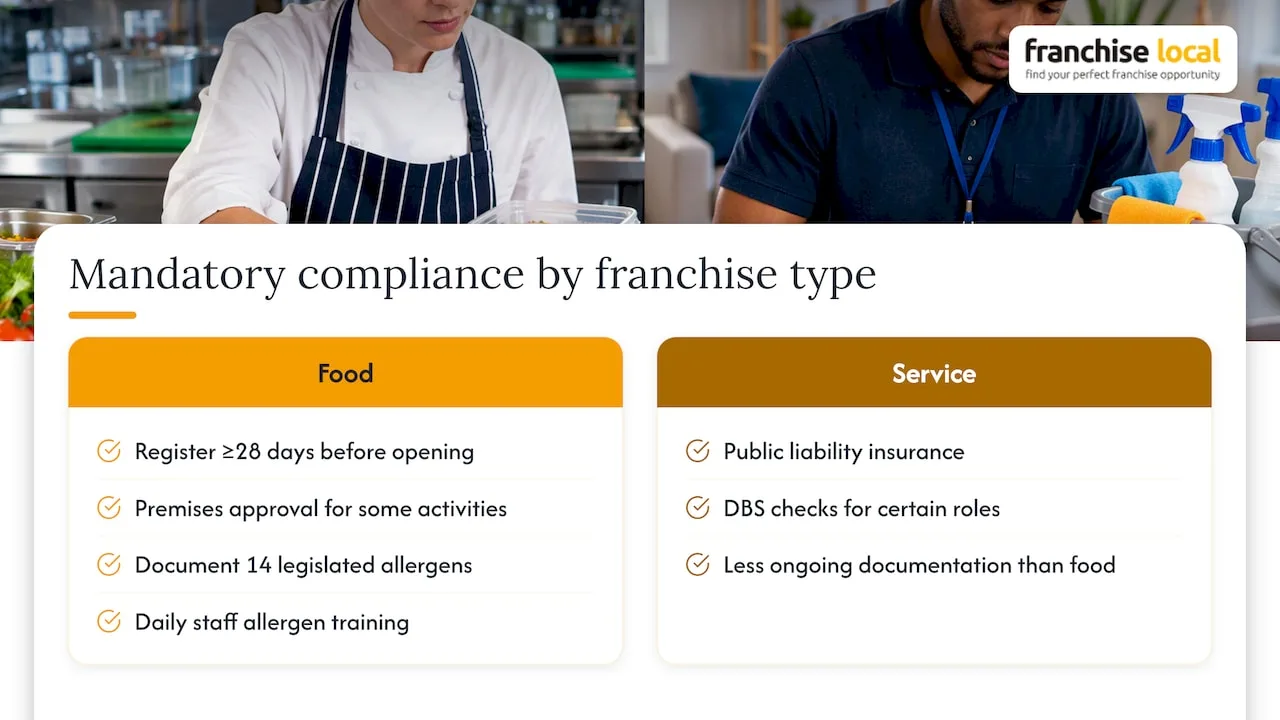
Food franchises carry a heavier compliance load. GOV.UK guidance requires food businesses to register at least 28 days before opening, and certain food production activities need separate premises approval, an offence to bypass.
Allergen management adds further weight: documenting the 14 legislated allergens and training every member of staff to avoid cross-contamination is a daily, non-negotiable duty. Service franchises face their own obligations, such as public liability insurance and DBS checks for roles working with vulnerable people or in private homes, but these tend to involve less ongoing documentation than food safety compliance.
How each model scales once you’re ready to grow
Food franchise growth usually means replicating a full site build for every new unit, so capital expenditure per location stays high. Service franchises can scale by adding territory or technicians without duplicating a kitchen or shopfront each time, making growth comparatively capital-light.
Both models face operational bottlenecks when expanding: finding reliable managers for food sites, or recruiting skilled technicians for service territories. Area developer and multi-unit ownership structures exist in both sectors for investors ready to grow beyond a single location.
A practical framework for choosing between the two
Start with four honest questions: how much capital can you commit, how many hours do you want to work, do you prefer managing people or delivering a service yourself, and how much risk can you absorb if trading is slower than forecast in year one.
Once you have a shortlist, put these questions to every franchisor and at least three existing franchisees:
- What is the total investment, including working capital, not just the headline franchise fee?
- What ongoing royalty and marketing fees apply, and how are they calculated?
- What training, marketing and operational support does the franchisor provide after launch?
- Is my territory exclusive, and how is that boundary defined and protected?
- What are the typical performance metrics for existing sites in this network?
- What happens at renewal, and what are my options if I want to sell or exit?
Pro Tip: Always have a specialist franchise solicitor review the agreement before signing, and speak with at least three current franchisees who are not on the franchisor’s reference list.
The British Franchise Association reports that franchising generally carries a higher five-year success rate than independent start-ups, but the agreement itself determines how risk is shared between you and the franchisor.
Turning this comparison into real research
Once you know whether food or service suits your budget and lifestyle better, the next step is verifying specific opportunities rather than relying on general sector averages. Filter listings by investment band, industry and lifestyle preference to narrow your options to a manageable shortlist, using resources such as a step-by-step franchise selection guide to structure your evaluation.

Ask any franchisor for BFA accreditation status, audited financial figures where available, and a full supplier list, then run everything past a franchise solicitor before signing. A detailed due-diligence checklist can help you organise what to request and when. From there, model a basic cashflow forecast for your first 12 months, schedule calls with existing franchisees, and book a solicitor review before you commit any deposit.
Find your next franchise opportunity
Franchiselocal lets you filter opportunities by budget, industry and lifestyle in one place, so you can compare food and service options side by side rather than researching sector by sector. Whether you’re weighing up a low-entry service franchise or a fully fitted food concept, the filters narrow the field to what actually fits your circumstances.
Start with trending franchise opportunities to see what’s gaining interest right now, or browse franchise industries to compare food and service sectors directly. For a longer shortlist across investment bands, the best UK franchise opportunities page is a solid starting point. Once you’ve found a few that match your budget and lifestyle, reach out to the franchisors directly through their listings to request full disclosure documents and arrange a call.
Sources
- Gov
- Business insights and impact on the UK economy – ONS (24 September 2026)
- How much does a cleaning franchise cost in the UK? — British Franchise Association
FAQ
What is the most profitable food franchise?
Profitability varies enormously by location, brand and management quality, so there is no single answer that holds across the sector. Rather than chasing a headline figure, compare audited financial disclosures and speak with existing franchisees about actual site performance before assuming any brand is more profitable than another.
Which franchise type tends to be most profitable?
Service franchises often report higher net margins than food franchises because they carry lower fixed overheads such as premises and equipment costs. That said, food franchises can generate strong total revenue at high-footfall sites, so profitability depends heavily on location and operating costs rather than sector alone.
What are the different types of franchises?
Franchises generally fall into two broad categories: product-based models, including food and retail, and service-based models, covering trades, education, care and business services. Investment levels, staffing needs and regulatory burden differ significantly between the two, which is why comparing them side by side matters before choosing.
Which franchise is best for beginners?
Franchises with lower entry costs and strong franchisor support networks are often easier for first-time owners to manage, since some entry-level service franchises are available from around £5,000. New franchisees should still verify the level of training and ongoing support offered, since a lower fee can sometimes mean less hand-holding after launch.